
Air Freight Export (Direct)
Guide information
Required modules
Freight Accounting (optional — for invoicing and profitability)
Air Direct means one shipment, one booking with one airline. This is the right mode when the customer needs speed, has exclusive cargo requirements, or the shipment volume is large enough that sharing with other customers’ cargo is unnecessary.
Scenario used throughout this guide: Hai Long Logistics processes export shipment SHP/202505/00080 for Viet Tech Electronics Co., Ltd. — electronic components, 3 pieces, gross weight 500 kg, total volume 2.160 CBM, route SGN → ICN, airline Korean Air, flight KE682, ETD 22/05/2025.
See also
Freight terminology (MAWB, HAWB, Chargeable Weight, ULD, Cargo Cutoff): Industry Glossary
Air Consolidation (multiple house shipments into one master): LCL Air Freight Consolidation (LCAF)
Key differences from sea freight
Air freight has three characteristics that frequently cause costly errors:
Point |
Operational meaning |
Risk if handled incorrectly |
|---|---|---|
Chargeable Weight |
Airlines charge the higher of: actual gross weight vs volumetric weight (volume × 167 kg/CBM). |
Quoting the wrong weight leads to either lost margin (undercharging) or a disputed surcharge from the airline. |
Short booking window |
From booking to flight departure is typically 1–3 working days. |
No time to correct MAWB, weight or flight number after ETD. |
Cargo Cutoff |
Cargo must arrive at the airline’s warehouse by the Cargo Cutoff — typically 3–5 hours before departure. |
Missing the cutoff = cargo held for next flight; 1-day delay minimum. |
Step 1: Create the shipment
Air Direct shipments are created the same way as sea shipments — from the main Shipments list or from a Sales Order. The key difference is the transport mode.
Go to and click New.
Fill in the header:
Shipment Type: Air Direct Export
Customer: Viet Tech Electronics Co., Ltd.
POL: VNSGN (SGN)
POD: KRSEL (ICN)
ETD: 22/05/2025
ETA: 23/05/2025 (KE682 is an overnight flight)
In the Cargo & Packages tab, add the cargo details:
Pieces: 3
Gross Weight (kg): 500
Volume (CBM): 2.160
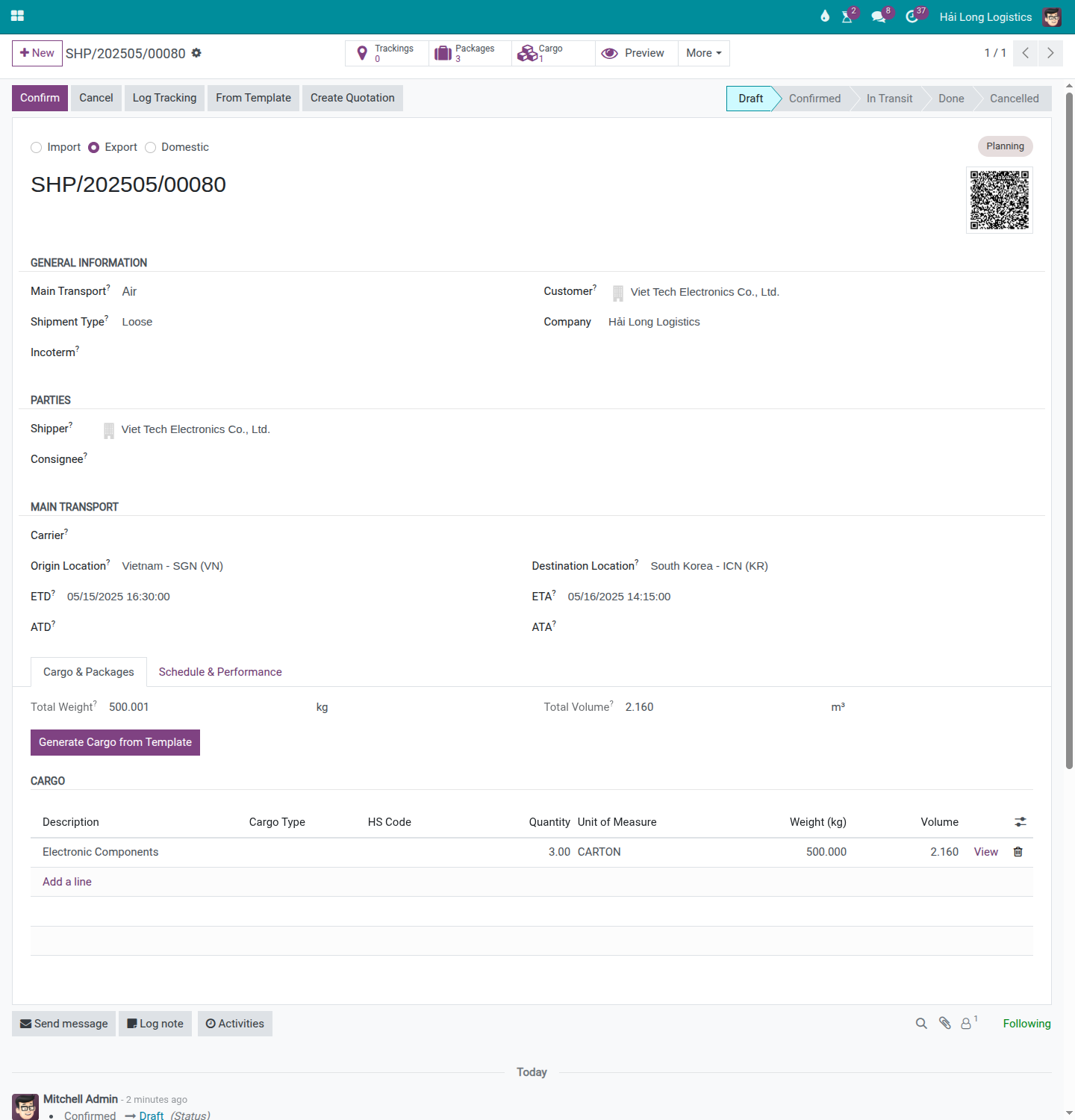
The system calculates:
Volumetric Weight: 2.160 × 167 = 361 kg
Chargeable Weight (CW): max(500, 361) = 500 kg (gross weight dominates)
Warning
Always verify the Chargeable Weight before quoting or booking.
The airline bills by Chargeable Weight — not by gross weight or volumetric weight alone. A 500 kg shipment in a 3 CBM box: volumetric = 501 kg, CW = 501 kg (volumetric dominates by 1 kg — a very small difference, but the billing changes). Even a small error multiplied by the air freight rate (e.g., USD 4.50/kg) results in a USD 4–5 discrepancy per kg of error across the invoice.
For SHP/202505/00080: CW = 500 kg → Ocean Freight equivalent = 500 × USD rate/kg. Verify this matches the quote issued to Viet Tech Electronics.
Click Confirm to lock the shipment.
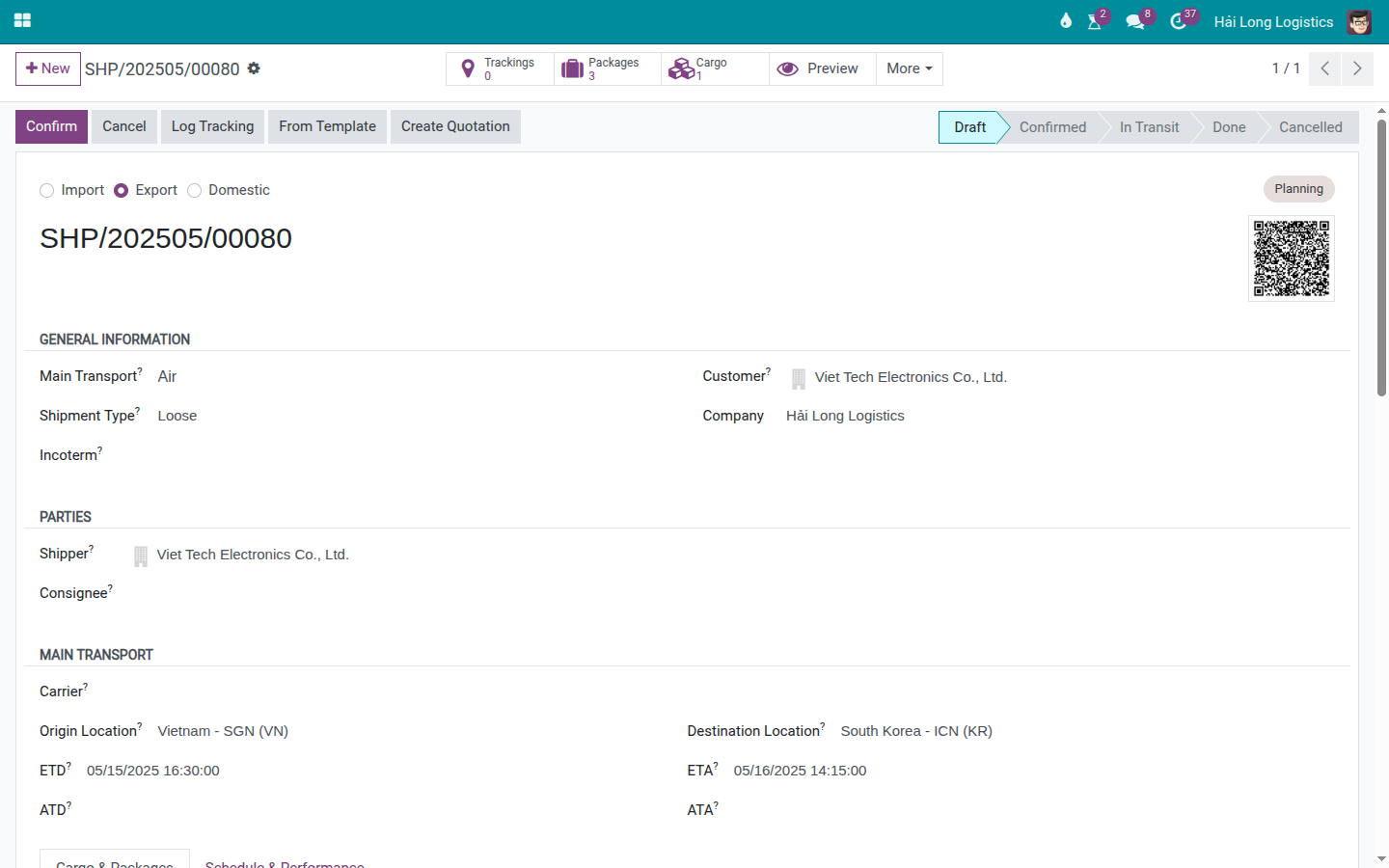
After confirming:
Shipment status changes to Confirmed.
POL, POD, ETD and ETA are locked — changes require cancellation and recreation.
The Charges tab becomes available.
Tip
Step 1 complete when:
Shipment SHP/202505/00080 is in Confirmed status.
Chargeable Weight = 500 kg (displayed in Cargo section).
Cargo details (3 pieces, 500 kg, 2.160 CBM) match Viet Tech Electronics’ packing list.
Step 2: Create the carrier booking for the flight
The air booking records the specific flight, the MAWB (or booking reference before the MAWB is issued), and the Cargo Cutoff deadline. Unlike sea bookings, air bookings are typically confirmed within hours rather than days.
From the confirmed shipment, click Booking on the header.
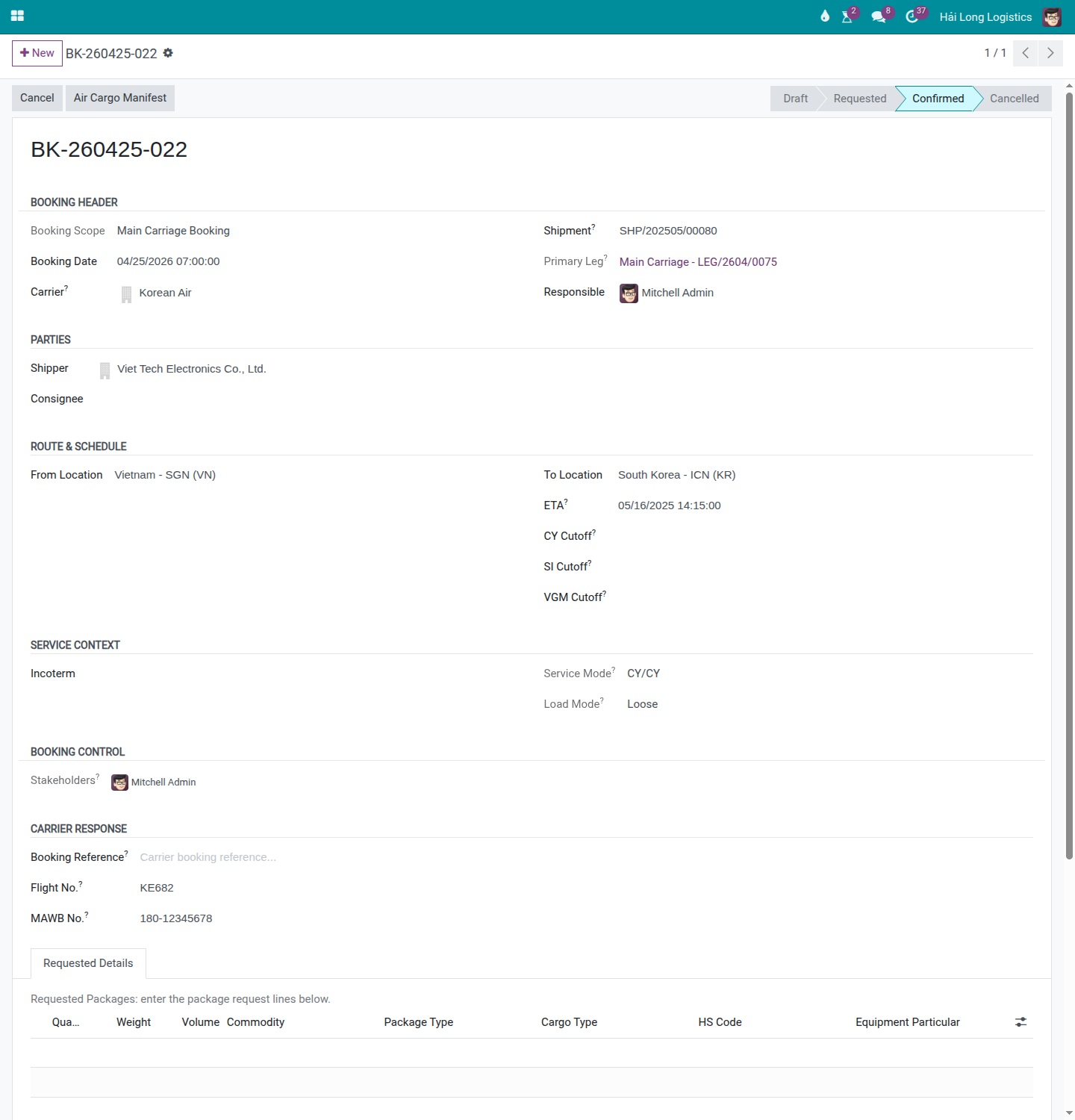
In the Create Booking dialog:
Booking Type: Air Booking
Carrier: Korean Air
Flight Number: KE682
ETD: 22/05/2025
ETA: 23/05/2025
Click Create → then click Mark as Requested to send the booking request to Korean Air.
When Korean Air confirms, fill in the Carrier Response section:
Booking Reference / MAWB No.: enter the MAWB number when issued (e.g., 180-12345678).
Feeder Name: Korean Air (or the specific aircraft type if the airline provides it).
Voyage No.: KE682 (the flight number doubles as the voyage reference for air).
Cargo Cutoff: the airline’s warehouse cutoff time — e.g., 22/05/2025 14:00.
Click Mark as Confirmed.
Warning
Cargo Cutoff is typically 3–5 hours before departure — plan truck dispatch accordingly.
For KE682 departing at 18:30 on 22/05/2025, Cargo Cutoff may be as early as 14:00. If the truck arrives at the airline warehouse at 14:30, cargo may be refused. Missed Cargo Cutoff = cargo waits for KE684 the following day. Viet Tech Electronics faces a 1-day delivery delay and potential customs complications at ICN.
Tip
Step 2 complete when:
Air booking is Confirmed with MAWB number and Cargo Cutoff date recorded.
Korean Air has confirmed the slot and flight number.
Operations knows the Cargo Cutoff time and has scheduled truck dispatch accordingly.
Step 3: Record MAWB and prepare the Air Cargo Manifest
The MAWB number is the master air waybill number issued by Korean Air — it is the primary identifier for the shipment in the airline’s system. The Air Cargo Manifest is the document presented to the airline at check-in, listing all cargo on this booking.
In the Bill of Lading section of the shipment:
MAWB No.: 180-12345678 (from Korean Air’s booking confirmation).
If Hai Long issues its own HAWB to Viet Tech Electronics: HBL No. (HAWB): HAWB/202505/00080.
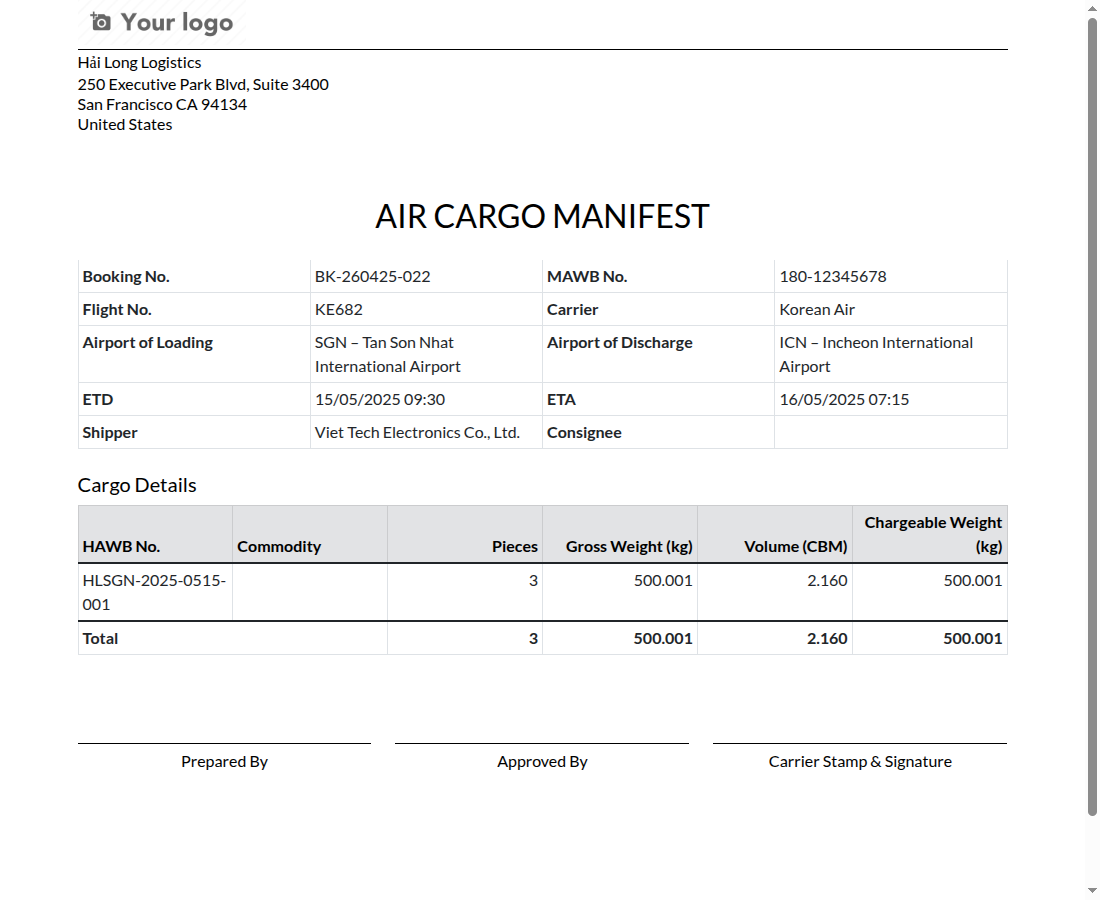
To print the Air Cargo Manifest: go to
The manifest includes: shipper, consignee, MAWB, flight, pieces, gross weight, volume, commodity description and declared value. Verify all fields before printing.
Tip
Step 3 complete when:
MAWB No. is recorded on the shipment.
Air Cargo Manifest has been printed and matches the packing list (3 pcs, 500 kg, 2.160 CBM).
If a HAWB was issued to the customer, the HAWB No. is also recorded.
Step 4: Set up charges for the air shipment
Air freight charges follow the same structure as sea freight (sell + cost), but the rate basis is per kilogram (Chargeable Weight) rather than per container.
On the Charges tab, verify or add:
Air Freight (Korean Air): Sell = USD 4.50/kg × 500 CW = USD 2,250; Cost = USD 3.80/kg × 500 = USD 1,900.
Fuel Surcharge (FSC): Sell = USD 0.80/kg × 500 = USD 400; Cost = USD 0.65/kg × 500 = USD 325.
Security Surcharge (SSC): Sell = USD 0.15/kg × 500 = USD 75; Cost = USD 0.10/kg × 500 = USD 50.
Total: Revenue USD 2,725 | Cost USD 2,275 | Gross Profit USD 450 (16.5% margin).
For the detailed charge recording workflow, see Charges and Profitability.
Warning
Record the cost price for every air charge line.
The rate lookup may fill the sell price but not the cost price. A missing cost price on an air freight charge reports zero cost, inflating gross profit by the full cost amount. For 500 CW at USD 3.80/kg = USD 1,900 inflation if left blank.
Troubleshooting
Chargeable Weight is lower than expected — margin at risk
Symptom: After entering cargo details, the CW is lower than what was quoted to the customer.
Cause: The cargo is lighter than estimated (gross weight lower than estimated volumetric weight).
Resolution:
Recalculate the actual CW from the packing list.
If the CW is lower than the minimum booking weight (some airlines set a minimum), confirm with Korean Air whether the lower CW applies or the minimum applies.
Update the Air Freight charge line with the actual CW.
If the margin falls below the agreed threshold, notify the Pricing team.
MAWB number not yet issued at booking
Symptom: Korean Air confirms the booking but has not yet issued the MAWB number.
Resolution: Leave MAWB No. blank for now. Record the Korean Air booking reference in the Carrier Response section. Update the MAWB No. as soon as Korean Air issues it (usually within 24 hours of booking confirmation). Do not use a placeholder number.
Cargo refused at airline warehouse — cargo cutoff missed
Symptom: The truck arrived at the Korean Air warehouse but cargo was refused — flight KE682 has already closed.
Resolution:
Contact Korean Air immediately to request an urgent re-booking to the next available flight (KE684, next day).
Update the booking ETD and ETA on the shipment.
Notify Viet Tech Electronics of the delay — provide a revised ETA.
Check if any additional surcharges from Korean Air apply (rebooking fee).
Post a Chatter note with the timeline of events for the audit trail.
See also
Charges and Profitability — Recording air freight charges and verifying profitability
LCL Air Freight Consolidation (LCAF) — Air consolidation (multiple house shipments into one master)
Document Management (SI, B/L, D/O) — B/L and document management