
Record charges, invoice the customer, and bill vendors
Guide information
Requirements
This tutorial requires the installation of the following applications/modules:
Freight Forwarder Management (installs Logistics Accounting automatically)
Freight Sale - the shipment in this guide comes from a sales order.
Every shipment carries two financial sides: what Hai Long Logistics charges the customer (sell) and what it pays carriers, agents and terminals (buy). A missing cost line, or a cost left blank, does not just look wrong on screen - it lets a shipment close as profitable when it is not, and the gap only surfaces once a real vendor invoice arrives. The main carriage charge already carries both prices (see Book carrier space for a shipment leg); this guide adds the remaining charges, checks the resulting gross profit, and creates the draft documents Accounting posts. For terms such as THC or D/O, see the Freight forwarding glossary.
Running scenario: Hai Long Logistics has confirmed the booking for Nhat Long Footwear’s 2 x 40HC shipment, Hai Phong Port to Port of Los Angeles, carrier ONE Line, Incoterm CFR (Port of Los Angeles), Freight Prepaid. The Charges tab has one Ocean Freight - FCL line with both prices; Tuan (Accounting) adds the local charges, checks gross profit, and creates the customer invoice and vendor bills.
Role handoff in this example: Sales/Pricing confirms the agreed customer selling prices; Operations confirms supplier costs; Tuan (Accounting) records the approved charge amounts and prepares the draft invoice and bills. Your approval process may assign data entry differently.
Before you start
The shipment is Confirmed and its booking is confirmed - the Charges tab only appears once the shipment has left Draft (see Book carrier space for a shipment leg).
To click Create Customer Invoice / Create Vendor Bill and to see the Draft Invoices / Draft Bills buttons, you need the Accounting access right Invoicing (or higher). Add User: All Shipments to edit any shipment (User: Own Shipments only edits the shipments you are responsible for, see Grant freight access by role). Your administrator sets both under . The Customer Invoices / Vendor Bills buttons only need read access to accounting.
Step 1: Check the Ocean Freight line
The Ocean Freight - FCL line came from the sales order and already carries its cost, so this step is a check, not data entry - a blank cost price here quietly overstates gross profit.
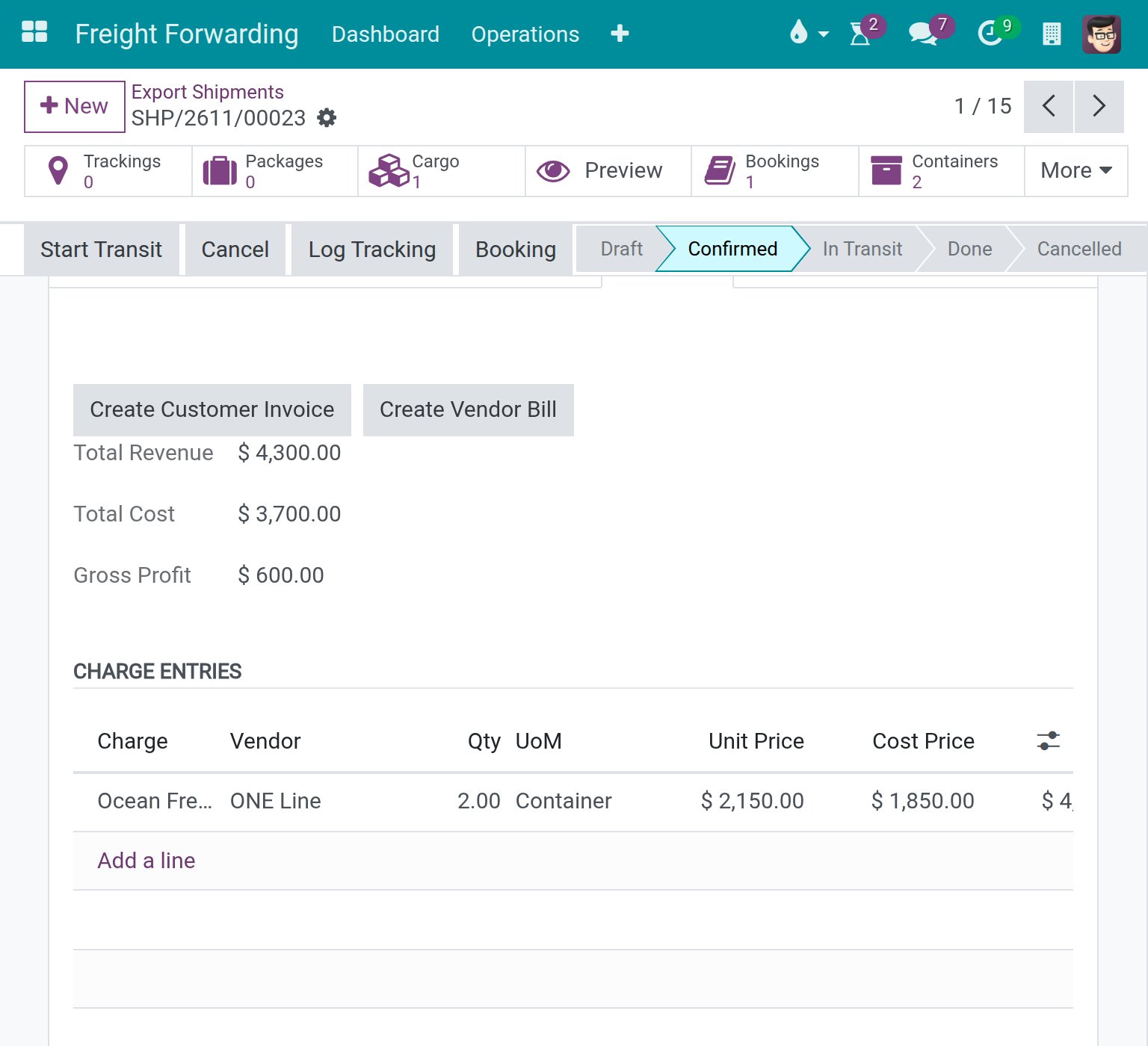
Go to and open the shipment for Nhat Long Footwear. Open the Charges tab.
On the Ocean Freight - FCL row, check:
Unit Price: 2,150 (USD) - the price sold to Nhat Long Footwear.
Cost Price: 1,850 (USD) - the buy rate of ONE Line’s rate card.
Qty: 2.
Note
If this shipment had been created directly, without a sales order, this line would instead show Unit Price = 0.00 and you would have to enter the sell price yourself - see Known limitations.
Tip
Step 1 is done when: the Ocean Freight - FCL row shows Unit Price = 2,150 USD and Cost Price = 1,850 USD on the same row - not two separate rows.
Step 2: Add the local charges
Ocean freight is not the only cost on this shipment - a missing local charge makes gross profit look better than it really is.
Before adding a line, decide which price combination fits it:
Type |
Use when |
What changes |
|---|---|---|
Buy + Sell (both charges below) |
The customer is charged and a vendor or agent is paid for the same service |
Both Unit Price and Cost Price are set; the charge counts toward both Total Revenue and Total Cost |
Sell-only |
The customer is charged and no vendor is involved |
Vendor/Agent stay empty, only Unit Price is set |
Buy-only |
The supplier cost is known and Sales has approved that the customer will not be charged |
Set Vendor or Agent, Currency and Qty; enter the known Cost Price and explicitly set Unit Price to 0 after selecting the product |
Enter the buy rate in Cost Price and set Vendor or Agent and the currency. Use Unit Price = 0 only if the customer will not be charged, as agreed by Sales or under company pricing policy. Use Buy + Sell when Sales/Pricing has approved a customer price.
Warning
A line with a Vendor or an Agent but an empty Cost Price is read as a cost-only line: its Unit Price is counted as cost, adds nothing to Total Revenue and is never put on a customer invoice. Fill in both prices on every Buy + Sell line.
Selecting a charge fills Unit Price from the product’s list price. Replace it with the agreed customer price before you create the invoice, otherwise the customer is invoiced the list price.
See also
The buy and sell rate cards these prices come from are set up before any shipment exists - see Maintain carrier rates and vessel schedules.
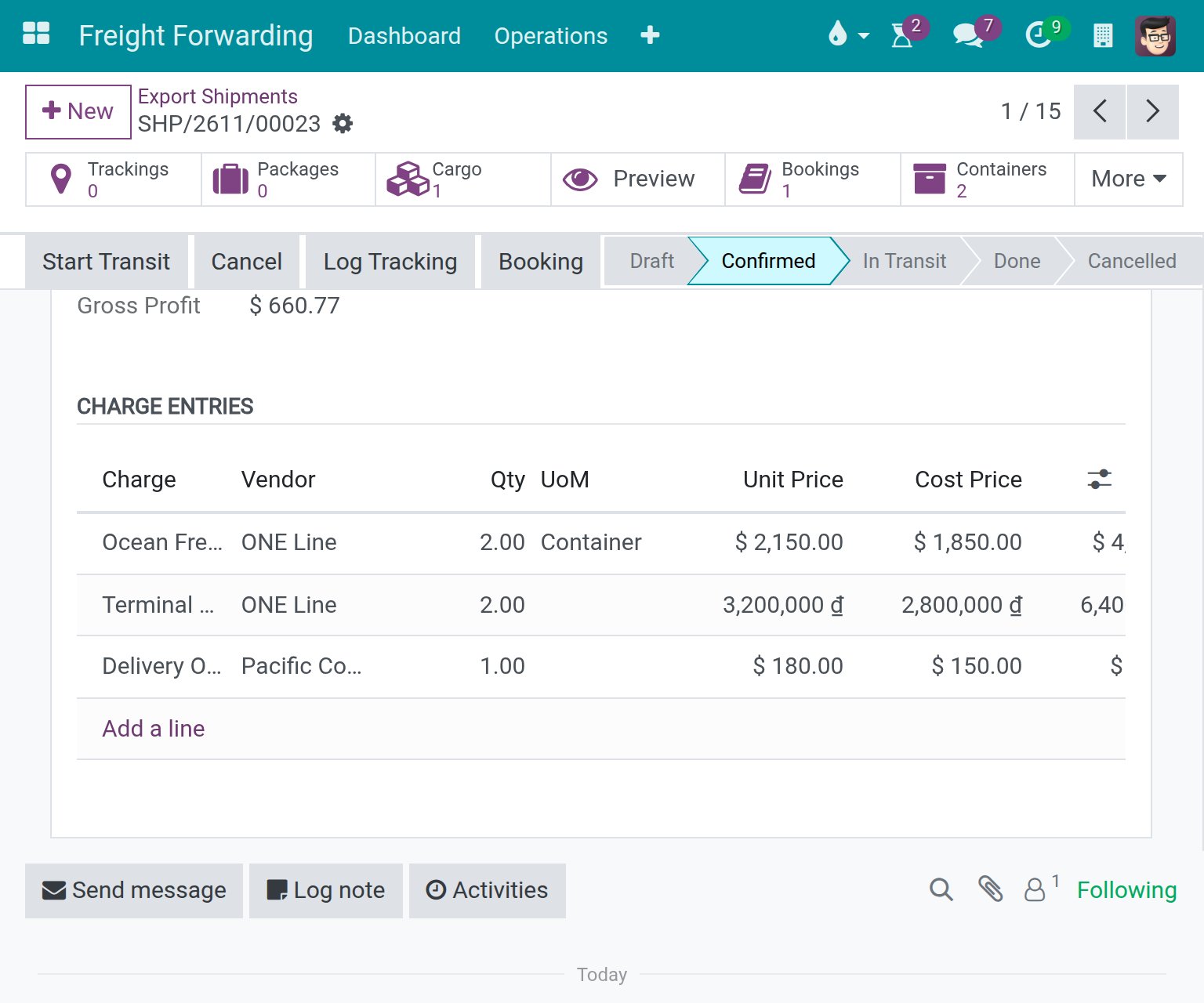
On the Charges tab, click an empty row to add a new line, and fill in:
Charge: Terminal Handling Charge (THC) (the product catalog also holds port-specific THC products, see Set up freight services and local charges), Vendor: ONE Line (the carrier collects the origin THC), Currency: VND, Qty: 2, Unit Price: 3,200,000, Cost Price: 2,800,000.
Charge: Delivery Order (D/O) Fee, Vendor: Pacific Coast Forwarding Agency, Inc., Currency: USD, Qty: 1, Unit Price: 180, Cost Price: 150.
Note
Each charge line has its own Currency field. A charge linked to a Sales Order defaults to that order’s currency; otherwise it defaults to the company currency. Check the line’s currency before entering a price; do not type a USD amount into a line still set to VND.
Tip
Step 2 is done when: the Charges tab has exactly 3 rows (Ocean Freight - FCL, THC, D/O Fee) and no row shows Amount = 0 that you did not intend.
Step 3: Read Total Revenue, Total Cost and Gross Profit
This is the number that decides whether the shipment is profitable - read it before generating any invoice or bill.
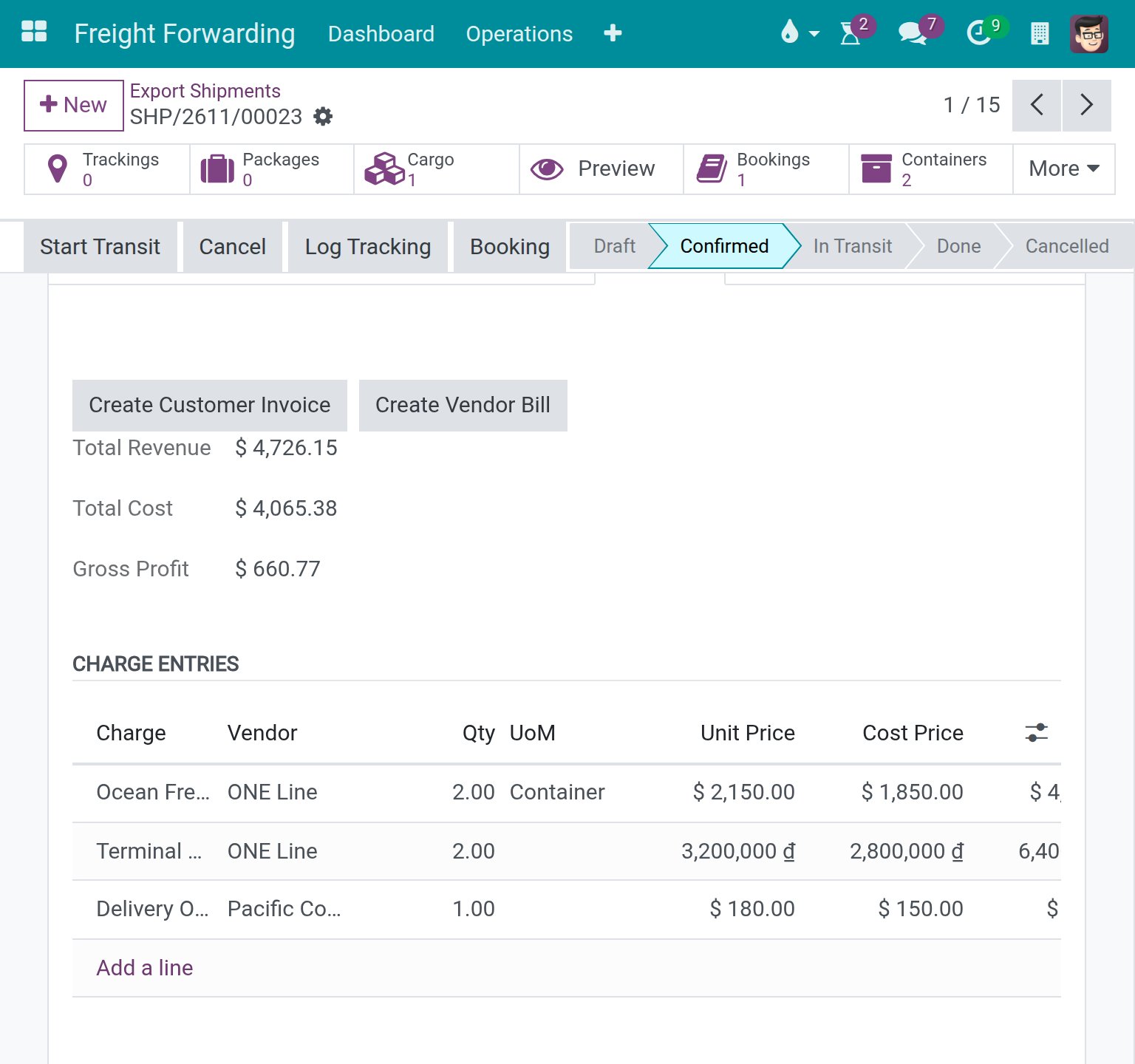
Above the charge table, Total Revenue, Total Cost and Gross Profit convert every line to the company currency (USD in this guide) at the exchange rate of that line’s own document date: the invoice date (sell side) or bill date (cost side) once it is posted, otherwise the booking date, otherwise the date the charge was created. The totals therefore do not change from one day or user to the next. With 1 USD = 26,000 VND on those dates, the three lines of this shipment add up as follows:
Figure |
Calculation |
Result |
|---|---|---|
Total Revenue |
4,300 + 246.15 (6,400,000 VND) + 180 |
USD 4,726.15 |
Total Cost |
3,700 + 215.38 (5,600,000 VND) + 150 |
USD 4,065.38 |
Gross Profit |
4,726.15 - 4,065.38 |
USD 660.77 |
Warning
Two things to keep separate here. First, if the exchange rate configured on this instance is not 26,000 VND/USD, these three figures will not match this guide’s numbers - that is not a bug, only a different rate. Second, a line that is not yet posted is converted at the booking date’s rate; when Accounting posts the customer invoice or vendor bill, the line is converted again at the posted document’s date, which can give a slightly different figure. Treat the figure as a working estimate until the invoice and bills are posted.
Tip
Step 3 is done when: Gross Profit reads USD 660.77, positive, and consistent with the buy/sell spread agreed with Nhat Long Footwear.
Step 4: Handle the “ESTIMATED cost” warning, if it appears
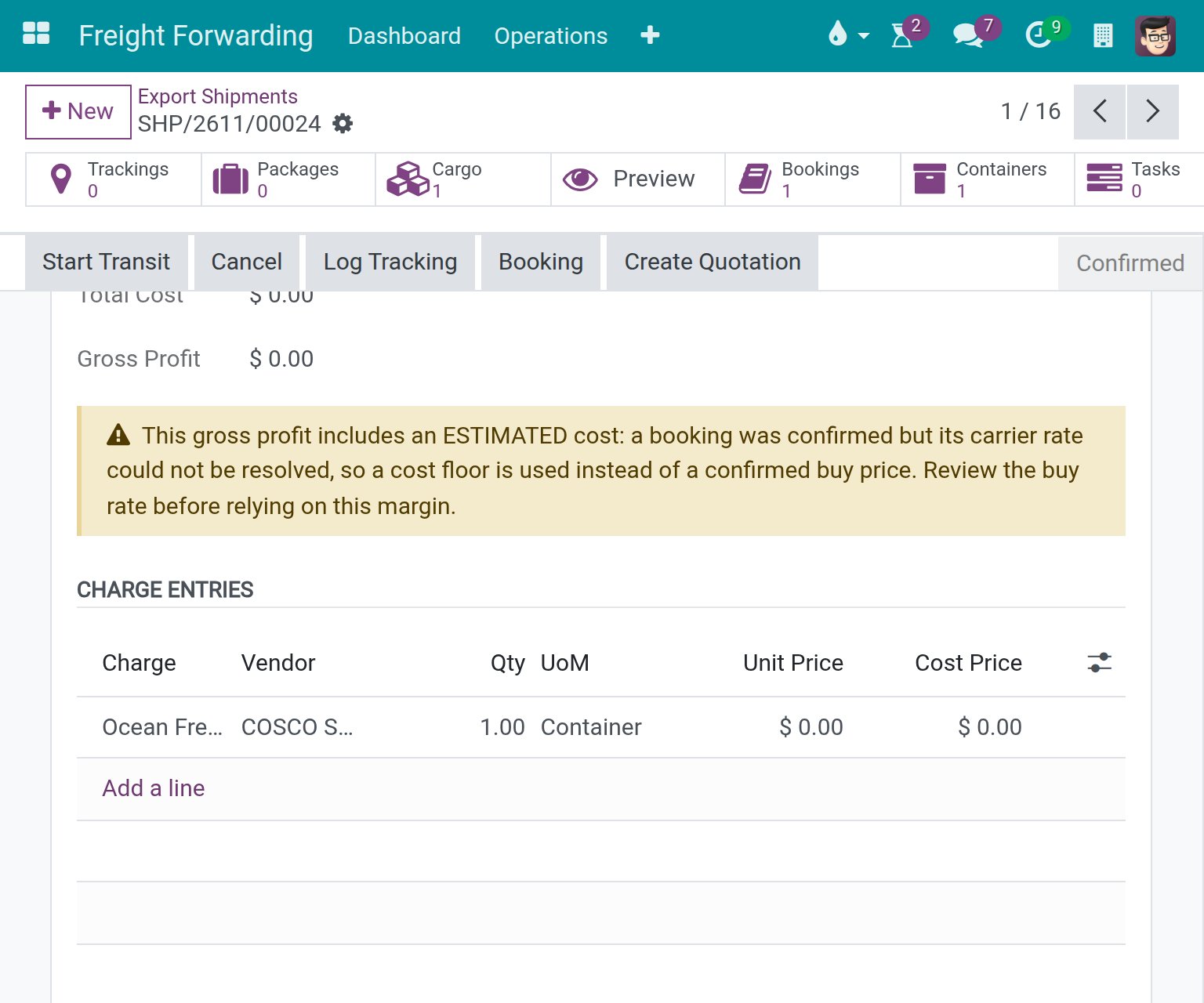
If a booking is confirmed but the carrier’s rate card has no rate for the lane, the charge keeps a Cost Price of 0. A zero would inflate gross profit to the full sell price, so Viindoo shows an estimate instead (the product’s cost, or 0 when the product has none) and puts a yellow banner above the charge table that starts with “This gross profit includes an ESTIMATED cost”.
Important
The estimate is used only for the Gross Profit display - it never flows into a vendor bill. Create Vendor Bill skips a charge whose Cost Price is still 0; enter the real buy rate by hand.
Tip
Step 4 is done when: either the banner is gone (every booked charge has a real Cost Price), or you understand the current Gross Profit is a working estimate, not a confirmed number.
Step 5: Create the customer invoice
This creates a draft only - posting it and issuing the VAT e-invoice required under Vietnamese tax law happens afterward, in Accounting, outside the Freight app.
Click Create Customer Invoice.
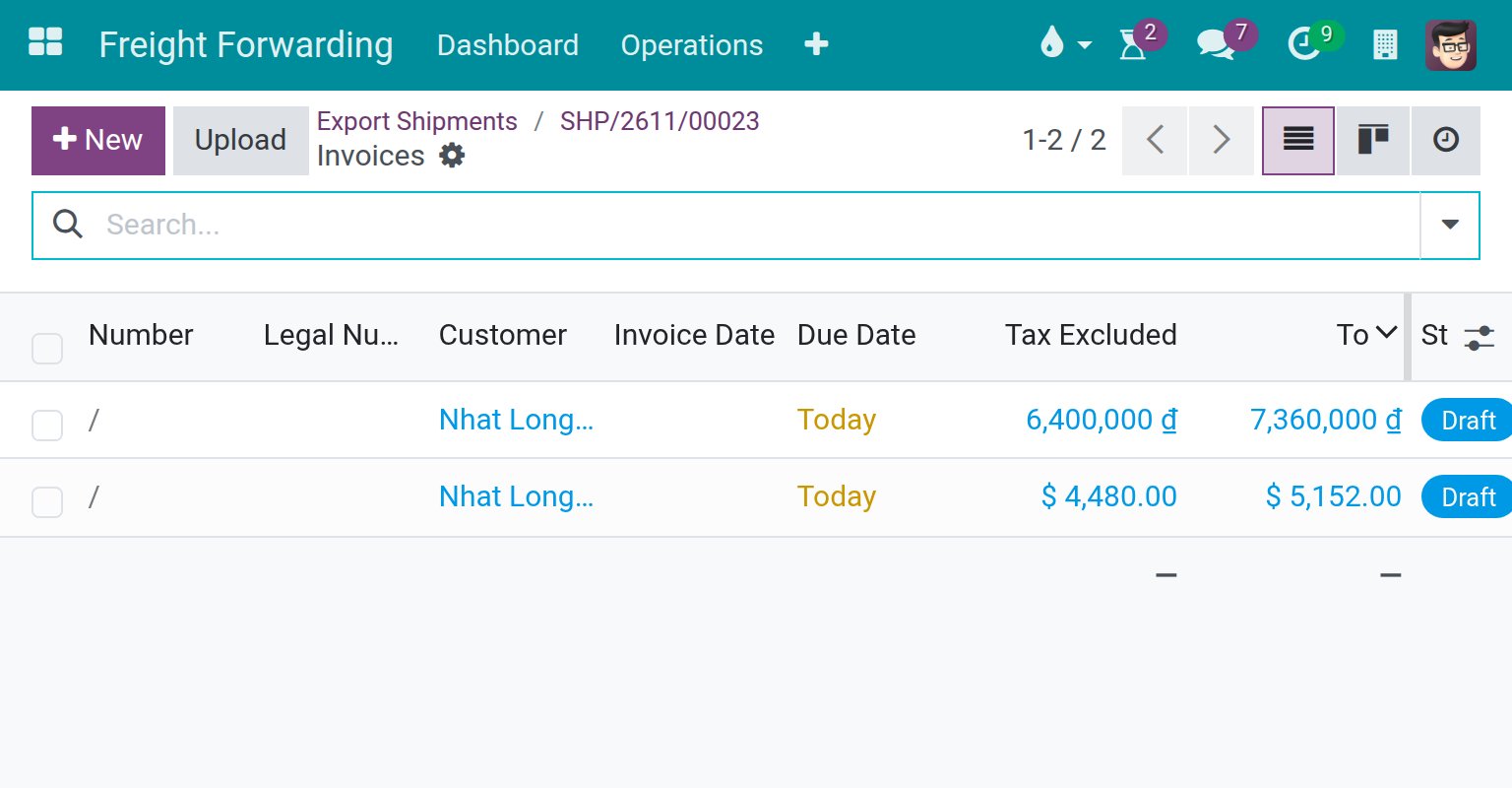
Viindoo groups every sell-side charge that has a customer, an amount above zero, and no invoice yet, by (customer, currency). For this shipment, that is two draft invoices, not one:
Nhat Long Footwear, USD: Ocean Freight - FCL (4,300) + D/O Fee (180) = 4,480 USD before tax.
Nhat Long Footwear, VND: THC = 6,400,000 VND before tax.
The Draft Invoices button at the top of the shipment lists them; the Tax Excluded column shows these amounts and Total adds the taxes of the charge products.
Note
To get a single invoice instead, every charge line would need to share the same currency from Step 2 onward - Viindoo does not convert currencies when grouping charges into an invoice.
Tip
Step 5 is done when: exactly two draft invoices exist for Nhat Long Footwear - USD 4,480 (Ocean Freight + D/O Fee) and VND 6,400,000 (THC).
Step 6: Create the vendor bills
Click Create Vendor Bill.
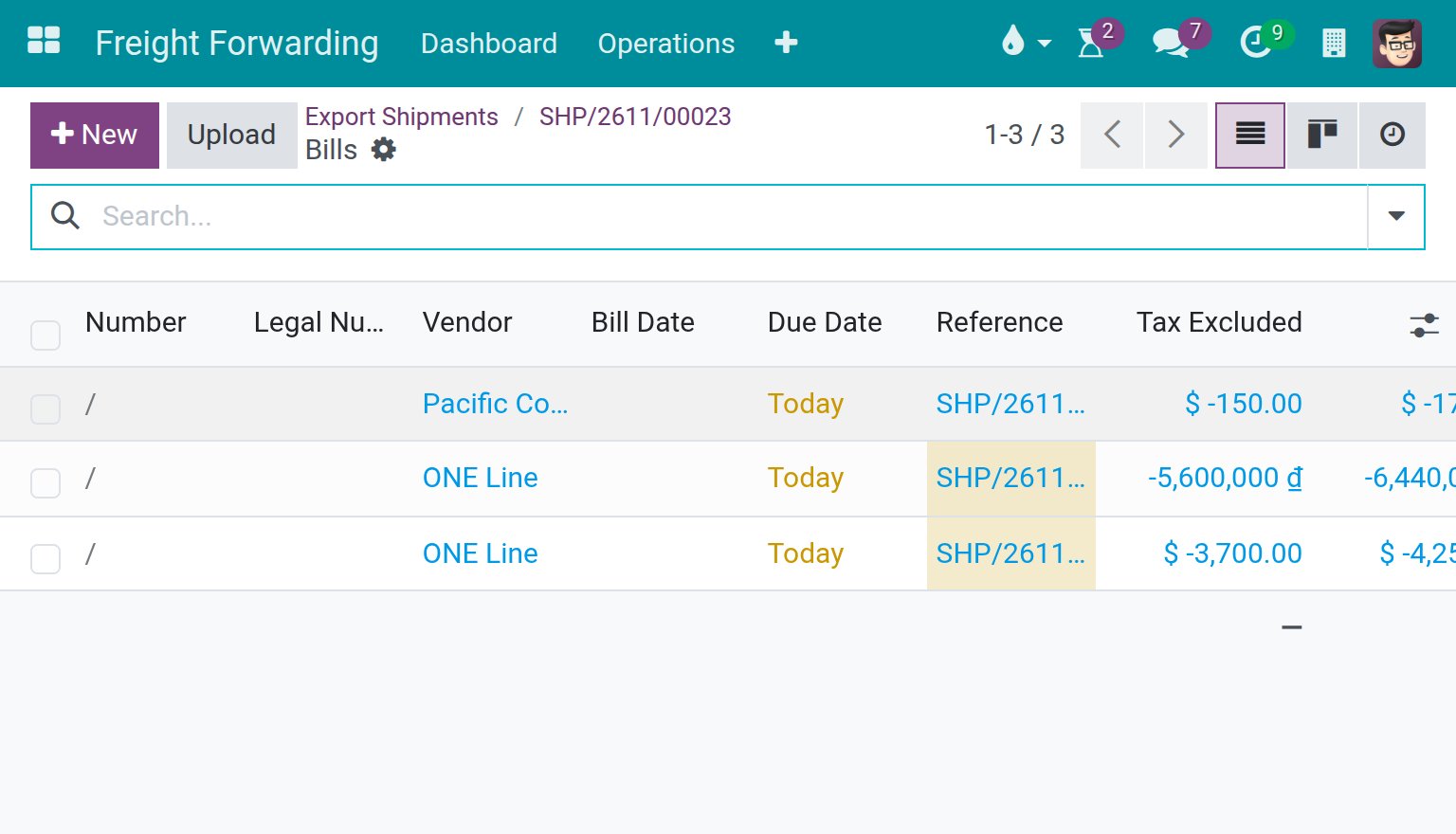
Viindoo groups cost-side charges that have a vendor, an amount above zero, and no bill yet, by (vendor, currency). ONE Line is the vendor on both the Ocean Freight - FCL line and the THC line, but in two different currencies, so this run creates three draft bills, not two:
ONE Line, USD: Ocean Freight - FCL cost = 3,700 USD before tax.
ONE Line, VND: THC cost = 5,600,000 VND before tax.
Pacific Coast Forwarding Agency, Inc., USD: D/O Fee cost = 150 USD before tax.
Note
The Bills list displays signed accounting amounts, so these vendor bills appear as negative amounts. That sign alone does not mean they are refunds. Open the bill to check its document type and positive total; the profitability report records its posted cost as a positive amount.
Note
Three kinds of charge never reach the bill. On-behalf charges are not bought from a vendor, so they are left out (and an on-behalf line with no partner yet does not generate a purchase order). A charge already on a draft, posted or cancelled document is skipped, so the vendor is never paid twice for the same cost. Costs split from a consolidated master shipment (see Allocate shared master costs to house shipments) carry no vendor on the house: the carrier is billed once, on the master shipment, and Create Vendor Bill on a house reports “No unbilled charges with a vendor set found.”
Tip
Step 6 is done when: exactly three draft bills exist, as listed above - Ocean Freight - FCL and THC do NOT merge into one bill even though both name ONE Line as vendor, because their currencies differ.
Known limitations
Step |
What Viindoo does today |
What you do instead |
|---|---|---|
Step 1 (shipment created directly, no sales order) |
The auto-generated Ocean Freight line always has Unit Price = 0.00 |
Treat “enter the sell price” as a required step after opening the Charges tab |
After Step 5-6 (prices edited after posting) |
Prices stay editable after the linked move is Posted; the Charges tab Amount does not re-read the posted move, so the two can drift apart |
Correct a price after posting with a credit note/refund, not by editing the charge line |
Step 5-6 (VAT e-invoice) |
Create Customer Invoice/Create Vendor Bill only create a draft invoice or bill |
Post the draft, then issue the VAT e-invoice through your accounting software - outside the Freight app |
Troubleshooting
Create Customer Invoice reports an error
Symptom: “No uninvoiced charges with a customer found.”
Cause: every charge on the shipment either has no customer set, already has an invoice, or has an effective sell amount of zero.
Fix: check that the shipment has a Customer set, and that the charge you want to invoice has a non-zero Unit Price.
Create Vendor Bill reports an error
Symptom: “No unbilled charges with a vendor set found.”
Cause: no charge satisfies Vendor set + no bill yet + Cost Price above zero, or every candidate charge is on-behalf, already on another document, or an allocated line from a Master consolidated shipment (those carry no vendor on the house).
Fix: check that the charge has a Vendor and a non-zero Cost Price. For an allocated line, bill the carrier once on the Master shipment instead.
Fewer charges appear on the bill than expected
Symptom: clicking Create Vendor Bill produces a draft bill with 1-2 fewer lines than expected.
Cause: the missing charge is on-behalf, or it already sits on a draft, posted or cancelled vendor bill or purchase order, so Viindoo leaves it out rather than pay the vendor twice for the same debt.
Fix: do not add the line back by hand. If it must be billed on a new document, release it on the document that carries it first (see “A charge cannot be deleted” below).
A charge cannot be deleted
Symptom: deleting a charge line shows an error that names a customer invoice, vendor bill or purchase order.
Cause: a charge that sits on an invoice, a bill or a purchase order cannot be deleted, even on a draft or an RFQ. A Master shipment’s ocean freight charge that was already allocated to house shipments cannot be deleted either.
Fix: follow the message: remove the line from the document that carries it (or delete the whole draft document), then delete the charge. To change an allocated Master charge, run Allocate Costs again with Replace Existing Allocation ticked (see Allocate shared master costs to house shipments).
A vendor’s real invoice does not match the recorded Cost Price
Symptom: ONE Line’s real invoice for the ocean freight differs from the 1,850 USD/container Cost Price on the charge line (a rate change, or a surcharge such as a GRI).
Cause: Cost Price is looked up from the rate card at booking confirmation and does not refresh later when the rate card changes or a surcharge is added.
Fix: correct Cost Price to match the vendor’s real invoice before clicking Create Vendor Bill; if a draft bill with the old amount already exists, delete it and click again.
Create Customer Invoice again looks like it did nothing
Symptom: after a new charge is added to a shipment that already has a draft customer invoice, clicking Create Customer Invoice again does not add a second invoice to the list.
Cause: a charge stays on its document when that document is reset to draft or cancelled, and Viindoo never creates a second document for a charge that already sits on one. The new charge is appended to the existing draft for the same customer, currency and shipment - this is by design, not an error.
Fix: open the existing draft through the Draft Invoices smart button; the new line is already there. To issue a cancelled invoice or bill again, use Reset to Draft, then Confirm. To replace a posted vendor bill, use Reverse and Create Invoice on it.
See also
Related articles
Book carrier space for a shipment leg - confirming the booking that fills in the Ocean Freight line used in this guide
Allocate shared master costs to house shipments - splitting a master consolidated shipment’s costs across its house shipments
Send a debit note for shipment charges - billing a charge added after the customer invoice was already created