
LCL Export (Consolidation)
Guide information
Required modules
Freight Consolidation (required for LCL)
Freight Accounting (optional — required for invoicing and vendor bills)
Less Container Load (LCL) is the process of combining cargo from multiple shippers into a single container. When the forwarder acts as consolidator, it collects individual loads at a Container Freight Station (CFS), books a full container with the carrier, issues a House Bill of Lading (HBL) to each shipper, and receives a Master Bill of Lading (MBL) from the carrier.
Running scenario: Hai Long Transport Co., Ltd. consolidates three LCL export loads from Hai Phong to Singapore:
VinaShoes JSC: 15 cartons of footwear, 800 kg, 5 CBM.
Hoang Gia Woodcraft Co.: 6 pallets of furniture, 1,200 kg, 8 CBM.
Phuong Nam Textile Co.: 20 pallets of textiles, 1,800 kg, 10 CBM.
All three loads share the same routing VNHPH (Hai Phong) → SGSIN (Singapore), the same origin CFS (CFS VICONSHIP Hai Phong), and are stuffed into one 40-foot High Cube (40HC) container with COSCO Shipping, vessel COSCO HARMONY, voyage 018S, ETD 20 May 2025.
Xem thêm
Glossary (CFS, HBL, MBL, VGM, CFS Cutoff, Co-loader, and more): Industry Glossary.
When to use this guide
Use this guide when your company acts as the consolidator and collects multiple LCL loads from different shippers onto a single container. If your company sends cargo as one of many shippers to another forwarder's container (co-loading), see the Quick Decision Table at the end of this guide.
Role |
Tasks in this guide |
What to verify |
|---|---|---|
Booking Officer |
Create a house shipment per shipper, consolidate into a master, and book the carrier. |
Master has 3 houses and the COSCO booking is confirmed. |
Consolidation Operations |
Track cargo receipt at CFS, stuff the container, update VGM, and gate-in. |
All 3 houses received and stuffed before their cutoffs. |
Documentation |
Submit SI on the master, issue an HBL to each shipper. |
Chatter records SI submitted and HBL released for each house. |
Accounting |
Create a customer invoice per house and vendor bills on the master. |
Per-shipper revenue and consolidated master costs are reconciled. |
Two-tier data structure
LCL Export uses two tiers. Understanding the division before starting prevents incorrect charge entry and document errors.
Record |
Manages |
Typical actions |
|---|---|---|
House shipment |
Each individual shipper's cargo, HBL, sell charges, and customer invoice. |
Enter shipper and consignee, record cargo/packages, issue HBL, create customer invoice. |
Master shipment |
The shared container, MBL, buy charges (carrier, CFS, trucking), and vendor bills. |
Create and confirm master, book carrier, stuff container, submit VGM, create vendor bills. |
Process overview
An LCL export consolidation passes through five main stages.
# |
Stage |
Purpose |
Responsible |
|---|---|---|---|
1 |
Create a house shipment per shipper. |
Record each shipper's cargo, CFS, and routing separately. |
Booking / Operations |
2 |
Consolidate into a master and book the carrier. |
Create the shared container record and reserve a slot with COSCO. |
Booking |
3 |
Receive cargo at CFS and stuff the container. |
Confirm each load has arrived on time and is loaded into the container. |
Operations |
4 |
Submit VGM, gate-in, and start transit. |
Get the container onto the vessel and cascade the shipment status to all houses. |
Operations / Documentation |
5 |
Issue HBLs, record the MBL, and verify financials. |
Finalise shipping documents and reconcile per-house revenue against master costs. |
Documentation / Accounting |
Step 1: Create a house shipment per shipper
Each shipper needs a separate house shipment because each has a different customer, consignee, HBL, selling price, and payment terms. If loads are merged from the start, Documentation cannot issue correct individual HBLs and Accounting cannot separate revenue by shipper.
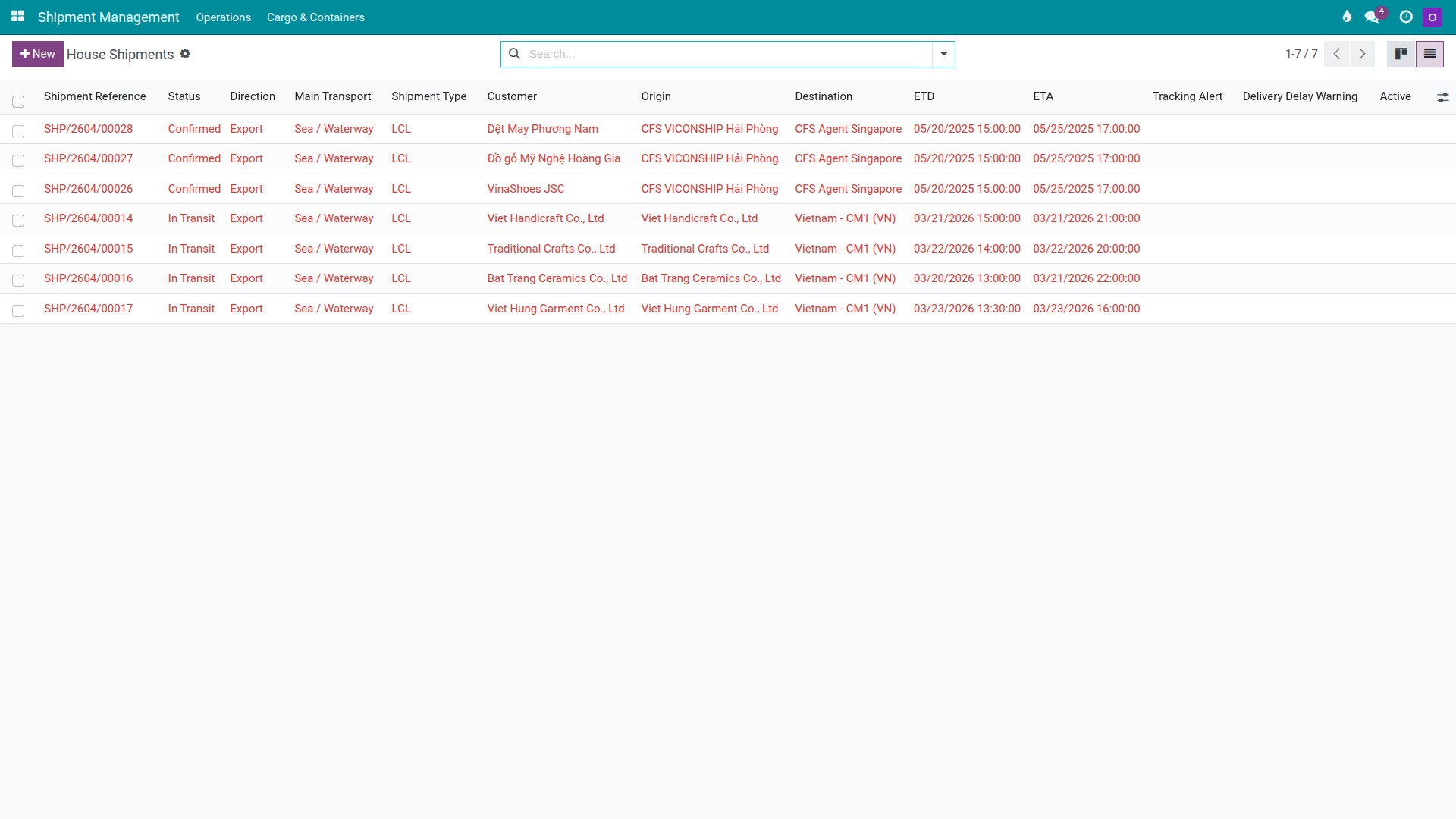
Go to and click New. Create the first house for VinaShoes JSC:
Shipment Type: Sea LCL Export.
Consolidation role: select House LCL to identify this as one shipper's portion of a consolidated load.
Customer / Shipper: VinaShoes JSC.
Consignee: the Singapore consignee per VinaShoes's contract.
POL / POD: VNHPH / SGSIN.
Origin CFS: CFS VICONSHIP Hai Phong.
Destination CFS: the Singapore CFS designated by Hai Long's Singapore agent.
LCL Service Scope: CFS to CFS.
ETD / ETA: 20/05/2025 / 25/05/2025.
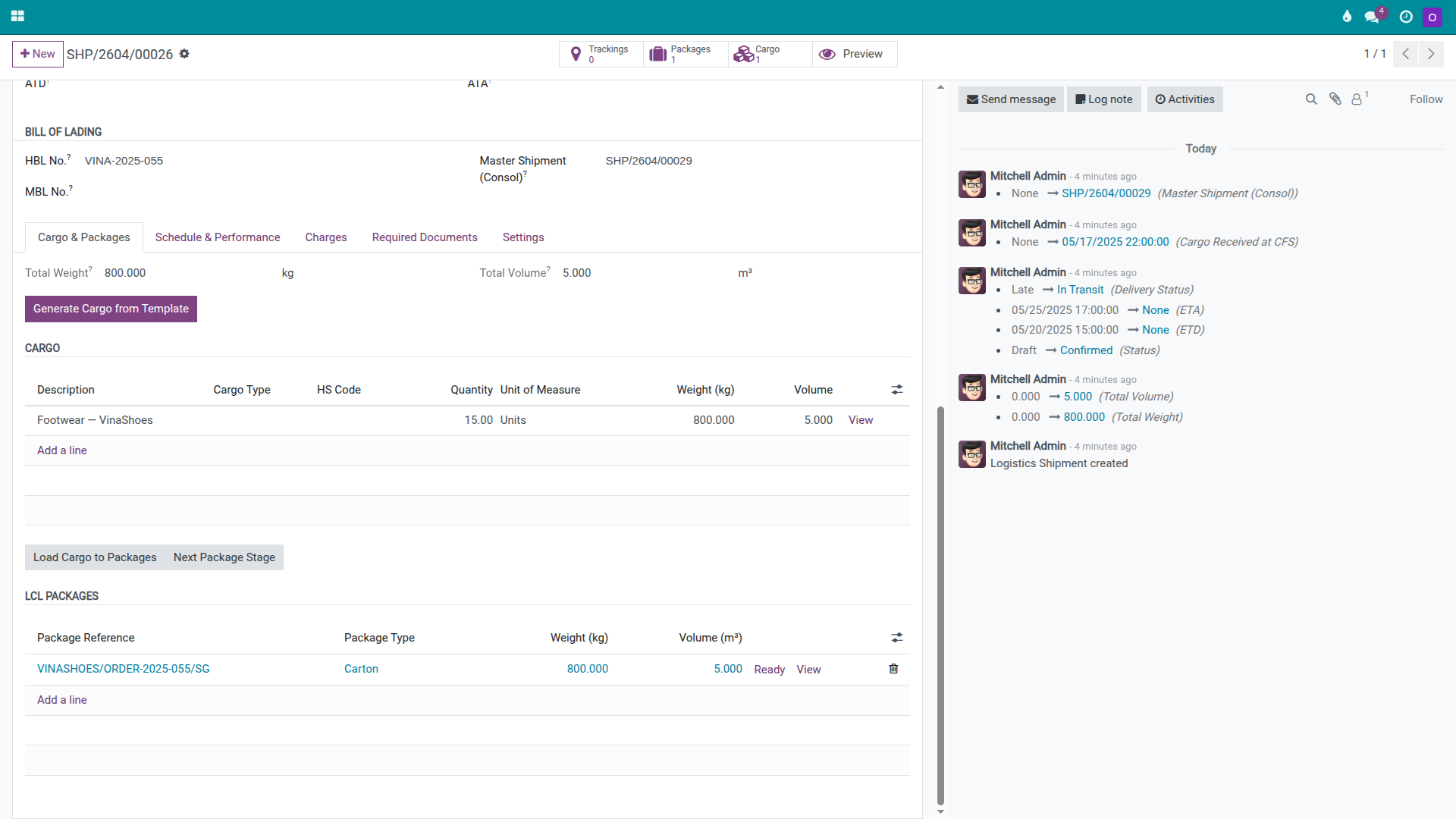
In the Cargo & Packages tab, enter VinaShoes's package and cargo:
Package Type: Carton.
Weight / Volume: 800 kg / 5 CBM.
Shipping Mark: VINASHOES/ORDER-2025-055/SG.
Cargo: Footwear, quantity 15 CARTONS, HS code 6402 if available from the packing list.
Repeat for Hoang Gia and Phuong Nam using their own data. All three houses must share the same POL/POD and the same origin/destination CFS for them to be consolidated into one master.
Cảnh báo
Houses with different Origin CFS locations should not be consolidated together. If VinaShoes delivers to CFS VICONSHIP and Hoang Gia delivers to a different CFS, Operations must align on a single delivery point or split into separate masters. Moving cargo between two CFS locations typically adds half a day and approximately VND 500,000–1,000,000 per load, and creates real risk of missing the CFS Cutoff.
Mẹo
How to know Step 1 is correct:
Three separate house shipments exist for VinaShoes, Hoang Gia, and Phuong Nam.
All three houses share the same POL/POD and the same Origin/Destination CFS.
Weight and volume match the packing lists: 5 CBM, 8 CBM, and 10 CBM, totalling 23 CBM.
Each house has a distinct shipping mark so the CFS can identify each load on receipt.
Step 2: Consolidate into a master and book the carrier
The master is the record Hai Long uses to book a full container with COSCO. Create the master after you have at least two houses on the same route, or when the internal consolidation cut-off date arrives. In this scenario, Hai Long consolidates all three houses into one 40HC master.
From the House Shipments list, select the three houses (VinaShoes, Hoang Gia, and Phuong Nam). On the Action toolbar, select Create Master Shipment (Consol). In the wizard, confirm:
House Shipments: all three houses are listed.
Carrier: COSCO Shipping.
Origin CFS / Destination CFS: matching all three houses.
CFS Cutoff: 17/05/2025 18:00.
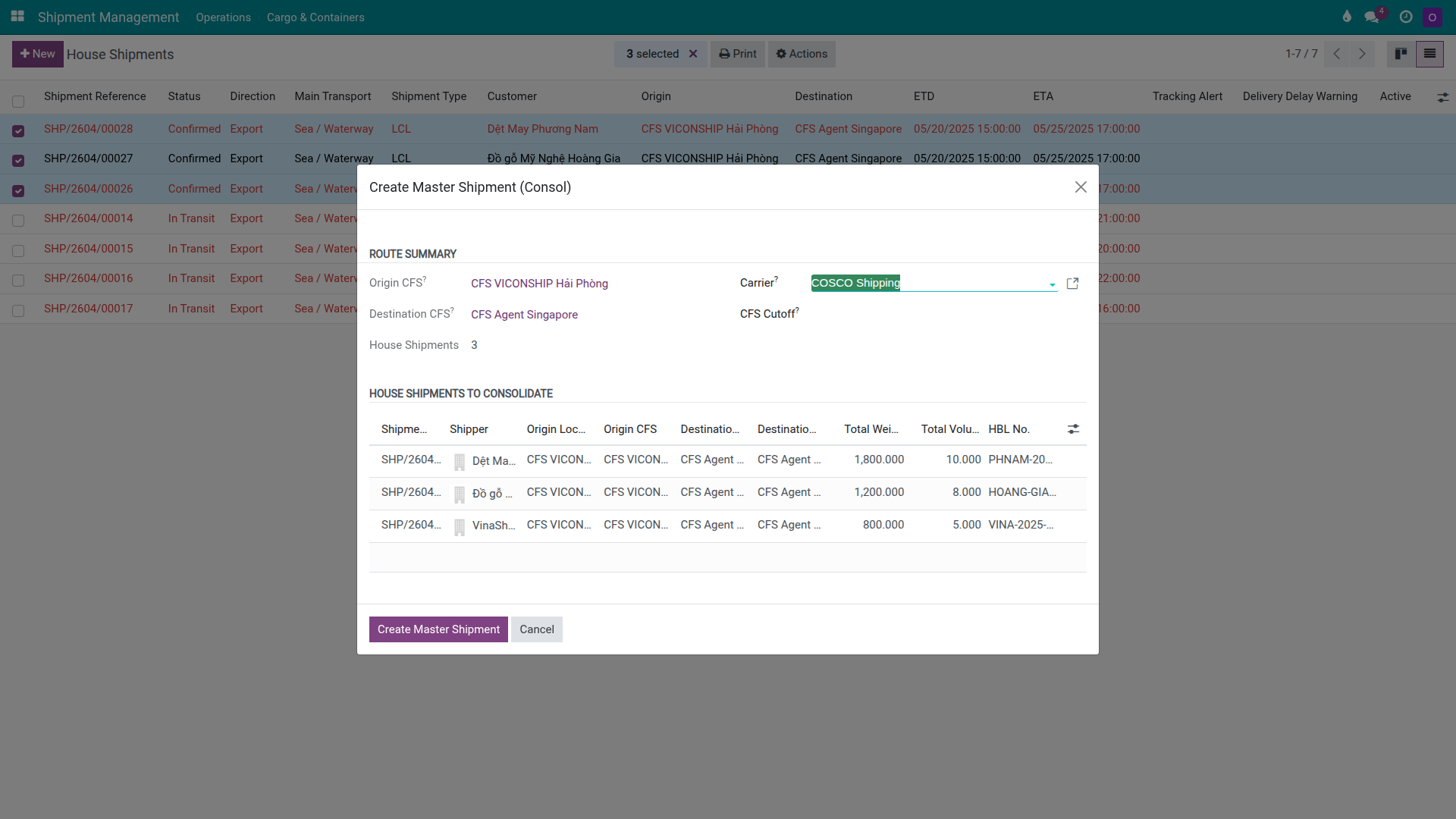
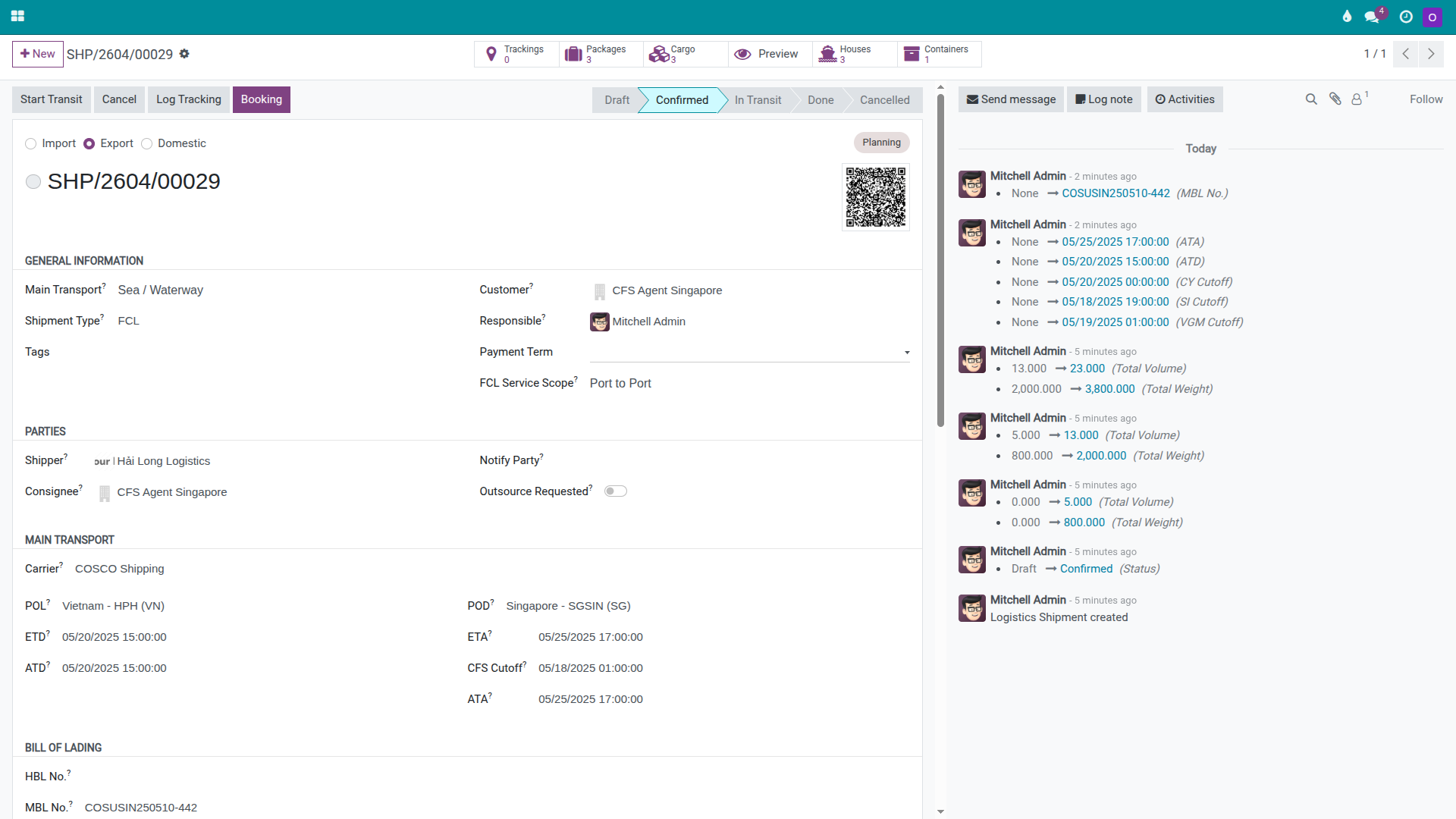
Click Create Master Shipment. After the master is created:
The Houses smart button shows 3.
The House Shipments tab lists all three house records.
The master is used to book the container with COSCO; each house continues to manage its own shipper data and HBL.
On the master, click Confirm, then create a booking with COSCO following the same flow as FCL Export:
Coverage: Main Only.
Carrier Booking Reference: COSC-BKG-20250510-442.
Vessel / Voyage: COSCO HARMONY / 018S.
SI Cutoff: 18/05/2025 12:00.
VGM Cutoff: 18/05/2025 18:00.
CY Cutoff: 19/05/2025 17:00.
Cảnh báo
The CFS Cutoff arrives before the CY Cutoff. If cargo arrives late at the CFS, the CFS cannot stuff the container in time to submit VGM and gate-in. A single house missing the CFS Cutoff typically costs VND 2–5 million, covering CFS storage, a voyage change, shipper notification, and potentially co-loading with another forwarder at a 15–25% higher rate.
Mẹo
How to know Step 2 is correct:
The master is Confirmed and the Houses smart button shows 3.
The COSCO booking is Confirmed with a carrier booking reference.
CFS Cutoff, SI Cutoff, VGM Cutoff, and CY Cutoff are all recorded in the team calendar.
If a rate card is configured, the master has an Ocean Freight cost line or equivalent carrier charge.
Step 3: Receive cargo at CFS and stuff the container
Operations monitors each shipper's delivery to the CFS. Mark receipt in the system only after the CFS has physically received the cargo and verified it against the packing list. This confirms that the house is ready for the stuffing plan.
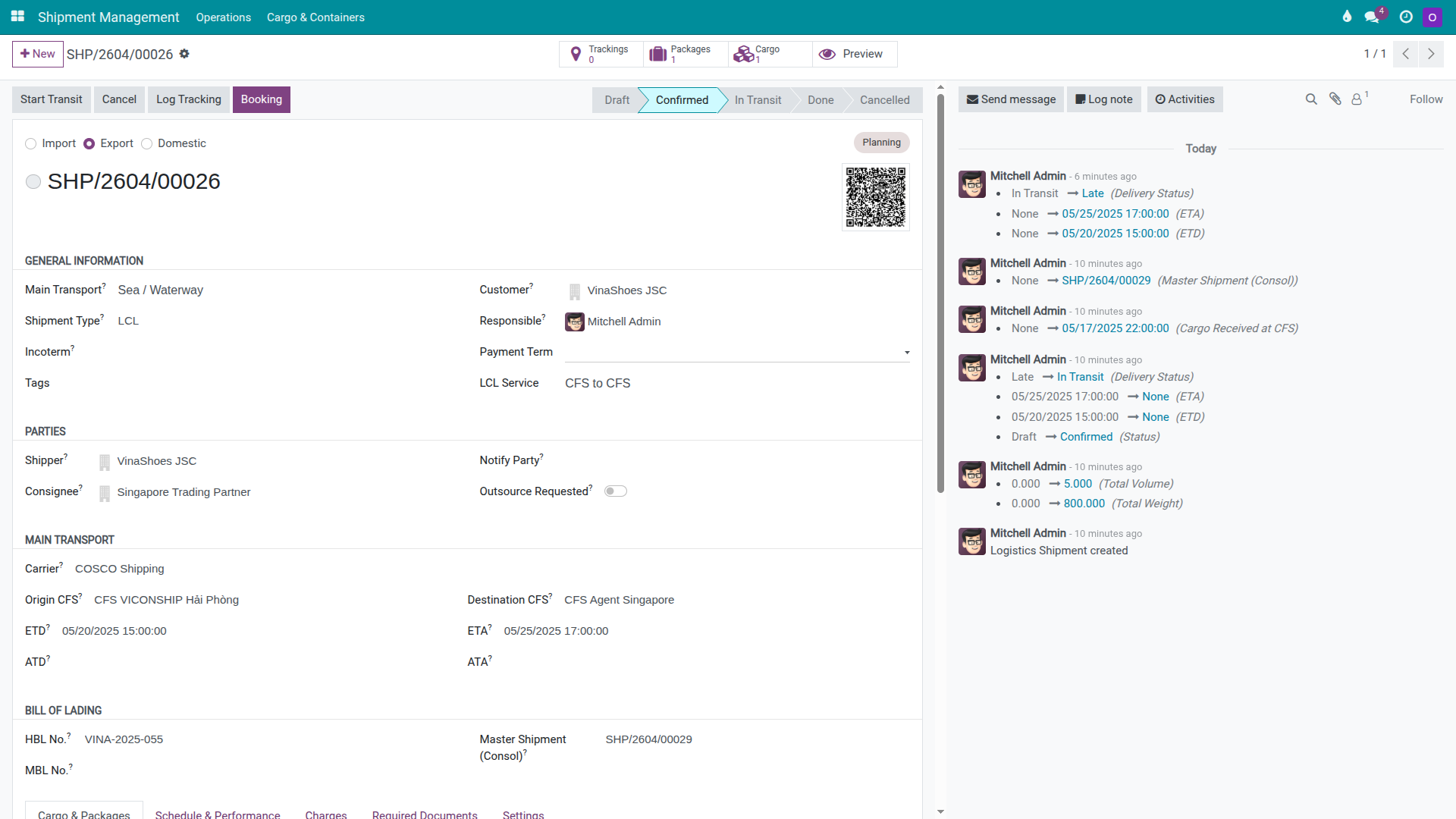
Open each house and click Cargo Received at CFS when the CFS receipt note is available. For the VinaShoes house, the receipt must match:
Shipping mark VINASHOES/ORDER-2025-055/SG.
15 cartons.
800 kg and 5 CBM.
Received before 17/05/2025 18:00.
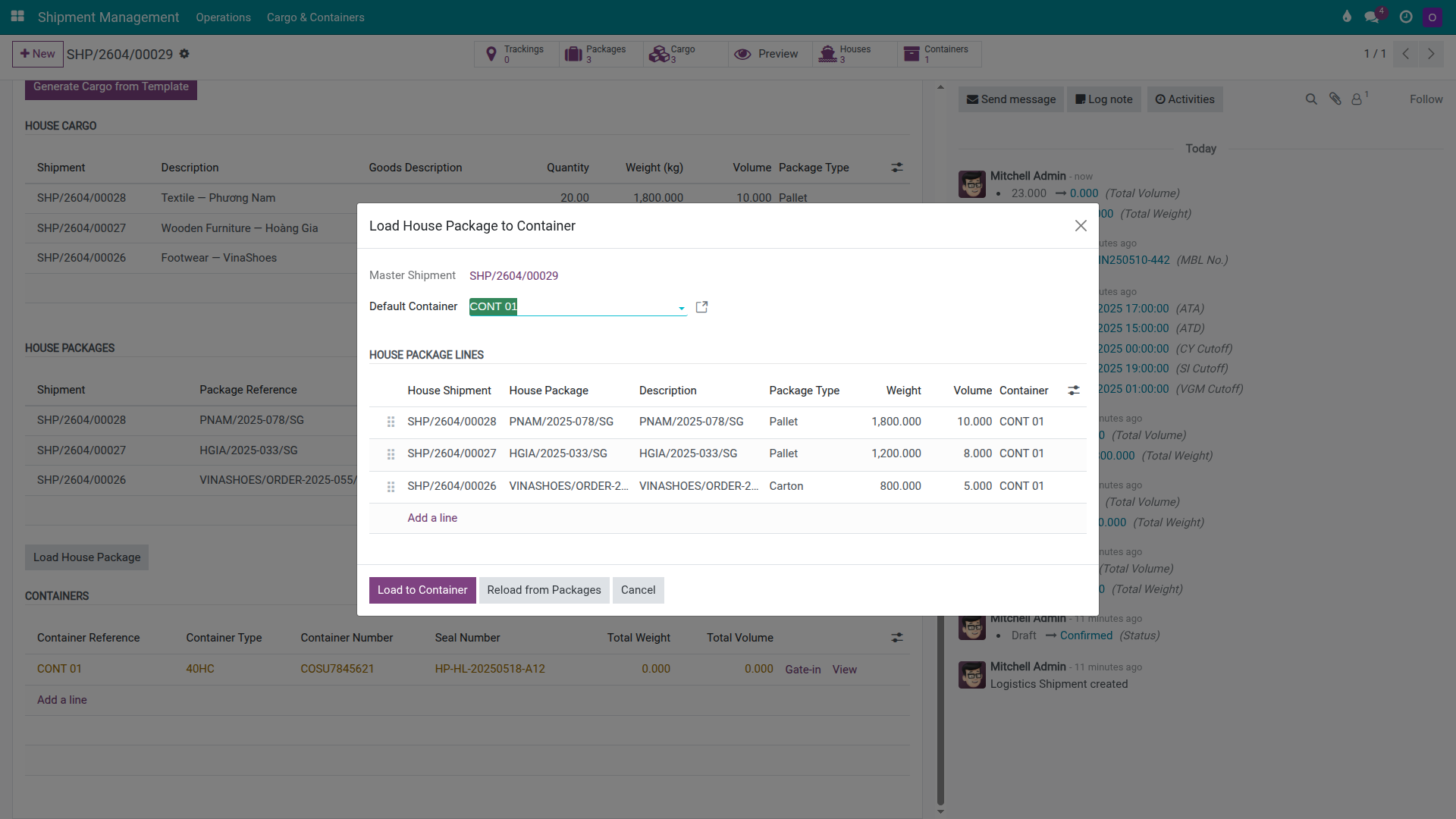
After all three houses have cargo received at the CFS, open the master and add container 40HC COSU7845621 if the booking wizard did not already create it. When the truck picks up the empty container and brings it to the CFS, mark Empty Picked on the container.
The CFS stuffs cargo from all three houses into the container according to the loading plan. On the master, click Load House Package to open the loading wizard, select container COSU7845621, select the packages from all three houses, and click Load to Container.
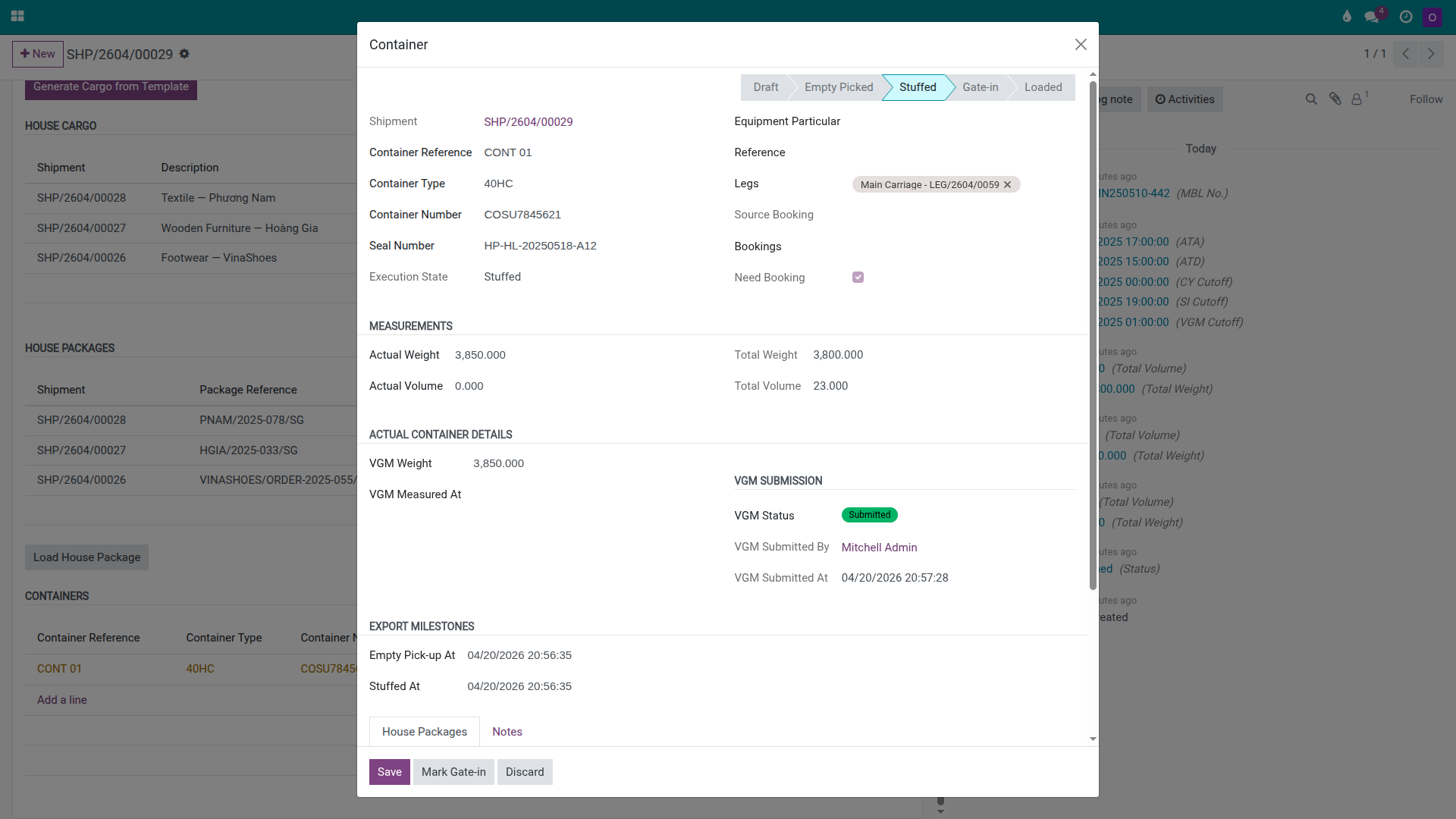
After stuffing is complete, open the container and enter:
Seal Number: HP-HL-20250518-A12.
Actual Weight: 3,850 kg from the CFS weighbridge.
Click Mark Stuffed.
Mẹo
How to know Step 3 is correct:
All three houses have a Cargo Received at CFS milestone recorded before the CFS Cutoff.
The master container has three house package lines, one per house.
The Seal Number is recorded before the VGM submission.
Actual weight is consistent with the total load of ~3,800 kg and within a reasonable tolerance for CFS weighbridge variation.
Step 4: Submit VGM, gate-in, and start transit
The Verified Gross Mass (VGM) is submitted on the master container — not on individual houses. If the VGM is missing or late, all three houses are at risk of missing the vessel, because they all share the same container.
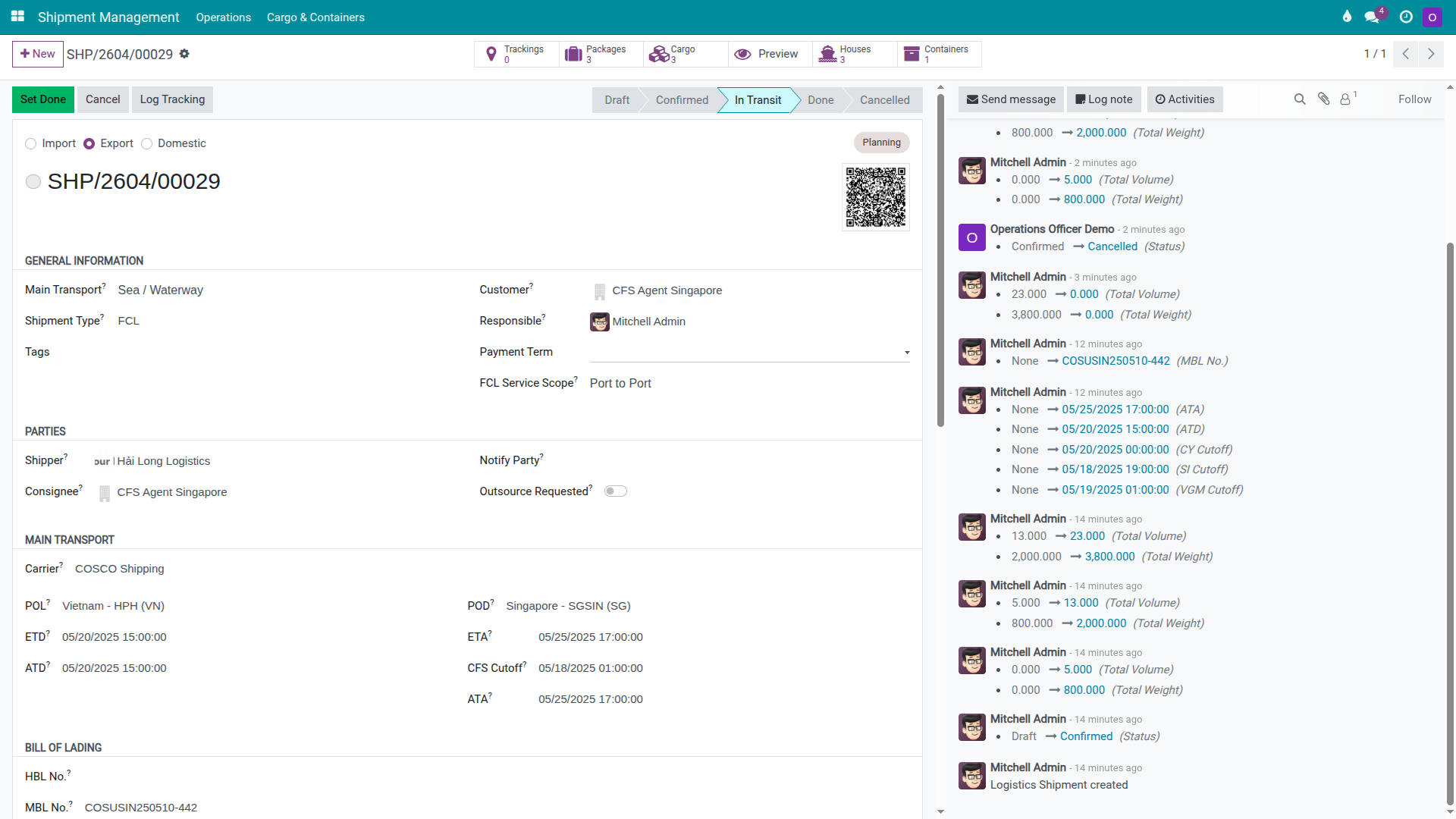
Open container COSU7845621, confirm VGM Weight = 3,850 kg matches the CFS weighbridge ticket, then click Submit VGM before 18/05/2025 18:00.
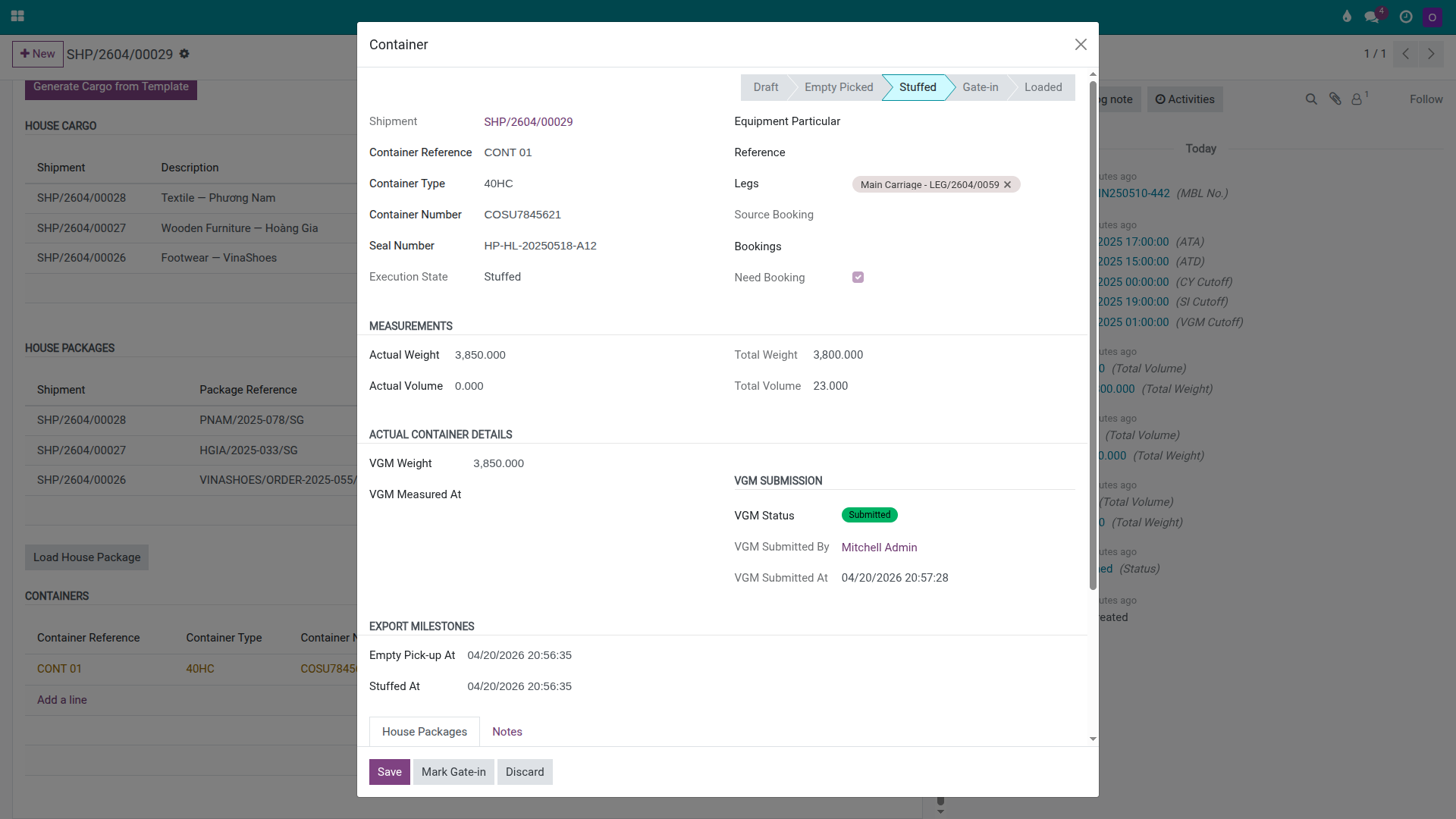
After the truck moves the container from the CFS into the port CY, mark Gate-in before 19/05/2025 17:00. When COSCO confirms the container is on board, mark Loaded and then click Start Transit on the master. The system changes the master to In Transit and cascades the same status to all linked house shipments.
Cảnh báo
A late VGM or CY Cutoff affects all three houses simultaneously. Rolling a single 40HC LCL master to the next sailing typically causes a 3–7 day delay, demurrage and roll-over costs of approximately VND 4–8 million for the master, and requires notifying all three shippers of the new ETD.
Mẹo
How to know Step 4 is correct:
VGM Status = Submitted before the VGM Cutoff.
Container is Gate-in before the CY Cutoff, then Loaded.
Master status = In Transit.
Spot-check any house shipment — its status should also be In Transit.
Step 5: Issue HBLs, record the MBL, and verify financials
Documentation submits the SI to COSCO based on the master shipment. On the MBL, the shipper is typically Hai Long or the forwarder entity; the consignee is the Singapore destination agent. For each house, Hai Long issues a separate HBL to the individual shipper, with the actual cargo receiver as the consignee on the HBL.
Before the SI Cutoff 18/05/2025 12:00, record this in the master's Chatter:
SI submitted to COSCO — 18/05/2025 10:30, booking ref COSC-BKG-20250510-442.
For each house, use Print HBL to generate a draft HBL, send it to the shipper for approval, and then record the release method:
VinaShoes: Telex Release.
Hoang Gia: 3 Original HBL copies (L/C transaction).
Phuong Nam: Telex Release.
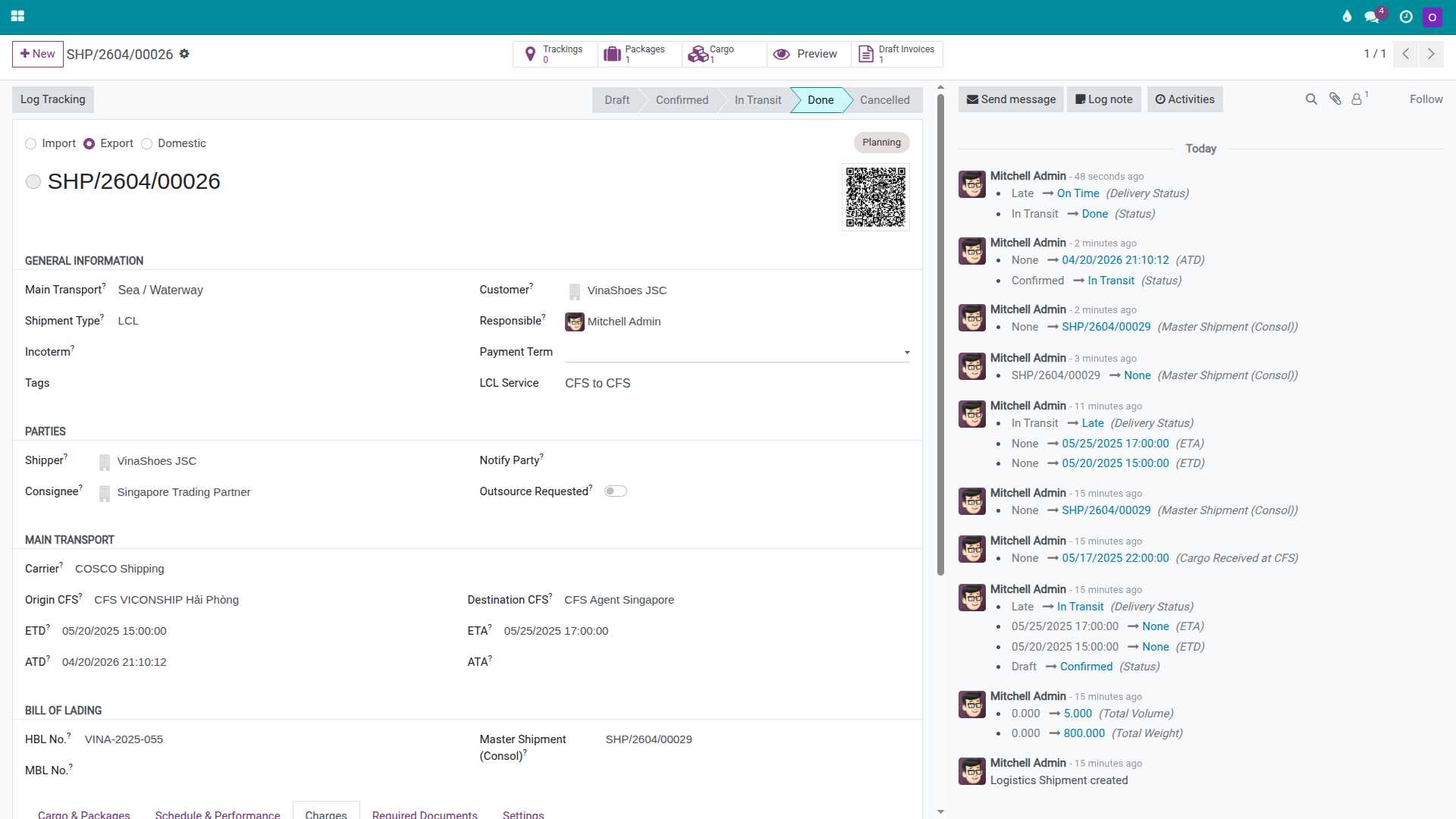
When COSCO issues the MBL, enter the MBL Number on the master and save the MBL file to Documents or the Chatter. Once the vessel arrives in Singapore and the agent confirms the container has discharged, click Set Done on the master. All houses transition to Done automatically.
Accounting verifies the financials using the following principle:
Customer Invoice: created per house. Each shipper receives a separate invoice.
Vendor Bill: created on the master for COSCO, the CFS, trucking, and other shared vendors.
Do not duplicate a cost on both a house and the master unless there is a clear business reason.
Ghi chú
If a quick per-house profit estimate is needed, apportion master costs by CBM: VinaShoes 5/23, Hoang Gia 8/23, Phuong Nam 10/23. Treat this as an estimate only. If the company requires formal cost allocation, contact Accounting or the system administrator to review the allocation configuration for the current version.
Mẹo
How to know Step 5 is correct:
The master Chatter contains an SI submitted note recorded before the SI Cutoff.
Each house has an HBL and a release note.
The master has an MBL number issued by COSCO.
Each house has a draft invoice addressed to the correct shipper.
The master has a draft vendor bill for shared costs.
Total revenue across 3 houses exceeds total master costs by the expected margin.
Quick decision table
Question |
When to choose |
This guide's approach |
|---|---|---|
Self-consolidate or co-load with another forwarder? |
Self-consolidate when you have enough cargo on the same route and can control the CFS Cutoff. Co-load when CBM is too low for a cost-effective fill rate or carrier slots are full. |
Hai Long self-consolidates because it has 23 CBM on the same route. If only 10–13 CBM were available, co-loading would be worth considering. |
Consolidate early or wait for more houses? |
Consolidate early to lock in the carrier slot, knowing you can add houses later. Wait for more houses to reduce later edits, at the risk of the slot filling up. |
Set an internal cut-off date approximately 10 days before ETD. Consolidate whatever valid houses exist at that point. |
Where do sell charges and buy charges live? |
Sell charges (revenue per shipper) go on the house. Buy charges (shared carrier/CFS/ vendor costs) go on the master. |
Create customer invoices on houses, vendor bills on the master. |
How do SI, HBL, and MBL differ? |
SI and MBL relate to the master and the carrier. HBL relates to each individual house and shipper. |
Submit the master SI to COSCO; issue and release separate HBLs to VinaShoes, Hoang Gia, and Phuong Nam. |
End-of-shipment checklist
Before closing an LCL export consolidation in the system, verify:
The master has three houses, all routing VNHPH → SGSIN.
All three houses have cargo/packages, shipping marks, and a CFS received milestone before the CFS Cutoff.
The master container is Stuffed, VGM Submitted, Gate-in, and Loaded.
The master Chatter has an SI submitted note; each house has an HBL released note.
Each house has a customer invoice; the master has vendor bills for shared costs.
Troubleshooting common issues
CFS refuses cargo because a shipper missed the cutoff
Symptom: A shipper's truck arrives at the CFS after 17/05/2025 18:00 and the CFS will not accept the delivery.
Common causes: Truck booked too late, traffic delays, missing packing list, or shipping mark not matching the CFS record, causing the CFS to spend time on verification.
Resolution:
Call the CFS immediately to request a grace period of 30–60 minutes and confirm whether an after-hours fee applies.
If the CFS refuses, separate that house from the current master and roll it to the next sailing.
Add any resulting charges to that house if the shipper is responsible for the delay.
Record in the house Chatter: reason for the delay, new ETD, and who confirmed the change with the shipper.
Not enough cargo to fill the container economically
Symptom: At the internal cut-off date, only two houses are available totalling 13 CBM — too low a fill rate for a 40HC.
Common causes: A forecasted house was cancelled, a shipper moved their export date, or volume on this route is unusually low this week.
Resolution:
Check the carrier deadline; if time permits, search for additional houses on the same route.
If fill rate is unworkable, contact a partner forwarder to co-load.
If a master draft has already been created, keep it in draft or cancel it per the company's internal process. Do not create a carrier booking before the costing is viable.
Update the charge lines to reflect the co-loader's rate rather than a direct COSCO ocean freight rate.
HBL issued with incorrect information for one shipper
Symptom: The VinaShoes HBL was sent for approval, but the shipper reports a wrong consignee or incorrect shipping mark.
Common causes: The shipper provided consignee details late, data was copied incorrectly from an email, or Documentation used data from another house by mistake.
Resolution:
Open the VinaShoes house and correct the consignee or shipping mark.
Re-print the HBL draft and send it to the shipper for re-approval.
If the MBL is not affected, no amendment to the master is needed.
Record the correction in the house Chatter and add an HBL Amendment Fee charge if it is recoverable from the shipper.
Master gross profit appears incorrect
Symptom: The consolidated load's total profit is negative or unusually high compared to the approved margin.
Common causes: A master cost was entered but the corresponding house revenue was missed; a cost was entered on both the house and the master creating a double-count; or invoices were created before all charge lines were entered.
Resolution:
Check each house: every shipper should have sell charge lines for Ocean Freight LCL, CFS Handling, and Documentation Fee.
Check the master: only shared buy charges (carrier, CFS, trucking, handling vendor) should be present.
If draft invoices or bills were created with incorrect data, cancel them, correct the charge lines, and re-create.
Cross-check: total revenue from all three houses minus total master costs should equal the approved margin for this consolidated load.
Xem thêm
Related guides
FCL Export — FCL Export.
LCL Import (Deconsolidation) — LCL Import (Deconsolidation).
Document Management (SI, B/L, D/O) — Shipment document management.
Charges and Profitability — Charges and profitability.