
LCL Air Freight Consolidation (LCAF)
Guide information
Required modules
Freight Accounting (optional — for cost allocation and profitability)
Air consolidation (LCAF — Less than Charter Air Freight) is the practice of combining multiple small export shipments from different customers into a single master booking with one airline. The forwarder acts as the consolidator, buying capacity in bulk at a lower rate per kg and reselling individual slots to each house customer. One data error on any house shipment can affect the entire master booking — because the airline bills the master total, not individual houses.
Export scenario (Part A): Hai Long Logistics consolidates 3 house air export shipments to Korean Air KE682 SGN → ICN, MAWB 180-99988877, ETD 22/05/2025:
House 1 — Saigon Tech Export: 200 kg / 2.0 CBM
House 2 — Viet Phat Industries: 350 kg / 1.5 CBM
House 3 — Dong A Trading: 250 kg / 3.5 CBM
Master totals: 800 kg gross / 7.0 CBM / Chargeable Weight 1,169 kg (volumetric dominates: 7.0 CBM × 167 = 1,169 kg).
Import scenario (Part B): Hai Long receives a master inbound from Tokyo Freight KK: NRT → HAN, MAWB 738-22255544, Japan Airlines JL751, ETA 18/06/2025, 4 house importers.
Xem thêm
Freight terminology (MAWB, HAWB, Consolidator, Co-loader, ULD, Chargeable Weight): Industry Glossary
Air Direct (single shipment, no consolidation): Air Freight Export (Direct)
When to use consolidation vs. Air Direct
Factor |
Air Direct |
Air Consolidation |
|---|---|---|
Volume per customer |
High enough to justify a dedicated booking. |
Small — each customer's cargo alone would get a poor rate per kg. |
Timeline flexibility |
Customer needs a specific flight with certainty. |
Customer can accept the master cutoff and the consolidation buffer time. |
Cost priority |
Customer pays for speed and exclusivity. |
Customer wants the lowest rate per kg. |
Cargo sensitivity |
Fragile or hazmat cargo that should not mix. |
General cargo that can share a ULD. |
When in doubt: If a customer's cargo can meet the master Cargo Cutoff and the rate improvement is meaningful (> 10% reduction), consolidation is usually the right choice. If the customer insists on a specific flight without risk of delay, use Air Direct.
Part A — Air Export Consolidation
Step A1: Create individual house shipments
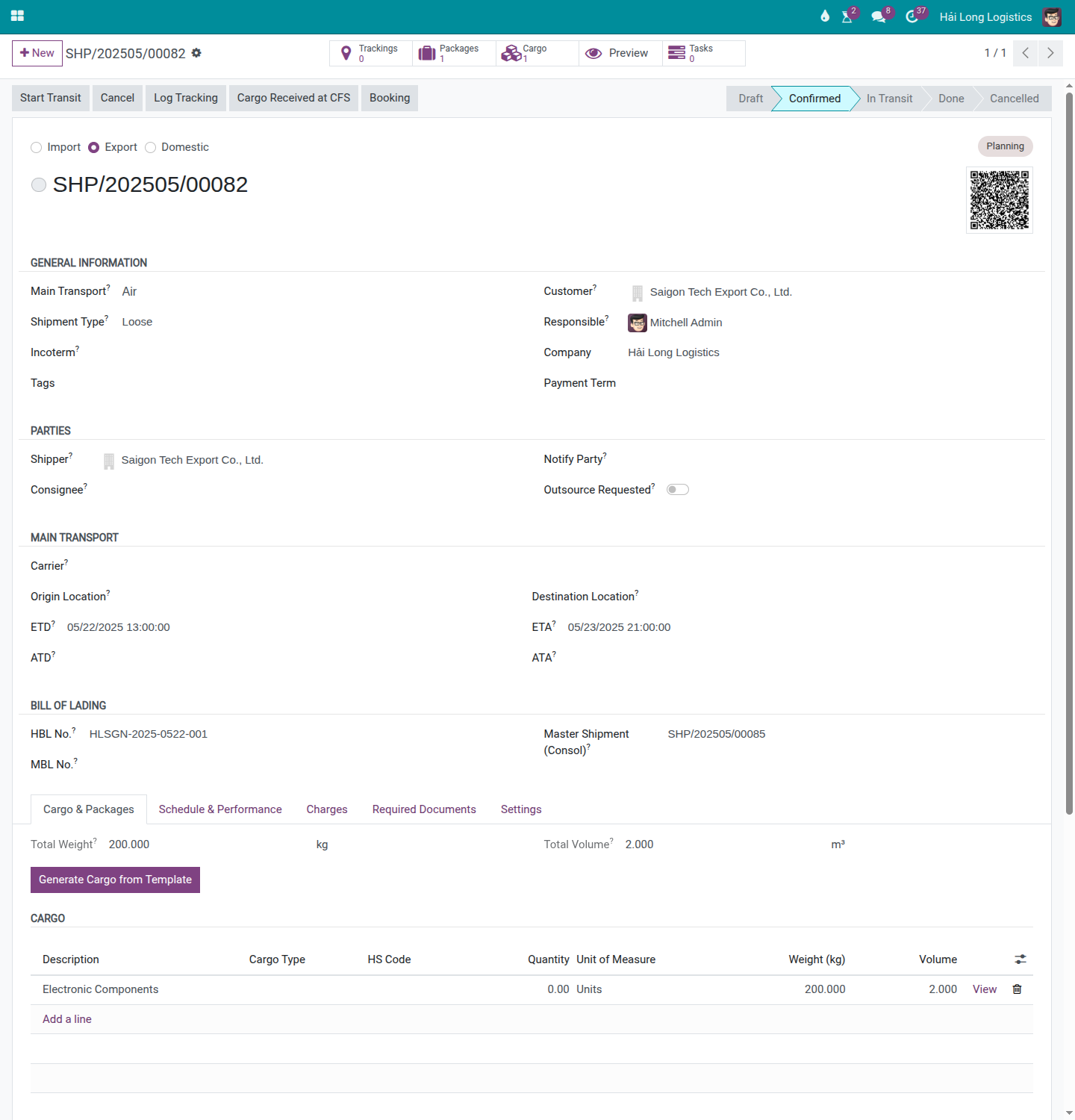
Each house customer's cargo travels on its own house shipment record, which is then linked to the master. Create house shipments the same way as Air Direct shipments, but with type Air House Export.
Go to and create three house shipments:
House 1 — Saigon Tech Export:
Customer: Saigon Tech Export Co.
POL/POD: SGN → ICN
Pieces: 4 / Gross Weight: 200 kg / Volume: 2.0 CBM
Chargeable Weight: max(200, 2.0 × 167) = max(200, 334) = 334 kg (volumetric dominates)
House 2 — Viet Phat Industries:
Customer: Viet Phat Industries JSC
POL/POD: SGN → ICN
Pieces: 6 / Gross Weight: 350 kg / Volume: 1.5 CBM
CW: max(350, 1.5 × 167) = max(350, 250.5) = 350 kg (gross weight dominates)
House 3 — Dong A Trading:
Customer: Dong A Trading Co.
POL/POD: SGN → ICN
Pieces: 5 / Gross Weight: 250 kg / Volume: 3.5 CBM
CW: max(250, 3.5 × 167) = max(250, 584.5) = 584.5 kg (volumetric dominates)
Confirm each house shipment.
Cảnh báo
The master Cargo Cutoff must allow time to collect all house cargo.
Build in a buffer of 6–12 hours between the house cargo collection deadline and the master Cargo Cutoff at the airline warehouse. If House 3 delivers cargo at 15:00 and the airline cutoff is 16:00, there is no margin for late trucks or repackaging.
For the KE682 Cargo Cutoff at 22/05/2025 14:00, set the house collection deadline at 07:00 on 22/05 to allow 7 hours of buffer for cargo receipt, palletizing and delivery to the Korean Air warehouse.
Step A2: Create the master air shipment and link houses
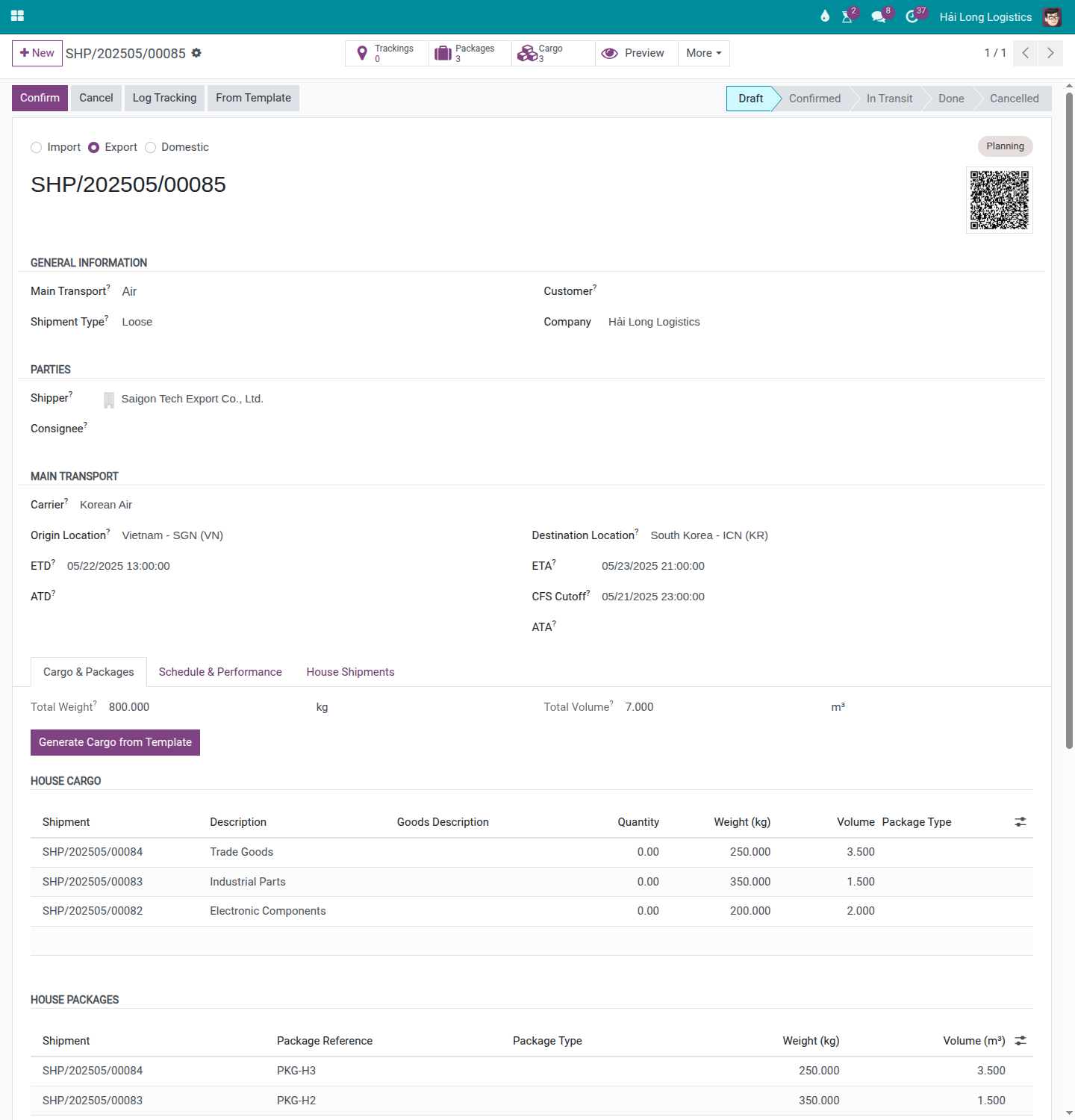
The master shipment represents Hai Long's booking with Korean Air. It carries the MAWB and the total weight/volume for airline billing.
Go to and click New.
Shipment Type: Air Master Export
Carrier: Korean Air
POL / POD: VNSGN / KRSEL
ETD / ETA: 22/05/2025 / 23/05/2025
In the House Shipments tab (or via the consolidation wizard), link the three house shipments to this master.
After linking:
Master totals are aggregated: 800 kg gross / 7.0 CBM / CW 1,169 kg.
Each house shipment's status shows as linked to this master.
Step A3: Book the airline and record the MAWB
Create a carrier booking for the master shipment — the same process as Air Direct booking.
From the master shipment, click Booking and fill in:
Booking Type: Air Booking
Carrier: Korean Air
Flight Number: KE682
ETD / ETA: 22/05/2025 / 23/05/2025
Cargo Cutoff: 22/05/2025 14:00
After Korean Air confirms, fill in:
MAWB No.: 180-99988877
Feeder Name: Korean Air
Voyage No. (Flight): KE682
Click Mark as Confirmed.
Step A4: Issue HAWB numbers for each house
Each house customer receives a House Airway Bill (HAWB) — the forwarder's contract of carriage with that individual customer. After booking is confirmed on the master, assign a HAWB number to each house shipment.
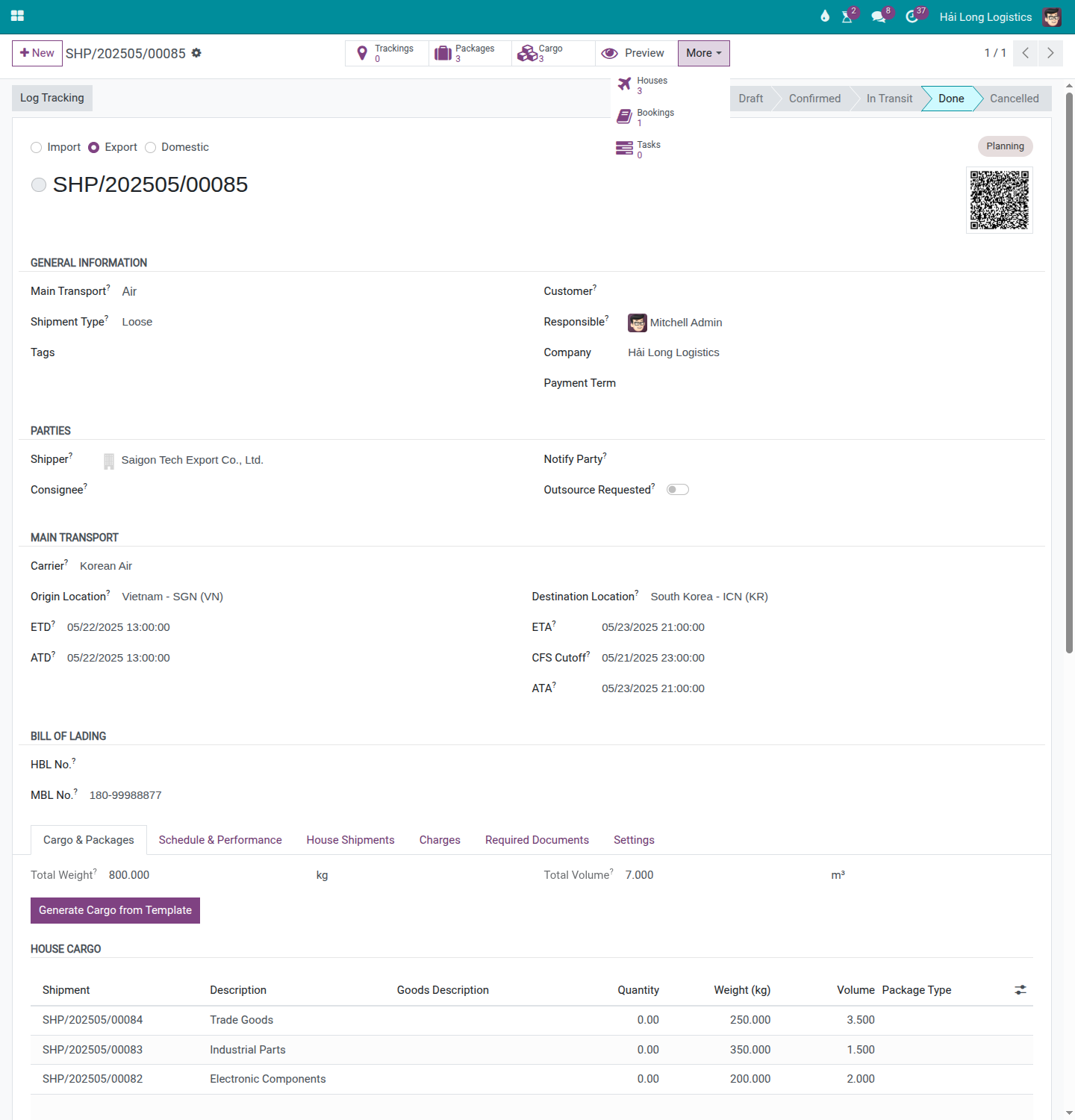
Open each house shipment and fill in the HBL No. (HAWB) field:
Saigon Tech Export: HAWB/202505/00090
Viet Phat Industries: HAWB/202505/00091
Dong A Trading: HAWB/202505/00092
Quan trọng
HAWB numbers must be entered manually on each house shipment after deconsolidation.
The deconsolidation wizard allows you to enter a HAWB number per line, but the system does not automatically copy this value to the house shipment's HBL No. field when the house is created. You must open each house shipment and fill in the HAWB No. manually.
This is a known system limitation. Until it is resolved in a future version, treat HAWB entry as a mandatory post-deconsolidate step for every house.
Step A5: Print the Air Cargo Manifest for the master
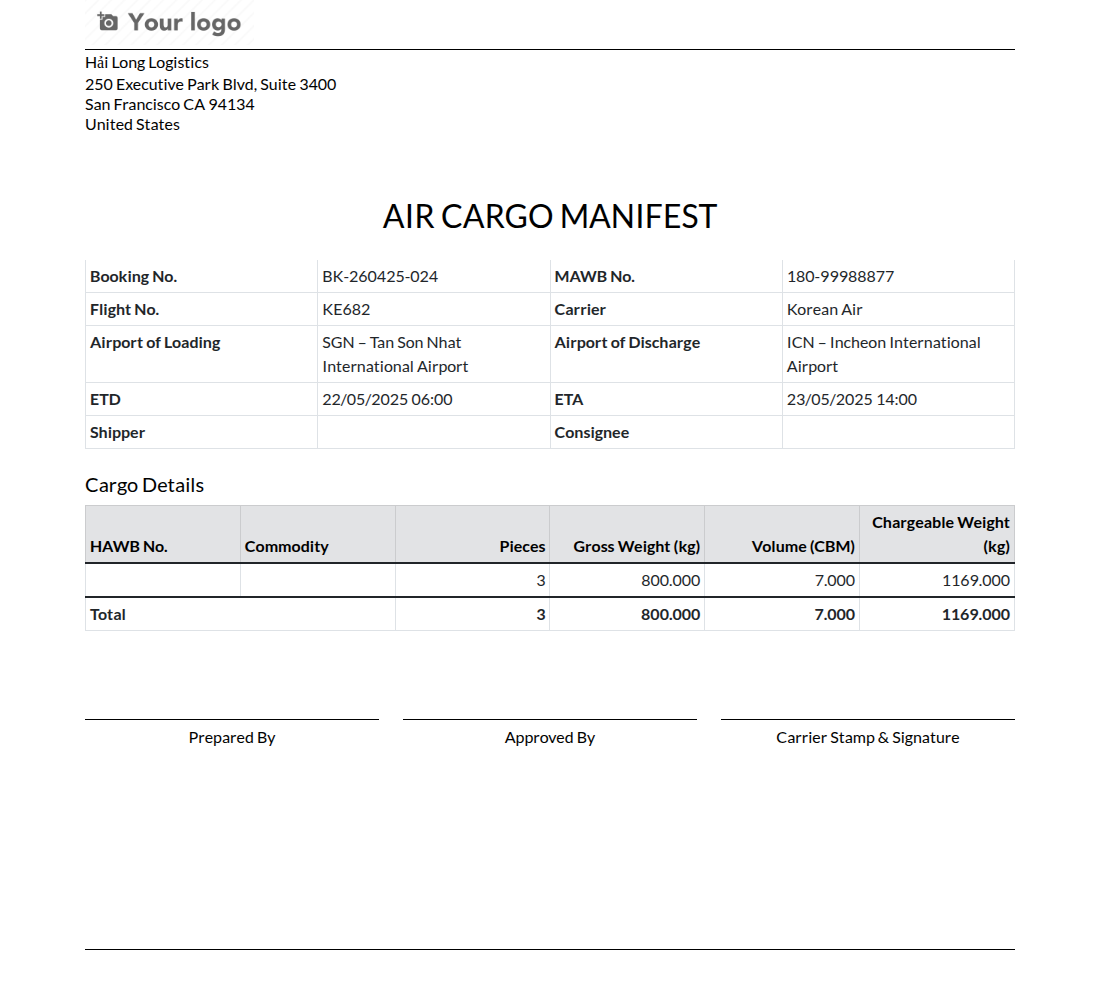
The Air Cargo Manifest lists all cargo on the master booking. Present this to Korean Air at cargo check-in. It includes: MAWB, flight, master totals, and a breakdown by house HAWB.
From the master shipment, go to:
Verify the manifest before printing:
Master totals: 800 kg gross, 7.0 CBM, 1,169 kg CW.
All 3 house HAWB numbers are listed.
Each house shows correct piece count and weight.
Part B — Air Import Deconsolidation
Step B1: Receive the master import shipment from the origin agent
When Tokyo Freight KK sends the master pre-advice, create the master import shipment in Viindoo.
Go to and create the master:
Shipment Type: Air Master Import
Origin Agent: Tokyo Freight KK
Carrier: Japan Airlines
POL / POD: JPNRT / VNHAN
ETD / ETA: 17/06/2025 / 18/06/2025
MAWB No.: 738-22255544
Flight: JL751
Master cargo: 640 kg gross / 4.5 CBM / CW 751.5 kg (volumetric = 4.5 × 167 = 751.5 dominates).
The origin agent pre-advice lists 4 house importers:
Bac Viet Precision — 180 kg
Ha Noi Auto Parts — 220 kg
Dai Duong Electronics — 150 kg
Sao Do Pharma — 90 kg
Step B2: Deconsolidate the master into house shipments
After the master arrives at HAN (ATA 18/06/2025), run the deconsolidate wizard to create individual house shipments for each importer.
From the master shipment, go to:
The wizard shows a line for each house listed in the master pre-advice. Fill in:
House Customer (each importer).
Weight / Volume for each house (from the pre-advice).
HAWB Number — enter the HAWB for each house line in the wizard.
Click Deconsolidate.
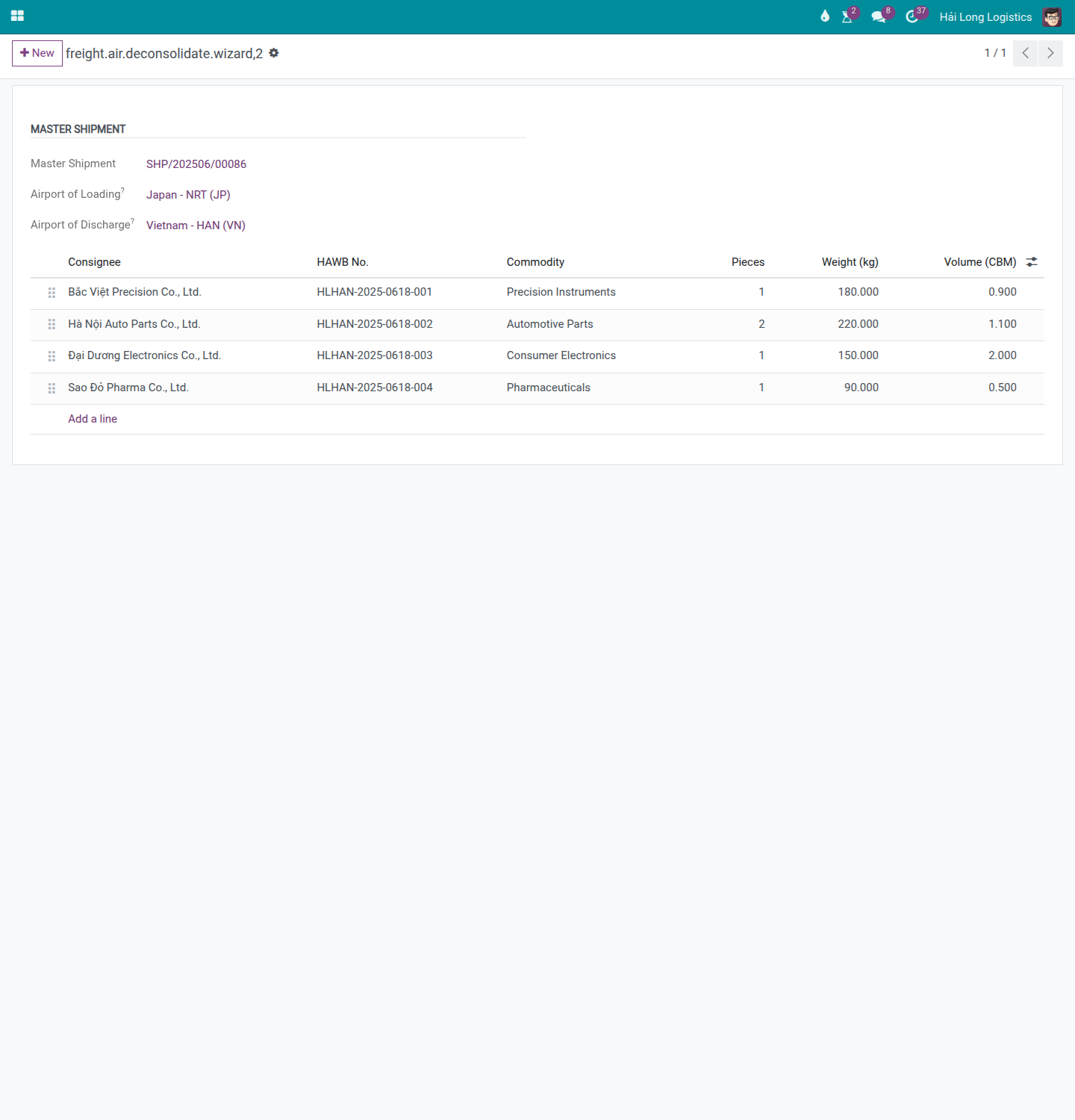
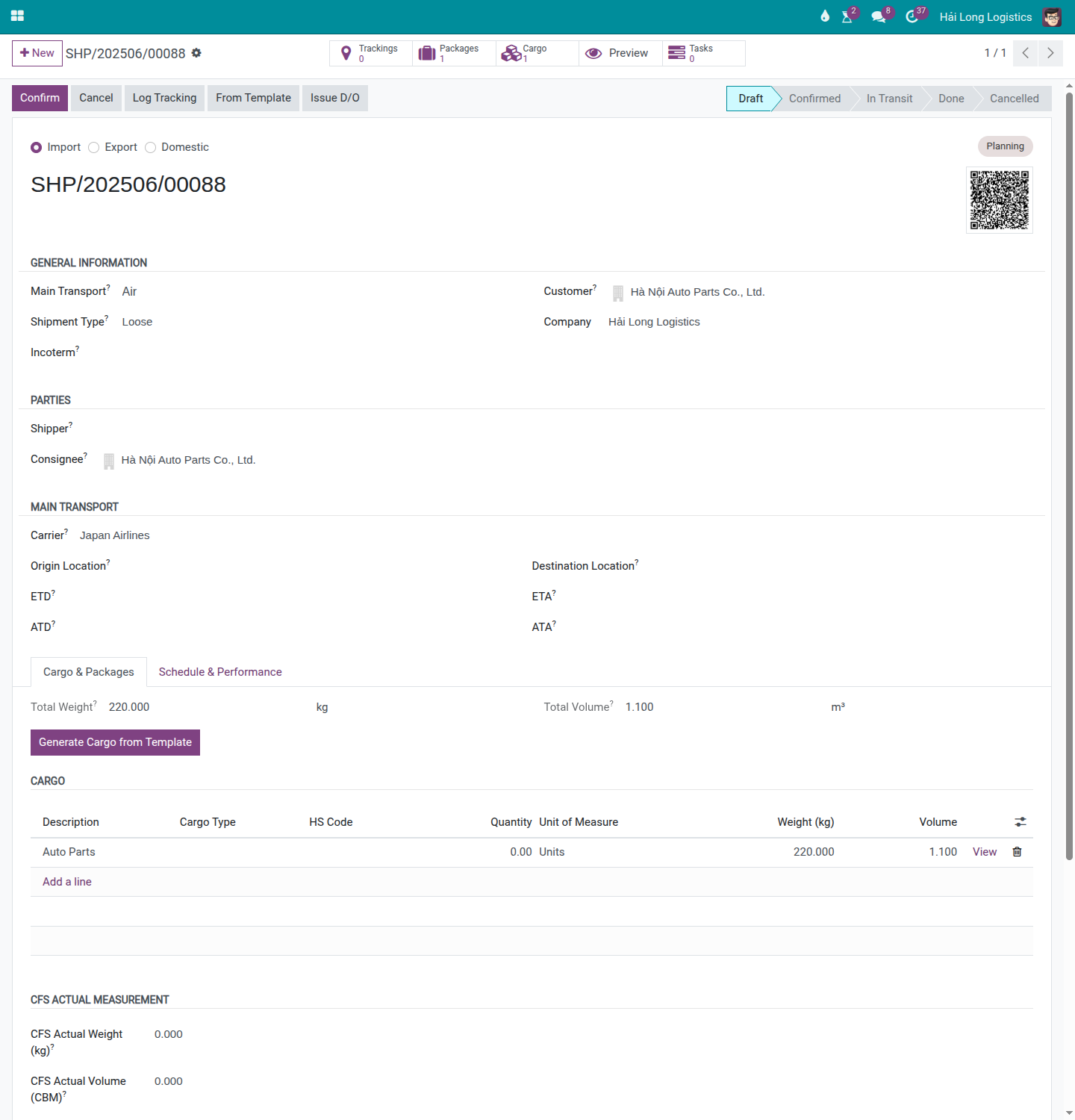
Four house import shipments are created, each linked to the master. Confirm each house.
After deconsolidation, open each house shipment and manually fill in the HAWB No. field (see the important note in Step A4 — the wizard does not auto-write the HAWB to the house).
Step B3: Manage customs clearance for each house
Each house importer files their own customs import declaration. Track clearance per house in the Chatter and the Import Operations section of each house shipment.
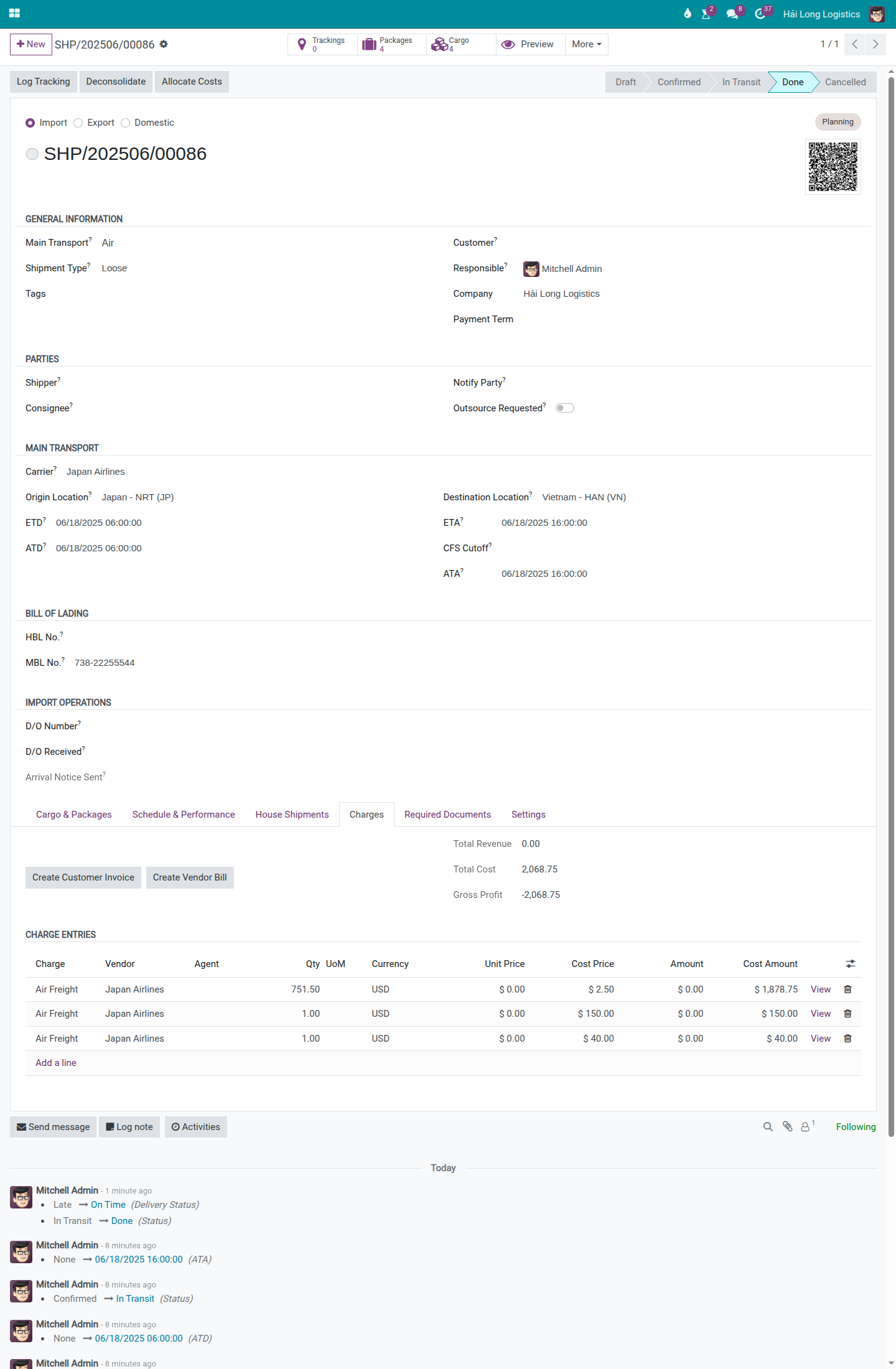
For the cost allocation: the master's total air freight cost from Japan Airlines (e.g., USD 3.00/CW kg × 751.5 CW = USD 2,254.50) must be distributed across the 4 house shipments.
Allocation methods:
Method |
When to use |
How to apply |
|---|---|---|
Pro-rata by CW |
Standard — each house pays proportional to their chargeable weight. |
Bac Viet: 180 ÷ 640 × USD 2,254.50 = USD 634. Apply to each house. |
Fixed amount per house |
When the origin agent quotes a fixed rate per house in advance. |
Enter the agreed amount directly as the cost on each house charge line. |
Agreement-based |
Commercial agreement with each customer (minimum charge, etc.). |
Enter per agreement on each house. |
Ghi chú
Viindoo does not have an automatic "Allocate Costs" wizard for air master imports (unlike sea LCL consolidation, which has a cost allocation wizard). Cost allocation for air master import must be entered manually on each house shipment's Charges tab.
Troubleshooting
House cargo not ready before master Cargo Cutoff
Symptom: One house customer (e.g., Dong A Trading) cannot deliver their cargo to the forwarder's warehouse before the master cutoff.
Resolution:
Contact Dong A Trading immediately. If cargo is within 30 minutes of the cutoff, assess whether it can physically reach the airline warehouse in time.
If not possible: remove Dong A Trading from this master booking. Create a new house shipment for them on the next available KE flight (KE684 next day).
Recalculate the master totals without Dong A Trading's cargo.
If the master CW drops significantly, check whether the rate tier from Korean Air still applies (some rate cards have minimum weight thresholds).
HAWB numbers need correction after houses are created
Symptom: A HAWB number was entered incorrectly on a house shipment after deconsolidation.
Resolution:
Open the house shipment.
Update the HBL No. (HAWB) field with the correct number.
Re-issue the HAWB document to the consignee with a written explanation.
Post a Chatter note explaining the correction.
Master weight on the airline invoice differs from system records
Symptom: The Japan Airlines invoice shows total CW = 762 kg; the system shows 751.5 kg.
Cause: The airline re-weighed cargo at check-in (common at large cargo terminals) or applied a rounding formula.
Resolution:
Request the weight certificate from Japan Airlines.
If the airline weight is confirmed, update the master CW and recalculate the cost allocation across house shipments.
Decide whether to pass the difference to importers or absorb it in the master margin.
Update the cost price on each house charge line accordingly.
Xem thêm
Air Freight Export (Direct) — Air Direct export (single house, no consolidation)
Air Freight Import (Direct) — Air Direct import
Charges and Profitability — Recording air freight charges and managing profitability per house