
How to create and edit email templates
Email templates let Viindoo fill in emails for you, such as the email that sends a quotation, an invoice or a reminder. To create or edit one, turn on developer mode, go to Settings ‣ Technical ‣ Email ‣ Email Templates, click New (or open a template), choose the document it Applies to, then write the Subject and the body with dynamic placeholders that are replaced by the record’s data (customer name, order number, amount…) when the email is sent.
Who |
Administrators (the Technical menu is visible in developer mode). |
App |
Settings (templates are used by every app that sends emails) |
Before you start
Turn on developer mode to see the Technical menu.
The screenshots show the Sales: Send Quotation template, which applies to Sales Order and comes with the Sales app. Without Sales, open a template of another app and follow the same steps.
Know how to send a message from a record, where templates are used.
How do I create an email template?
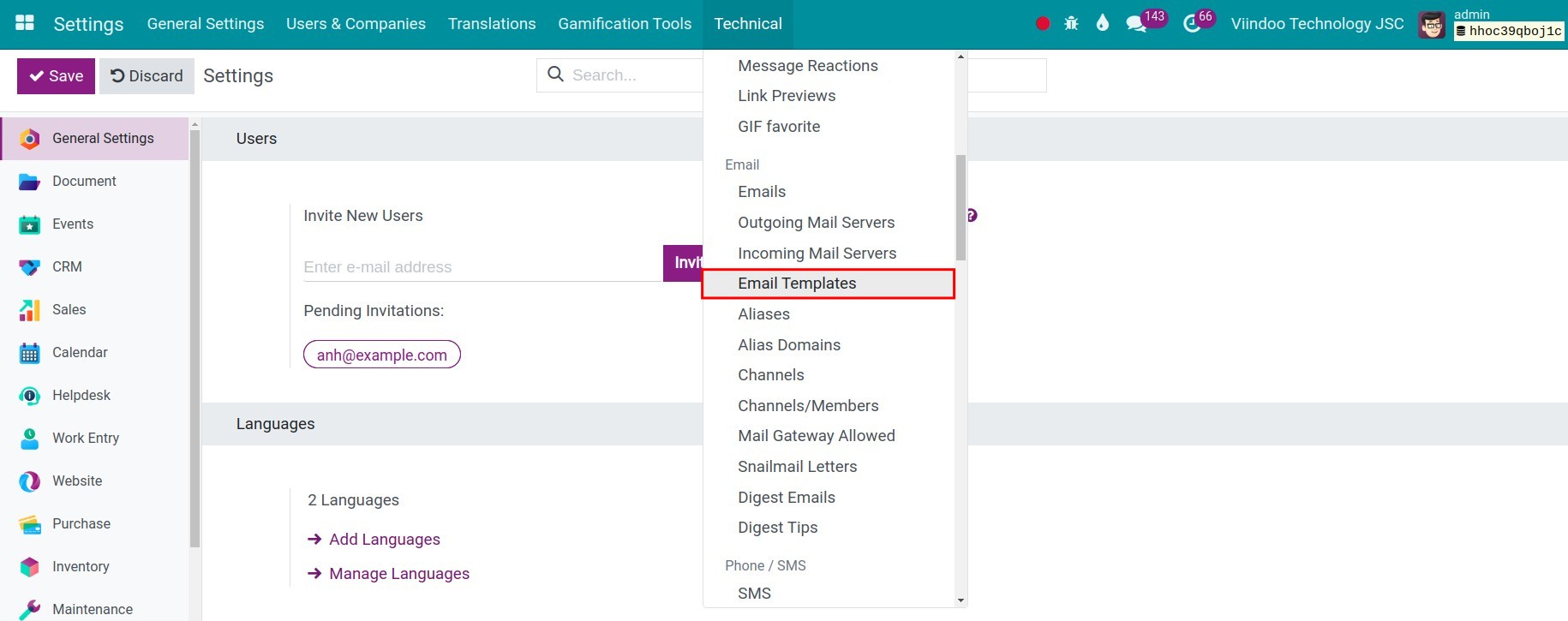
Go to Settings ‣ Technical ‣ Email ‣ Email Templates. The list opens with the Base Templates filter; remove it to see every template. Click New, or open an existing template to edit it.
![Email Templates list reached from Settings, Technical, Email]()
Enter the Template Name, choose the document type in Applies to (for example Sales Order) and write the Subject. The subject can contain placeholders such as
{{ object.name }}.![Email template form with Template Name, Applies to and Subject]()
In the Body tab, write the email. Select text to show the formatting toolbar, type / to open the list of editor commands, and use Attachments in the Options tab to attach fixed files. To show customer or document data, insert dynamic placeholders.
![Body tab with the formatting toolbar over selected text]()
Set the sender and recipients in the Settings tab and the attachments in the Options tab (see the tables below). The template is saved when you leave the form.


To write the body in HTML/CSS instead, select a word, click the three dots (Expand toolbar) at the end of the toolbar, then the Code view icon (</>); click it again to return to the normal editor.

Which sender, recipients and options can I set?
Settings tab:

Field |
What it does |
|---|---|
Send From |
Sender address. In the Sales template: the salesperson’s email, else the company’s, else the email of the user who sends. |
Default Recipients |
Sends to the document’s usual recipient (the customer of an invoice, the vendor of a purchase order…). When ticked, To (Emails), To (Partners) and Cc are hidden; untick it to type your own recipients. |
To (Emails), To (Partners), Cc |
Addresses and contacts always added as recipients, separated by commas. |
Reply To |
Where replies go. Empty means replies are captured in the chatter of the document. |
Language |
Language of the email. Use |
Auto Delete |
On by default: the sent email is deleted from the outgoing queue to save space. The message stays in the document’s chatter. |
Scheduled Send Date |
If set, the email is sent after this date; otherwise as soon as possible. |
These fields also accept placeholders, for example {{ object.partner_id.email }}.
Options tab:

Field |
What it does |
|---|---|
Attachments |
Fixed files attached to every email sent with this template. |
Dynamic Reports |
PDF reports attached automatically, for example the quotation PDF. |
Owner |
Restricts the template to one user. Empty means shared with all users. |
Template Description |
Internal note on what the template is for. |
How do I insert customer or document data (dynamic placeholders)?
A dynamic placeholder is replaced by the data of the record when the email is sent, for example the customer’s name on a sales order. The steps below build a new template that applies to Sales Order.
In the body, place the cursor where the data should appear, type / and choose Dynamic Placeholder. In Select a field, search for the field. If it has an arrow (a related record, such as Customer), click the arrow to choose one of its fields, such as the customer’s name.
![Select a field popover with the Customer field and its arrow]()
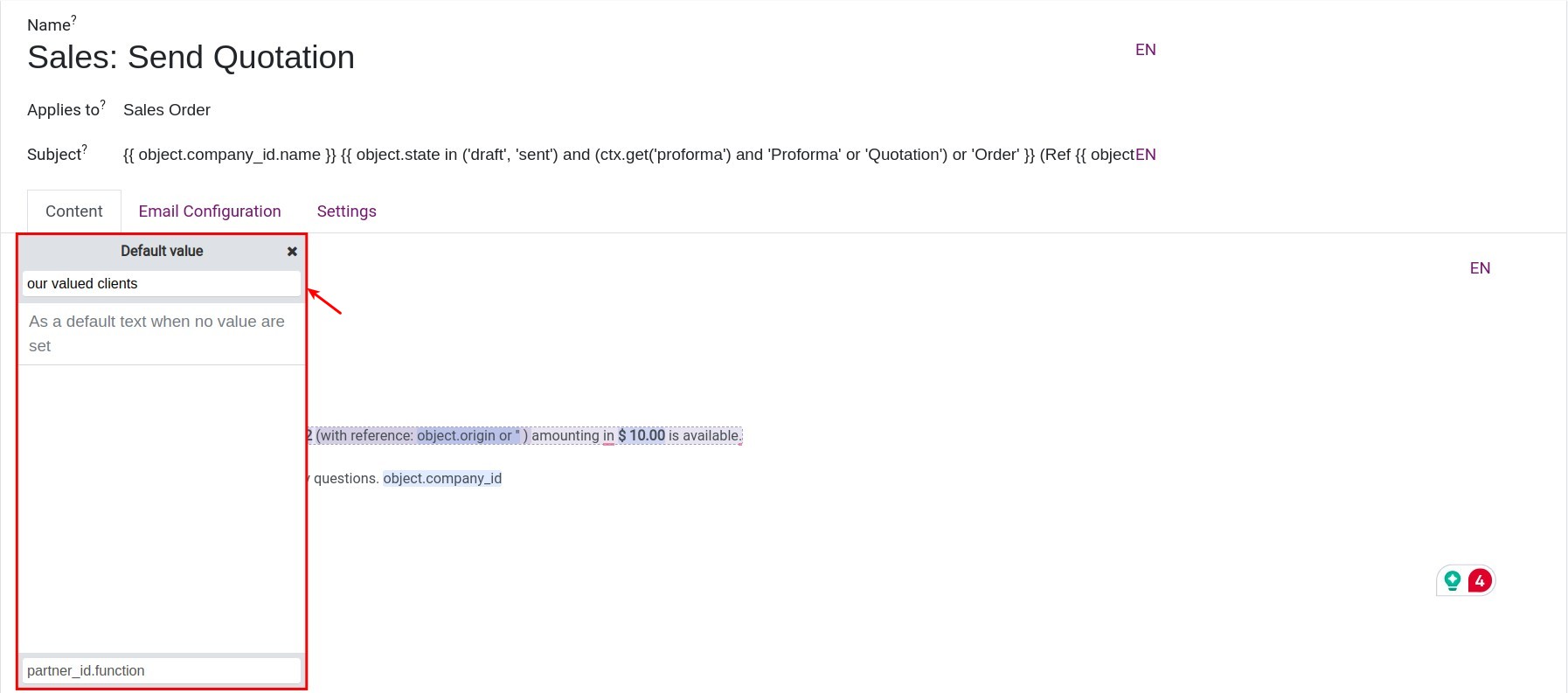
In Enter a default value, optionally type the text to show when the field is empty, for example our valued clients, then click Insert.
![Enter a default value step with a default text and the Insert button]()
Check the result with Preview at the top of the template: choose a Test Record to see the email filled in with its data. A placeholder whose field is empty on that record shows its default value, here not provided for the customer reference.
![Template Preview with the customer name filled in and a default value for an empty reference]()


How do I translate a template?
Viindoo sends the template in the language set in Language (usually the contact’s language), using the translation you enter for that language.
Click the language code at the end of a translatable field, for example EN next to the Subject, enter the text for each language and click Save. The language code of the body is at the top right of the Body tab; its window lists the body of each language as HTML, so translate the visible text between the tags.
![Translate window of the subject with the English and Vietnamese versions]()

Common problems
Problem |
What to do |
|---|---|
The Technical menu is missing. |
Turn on developer mode. |
A placeholder shows nothing in the email. |
The field is empty on that record. Set a default value for the placeholder. |
The email goes out in the wrong language. |
Check Language in the Settings tab and the language of the contact, and that the template has a translation for it. |
To (Emails) and Cc are not visible. |
Default Recipients is ticked. Untick it to type your own recipients. |
Next steps
Chatter: follow records, log notes and send messages: use your template with Send message.
How to connect Viindoo to your own mail servers: make sure Viindoo can send the emails.