
Before you start
The master already has its three houses consolidated (5 / 8 / 12 CBM, 25 CBM total) and is booked with the carrier: see Consolidate LCL export shipments under a master.
The master carries one buy-only charge that is not yet allocated to any house and not yet committed to a vendor bill or purchase order: Terminal Handling Charge (THC) - HPH, Vendor Wan Hai Lines, Cost Price 2,600,000 VND, Unit Price 0.00 - added on the Charges tab the same way as any other charge line (see Record charges, invoice the customer, and bill vendors). The master’s Ocean Freight - FCL charge from its booking qualifies in the same way.
The THC and ocean freight products have Split Method = By Volume (field Split Method on the product, set once by an administrator, see Set up freight services and local charges). A charge whose product has no split method starts as Manual, and you choose the method in the wizard instead.
The split by volume reads the volume of each house in this order: the volume measured on a confirmed Outturn Report, else the CFS Actual Volume (CBM) of the house, else the volume booked for the house. Fill the volumes in before you start.
You are in the User: All Shipments group, or you are a User: Own Shipments user who is Responsible for the master and for every house under it: the person who looks after a consolidation looks after all of its houses. The button is always shown, but the wizard lists only the houses you can read - see Known limitations. The amounts in the wizard are visible to users with the access right See and edit charge buy costs (every internal user by default), Invoicing or Administrator; others see only the percentages.
Step 1: Open the Allocate Costs wizard
The THC on the container was paid once, for the whole load - nothing on the master yet tells Accounting how much of it belongs to Song Hong, how much to Long Bien and how much to Tay Nguyen.
Go to and open the master shipment holding container WHLU2233445. In the header, click Allocate Costs.
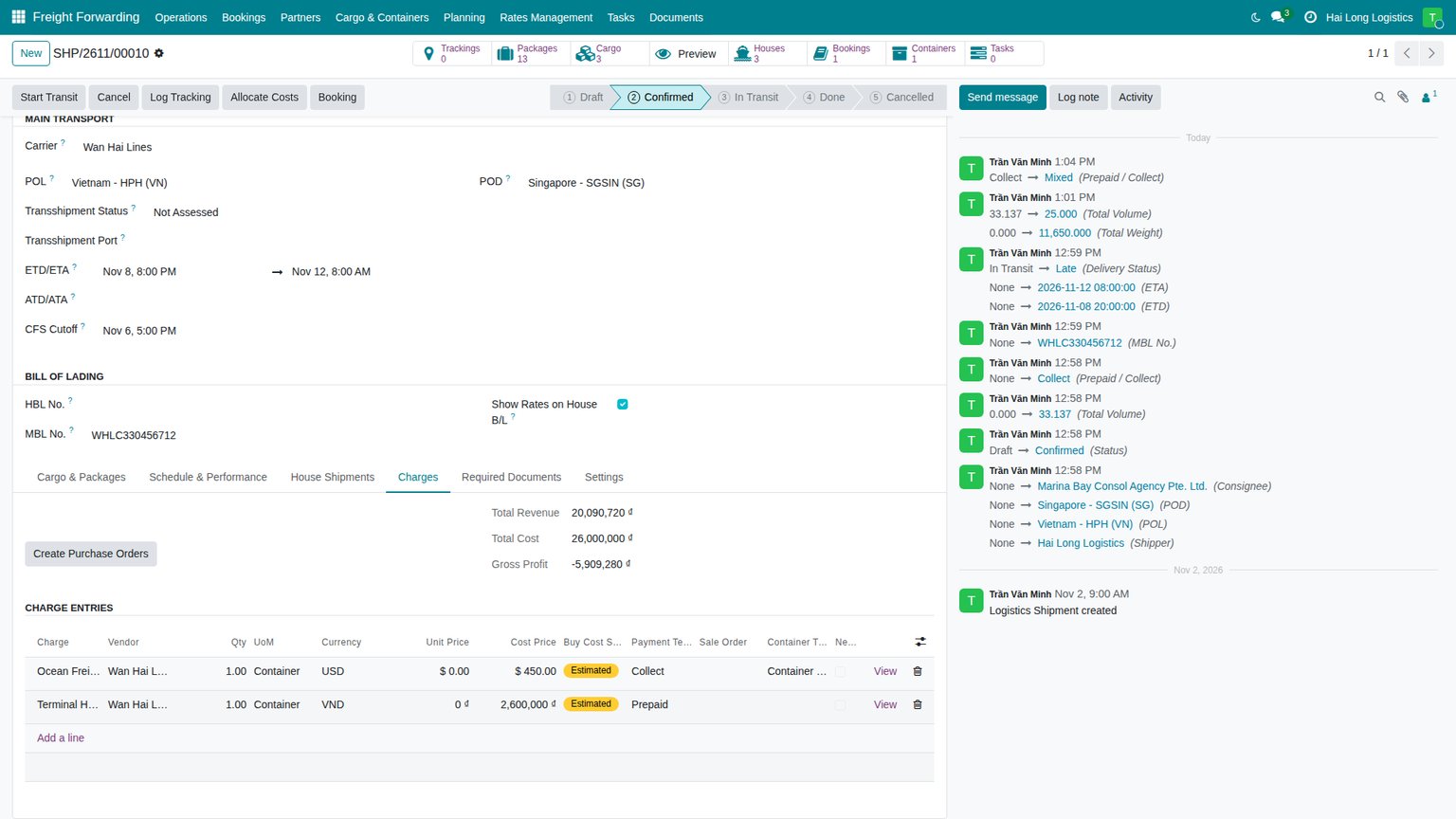
After you click it, the Allocate Costs to House Shipments window opens with the Select Charges field already carrying the Terminal Handling Charge (THC) - HPH tag - Viindoo pre-selects every charge still eligible for allocation, not an empty list.
Note
Pre-selection is a default, not a lock: if the master had a second shared charge you did not want to split this round, it would appear ticked too, and you would remove it in Step 2, not here.
Tip
Step 1 is done when: the window opens with the Terminal Handling Charge (THC) - HPH already selected under Select Charges - not a blank list. The master’s Ocean Freight - FCL charge is selected beside it when the master has been booked.
Step 2: Review the charge, then click Prepare Allocation
Confirming which charge to split now avoids splitting the wrong one later - a charge that was already billed directly to one house, or already allocated once, cannot be selected here at all.
Keep Terminal Handling Charge (THC) - HPH selected (remove the tag of any charge you do not want to split this round - for this walkthrough, Ocean Freight - FCL can stay selected or be split in its own round), then click Prepare Allocation.
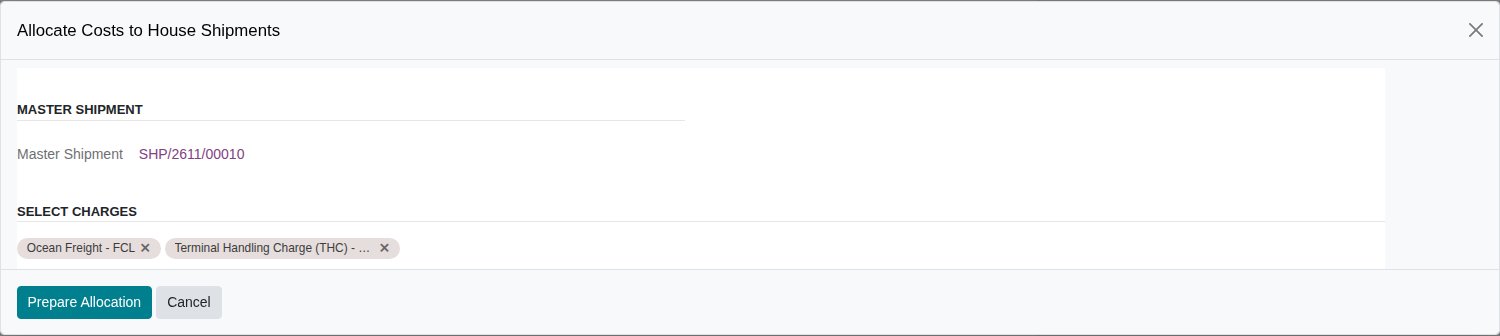
After you click it, two tables appear. Charges to Allocate has one row per charge: Amount to Allocate, Split Method, Total Basis, Allocated (%), Allocated and Left on Master. Allocation Preview has one row per charge and house: Eligible, Basis, No Basis, Manual (%), Share (%) and Allocated Amount. Basis is the house’s volume (5, 8 and 12 CBM), Share (%) is its part of the total, and Allocated Amount is the cost it takes.
Note
A house with no basis for the chosen method - for example a shipper who never delivered, so its volume is 0 - is left out of the split with a tick in No Basis, and the charge shows a warning. Check that every house you expect is listed and eligible; see Decide how to split the cost below.
Tip
Step 2 is done when: all three houses are listed with Basis 5 / 8 / 12, Total Basis reads 25.000 and Allocated (%) reads exactly 100.00.
Step 3: Confirm the allocation
Each house starts with the share its volume gives, and you can review it here before anything is written to the houses.
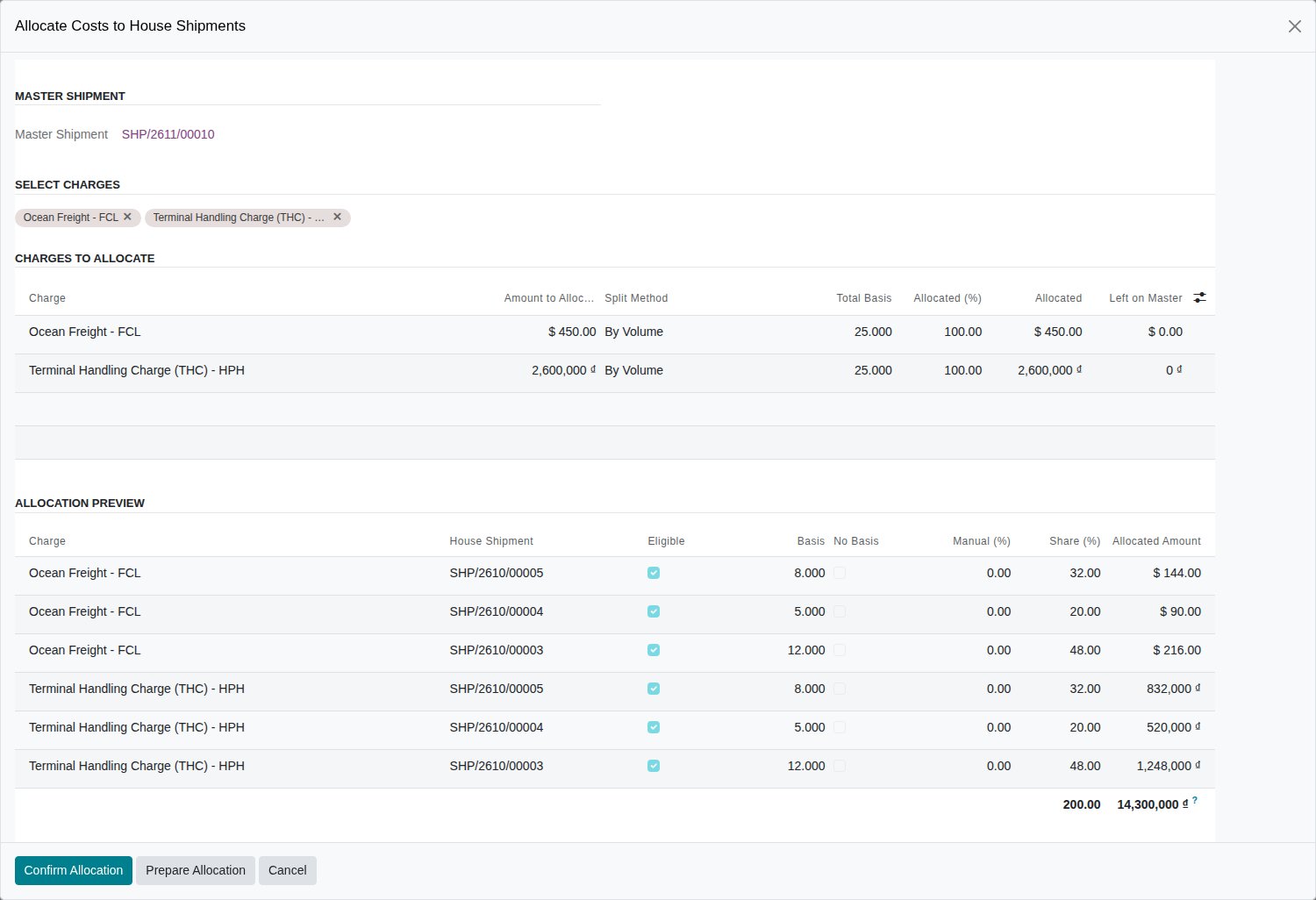
In the Allocation Preview, Share (%) reads 20.00 (Song Hong), 32.00 (Long Bien) and 48.00 (Tay Nguyen). The THC of 2,600,000 VND splits into 520,000, 832,000 and 1,248,000 VND, and the ocean freight of USD 450.00 into USD 90.00, USD 144.00 and USD 216.00. The footer adds the lines up in the company currency. Check Left on Master: it reads 0 when the shares add up to 100%. Click Confirm Allocation.
Warning
Agree the basis with Accounting before you change a method or a percentage, and do not add independent house costs and bill the same underlying cost again from the master.
Note
The suggested shares come from the volumes, so a wrong volume gives a wrong share: correct the cargo packages, the CFS Actual Volume or the Outturn Report when the real volume differs, rather than forcing a percentage. You can run Allocate Costs again at any time, before or after the vendor bill is posted: the new split replaces the previous one and the master’s chatter records the old and the new values. Check the preview before confirming - see Known limitations.
Tip
Step 3 is done when: clicking Confirm Allocation closes the window without an error and Left on Master read 0 just before you clicked it.
Step 4: Check the allocated share on each house
The wizard writes straight to each house’s own Charges tab - checking here, not on the master, is what confirms the split actually landed where it should.
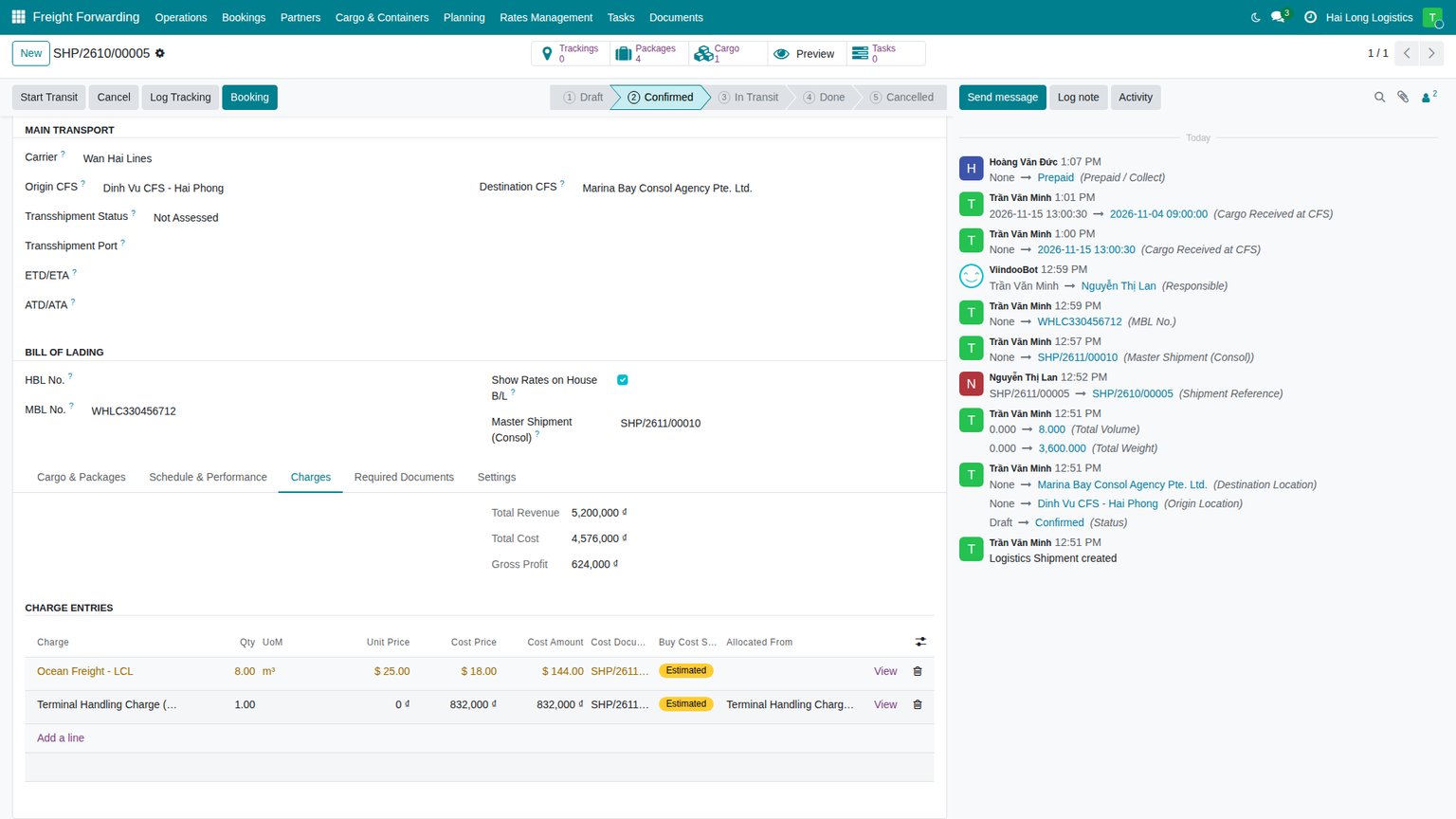
Open each house shipment and its Charges tab. A house that already has a line for the same service takes its share on that line: the house’s own Ocean Freight - LCL line shows the ocean freight share in Cost Amount (for Long Bien, USD 144.00, 8 m3 at USD 18.00). A house that has no such line gets a new one: the Terminal Handling Charge (THC) line, Qty 1, Unit Price 0, with no vendor, because the vendor bill is made once, from the master. The Allocated From column names the master’s charge the share comes from, and Cost Document shows the master. The cost on these lines is the house’s real cost. The THC shares read:
Song Hong Handicraft Co., Ltd.: Cost Price 520,000 VND.
Long Bien Ceramics Export Co., Ltd.: Cost Price 832,000 VND.
Tay Nguyen Coffee Export Co., Ltd.: Cost Price 1,248,000 VND.
Tip
Step 4 is done when: the three houses read 520,000 / 832,000 / 1,248,000 VND for the THC on their own Charges tab, adding back up to the master’s original 2,600,000 VND.
The cost on a house is Estimated while no vendor bill exists. When the bill of the master is posted, the lines of the houses read Confirmed by vendor bill.
Tuan (Accounting) checks these lines before billing the vendor on Record charges, invoice the customer, and bill vendors - each house now carries its own share of the THC instead of the master carrying the whole amount alone.
Decide how to split the cost
Option |
Use when |
What changes |
|---|---|---|
By Volume (set on the freight and THC products) |
The cost follows the space the cargo takes - most LCL costs |
Shares come from the houses’ volume (5 / 8 / 12 CBM here) |
Equal, By Quantity or By Revenue Ton (W/M) |
The commercial agreement shares the cost evenly, by pieces, or by the greater of weight and volume |
Same preview, other basis; Equal also gives a share to a house with no cargo |
Manual |
A contract sets its own percentages |
Type the percentage of each house in Manual (%) in the preview; what you do not give to a house stays on the master (Left on Master) |
A house with no basis for a volume, quantity or revenue-ton split takes no share, and the other houses split 100% of the cost; the preview shows the house under No Basis and the charge shows a warning. Include the houses that the approved allocation policy says should share this cost. Confirm the house list and the split method with Operations/Pricing before confirming the allocation.
Decide where to bill the allocated cost
Option |
Use when |
What changes |
|---|---|---|
Bill the original charge on the master |
Always, for the carrier’s cost: the allocated lines carry no vendor, so the carrier is bought and billed once, from the master |
The vendor bill is made once from the master’s purchase order, and its lines carry each house’s share, so every house receives its part of the cost. A house has no Create Vendor Bill button. |
An allocated line already shows each house’s share of the cost in its gross profit, so there is nothing to bill on the houses. Do not look for a per-house vendor bill: the vendor bill is created once, from the master’s purchase orders. Allocate before you bill the master, so the houses’ profit is right when the bill is posted.
See also
Viindoo blocks the same underlying cost from being billed twice, on either side, once it is linked here - see Record charges, invoice the customer, and bill vendors for how purchase orders and bills pick up (or skip) an allocated charge.
Known limitations
Step |
What Viindoo does today |
What you do instead |
|---|---|---|
Step 3 - Manual percentages |
The wizard lets you type any percentage and checks it only when you click Confirm Allocation; a total above 100% is refused, and a total below 100% leaves the rest on the master |
Read Allocated (%) and Left on Master in Charges to Allocate before you confirm. Correct inaccurate volumes from verified cargo measurements instead of typing another percentage |
Step 3 - a house with no basis |
The house takes no share (No Basis) and the other houses take 100% of the cost |
Create the house’s packages or fill in its CFS Actual Volume before running the wizard, and check on the preview that every house you expect is listed |
Step 1 - houses a User: Own Shipments user can read |
Allocate Costs is always shown, but the wizard lists only the houses the user can read. A house the user cannot read is left out without an error, so 100% of the cost falls on the listed houses |
Keep one person Responsible for the master and every house under it: before consolidating, the Responsible of each house hands it over to the person who will consolidate. Otherwise run this wizard as a User: All Shipments user (see Grant freight access by role) |
Troubleshooting
Allocate Costs does not appear on the master
Symptom: opening a master with three consolidated houses does not show Allocate Costs in the header.
Cause: the button is hidden when the shipment is not a master, has no house, or has no remaining charge that qualifies - each one is either already allocated, already billed to a vendor, or was charged directly to one house using the same product. Who owns the master or its houses does not hide it.
Fix:
Open the master’s Charges tab and check for a buy-side charge that is not yet allocated and not yet committed to a vendor bill or purchase order.
If every shared cost was already billed, there is nothing left to split - this is expected, not an error.
Prepare Allocation or Confirm Allocation stops with a share error
Symptom: “Select at least one charge to allocate.”, “A House share must be between 0% and 100% of the charge…”, “The charge(s) below have no House share yet…” or “The House shares typed on the charge(s) below add up to more than 100% of the charge. Lower them so what is left stays on the master: …”.
Cause: no charge is selected, a house has a percentage outside 0-100, no house has a share (for example no house has a basis for the chosen method, or every Manual (%) is 0), or the Manual (%) values of a charge add up to more than 100%. The over-100 case only shows when you click Confirm Allocation; before that the preview paints Allocated (%) in red and Left on Master turns negative.
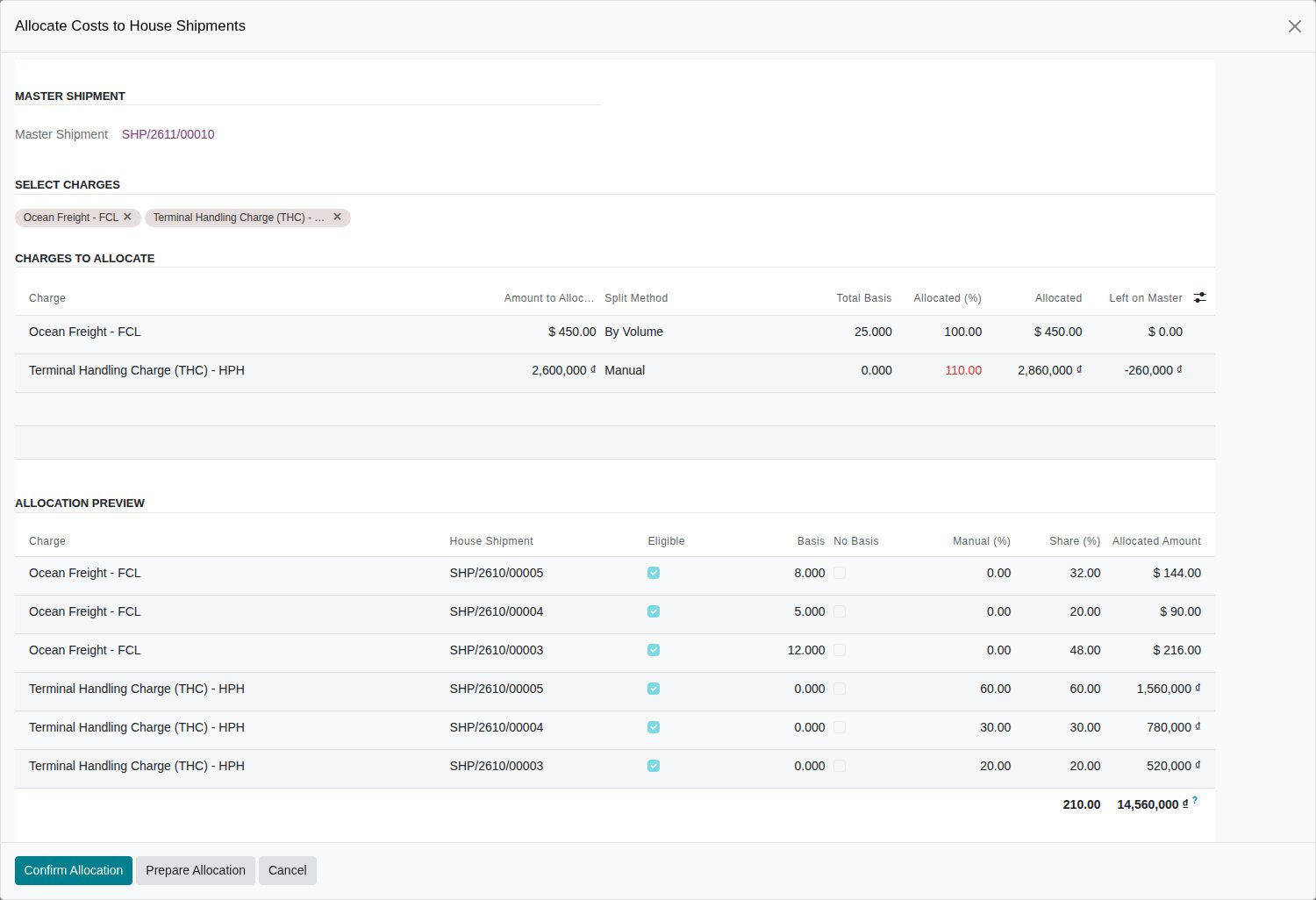
Fix:
Select at least one charge, or give at least one eligible house a basis (create its packages, fill in its CFS Actual Volume) or a Manual (%) above 0.
Lower the percentages until Allocated (%) is 100.00 or less and Left on Master is not negative, click Prepare Allocation, then Confirm Allocation again.
Allocating again is blocked
Symptom: “Cannot allocate again: the allocations below are already committed downstream, so the whole cost line is left exactly as it is. Release each one on the document that carries it, on the House named beside it, then allocate again: …” followed by the names of the allocations.
Cause: a house has already committed its share on another document - a vendor bill, a customer invoice or a purchase order, even a Draft one. Without such a commitment, allocating again simply replaces the previous split.
Fix: Ask Accounting to identify every document the message points to, then release each charge on the document that carries it, on the house named beside it:
On a customer invoice or vendor bill, delete the line, or delete the whole draft document. If it is already posted, reset it to draft, then delete the line. Reset to Draft or cancelling the document alone does not release the charge: it stays on the document until you delete the line, and this includes a cancelled customer invoice.
On a purchase order, cancel the order - this releases the charge (a locked order must first be unlocked by a purchase manager) - or delete its line while the order is still an RFQ.
Click Prepare Allocation and Confirm Allocation again.
Accounting must handle each document through the approved correction process. Reset documents can leave a draft behind: correct or remove its old lines through the normal accounting workflow before billing the replacement allocation, to avoid charging twice.
See also
Related articles
Consolidate LCL export shipments under a master - the consolidation step that creates the master and houses this guide splits costs across