Shop floor management is the work that connects the production plan with the factory floor. Many manufacturers already run software for orders, bills of materials (BoM), planning, inventory and costing, and the daily plan is complete: how many units, on which machines, ready before which delivery date.
The gap between the plan and the shop floor
Yet in the middle of a shift, the production supervisor needs answers that the plan does not contain:
- How many good units have been made so far?
- Which machine is stopped, since when, why, and who is handling it?
- Which operation is running late, and will that delay tomorrow's delivery?
- At which operation, on which shift and on which machine do defects appear?
- Does the operator have the materials, tools and instructions to do the job right?
The plan lives in the office; the truth lives on the floor. When shop floor management works, a correct plan turns into correct output. When it does not, a correct plan can still produce a wrong result, and the business usually finds out too late.
Five principles of shop floor management
None of these principles is new. They come from lean manufacturing methods proven over decades. Technology makes them easier to practise; it cannot replace them.
1. Decide close to where the work happens
The Japanese call the shop floor gemba, "the place where the truth happens". Their advice is to go there and see for yourself before drawing conclusions. A number in the end-of-month report has passed through many layers of summary and rarely shows why machine number three keeps stopping in the middle of the afternoon shift.
This does not mean managers must stand on the floor all day. It means the information used to decide must come from the floor, fast enough and specific enough for the person with authority to act while there is still time.
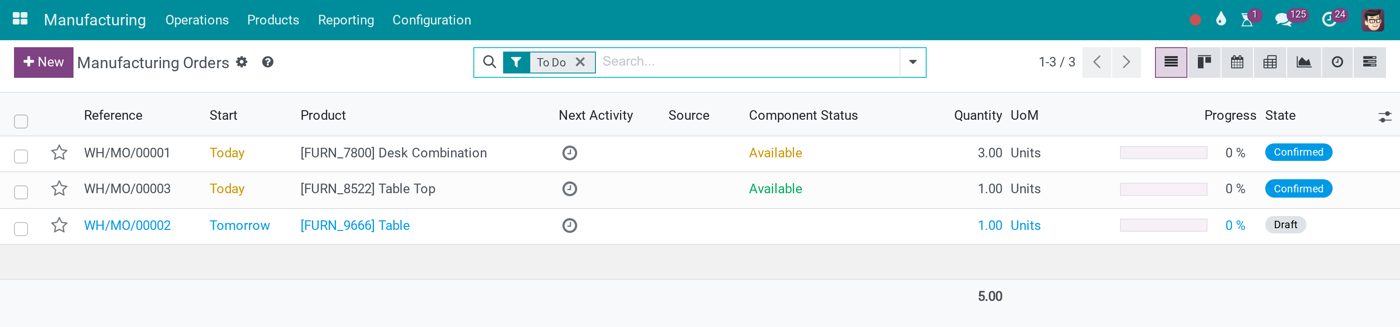
Example: progress of each manufacturing order, updated from what is recorded on the floor.
2. Make abnormalities show themselves
On a well-managed floor, anyone walking past can see at once what is on track and what is not. That requires a clear standard for every operation: output per hour, quality parameters, cycle time. Only with a standard does a deviation become visible.
This is what visual management means, built on the same discipline as the 5S workplace: nobody waits for a report, the deviation appears on the board by itself.
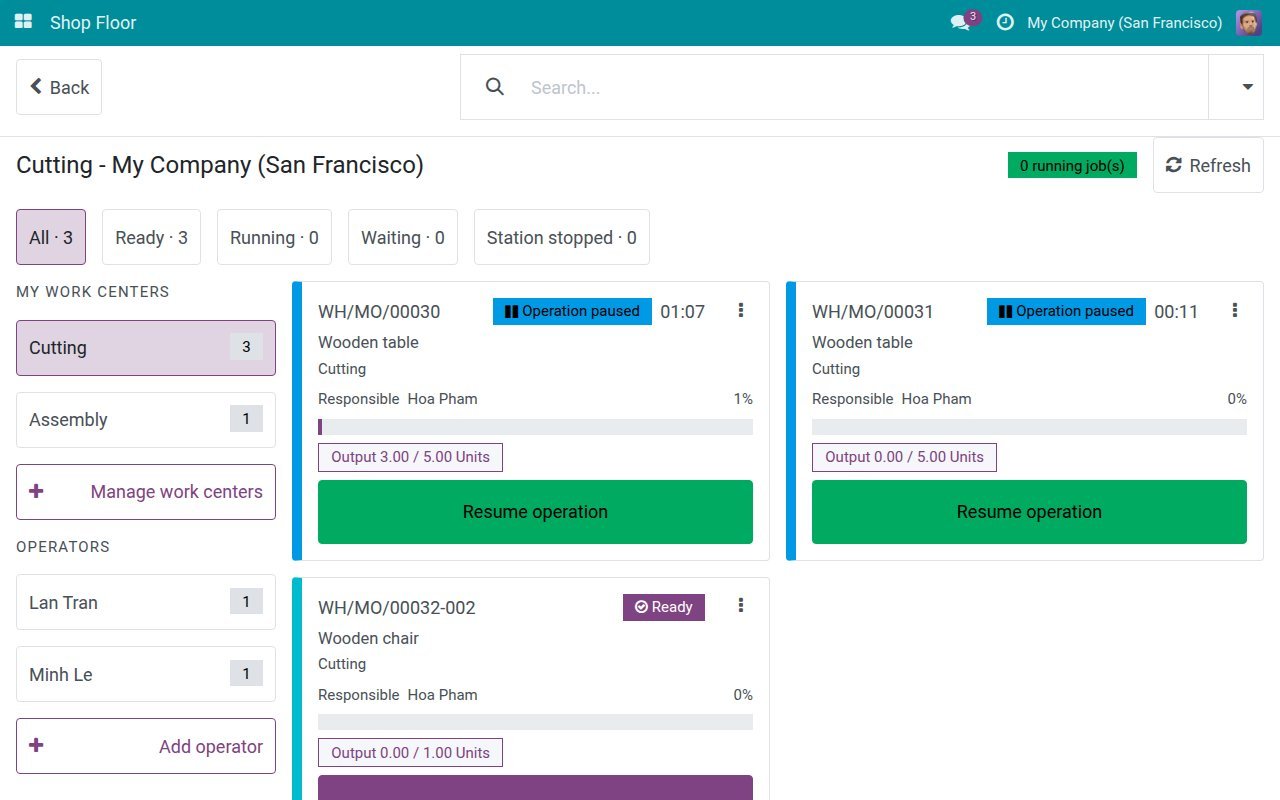
Example from the Viindoo Shop Floor screen: work orders of a work center grouped by status, so a stopped station stands out at a glance.
3. Stop and fix at the source
A defect found at the last operation is the most expensive defect. By then, the materials, machine hours and labour of every earlier operation have gone into a bad product. Lean manufacturing insists on detecting problems at the operation that creates them, stopping, calling the right person, and continuing only once the cause has been dealt with.
The hardest part is not detection but closing the loop. An incident reported by word of mouth easily drifts: the reporter assumes someone is on it, the listener thinks it is minor. Every incident needs an owner, a start and an end time, and a recorded cause.
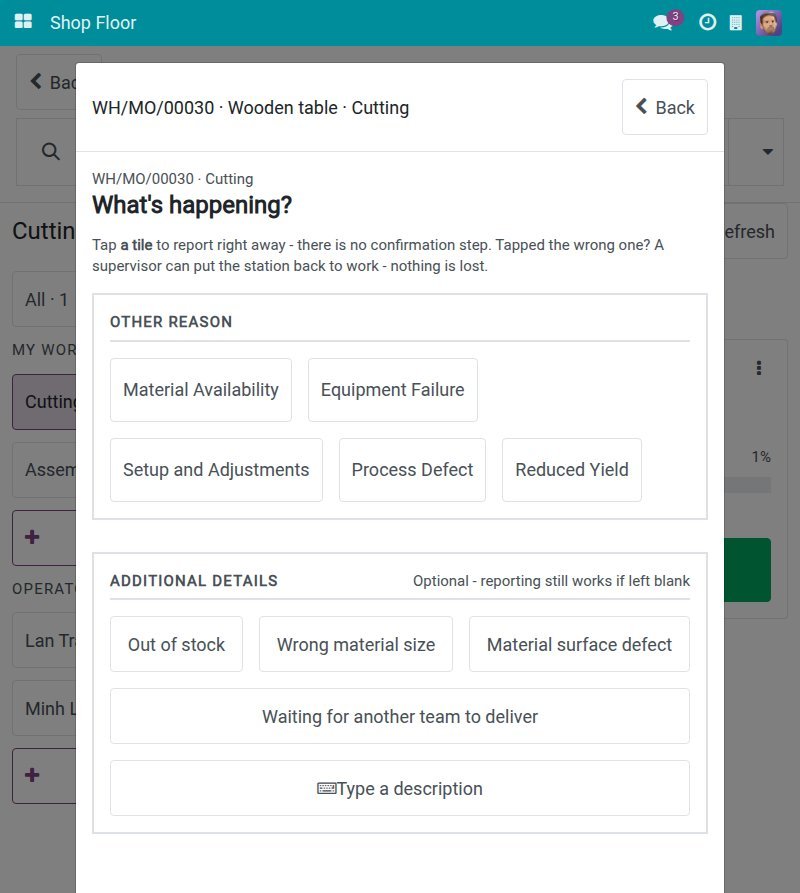
Example: the operator taps one reason to report a stop, and the stop is logged with its time and cause.
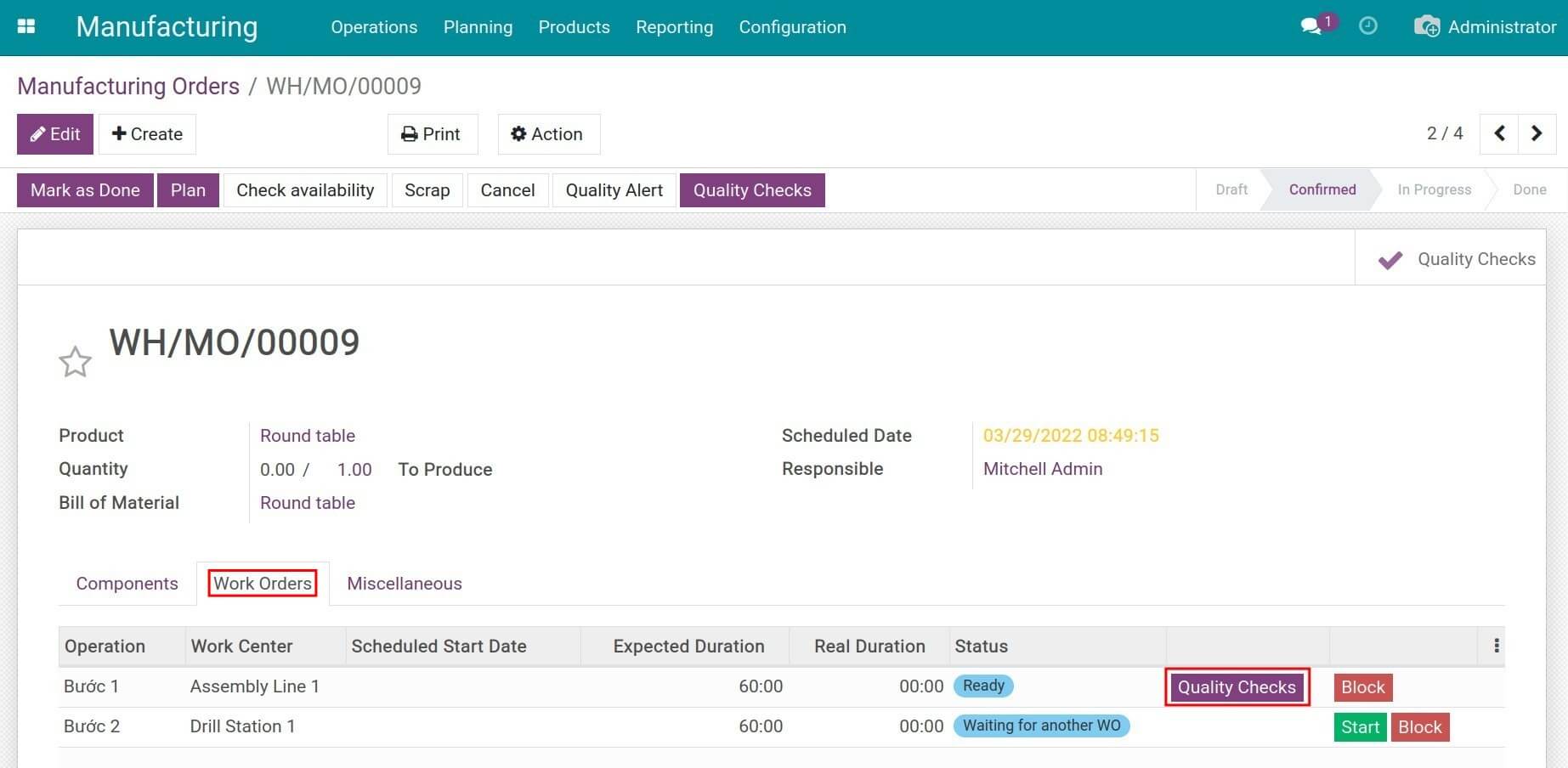
Example: the quality check sits on the operation itself, so defects are caught where they arise.
4. A tiered management rhythm
The floor needs a steady rhythm to review and adjust. Team leaders hold a few minutes of start-of-shift meeting with their team, supervisors review the teams, the plant manager reviews the workshops. Each tier looks only at the indicators it can act on. Any problem beyond a tier's authority goes up to the next tier the same day, not at the monthly meeting.
This rhythm keeps small problems from growing. It also shows people on the floor that what they report actually gets handled.
5. Standardize to keep the know-how
On many floors, skill lives in the heads of a few experienced people: how to set a machine, how to spot a defect by eye, how to handle a familiar breakdown. When they are on leave or leave the company, quality wobbles with them. The question gets sharper as AI enters operations, as discussed in if AI learns every process, do you still need your best people?
Standard work turns individual experience into a shared asset: clear instructions for each operation, updated whenever a better way is found. Today's standard is the starting point for tomorrow's improvement (Kaizen), as explained in why to standardize before you automate.
Technology does not replace these principles. It only makes them easier to practise every day.
Three gaps shop floor management has to close
Seen through these five principles, most difficulties on the floor fall into three gaps:
Information gap
Output, defects and downtime are recorded at the end of the shift or the day, sometimes from memory. The question: how long after something happens do we know about it?
Coordination gap
Incidents are reported verbally, nobody is clearly in charge, nobody knows when they end. The question: does anyone follow an incident from detection to closure?
Knowledge gap
The right way of working depends on long-serving people; newcomers learn by watching and asking. The question: is the best person's experience kept for others to use?
The three gaps are linked. A machine stop does not only cost machine time (what OEE measures). It leaves the operator waiting, materials idle, the delivery plan off track and the unit cost higher. If the stop is not recorded with its cause, the business also loses the chance to learn from it.
The real value is not knowing that a machine stopped for 25 minutes (illustrative example). It is knowing at the end of the month how many times that machine stopped, and that most stops share the same cause. Only then is there a basis to decide whether to fix the process, change the maintenance schedule or invest in a new machine.
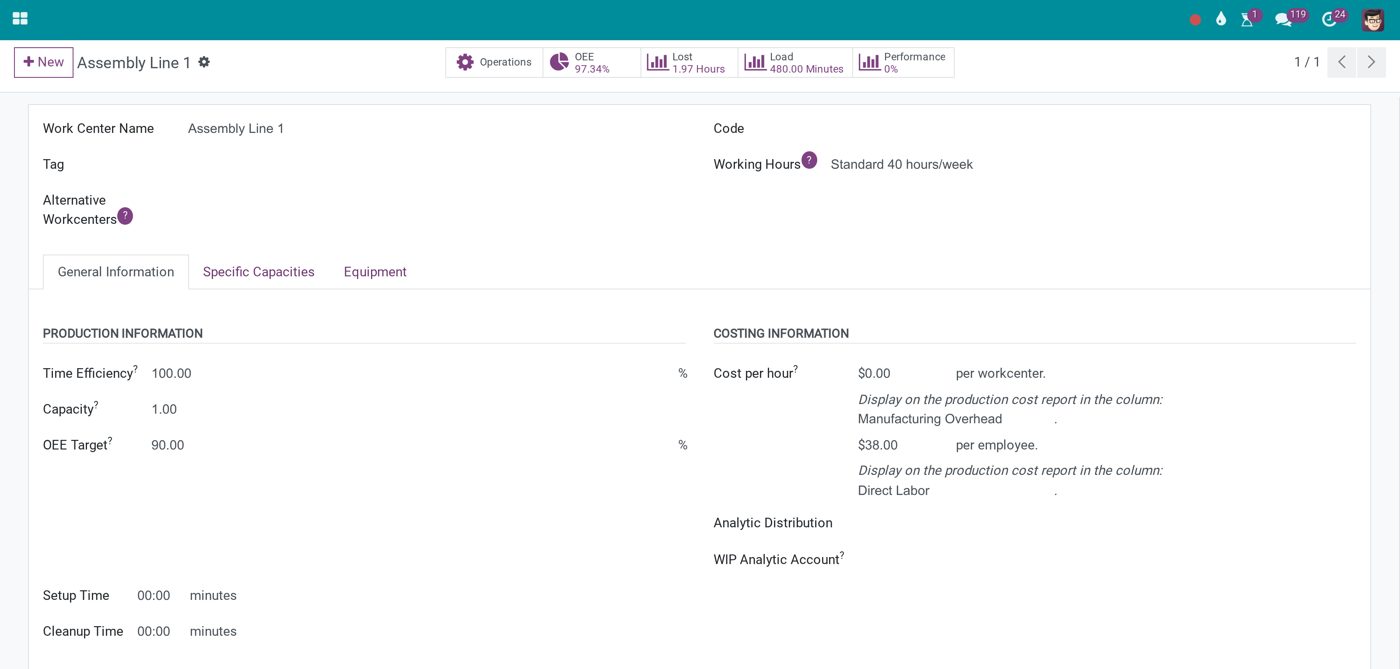
Example: once stops are recorded with their cause, a work center shows its OEE and lost hours.
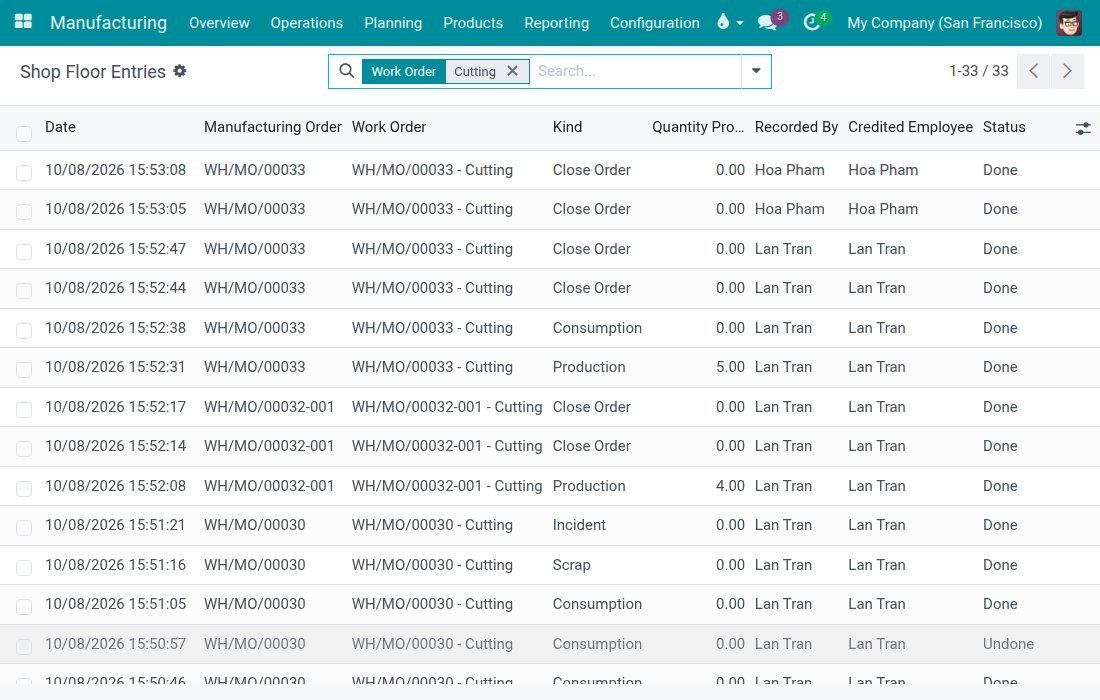
Example: every entry made on the floor keeps its time, work order, type and the person who did it, so the month can be reviewed later.
Each role needs to see something different
A common mistake in shop floor management, when bringing technology to the floor, is designing for the people who read reports and forgetting the people who create the data.
| Role | What they need from the floor |
|---|---|
| Machine operator | Know what to do and how, report results quickly, call for help easily |
| Team leader | Who is doing what, where it is slow, which machine has a problem, what needs action now |
| Production supervisor | Allocate people and machines, spot bottlenecks, follow productivity and quality by shift |
| Quality control | Record defects where they occur, isolate bad goods, prevent repeats |
| Maintenance | Receive incidents in time, know the machine history, have parts and repair instructions |
| Planning | How much real capacity is left, which orders risk being late |
| Plant manager, owner | Productivity, losses, costs and delivery capability |
The operator creates almost all floor data, yet is rarely asked what they need. Operators do not want to spend time entering data for their managers' reports, a trap discussed in why digitalization sometimes adds tasks. A floor application survives only when it makes the operator's own work easier, or at least adds no extra work. Each entry must be a short action, made right when the work is done, right where it is done.
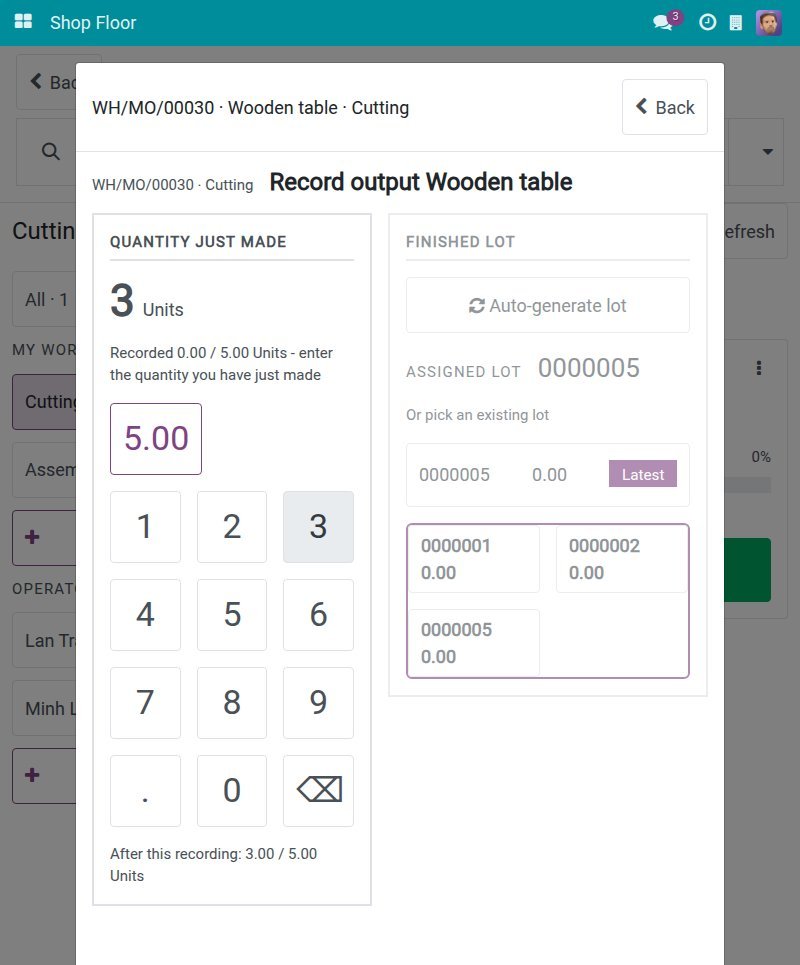
Example: the operator records the quantity just finished with a few taps on a numeric keypad, right at the station.
Technology for shop floor management, in three levels
When technology for the floor comes up, businesses immediately hear about manufacturing execution systems (MES), the industrial internet of things (IIoT) or artificial intelligence (AI). Each has its place. But the order in which they are applied matters more than any single technology. We discussed a similar question in ERP, WMS, MES, IoT: where should businesses begin?
Level 1 - Digitize people's work
Operators take jobs, report output, record defects and stops, call for help and read instructions on a tablet at the station. Low cost, quick results. Start here.
Level 2 - Connect machines and gauges
Data from machines, scales, gauges and sensors flows in by itself, tied to the right manufacturing order and operation.
Level 3 - Analyse and support decisions
Bottlenecks, late-order risk, scheduling suggestions, help with diagnosing incidents and finding accumulated know-how.
Level 1 closes the information and coordination gaps first. It is the backbone of shop floor management: the real work of people, recorded at the right time and place.
Level 2 gives more accurate data and fewer manual steps, but it only means something when the data is tied to order, shift, machine, product and cause. A sensor that says a machine stopped, without anyone knowing which order it was running or why it stopped, just produces another number nobody uses. More on this in applying IoT in manufacturing.
Every plant has a different set of machines: different brands, ages and controllers; some with a data port, some that need extra sensors. Machine connectivity is therefore almost always designed for the specific plant. This is how manufacturing execution systems work too; there is no plug-and-play solution for every floor.
Level 3 needs the data of the first two levels to be long enough and clean enough. Without good data, any analysis is a guess. See also when to use AI in Kaizen and ERP.
The levels are not strictly sequential: a plant can fit a sensor to one critical machine before digitizing the whole floor. And a business does not need twelve applications for twelve needs. Progress, quality, maintenance, materials and labour on the floor are closely linked; they need one shared source of data, or at least a consistent exchange of data.
Where to start: one line, one trial round
For a floor that is not yet digitized, the safest approach is not to go wide at once. Choose the line with the most visible losses and go through four stages:
Measure the baseline
Follow one order through its operations: who takes it, where data is written, how incidents arise, who handles them. Measure current output, downtime and defect rate.
Digitize people's work
Move taking jobs, recording results, reporting stops and defects and calling for help onto a device at the station.
Show it and connect what fits
The supervisor can see the situation during the shift. Devices that can be connected at a sensible cost are connected on trial.
Compare and decide
Put before and after side by side, including how much time operators spend on recording.
Indicators worth comparing: machine downtime, incident response time, good output per hour, defect and rework rate, time spent compiling reports, and the share of incidents closed with confirmation. How to measure when there is no baseline yet is covered in measuring ROI without a baseline.
Do not promise a percentage improvement before there is a baseline. The baseline is what turns a trial into a basis for scaling up.
Six questions to assess your shop floor management
Seeing progress
How does the supervisor know actual progress: end-of-shift reports, phone calls and chat groups, handwritten boards, or live tracking?
Reacting to stops
When a machine stops or an operation jams, who knows first, and how long until someone arrives to handle it?
Biggest loss
Where does the biggest loss come from: machine stops, waiting for materials, defects and rework, missing people, or constant plan changes?
When data is recorded
Are output and defects recorded when they happen, at the end of the shift, at the end of the day, or only when someone asks?
Traceability
When there is a quality problem, can you trace it back to machine, shift, operator and material lot?
Resistance to software
What makes floor staff reluctant to use software: too much input, inconvenient devices and network, no benefit for them, or too much process change?
The answers show which gap your floor has, and which level to start from.
How Viindoo looks at the shop floor
At Viindoo, we see shop floor management as a natural extension of the management system, not a separate system. Planning, bills of materials, materials and costing already live on one platform. What remains is bringing floor execution onto that same platform, so data flows both ways: the plan goes down to the station, reality comes back to the plan.
| Layer | Viindoo's approach |
|---|---|
| Management and planning | Available: manufacturing orders, bills of materials with loss rates, operation scheduling, inventory, quality, maintenance, cost per order |
| Execution on the floor | Available: the Shop Floor screen on a tablet, where operators take jobs, record output, materials and scrap, report stops, call maintenance, run quality checks and read instructions at the station |
| Device and machine connectivity | Scales and barcode scanners connect at the station, with scale readings going straight into quality checks. Production machines are connected through a design for each plant, via the system's open interface, feeding the same records operators already use |
| Analysis and decision support | Direction of development: using accumulated floor data to identify bottlenecks and support incident handling |
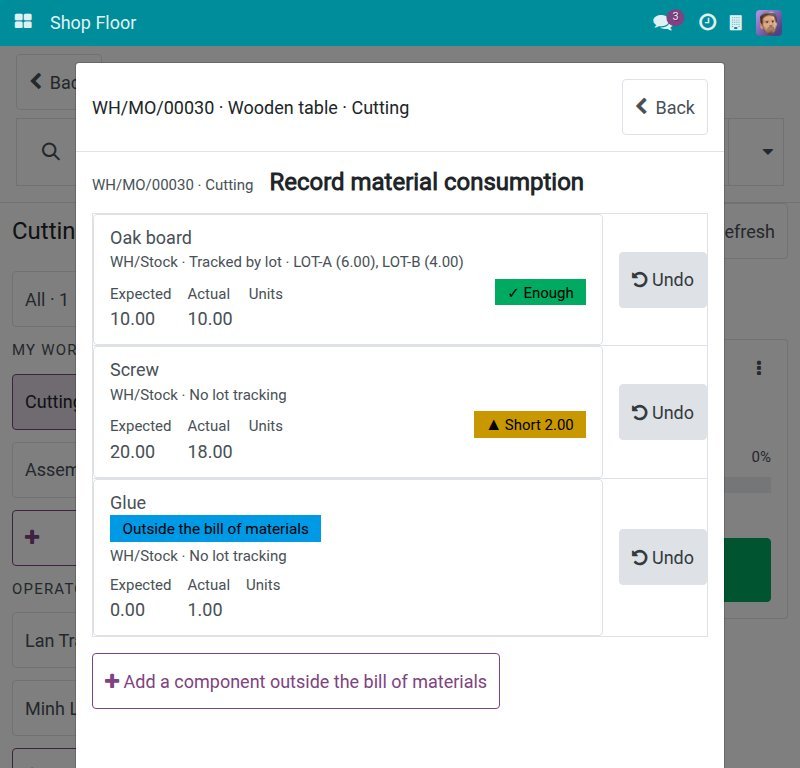
Materials actually used are recorded at the station and compared with the bill of materials: enough, short, or outside the bill.
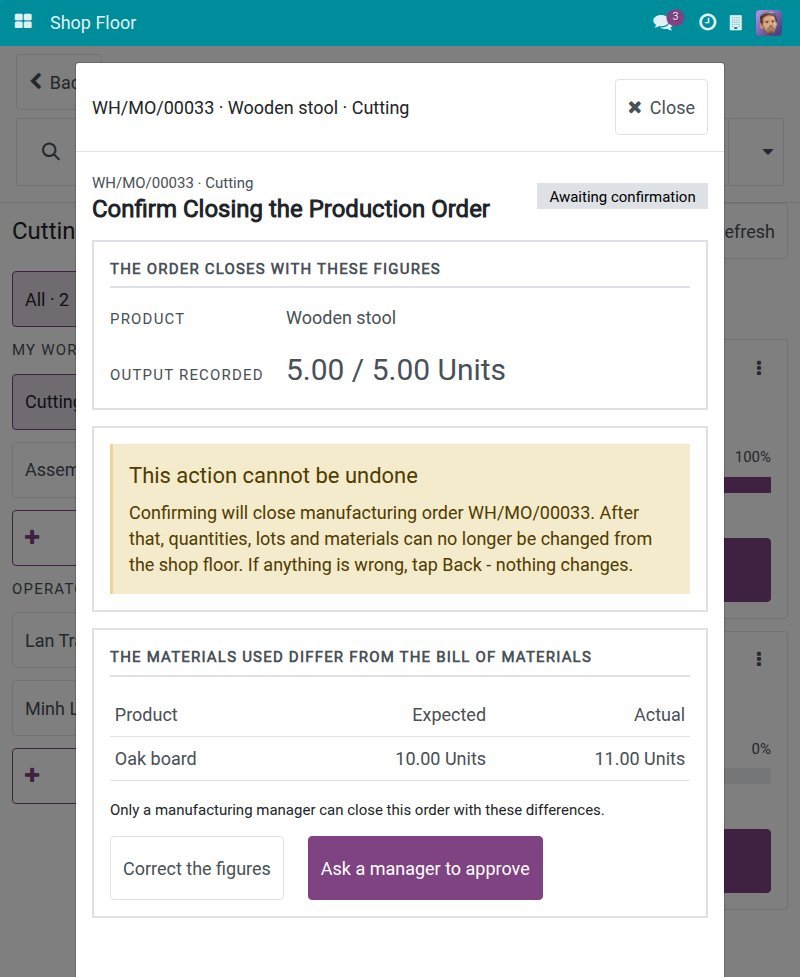
When consumption differs from the bill of materials, only a production manager can close the order, so the deviation does not pass silently.
A business does not need all four layers from day one. It can start by recording work on time on one line, then expand once the numbers have proven their value.
Frequently asked questions
ERP is strong in planning and finance; an MES is strong in floor execution. The right question is whether anyone is handling execution yet, not whether to add another application. If the management software already has an execution layer on the floor, the business avoids integrating two systems.
Only once you know which decision the machine data will feed. Recording people's work first is usually faster and cheaper, and it builds the frame that gives machine data meaning later.
Yes, if each action takes only a few taps, the text is large, there are few fields to fill, and they see the benefit themselves: no logbook at the end of the shift, faster help from maintenance, instructions right at the machine.
One trial round on one line is usually enough to compare before and after. The exact time depends on the size and readiness of the floor.
Want to know which gap your floor has and where to start? Book a shop floor assessment with Viindoo: we walk one manufacturing order through its operations with you before talking about software.
Related articles