When a business implements ERP, questions about data entry come up early. One of the most common expectations when investing in technology is:
Bring in software to reduce work, people, steps and cost.
This expectation is completely understandable. But during ERP implementation, businesses sometimes face the opposite reality:
- Sales has to enter orders in more detail.
- Engineering has to standardize the BOM.
- The warehouse has to confirm receipts, deliveries and material issues.
- Production has to record output or work status.
- QC has to record defects and inspection results.
- Managers have to approve steps more explicitly.
From the user's point of view, the natural question is: "I used to do one step, why does the software turn it into three?" And from the Kaizen point of view, the question is even bigger: if Kaizen is about removing waste, why does digitalization add more steps?
This is a very real contradiction in digital transformation. But the issue is not whether there are more steps. The issue is:
Does that step create management value, or does it just create more work?
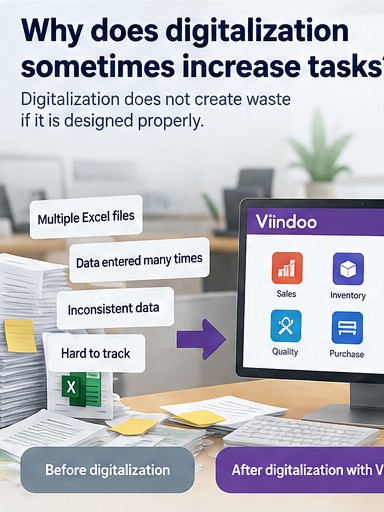
Illustration: before and after digitalization with Viindoo.
Kaizen does not mean cutting every step
One simple but misleading way to understand Kaizen is: the fewer steps, the better. In practice, Kaizen aims to remove waste, not every activity. Activities can be divided into three groups.
1. Value-adding activities
These directly create value the customer is willing to pay for, such as machining, assembly, custom design, or checking a mandatory product characteristic.
2. Non-value-adding activities that can be removed
For example, entering the same data several times, searching for files, waiting for unnecessary approvals, reconciling several Excel sheets by hand, or retyping figures from paper into the system. This is the group Kaizen should remove first.
3. Activities that do not add value directly but are needed for management
For example, confirming that an operation is finished, recording actual quantities, scanning material codes, recording defects, confirming start and end times, or recording the reason a machine stopped. These steps do not make the product, but they can create the data the business needs to control, measure, trace and improve. This is the most debated area in an ERP project.
The cost of data entry shows up now, the value of data shows up later
Take a simple example. Before ERP, a worker finishes an operation and passes the product to the next step. After ERP, the same person may have to confirm completion, enter the good quantity, enter the defective quantity and choose a reason if there is a deviation. At that moment, the business clearly sees that users have to do extra work.
But the value of that data appears in later steps. Thanks to these records, the business can know which operations take the most time, what the defect rate is, where defects cluster, how actual output differs from the plan, which operation creates a bottleneck and whether an improvement really worked.
The cost of creating data sits at the start of the process, while the value of data usually appears at the end.
So if you only look at the step on the spot, it is easy to conclude that the software is adding work. It is also normal that the first phase of a project needs more effort to set up data.
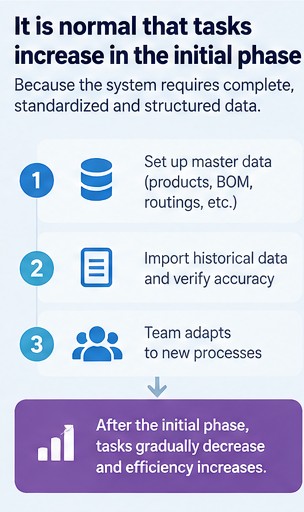
Illustration: master data, historical data and new habits make the first phase heavier; tasks decrease afterwards.
Example in a mechanical company: why does the BOM need more detail?
Take a mechanical company that manufactures to order. Before, sales could create a very simple order: "Machining of assembly A, 1 set, 120 million VND". This is fast. But if the business wants deeper management, the system may need product configuration, the BOM, raw materials, standards, operations, expected times and quality requirements. Users may then feel: "Why do we have to enter this much detail?"
The answer depends on what the business wants to see later. If it only needs revenue, total cost and profit at the end of the period, very detailed data may not be needed yet. But if it wants to know which materials exceed the standard, which operations run over time, which products often have defects, which orders are truly profitable and which BOMs keep changing, the data at the start of the flow has to be detailed enough.
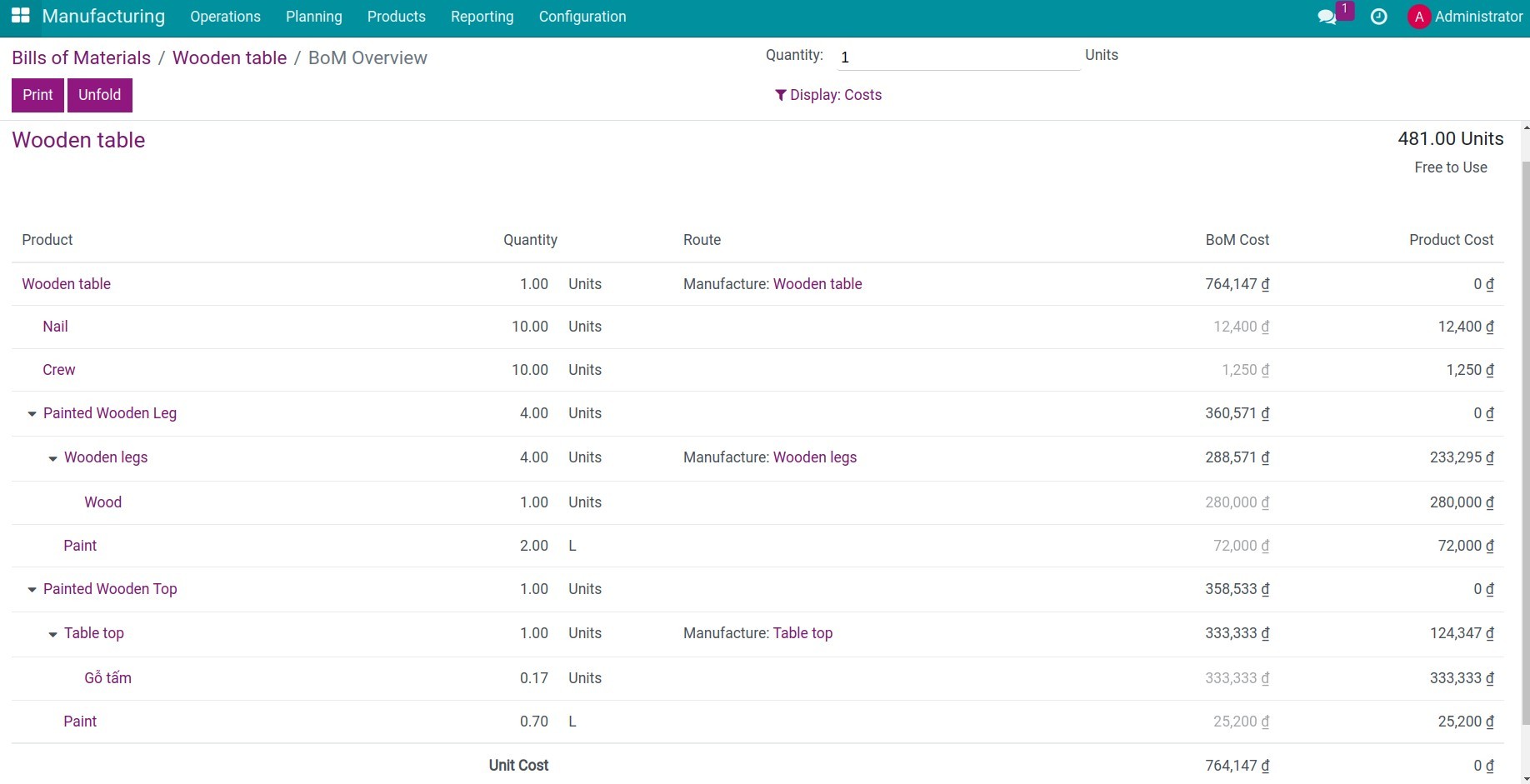
A multi-level BOM with quantities, routes and costs: the depth of the BOM decides what can be analyzed later.
The depth of management decides the level of detail of the data.
Wrong digitalization really can go against Kaizen
Not every step an ERP asks for is right, and this needs to be said very clearly. If the business asks users to enter data nobody uses, fill in too many fields just because the system has them, record the same information in several places, confirm steps that create no control, or build workflows more complex than reality, then digitalization is creating digital waste. The software then does not support Kaizen; it simply turns manual waste into waste inside the software.
The goal of ERP is not to digitalize every step, but only the data points needed to operate, control, measure and improve.
Data entry should only happen when it serves a clear purpose
A practical principle when implementing Viindoo is: do not ask users to enter data just because the software has a field for it. Each piece of data should answer at least one of four questions.
Does it drive a later step?
The BOM determines material requirements; without it, the system cannot correctly calculate purchasing or material issue needs.
Does it serve control?
A quality check confirms whether the product meets requirements.
Does it serve measurement?
Start and end times make it possible to measure cycle time.
Does it serve a decision?
The gap in material consumption helps decide whether to adjust the standard or improve the operation.
In Viindoo, with the Manufacturing Quality Control app, quality checks appear on the operations of a manufacturing order (for materials covered by a quality control point) and are shown next to its expected and real duration, so the extra check is part of the work, not a separate report.
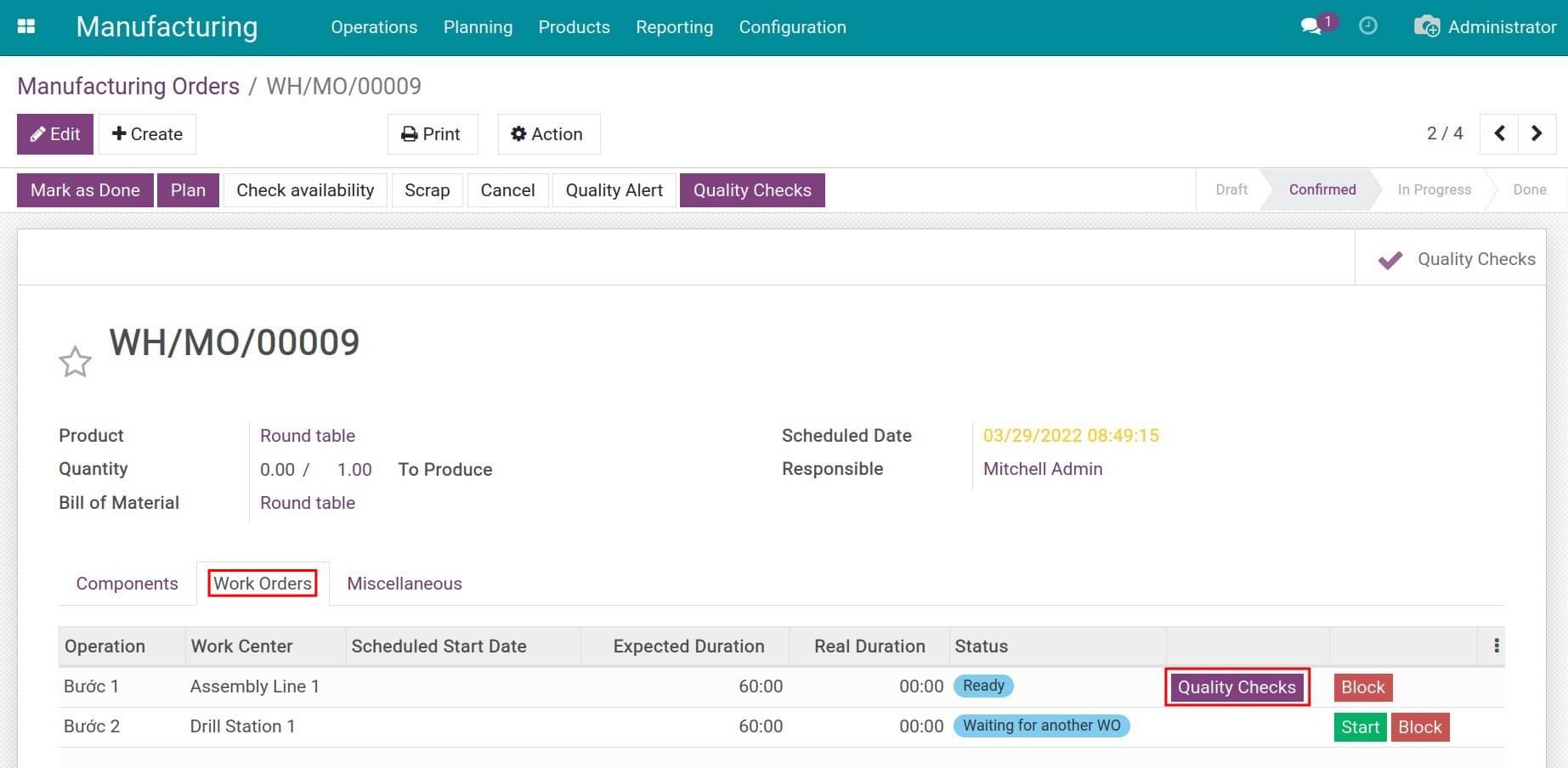
Quality checks shown on the operations, next to expected and real duration.
If a piece of data answers none of the questions above, the business should ask: is entering this data really necessary?
Don't make people enter what the system can generate
This is where digitalization should support Kaizen most clearly. If the system can generate data automatically, people should not have to enter it again:
- the order creation date is recorded automatically,
- the person who created a transaction is already known,
- statuses can change automatically along the workflow,
- order values are calculated automatically,
- material needs can be derived from the BOM,
- stock is updated from receipt and delivery transactions,
- data flows automatically between modules.
Scanning replaces typing too: with Stock Barcode and MRP Barcode in Viindoo, the warehouse and the shop floor scan products, lots and quantities instead of entering them line by line.
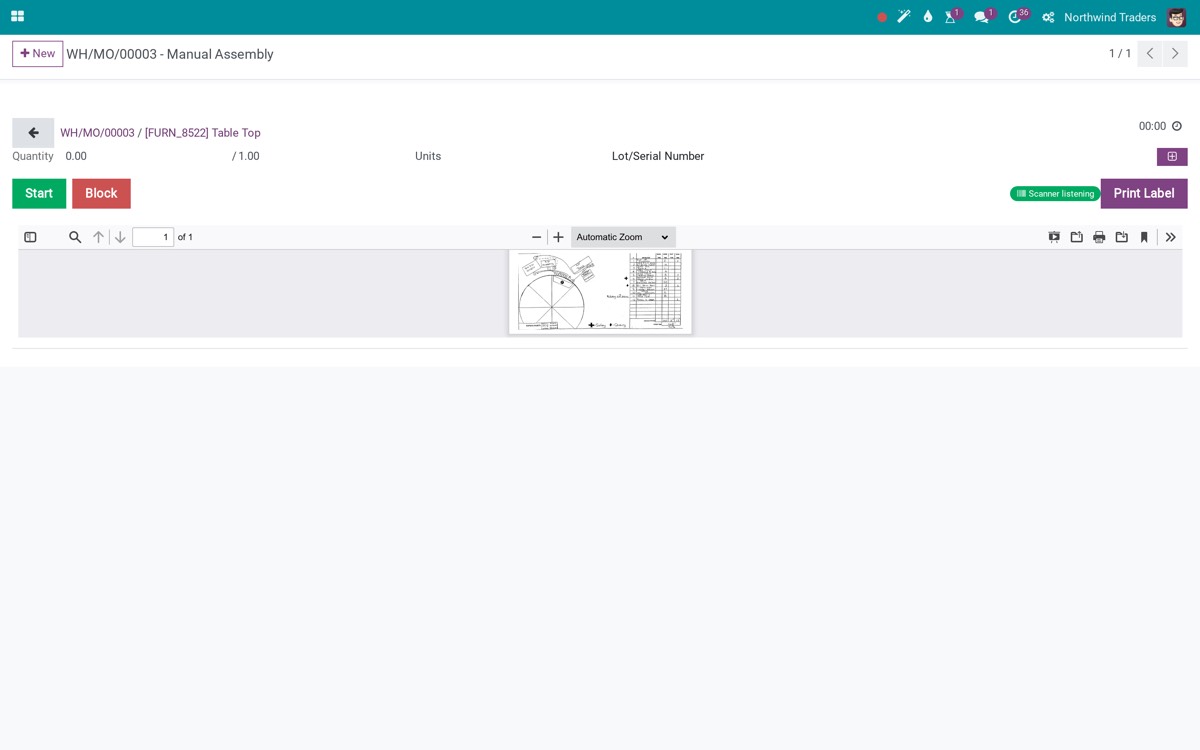
A shop-floor work order screen listening for the barcode scanner, so quantities and lots are scanned instead of typed.
Implemented correctly, ERP should do two things at once: create the management data that is needed and remove unnecessary data entry. That is the real balance.
From data entry to recording within the flow of work
A good ERP project should not create a team whose job is to enter data after the work is done. Data should be created as the work happens: sales confirms the order when closing with the customer, engineering completes the BOM during design, the warehouse scans when issuing materials, production confirms when an operation is finished, QC records results right at inspection.
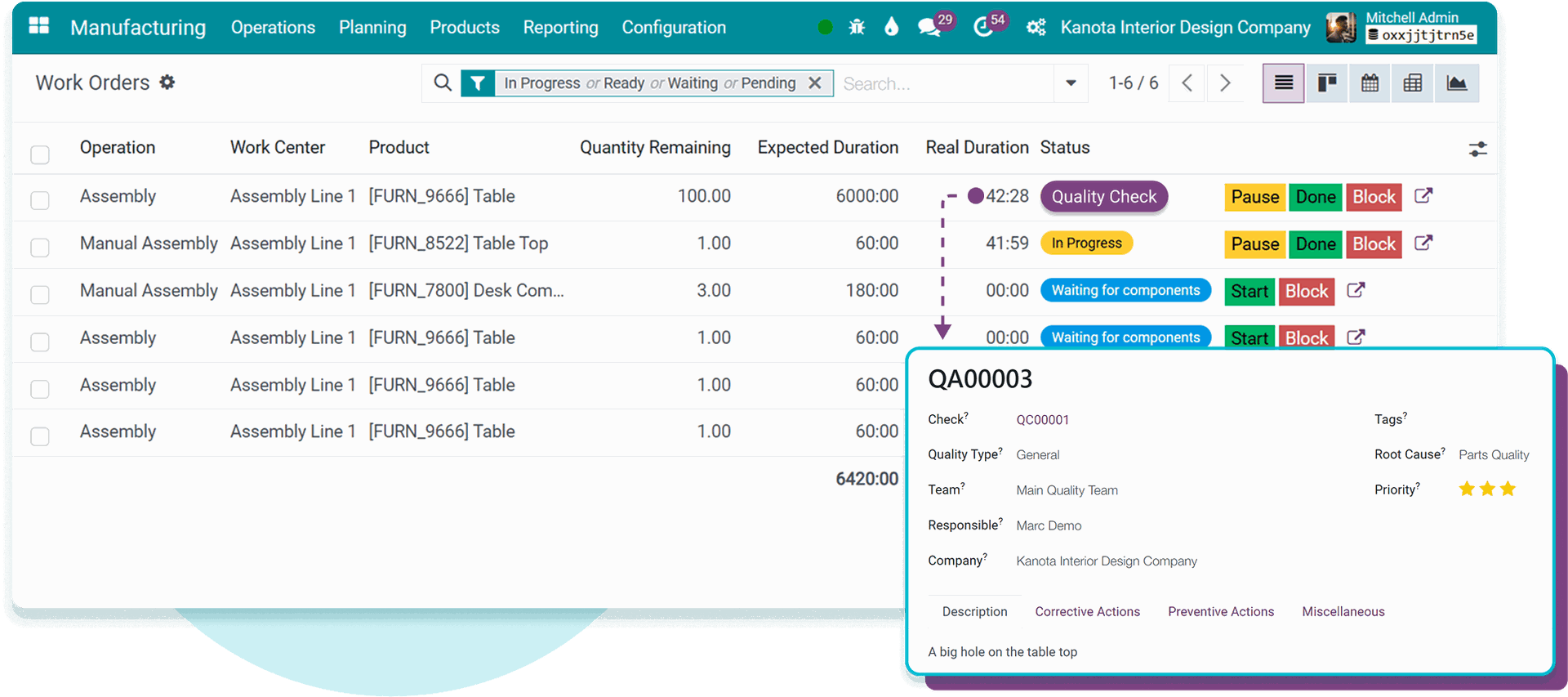
Starting and finishing a work order is the action itself, and it records real duration and status.
Users then do not work first and enter data later; instead, the action in the system is part of the work itself. That is the big difference between good digitalization and digitalization for show.
Three levels of data to keep the project light
The business does not need to collect everything from the start. As in the previous article on ERP and Kaizen, implementation can go through three levels.
Level 1: Traceable
Just enough data to answer where the work is, what its status is, who is responsible and whether it is done. In production, that means the manufacturing order, work orders, material status and delivery status. Goal: see the flow of work.
Level 2: Measurable
When deeper management is needed, add actual time, output, consumption, defects and deviations. Goal: measure deviations.
Level 3: Optimizable
With enough data: analyze bottlenecks, find root causes, run Kaizen, standardize and automate. Goal: data-driven improvement. This avoids two extremes: digitalization too thin to manage, or so detailed that users are overloaded.
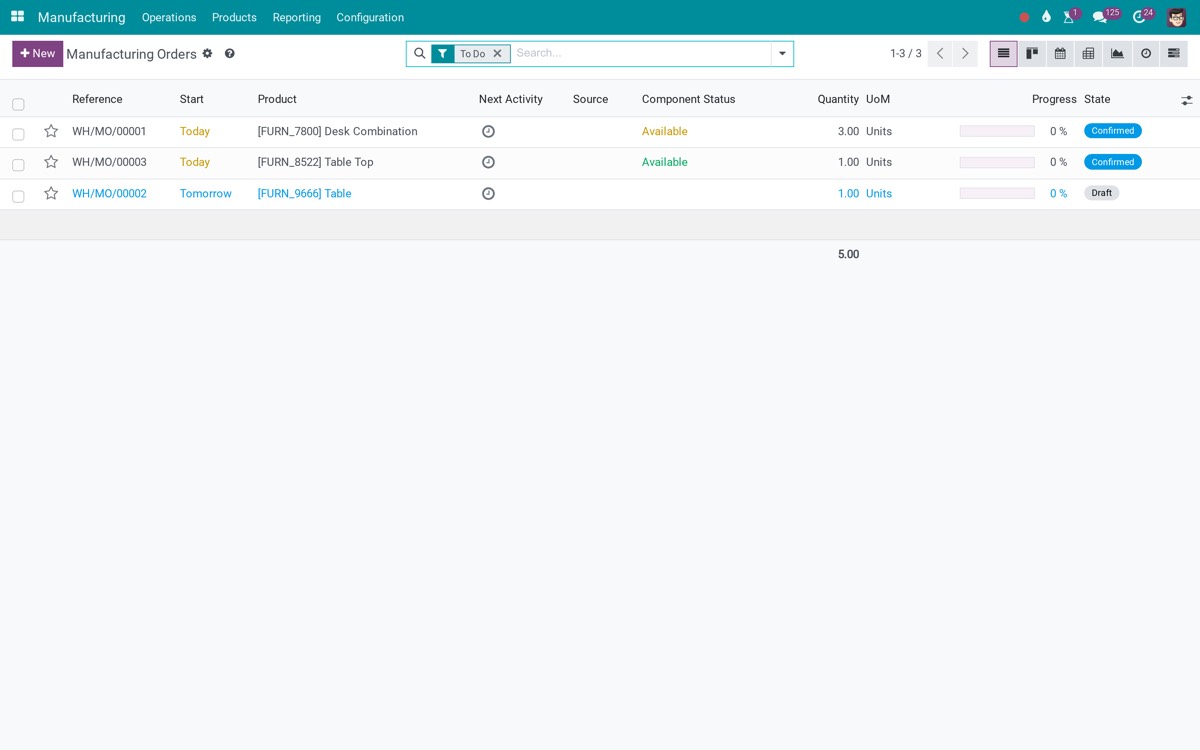
Level 1 needs little recording: manufacturing orders with component status and progress.
When is data entry waste?
A quick check with five questions:
- Is this data used after it is entered?
- Can it be taken automatically from existing data?
- Does anyone have to enter it again at another step?
- If it is dropped, which decision or control is lost?
- Is the management value greater than the cost of recording it?
If nobody uses it, it can be automated, or it only exists to "complete the form", that step is very likely waste. Conversely, if the data helps the business avoid a major error, spot a bottleneck, calculate the right cost of goods sold, reduce stock or measure the effect of an improvement, a few seconds of recording can create far more value.
Viindoo's role: closing the gap between needing data and the effort of data entry
One of the goals of an integrated ERP platform is: data is created once but used in many later steps.
Sales order
Creates real demand.
BOM
Used for material planning, purchasing, production and costing.
Stock transactions
Used for inventory, material issue, traceability and cost of goods sold.
Work order
Used for progress, time, productivity and bottlenecks.
Quality check
Used for quality control, defect statistics and improvement.
That is the difference between entering data many times and creating data once to serve many management purposes.
A good ERP should reduce tasks over time
In the first phase of implementation, some extra steps may appear to build the data foundation. But the long-term goal is not to keep them forever. Once processes are clear and data is stable, the business can keep doing Kaizen on the digital system itself: barcodes (including QR codes read by a scanner), automatically generated documents, automatic status updates, machine connections, APIs, automated workflows, automatic alerts and AI. In Viindoo these rely on existing apps such as Stock Barcode, MRP Barcode, Automation Rules, OmniApproval, IoT connections, the API and Viindoo AI.
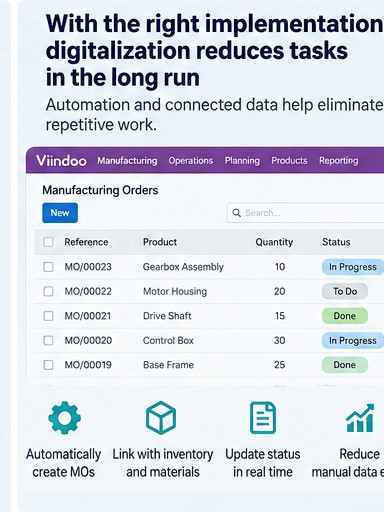
Illustration: automation and connected data remove repetitive work over time.
Record
Measure
Kaizen
Standardize
Automate
Fewer steps
In other words: some steps may need to appear first to create management capability, and then the data itself tells the business which steps to remove and automate.
Digitalization and Kaizen do not conflict if the goal is right
If the goal of digitalization is only as few steps as possible, the business may lose data it needs to manage. If the goal is as much data as possible, it creates a heavy system. The balance lies in between:
Collect the minimum data that is still enough to see, measure and improve operations.
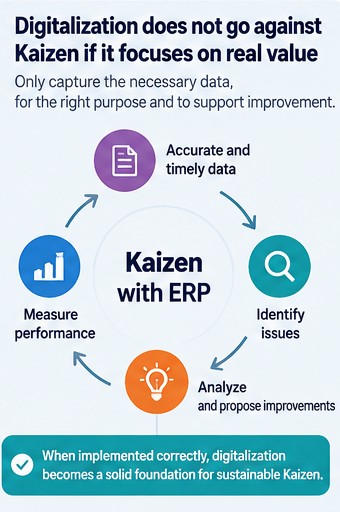
Illustration: digitalization supports Kaizen when it captures only the data that serves improvement.
This is also the approach when implementing Viindoo: do not digitalize everything, do not cut every step; keep only the recording points that create clear management value, then keep automating them when possible.
Frequently asked questions about data entry and Kaizen
No. Some processes gain extra recording points in the first phase, but ERP can also remove a lot of repeated input, manual consolidation and reconciliation between systems.
Not all data entry is waste. If the data serves control, measurement or decisions, it can be a necessary activity. Entering data without a clear purpose is the waste to remove.
Start with the minimum needed to follow the flow of work and the main deviations. Add detail only when there is a specific management or improvement need.
Yes. An integrated ERP lets data be created once and used across many operations. Barcodes, APIs, workflows, IoT and automation can reduce manual work further.
Viindoo connects data across operations on one unified platform, reducing repeated input and keeping only the recording points needed for operations, control and improvement.
Next in the series: When is data entry waste, and when is it management value?
In this article, we saw that more steps do not necessarily mean going against Kaizen. But the more practical question is: how do you know whether a piece of data is worth asking users to enter? The next article looks at how to assess the value of data, especially for SMEs that find it hard to quantify ROI from the start.