Businesses often treat Kaizen and digitalization as two separate stories.
Kaizen focuses on continuous improvement: eliminating waste and raising operational efficiency.
Digitalization, meanwhile, is usually understood as applying software, ERP, automation or new technologies to change the way a business works.
Yet there is a very important link between the two:
Kaizen needs a business to see its problems. Digitalization lets it see those problems through data.
Digitalization therefore does not replace Kaizen. Done right, Kaizen and digitalization reinforce each other: digitalization builds a data foundation that lets Kaizen happen regularly, on solid ground, with results that can be measured.
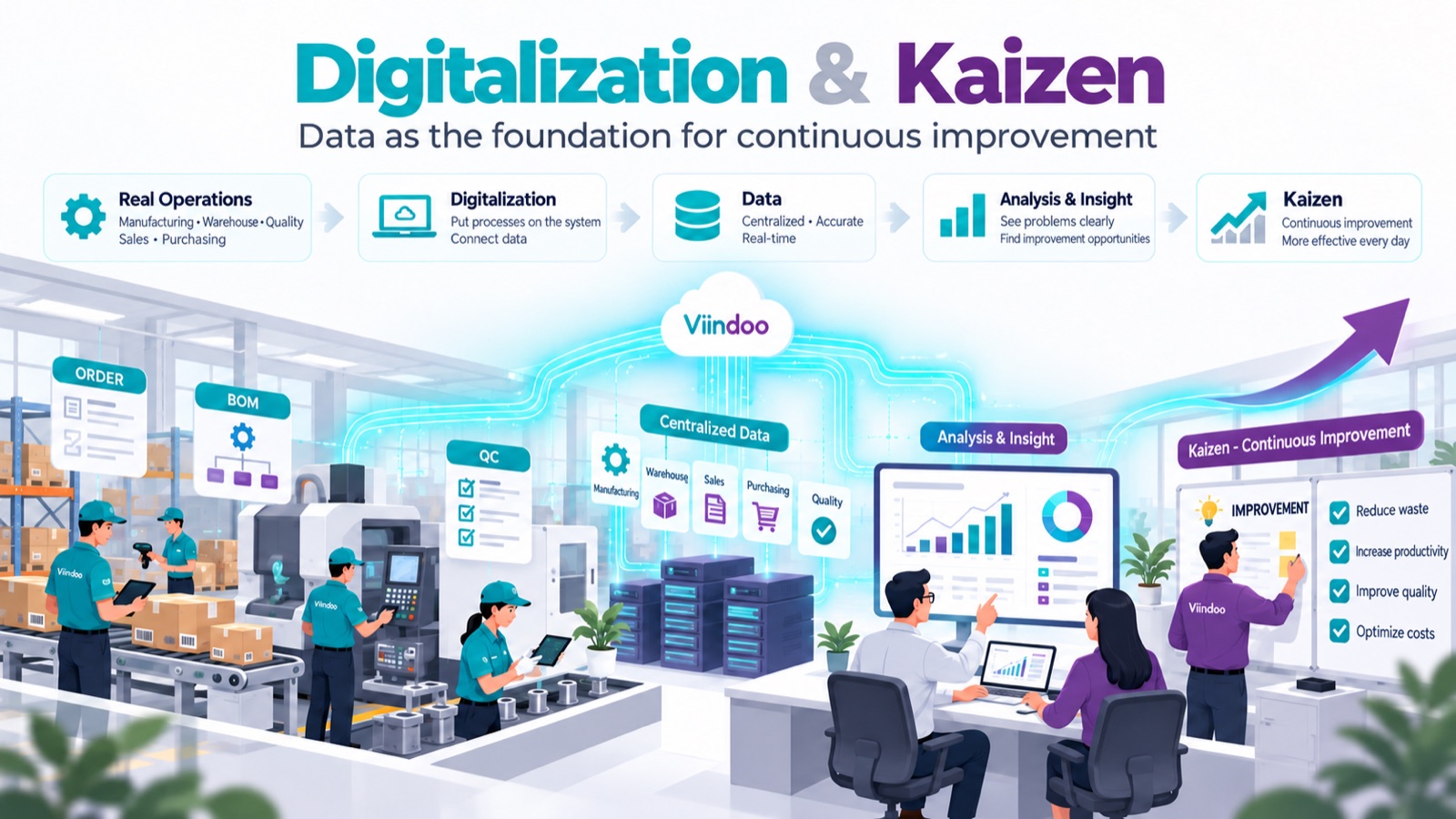
Kaizen and digitalization: data is the foundation for continuous improvement, from real operations to insight and Kaizen.
What is Kaizen?
Kaizen is the philosophy of continuous improvement: instead of waiting for big changes, the business keeps looking for small improvements in how it operates every day.
A question that captures the spirit of Kaizen is: "Is there a better way to do this?" For example:
- Can we shorten the time spent waiting for materials?
- Can we reduce how often products need rework?
- Can we reduce the inventory sitting between two operations?
- Why is a certain order regularly delivered late?
- Why does the same product take different amounts of time to make from one batch to the next?
- Are there steps being performed that add no value?
To answer these questions, a business first needs to know what is really happening in its operations. That is exactly where digitalization starts to matter for Kaizen.
What role does digitalization play in Kaizen?
In a small business, the owner can walk the shop floor, observe the work and talk directly with employees to spot problems.
But as the business grows, the number of orders, products, customers, employees, operations, warehouses and machines keeps increasing, and observation based on experience becomes difficult. The more departments a problem passes through, the harder it is to find its cause.
Take an order that is delivered late. Sales may say production is slow. Production says materials did not arrive on time. Purchasing says the bill of materials (BOM) came too late. Engineering says the customer kept changing requirements.
Every one of those statements may be true. But to do Kaizen, the business has to answer a different question:
Where was the time actually lost?
To know that, the business needs data.
From real activity to data
Consider a mechanical engineering company that manufactures to order. A typical flow of work looks like this:
Order → Design/BOM → Material purchasing → Warehouse → Production → Quality control → Finished goods → Delivery
If these activities run separately through Excel, Zalo, email, paper and face-to-face conversations, the business can still get the work done. But once it wants to analyze in order to improve, many questions appear:
- When was the order confirmed?
- How long did engineering take to complete the BOM?
- Which materials are frequently short?
- How long does purchasing take to respond?
- When did the manufacturing order actually start?
- How long does a product wait between two operations?
- Which operation frequently produces defects?
- How many times does a product have to be reworked?
- How far is the actual cost from the standard?
Without data that runs through the whole process, these questions are hard to answer accurately. And when nobody knows exactly where the problem is, Kaizen easily turns into improvement based on gut feeling.
Digitalization leaves a "trail" of the workflow
One of the key values of digitalization is not simply replacing paper with software. More importantly, activities in the business start to leave a data trail.
For example, when an order runs through Viindoo, the business gradually builds a stream of data:
- The customer places an order and the sales order is confirmed.
- A production demand is created.
- The BOM defines the materials needed.
- The system checks current stock and proposes what needs to be purchased.
- The manufacturing order is carried out.
- Produced quantities and material consumption are recorded.
- The product is inspected.
- Finished goods are delivered.
- Costs and revenue are consolidated.
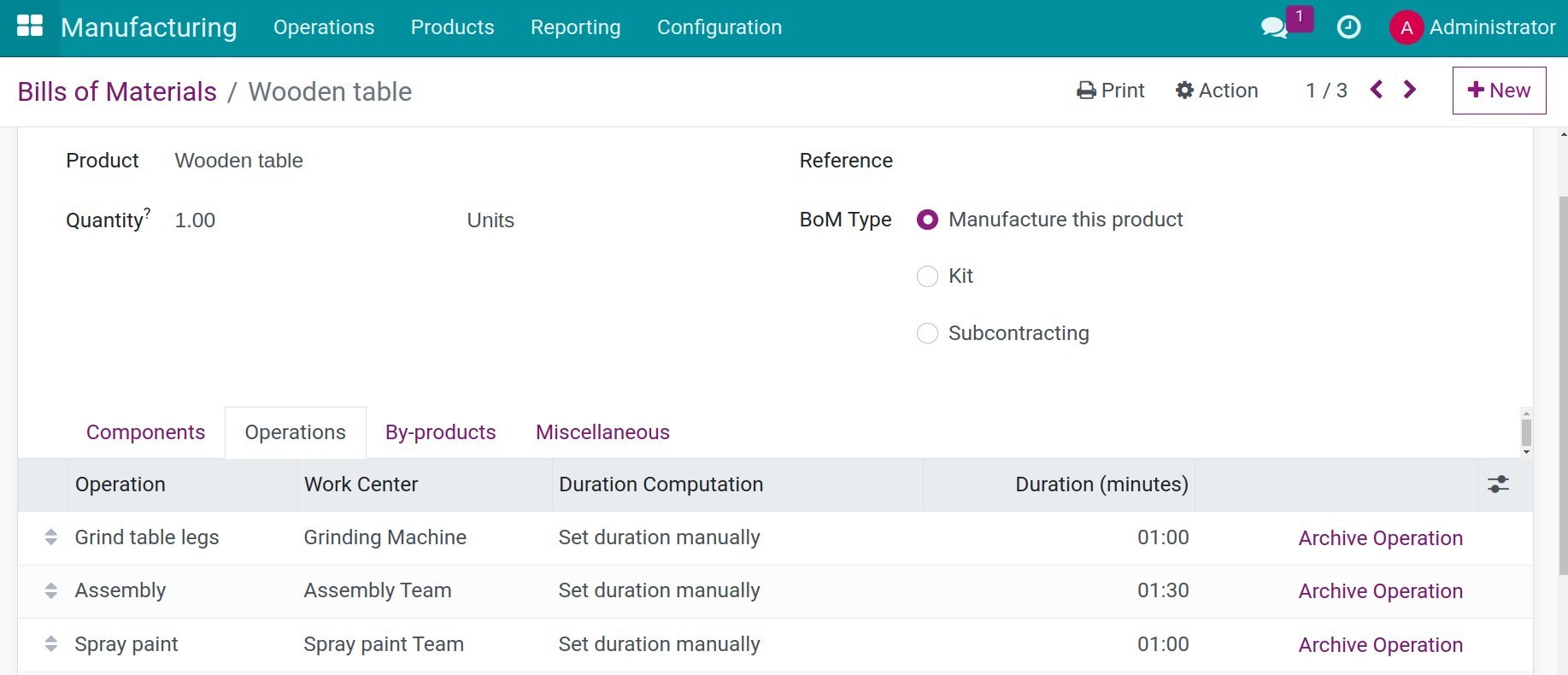
A bill of materials in Viindoo defines not only components but also the operations, work centers and standard duration of each step.
When these data points are linked together, the business knows not only the final result but can also look back at the process that produced it. This is a crucial foundation for Kaizen.
Example: a late order
Suppose (as an illustration) an order is confirmed on 1 April and promised for 25 April, but is only delivered on 8 May: 13 days late, 37 days in total. Looking only at the final result, all the business knows is that the order was late. Once the process is digitalized, it can break the lead time down:
| Activity | Time | Share |
|---|---|---|
| Waiting for technical requirements | 5 days | 14% |
| Approving the BOM | 2 days | 5% |
| Waiting for materials | 14 days | 38% |
| Production | 7 days | 19% |
| Waiting between operations | 4 days | 11% |
| Quality control (QC) | 3 days | 8% |
| Delivery | 2 days | 5% |
| Total | 37 days | 100% |
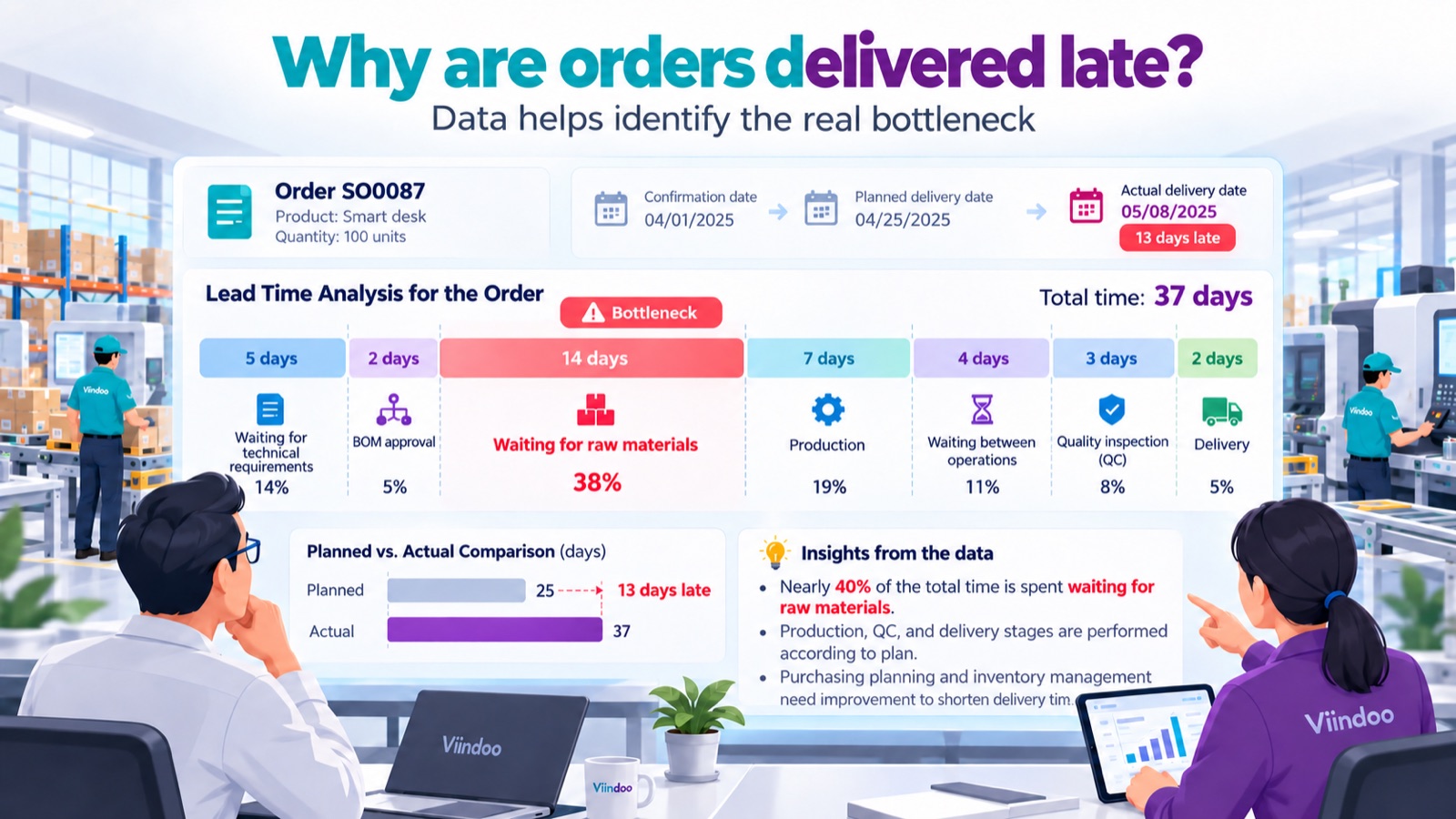
Lead-time breakdown of a late order: the bottleneck is waiting for materials, not production speed.
A very important fact now emerges: actual production time accounts for only 7 of the 37 days (19%). If the business simply pushes workers to produce 10% faster, total lead time drops by only about 0.7 days, while waiting for materials alone takes 14 days (38%).
So the point that needs Kaizen may not be the workers' speed at all, but rather:
- when the BOM is completed,
- material planning,
- stock levels,
- purchasing lead time,
- or how engineering and purchasing coordinate.
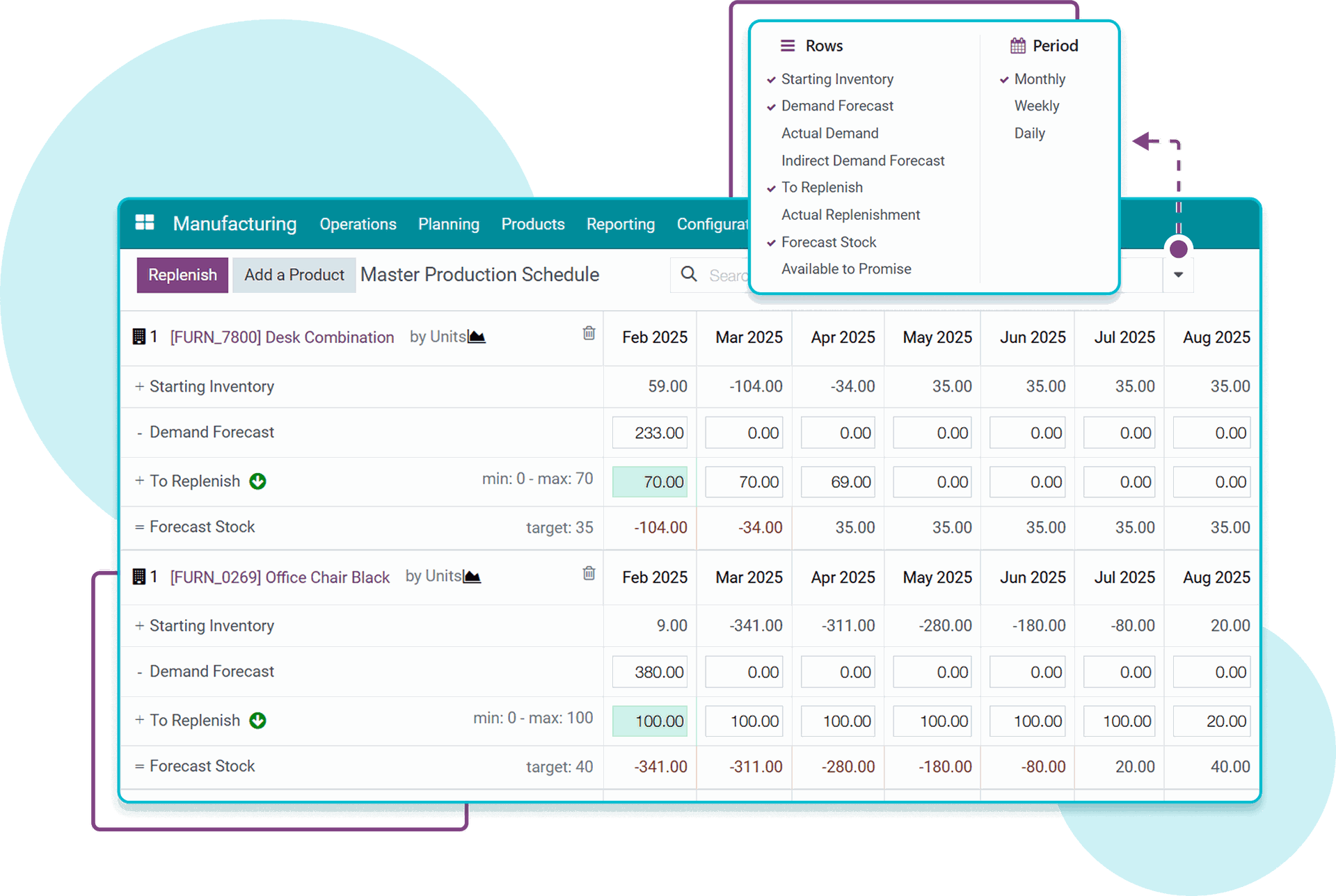
Master Production Schedule in Viindoo: demand forecast, replenishment needs and forecast stock by period.
Digitalization does not create improvement by itself. But it helps the business look at the right place to improve.
From "I think" to "the data shows"
This may be one of the most important shifts when digitalization is combined with Kaizen (the figures below are illustrative):
| Before: "I think..." | With data: "The data shows..." |
|---|---|
| "Production is slow." | "38% of the order's time is spent waiting for materials." |
| "This worker is not efficient." | "Actual processing time has not increased, but the waiting time between two operations has." |
| "This product doesn't seem profitable." | "Actual material cost exceeds the BOM by 8%, and actual labor hours are 12% above standard." |
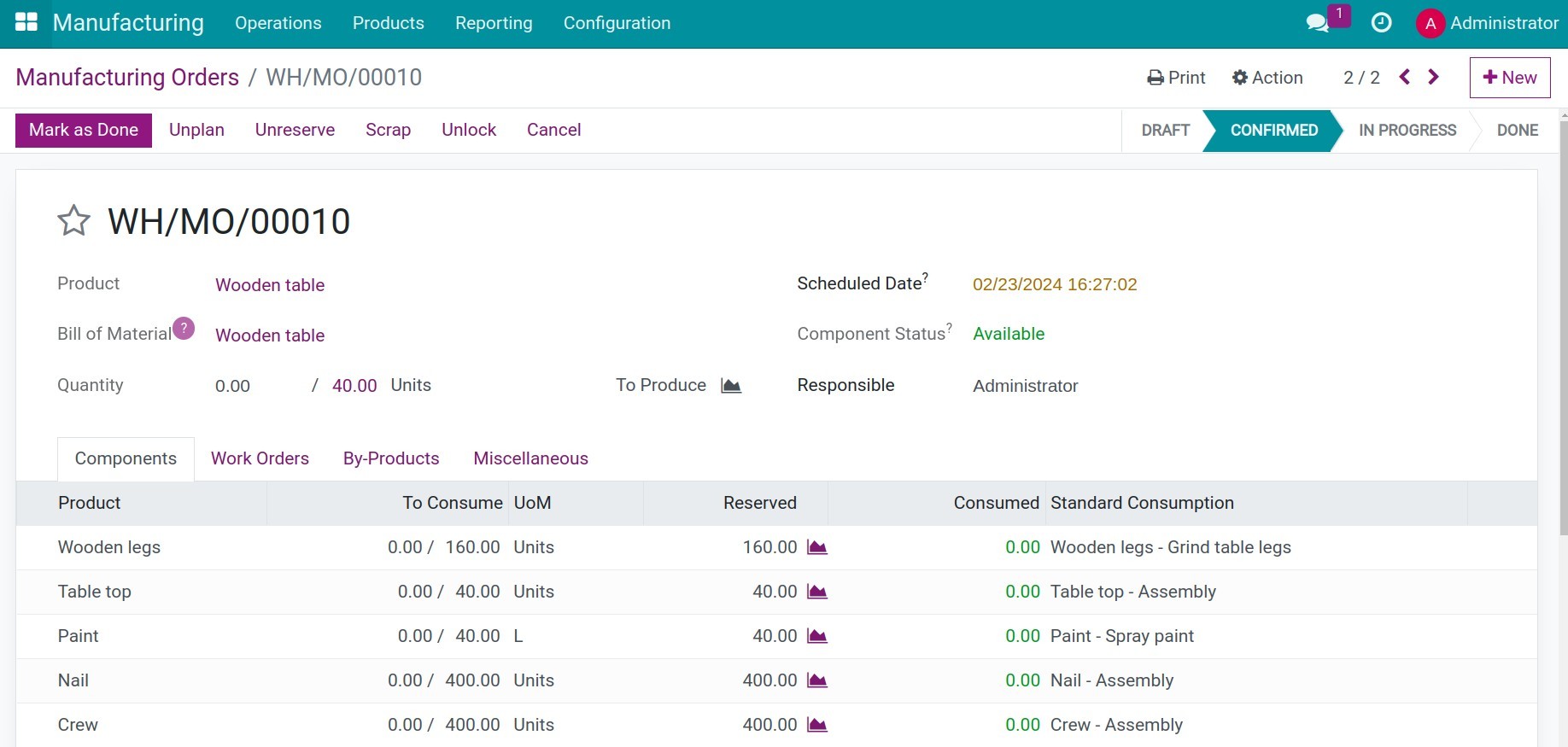
A manufacturing order shows quantities to consume, reserved and consumed, next to the standard consumption of each operation.
The difference is that the business starts Kaizen from data instead of from assumptions.
Where does Viindoo fit in this process?
If ERP is seen merely as software for issuing invoices, managing stock, entering orders, handling HR or producing reports, its value easily stays confined to individual departments. Viindoo's approach aims at a broader problem:
Connecting the activities of the business into one continuous stream of management data.
Sales creates demand. Engineering defines the product structure through the BOM. Purchasing and the warehouse meet material needs. Production turns materials into products. Quality confirms the result. Accounting reflects the result in costs and revenue. When all of these activities share one platform, the data from one step becomes the input for the next, and the business gradually stops having a different "version of the truth" in each department.
More importantly, leaders can trace back from the result to the causes that produced it. This is especially useful when combining Kaizen and digitalization.
Where is each part of the data trail recorded in Viindoo?
- Orders and production demand: a sales order confirmed in the Sales app can automatically generate the corresponding manufacturing order when the product is set up to be manufactured to order.
- BOM and engineering changes: with the Product Lifecycle app, BOM changes go through engineering change orders (ECO) with approval steps, keeping the time and history of every change.
- Materials and purchasing: material requirements are checked against stock, and replenishment rules in Inventory and Purchase propose what needs to be bought.
- Production: work orders record start and finish times and actual versus expected duration for each operation, while Manufacturing Progress Management tracks produced and consumed quantities against the plan so delays are visible while they can still be handled.
- Quality: quality control points attached to operations or to receipts and deliveries record inspection results and raise alerts when defects occur.
- Cost: Advanced MRP Accounting and Manufacturing Standard Consumption Analysis analyze cost per manufacturing order, compare actual material consumption with the BOM standard, and calculate labor and machine cost using each work center's hourly rate.
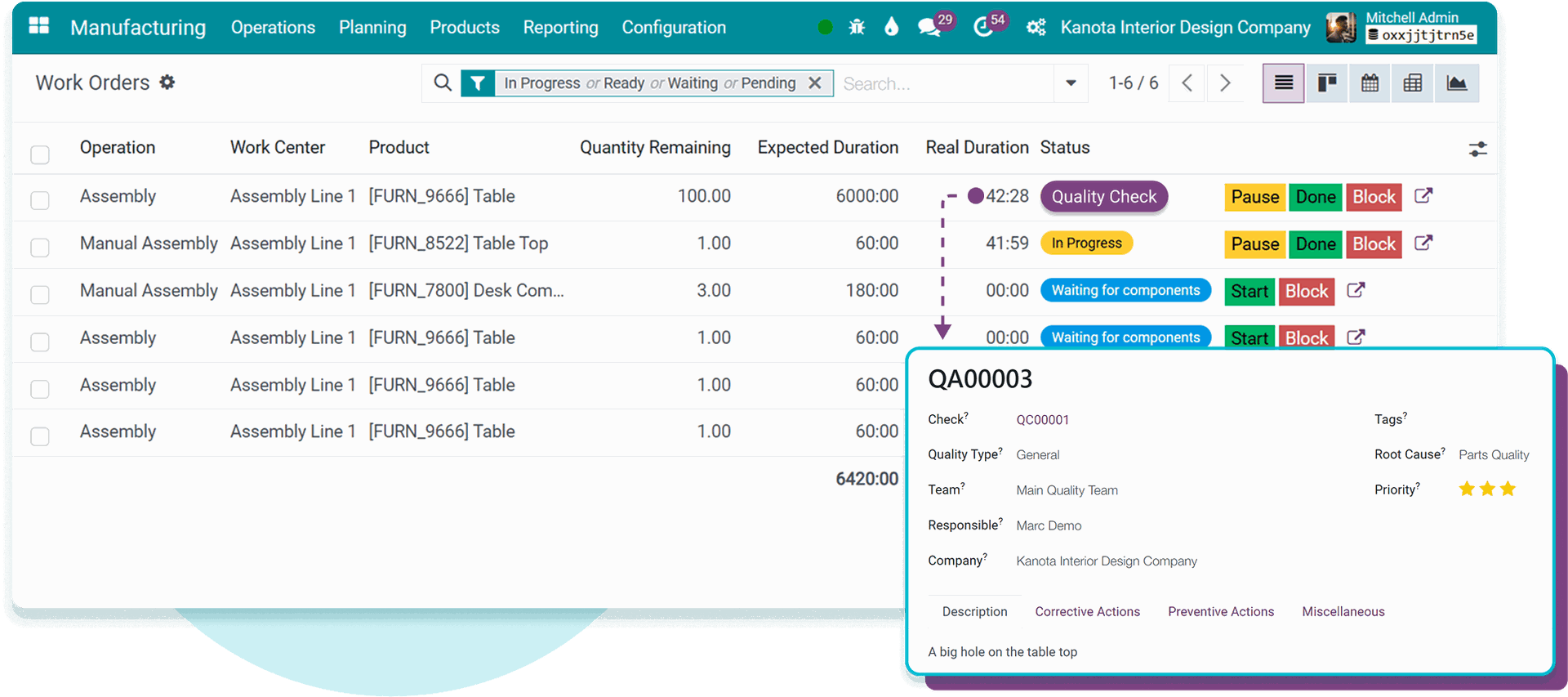
Work orders show expected versus real duration for each operation, with quality checks and quality alerts attached.
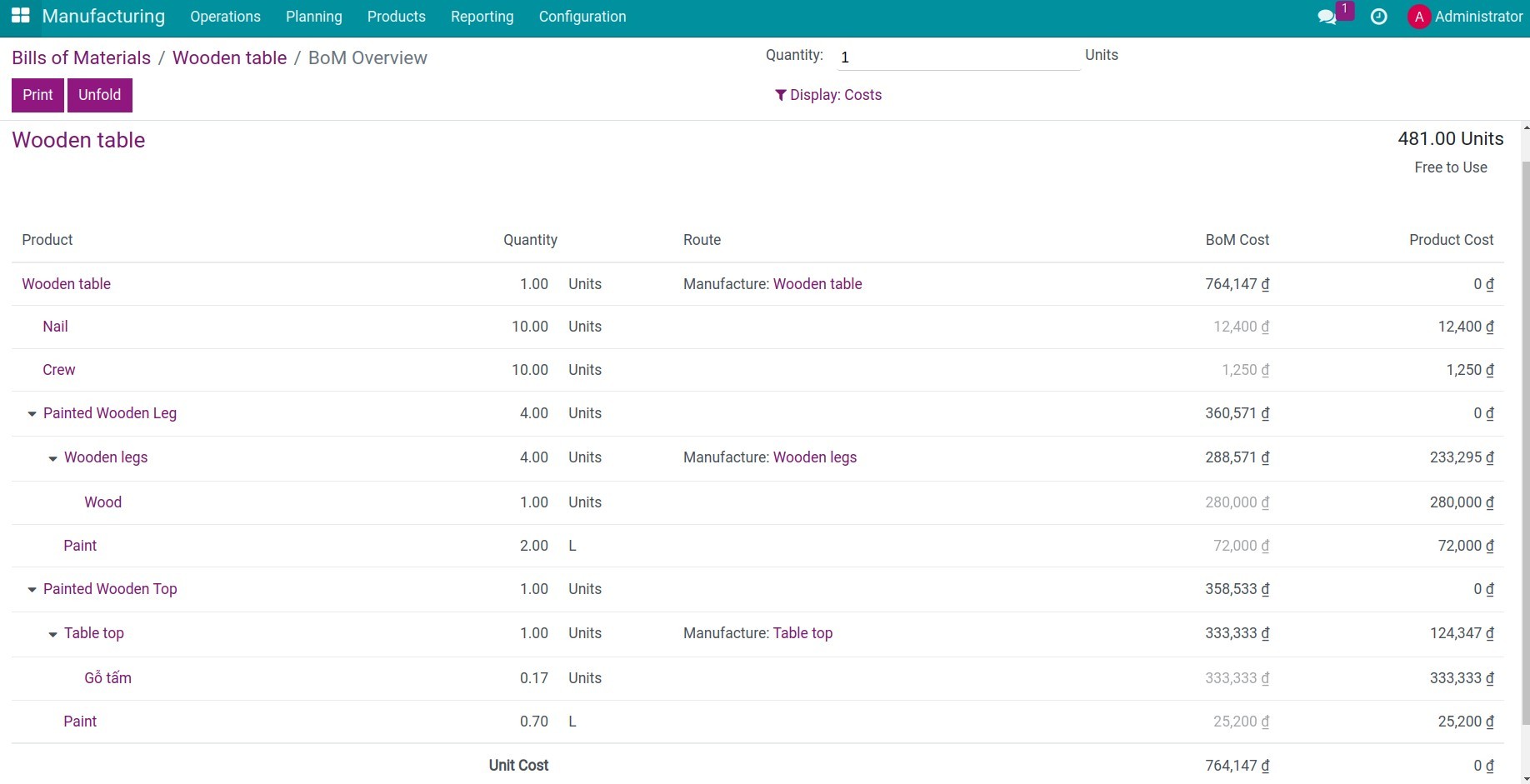
The multi-level BoM overview shows the standard cost structure of a product, the baseline for comparing actual cost after production.
One practical note: these timestamps live on different documents. To get a lead-time breakdown like the example above, the business needs to agree on which milestones to measure and set up a consolidated report during the survey and planning phase of implementation, rather than expecting it to appear automatically.
Kaizen and digitalization form a loop
The relationship between Kaizen and digitalization is not a straight line that ends once ERP is implemented. It is a loop:
- Operate: the business carries out its real work.
- Digitalize: the key events in operations are recorded.
- Data: the business has data on time, output, inventory, defects, costs and work status.
- See the problem: anomalies, bottlenecks and deviations become clear.
- Kaizen: the business changes the way it works to solve the problem.
- Measure again: new data shows whether the improvement really worked.
- Keep improving: a new Kaizen cycle begins.
When this loop runs continuously, Kaizen and digitalization stop being two separate projects, and ERP is no longer just a place to store transactions. It becomes part of the business's continuous improvement system.
Does more digitalization always mean better Kaizen?
No. This is one of the most important issues a business needs to watch.
If employees are asked to record a lot of data that the business never actually uses to control, analyze, decide or improve, that data entry itself becomes a form of waste. Conversely, if the business skips even the minimum necessary data just to cut steps, the system cannot reflect the real flow of work.
So the goal should be neither "collect as much data as possible" nor "as few steps as possible", but:
Collect enough data for the business to see, measure and improve its operations.
This is also one of the hardest problems in ERP implementation, and we will explore it in depth in the next articles of this series.
From digitalization to data-driven Kaizen
The maturity of management can be pictured as a sequence of six steps:
- See: the business first needs to see the flow of work.
- Measure: once the flow is visible, it can be measured, and measurement reveals where the problems are.
- Improve: with data as the basis, the business decides where Kaizen is needed and changes how it works.
- Standardize: the better way of working becomes the standard process.
- Automate: only stable, repetitive activities are good candidates for automation.
- Optimize: automation keeps reducing steps, time, errors, resources and cost.
This is how Kaizen and digitalization complement each other.
What does the Viindoo implementation method aim for?
A successful digital transformation project should not be judged simply by the number of features deployed. A more important question is:
After implementation, how much better can the business see and control its operations?
That is why, in the survey and planning phase of a Viindoo project, the key task is not only configuring software but agreeing on:
- How far does the flow of work need to be visible?
- Which points truly need data to be recorded?
- Which data is needed by the steps that follow?
- Which indicators are needed for management?
- Which steps can be automated?
- And which data does not need to be collected at all?
This follows the principles Viindoo applies to every project: keep things simple, customize only what is truly necessary, implement complete processes from input to output, and go live early with a small set of high-value features, so that data serves improvement from the very first weeks.
Don't digitalize just to have software. Digitalize so the business can see, measure and improve its own operations.
That is the most important meeting point between Viindoo, Kaizen and digitalization.
Frequently asked questions about Kaizen and digitalization
Does Kaizen need ERP?
No. A business can practice Kaizen without ERP. However, as operations scale up, ERP helps collect and connect data across many departments, giving the business more basis to detect problems and measure the effect of improvements. We will look at this question in detail in article 3 of the series.
Does ERP make a business do Kaizen automatically?
No. ERP provides data and management tools. The business still needs people to analyze problems, identify root causes and carry out improvements.
Is digitalizing more data always better?
Not necessarily. Data is valuable only when it serves operations, control, measurement or decision-making. Collecting data without a clear purpose can add steps and create more waste.
How does Viindoo support Kaizen?
Viindoo connects data across sales, purchasing, inventory, manufacturing, quality, HR and accounting on one unified platform. This end-to-end data helps the business see its flow of work, measure deviations such as actual versus standard consumption or actual versus expected operation time, and identify the areas that need improvement.
What is the relationship between Kaizen and digital transformation?
Kaizen helps a business keep looking for better ways to operate, while digital transformation provides the data and tools to observe, measure and verify those improvements. The two reinforce each other in raising management effectiveness.
Next in the series
What does digitalization help a business "see" in order to do Kaizen? We will dig into the concept of flow, from orders and materials to production and delivery, and explain why seeing the whole flow matters so much for continuous improvement.
Related articles
- What is Kaizen? What is Kaizen method benefit?
- A Guide to Implementing Kaizen in Manufacturing with Viindoo
- Transformation journey of Viet Ha - Mechanical Manufacturing Business
- Production Planning: The Linkage Foundation in Strategic Enterprise Management
- Digital Maturity Framework: Mapping Readiness Before the Transformation Journey
- ERP, WMS, MES, IoT: Where Should Businesses Begin?