When does AI in Kaizen and ERP actually create value, and when is it too early? Article 10 of the "From Data to Kaizen" series looks at where AI fits once a business has processes, data and automation.
AI in Kaizen and ERP: yes, but do not start with AI
Once a business has standardized its processes at a minimum level, digitalized the operating flow, built enough data to manage and started automating the clear steps, as the previous article described, the next question almost always comes up:
"Should we bring in AI to analyze automatically and suggest improvements?"
The answer is: yes, but do not start with AI. Artificial intelligence is very good at:
Finding patterns
Spotting what repeats across thousands of transactions.
Detecting anomalies and forecasting
Flagging what deviates and what is likely to happen next.
Summarizing and supporting decisions
Pulling scattered data together so people decide faster.
But AI cannot replace a management foundation that is still unclear. If the data is missing, wrong, inconsistent or does not reflect the real operating flow, AI simply produces results faster on a weak foundation.
AI cannot fix poor data. AI only amplifies the quality of the data the business already has.
Where should AI sit in the digital transformation journey?
A sensible order is:
Standardize
Digitize
Measure
Kaizen
Automate
AI support
AI should come in once the business has enough history to compare, find patterns, identify anomalies and forecast trends. Without that foundation, AI usually stops at chatbots, lookup assistants or content tools. Those are still useful, but they do not yet touch operational Kaizen, which is where AI in Kaizen and ERP creates value.
AI can help spot problems faster
In a traditional ERP, managers look at dashboards to spot late orders, unusual stock, rising defect rates or costs above standard. AI can go one step further: not just display data, but actively detect unusual patterns. For example:
- a product group whose defect rate is rising unusually,
- a work center whose lead time keeps creeping up,
- a supplier that often delays orders,
- material consumption that tends to exceed the standard.
Instead of waiting for a manager to notice, AI can warn, rank how unusual a case is and suggest where to look. This fits Kaizen very well, on one condition: the signals must already be recorded consistently in the system.
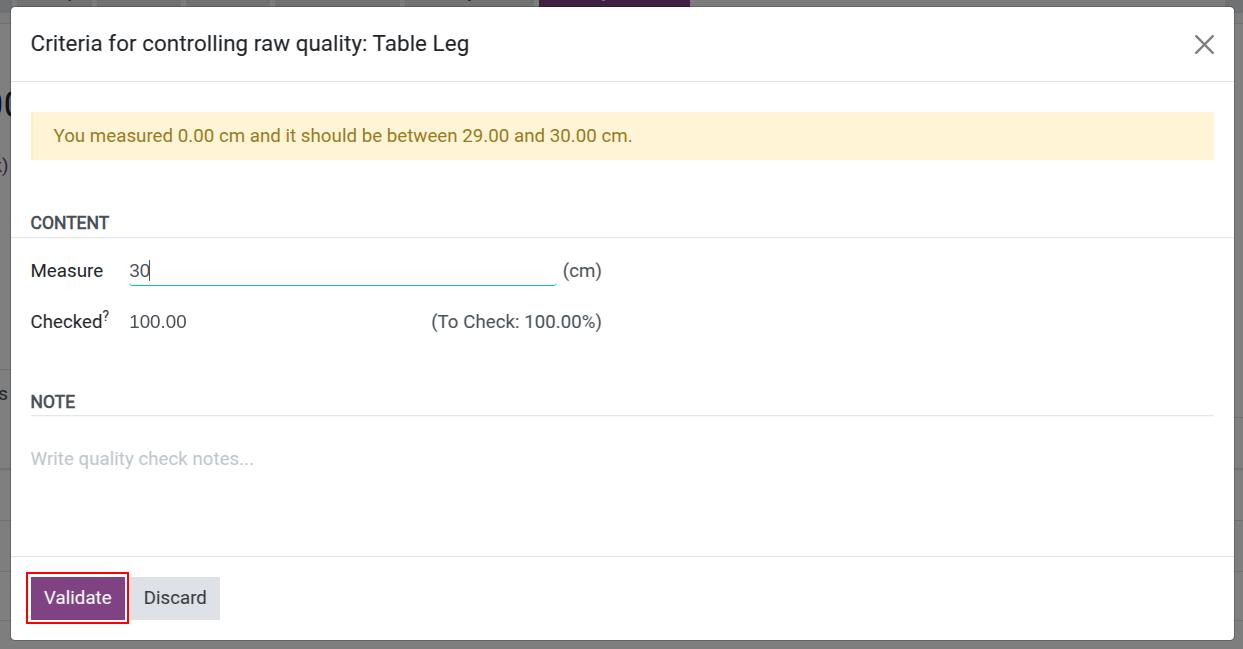
A measurement check compares the value entered with the tolerance of the control point and warns when it falls outside. Each check becomes structured data, exactly what AI needs later to find patterns.
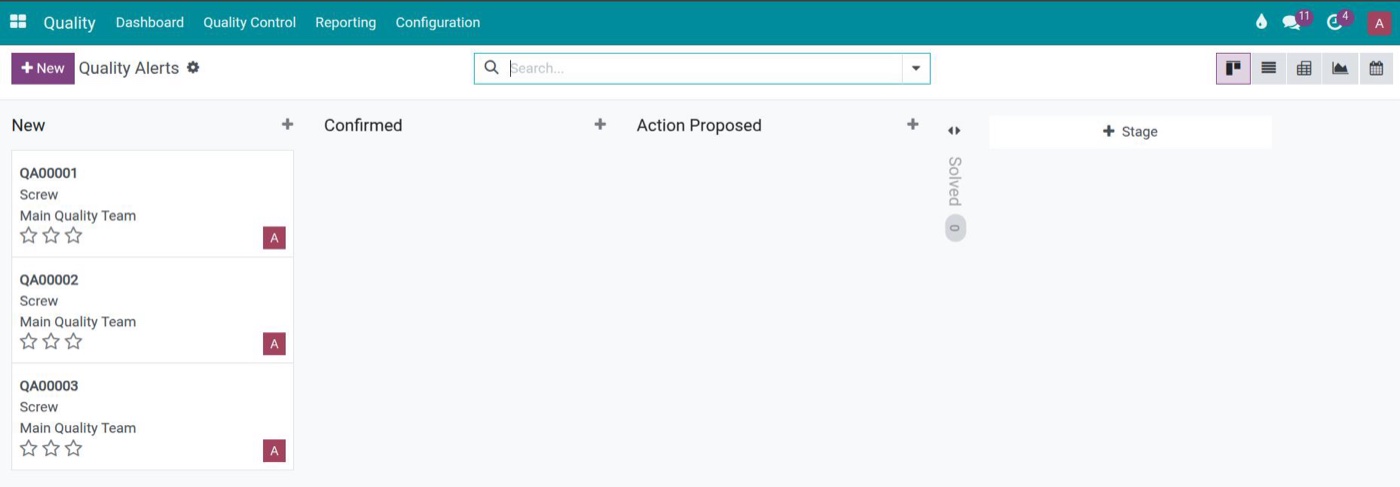
Quality alerts are tracked by stage, product and quality team. Over time, this list is the history that reveals which defects repeat.
AI can help with a first root-cause analysis
Kaizen has to answer why did the problem happen? This takes a lot of time when the data sits in many places. AI can help by pulling together orders, BoMs, change history, work orders, quality alerts, stock, suppliers and costs, then pointing out suspicious correlations. For example (illustrative):
"80% of late orders this month are linked to missing materials in group A."
"The defect rate of product X rose sharply after switching the supplier of material Y."
This is not yet the final root cause, but AI can narrow the scope of the investigation. The better the operational data, the more useful this first pass becomes: a comparison of standard and actual consumption, for instance, already shows where the gaps are.
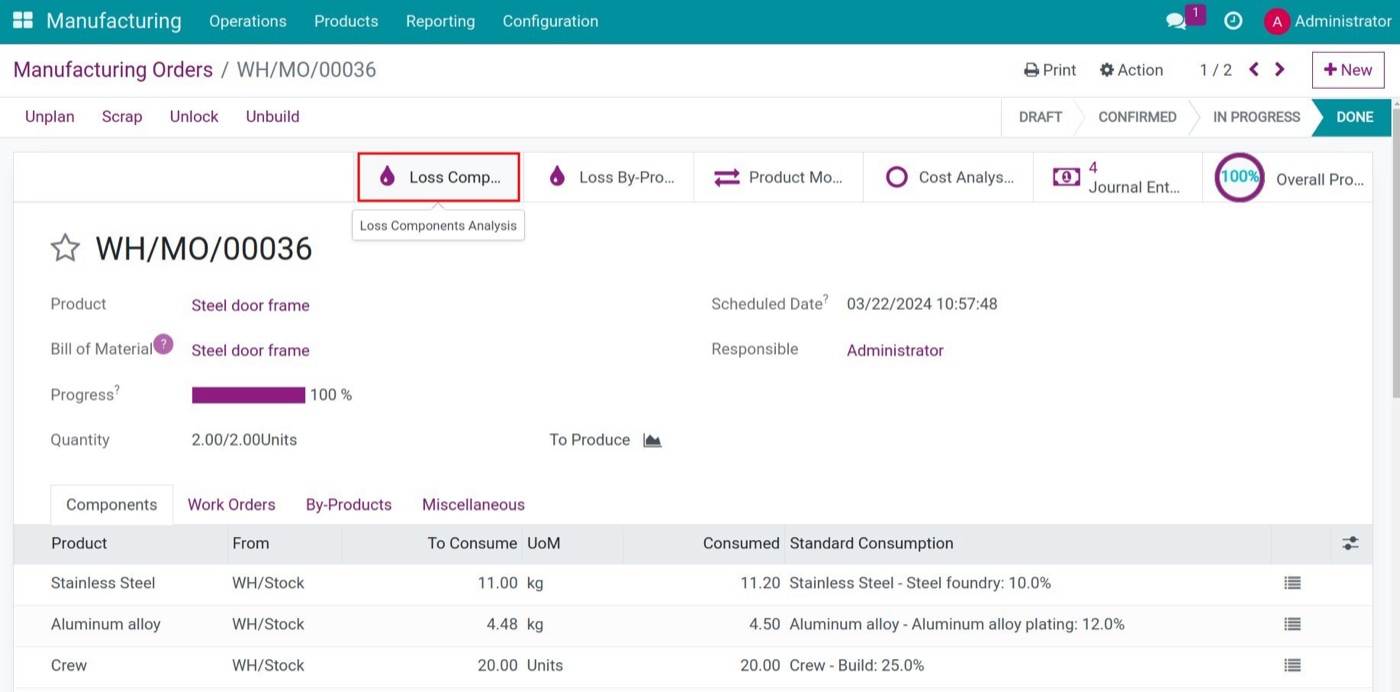
On each manufacturing order, the required quantity, the quantity actually consumed and the standard loss rate sit side by side, with a loss analysis one click away.
AI can forecast before problems happen
This is where AI differs from traditional reports. Reports usually answer what happened? AI can help answer what is likely to happen next? For example: which orders risk being late, which materials risk running short, which machines risk stopping, which customers are likely to pay late, which products risk exceeding their cost.
If the forecast is reliable enough, the business can act in advance, a very important step from reactive management to proactive management. Forecasting also starts from good operational data: in Viindoo, the stock forecast is built from documents already in the system, such as confirmed sales, manufacturing orders and incoming receipts.
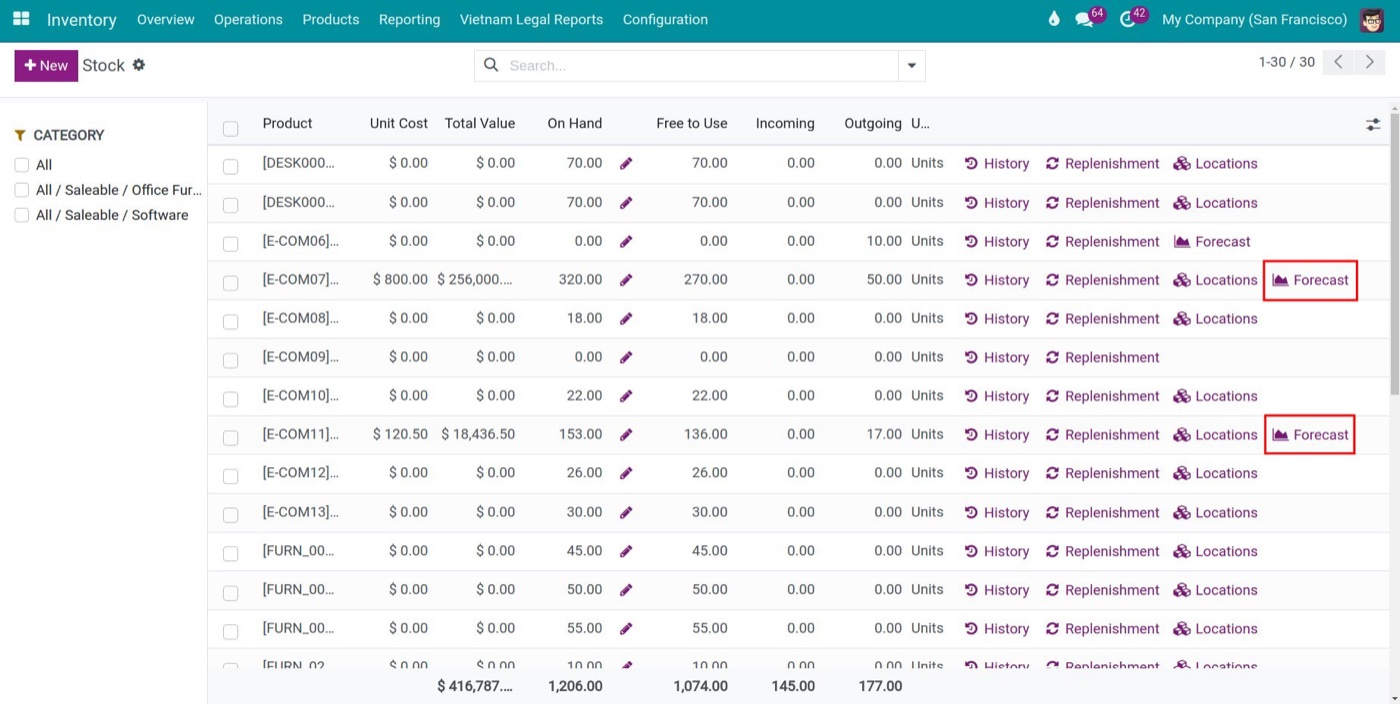
The stock list shows on-hand, free-to-use, incoming and outgoing quantities per product, with a Forecast button for products that have upcoming movements.
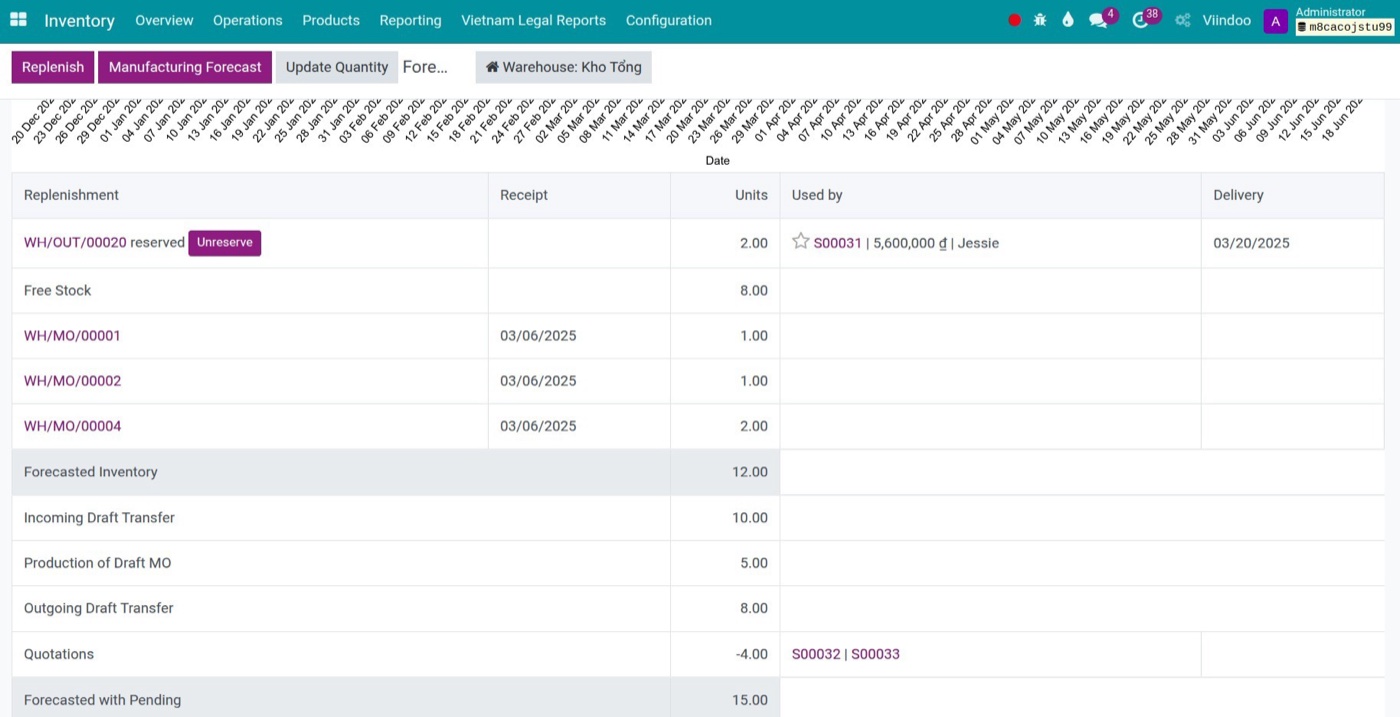
The forecasted report lists which deliveries and manufacturing orders use the stock and computes the forecasted quantity, including drafts and quotations. This is the kind of data AI can build on.
AI can help prioritize Kaizen
A business may have dozens of problems at once, while improvement resources are always limited. AI can help rank them by frequency, impact, cost, lead time, defect rate and risk. For example:
Defect A
Happens often but has a low impact.
Defect B
Happens rarely but causes heavy losses.
Defect C
Creates a bottleneck for the whole flow.
Based on history, AI in Kaizen and ERP can suggest which point to improve first. The final decision still belongs to people.
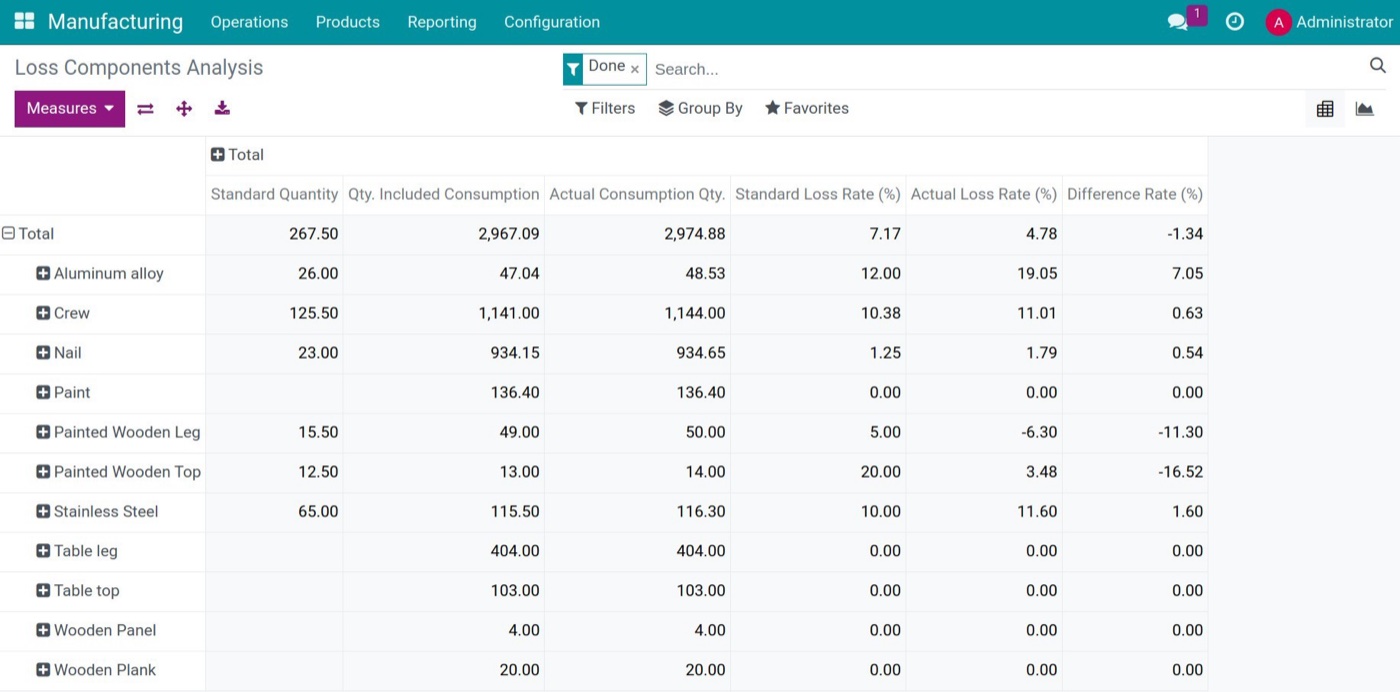
The loss analysis compares standard and actual loss rates across completed manufacturing orders. The materials with the biggest difference are natural candidates for Kaizen.
AI can help standardize knowledge
In many SMEs, knowledge lives in the foreman's head, in engineers' experience, in chat groups, in Excel files and scattered documents. AI can help turn these sources into troubleshooting guides, checklists, work instructions, FAQs and business assistants.
For example, a worker runs into a QC defect. AI can look up where a similar defect happened before, how it was handled last time and which documents are relevant. This reduces dependence on individuals, speeds up training and keeps knowledge in the company. In Viindoo, lessons and procedures can be kept in the Viindoo Brain knowledge base, and Viindoo AI can answer questions from it while citing the source page.

Asked about a warehouse rule, Viindoo AI answers from the knowledge base and names the checklist and incident page it used, so the answer can be verified.
But AI should not replace Gemba
Kaizen has an important principle: go to where the problem actually happens. Data and AI are very useful, but AI in Kaizen and ERP should not make the business skip the shop floor.
For example, AI detects that cycle time is rising at the milling operation. The real cause may be worn tools, a poor layout, materials stored too far away or workers waiting for the forklift. These things are not always in the data.
AI shows where to look. Gemba confirms what is really happening.
AI should not make the final decision everywhere
AI fits suggestions, warnings, ranking and forecasting very well. But for high-risk decisions, such as changing a BoM, switching suppliers, stopping a line, changing a quality standard or approving a large expense, people still need to stay in control. A sensible model is:
AI proposes
People evaluate
The system records the decision
This is human-in-the-loop. Viindoo AI follows the same idea: actions that write data, such as creating a draft purchase order or a draft invoice, wait for the user to confirm before they run, and every AI call is logged with its cost, tokens and the tools it used.
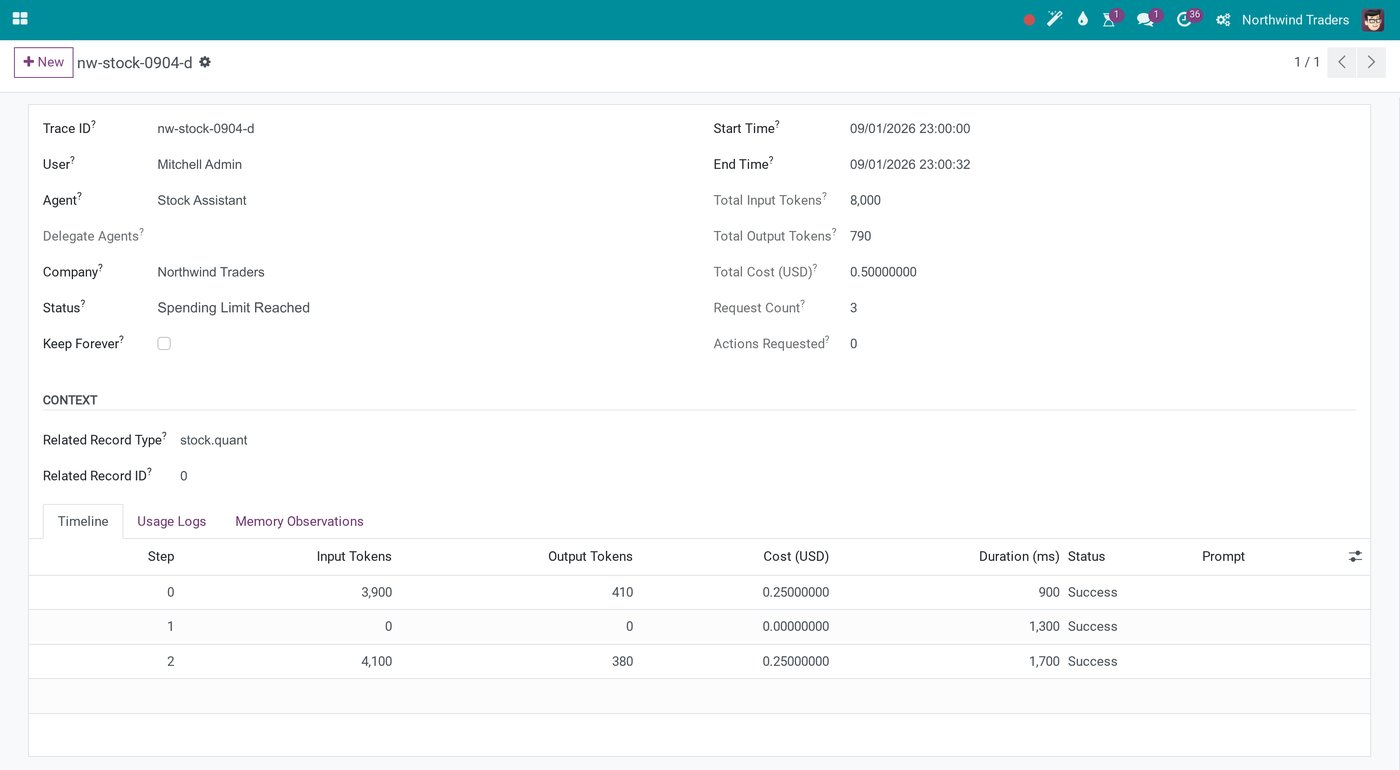
Each AI run keeps a trace: user, agent, related record, cost in USD, tokens per step and status. Here the run stopped because the spending limit was reached.
Conditions for AI in Kaizen and ERP to be truly useful
AI does not need perfect data, but it does need a minimum, the same minimum described in the article on the minimum management backbone:
Structured data
Product codes, orders, work orders, quality alerts.
Consistent enough
If the same defect is recorded in 10 different ways, AI can hardly learn.
History
AI needs enough data to recognize patterns.
A clear goal
Cut defects, cut lead time, forecast stock or support decisions.
Start AI with a small use case
Do not start with "We need AI for the whole company." Start with one concrete problem, for example: warning about orders at risk of being late, classifying quality alerts, forecasting material shortages, summarizing defect causes or suggesting suppliers.
Then measure accuracy, time saved, how often users accept the suggestions and the real impact. If it works, expand. This is how a business tests AI in Kaizen and ERP without betting everything at once.
AI in Viindoo should sit on integrated data
A big advantage of an integrated ERP is that AI does not have to hunt for data in many places. When sales, BoMs, purchasing, inventory, manufacturing, quality and accounting sit on one platform, the demand, materials, progress, defects and costs are connected. AI does not only see that an order is late; the context around it, such as a BoM change, late materials or an overloaded work center, lives in the same system.
Viindoo AI works on this foundation. The business chooses its own AI provider, from OpenAI, Anthropic or Google Gemini to a self-hosted model through Ollama, and manages its own API key; spending limits can be set per user and per company. Connectors for sales, purchasing, inventory, manufacturing, accounting, CRM and approvals let AI read business data and prepare drafts for people to confirm.
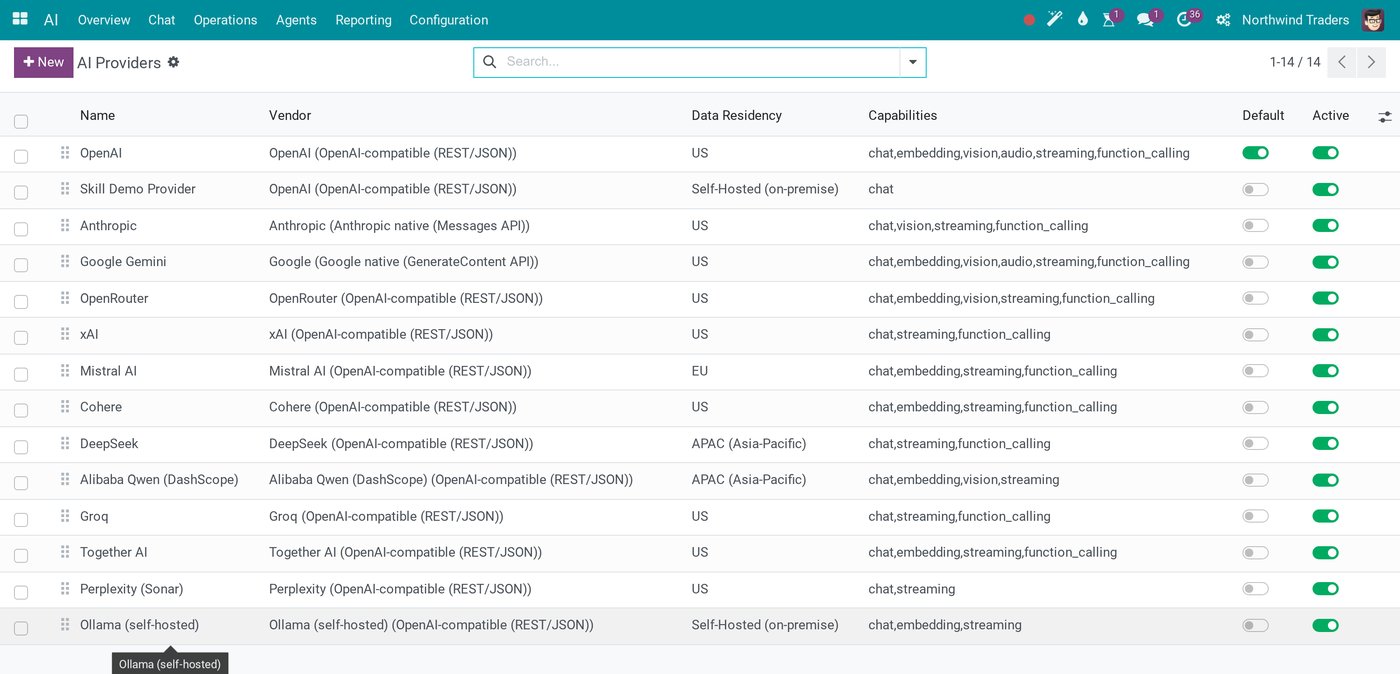
The list of AI providers shows each vendor, where the data is processed and its capabilities. The business picks the default provider and enters its own key.
AI does not replace traditional automation
There is a trend of using AI even for jobs that rule-based automation already does well. That is not necessary. Stock below the minimum creates a request for quotation, an overdue task triggers a reminder, a measurement outside tolerance shows a warning: these have clear rules. Rule-based automation is usually easier to control, cheaper and more stable.
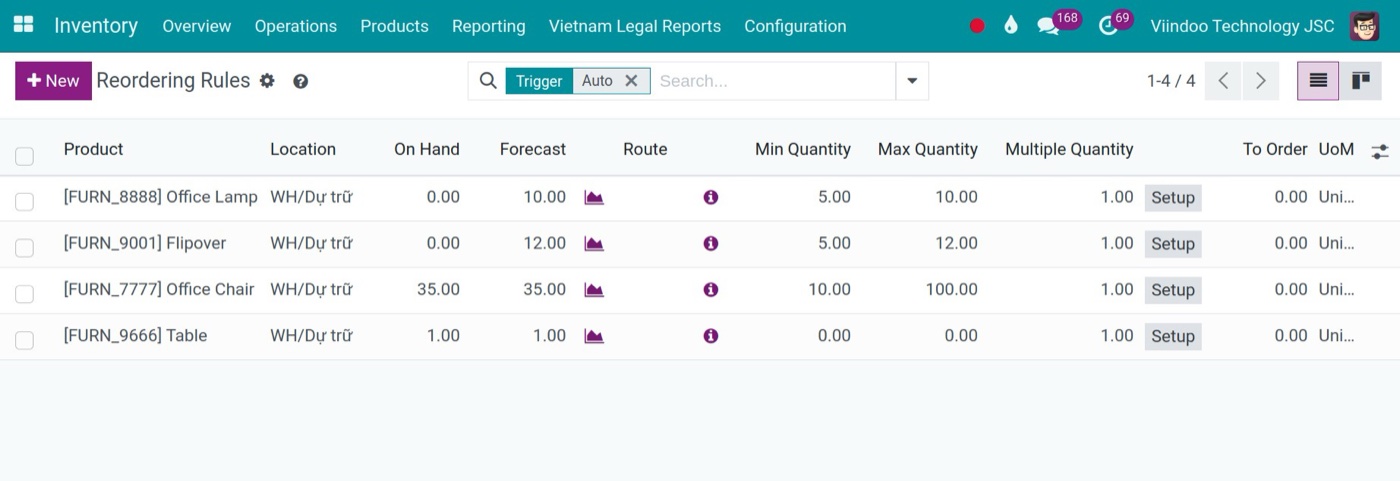
Reordering rules with minimum and maximum quantities handle replenishment on a clear rule: no AI is needed for this.
AI should be used where data is complex, patterns are unclear, forecasting is needed, language must be understood or many variables must be analyzed. A simple question helps choose:
Can this decision be described as "if A, then B"?
If yes
Use traditional automation.
If not
If it needs pattern analysis, probability, understanding text or unstructured data, AI may fit better.
How can AI support PDCA?
AI can be seen through the Plan, Do, Check, Act cycle, the same improvement loop the article Does Kaizen Need ERP? describes:
Plan
Forecasting, trend analysis, suggested priorities.
Do
Guidance, checklists, entering or classifying data.
Check
Detecting anomalies, before and after comparisons, summarizing results.
Act
Suggesting actions, writing lessons learned, updating the knowledge base.
AI does not replace PDCA. It makes PDCA faster and richer in data.
AI needs Kaizen too
AI in Kaizen and ERP is not deployed once and done. Models can be wrong, drift, become outdated or no longer fit. Track whether forecasts are accurate, whether suggestions are accepted, whether there are too many alerts and whether users trust AI. AI has to be improved continuously as well.
And do not use AI just to look modern. A nice chatbot does not necessarily create value, and an AI dashboard full of charts does not necessarily lead to better decisions. Before deploying, ask:
- What is the management problem?
- Is the data sufficient?
- If AI is right, what will the business do?
- If AI is wrong, what is the risk?
- Is there a simpler way?
If these questions cannot be answered yet, it is too early for AI.
Conclusion: AI should accelerate Kaizen, not be the starting point
AI can help a business see problems earlier, analyze faster, forecast better, prioritize Kaizen and keep knowledge. But AI in Kaizen and ERP only creates real value on top of clear enough processes, good enough data and a Kaizen mechanism that is already working.
Do not start by asking "What can AI do?" Start with "What does the business need to improve, and can AI help see or handle it better?"
That is also how AI should be integrated into Viindoo, as a continuous loop:
Operational data
AI analyzes
People decide
Kaizen
Better data
Frequently asked questions about AI in Kaizen and ERP
When it already has good enough data and a concrete problem such as forecasting, anomaly detection, classification or root-cause analysis.
No. AI helps detect and analyze problems, but improvement still needs people to confirm on the shop floor and change the process.
No. Clear rules should stay with traditional automation. AI fits complex, probabilistic problems or unstructured data better.
Not necessarily a lot, but the data must be consistent and relevant to the problem being solved.
Business data from sales, purchasing, inventory, manufacturing and accounting sits on one platform, so AI has better context. The business chooses its own AI provider and key, and actions that write data wait for a person to confirm.
Next in the series: How can an SME measure the ROI of Kaizen and digitalization without a baseline?
Another big issue is that SMEs often do not know how much they are wasting, so it is hard to prove the ROI of ERP or Kaizen from the start. The next article looks at how to create a minimum baseline, measure before and after, and assess the value of digitalization without turning the project into an oversized strategy consulting program.