Standard work is how a plant keeps the right way of doing each job when the people change. On many floors the warning signs are familiar: one machine runs well only on the shift of one experienced operator, a new hire takes months to reach normal speed, and quality dips every time a senior worker is on leave.
These are not three separate staffing problems. They are one knowledge gap, the third gap described in the pillar article on shop floor management. This article looks at it from the people who create both the output and the data: the operators.
Design for the people who create the data
Almost every number about the floor starts with an operator: output, scrap, stops, materials used. Yet most data entry on the floor is designed for the people who read the reports, not for the people who make the entries. The operator gives time and gets nothing back.
When that happens, entries are made late, from memory, at the end of the shift, and the numbers drift towards what looks acceptable. This is not a discipline problem. It is a design problem, and a common reason why digitalization sometimes adds tasks instead of removing them.
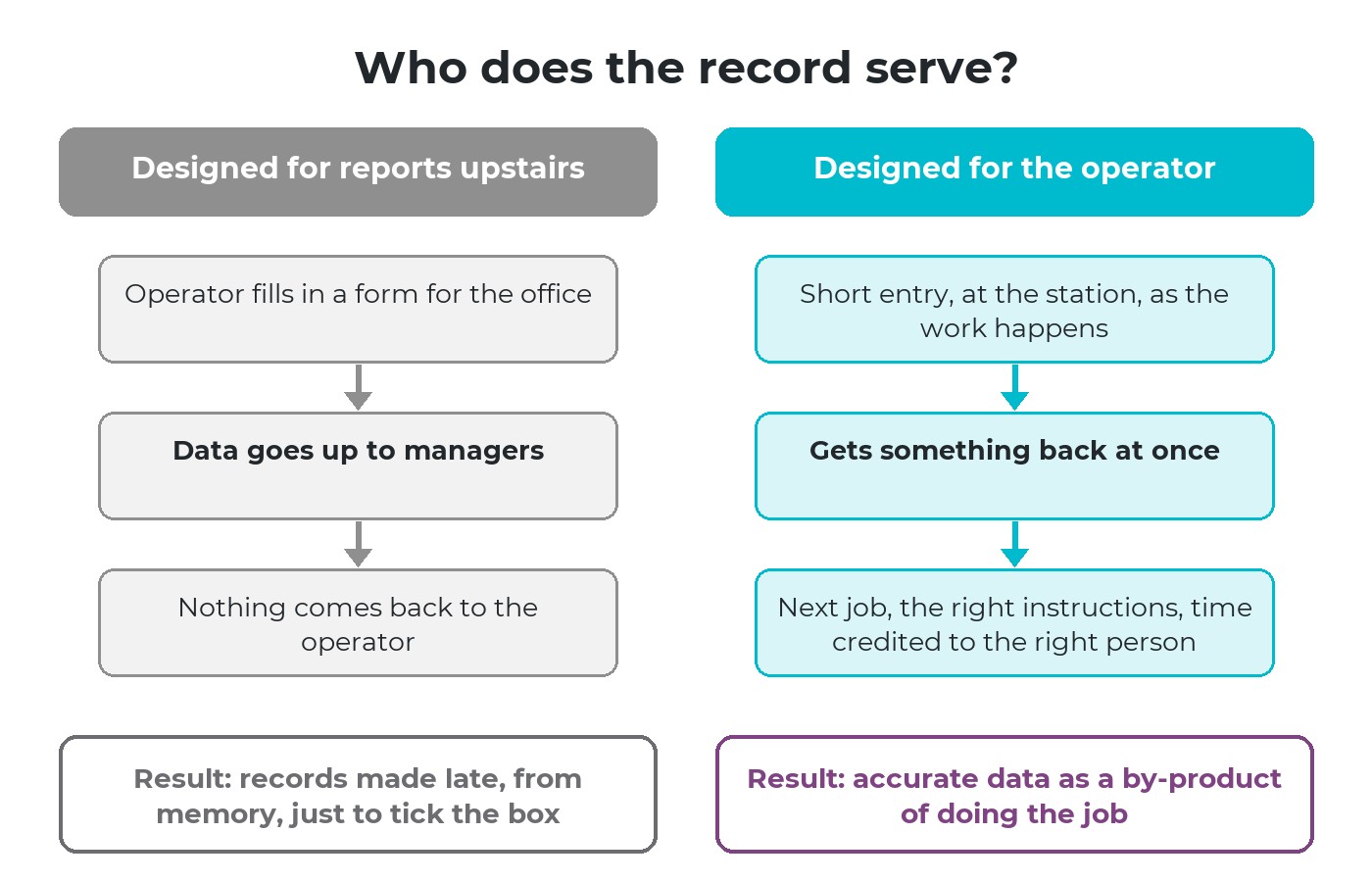
The same entry, designed for two different readers, produces very different data.
Three tests for any entry at the station
- Short: a few taps, large buttons, no free text unless it is needed.
- On time: made when the work happens, not collected at the end of the shift.
- On the spot: made at the station, without walking to an office computer.
A fourth test matters even more: what does the operator get back? The next job and its instructions on the same screen, time credited to the right person, a quick call for help. When each entry returns something useful, accurate data becomes a by-product of doing the job. The line between useful records and waste is discussed further in when data entry is waste.
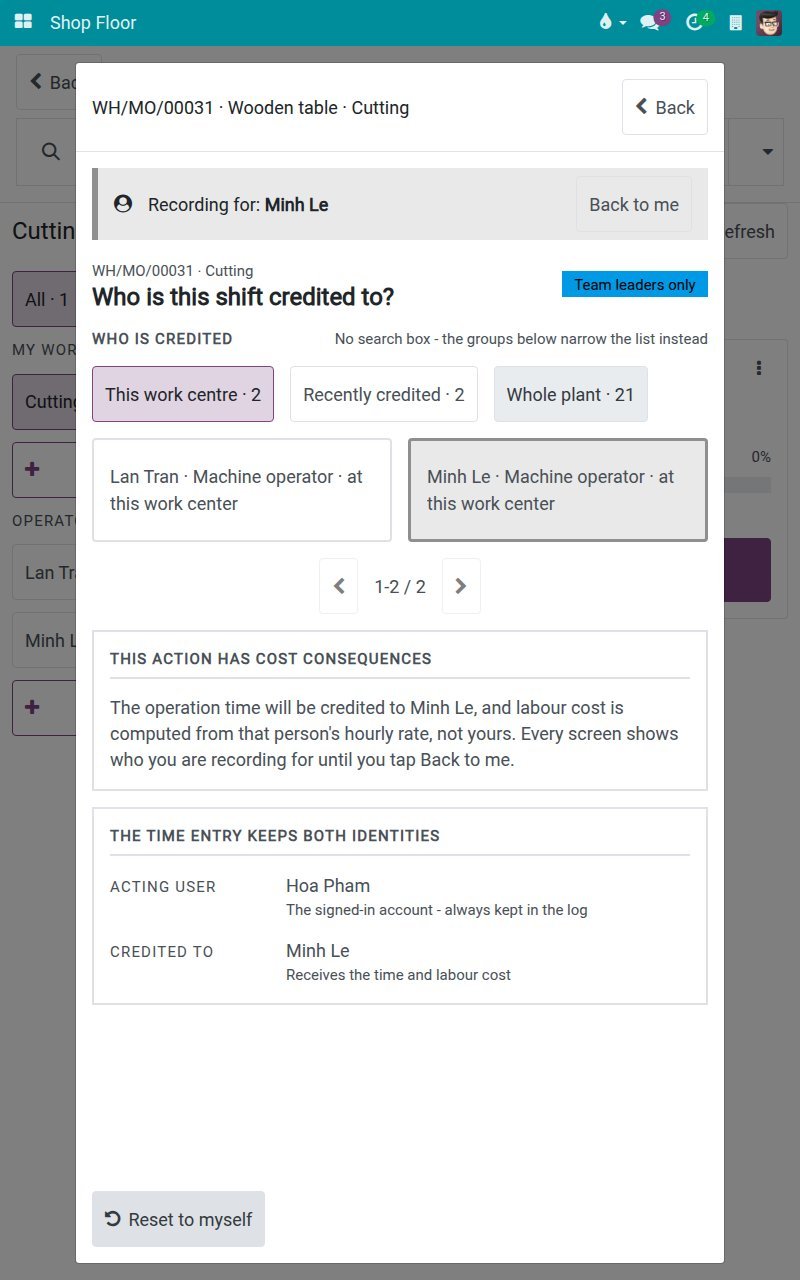
Example: a team leader records on behalf of an operator; the time and labour cost go to the operator, while the log keeps both names.
Skill that lives in a few heads
Every plant has people who know the things no document says: how a machine sounds just before a fault, how to adjust a setting when the material batch changes, which defect can be fixed and which must be scrapped. This is tacit knowledge, learned over years and rarely written down.
The risk is not that these people exist. The risk is that the plant depends on them without knowing it. When one of them retires, moves to a competitor or simply falls ill, three things happen at once: output slows, defects rise, and nobody can say exactly what changed, because the old way was never recorded.
The same gap shows up daily between shifts and operations. A handover by word of mouth loses details, which is why work fails at the handover more often than in one person's hands.
New technology does not remove this risk by itself. A system that learns from records can only learn what was recorded. The question of whether you still need your best people when AI learns every process starts here: the best people are the source of the standard, and the standard is what any tool learns from.
Standard work and work instructions by operation
Standard work is the current best known way to do one operation safely, at the right quality and in the expected time. It is written down per operation, kept where the work happens, and owned by the people who do it. It is not a thick procedure manual that sits in the quality office.
What a useful instruction contains
Sequence
The main steps in order, each one short enough to read at a glance.
Key points
What makes the step succeed or fail: a setting, a check, a feel. This is where the expert's knowledge goes.
Reasons
Why each key point matters, so the operator can judge an unusual case instead of guessing.
Pictures
Photos or drawings of the right result and the common defects. One picture beats a paragraph on the floor.
The best operator should help write the instruction, with the team leader keeping it short and testable. When the expert sees their own know-how recognised in the standard, the standard stops being a rule imposed from above and becomes a record of the team's craft.
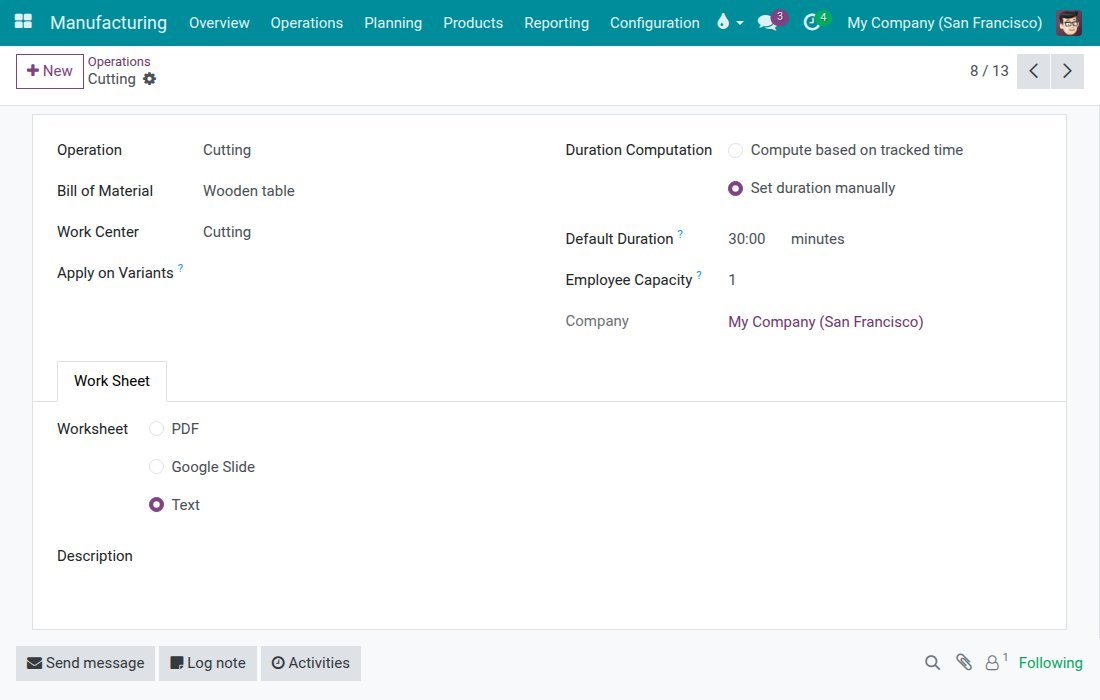
Example: on the operation form, the work instructions can be a PDF file, a slide deck or a written note.
Today's standard is the base for tomorrow's improvement
A standard is not frozen. In Kaizen, standard work is the reference that makes improvement visible: without it, nobody can tell whether a new method is better or just different. When an operator finds a better way, the team tries it, confirms the result and updates the instruction. The new standard then holds the gain so the floor does not slide back.
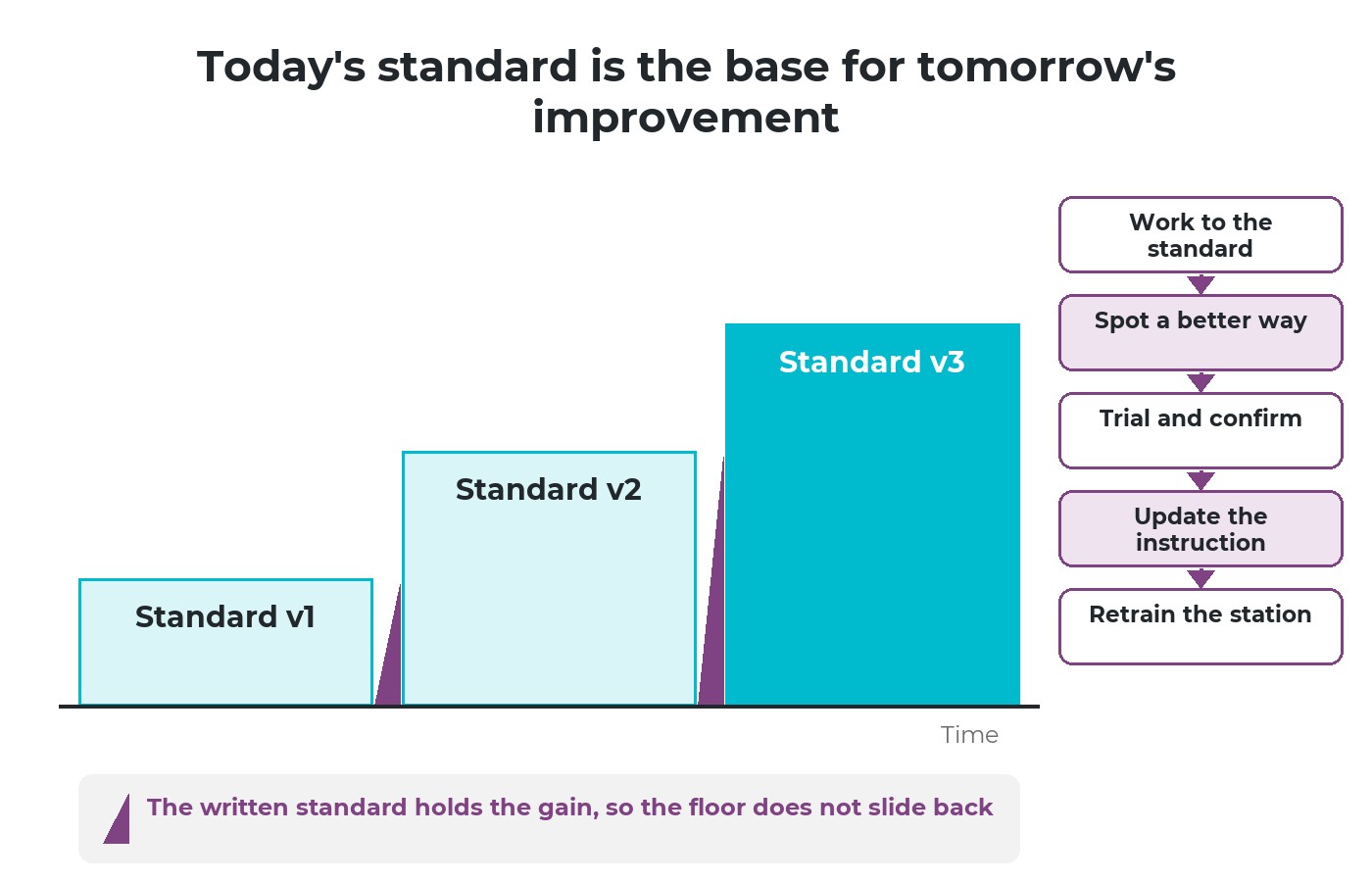
Each confirmed improvement becomes the next written standard, and the written standard keeps the floor from sliding back.
This order matters for technology too: tools that automate a process copy whatever method they are given, which is why it pays to standardize before you automate.
One current version, controlled changes
An outdated instruction at the station is worse than none, because it looks authoritative. Each operation needs exactly one current version, a named owner, and a simple path for changes: who proposes, who approves, from which date it applies, and who must be retrained. Engineering changes to a product or its operations follow the same logic, covered in change management in manufacturing.
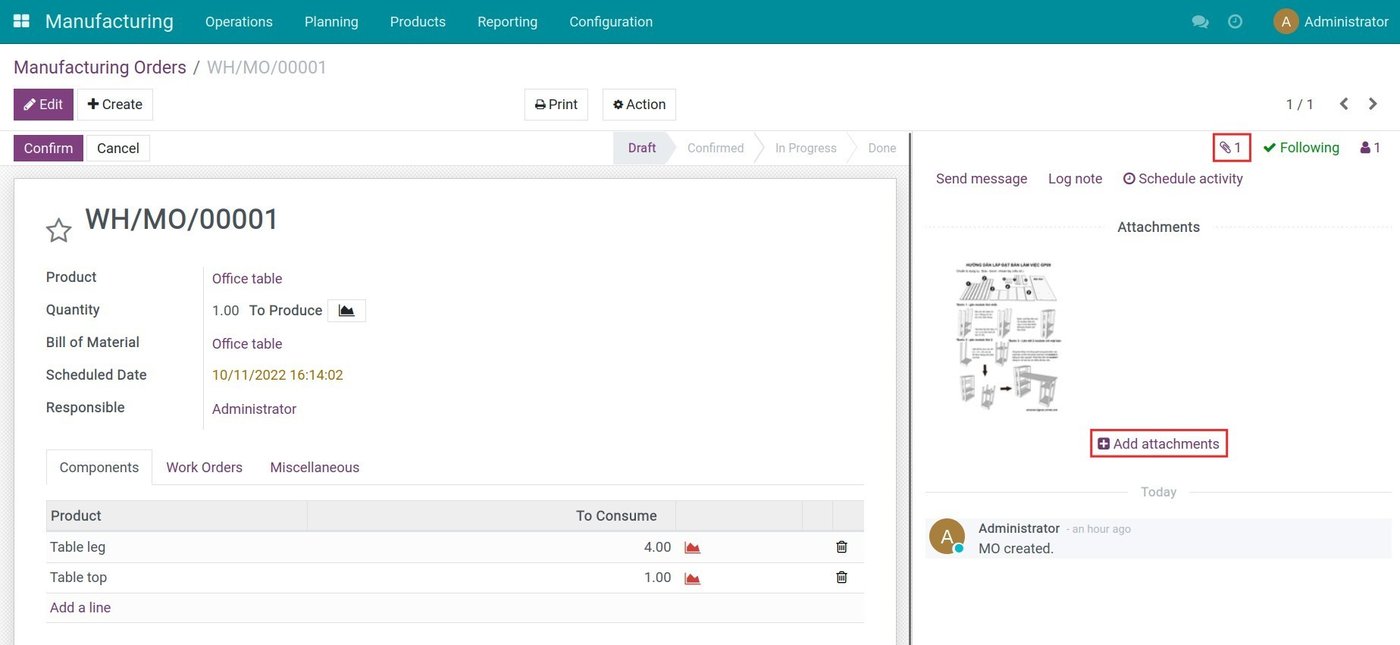
Example: an assembly drawing is attached to the manufacturing order, so the documents of the order are kept in one place.
Training new operators with instructions at the station
Most plants train by shadowing: the newcomer stands next to an experienced operator and copies. It is slow and copies habits along with skills. Each trainer teaches a slightly different method, so variation spreads.
A tested alternative dates back to the Training Within Industry programme of the 1940s, whose job instruction method is still used in lean plants. It works best when the written standard and the trainer use the same steps and key points.
Prepare
Put the learner at ease and show the finished result and why it matters.
Show
Do the job step by step from the instruction, stressing each key point and its reason.
Try out
The learner does the job and explains the key points; mistakes are corrected on the spot.
Follow up
Check often at first, then less, and record when the person can work alone.
The instruction at the station keeps working after the trainer has left. A newcomer who forgets a step opens the instruction for that operation instead of guessing or waiting. When an operation has no instruction at all, that empty space is itself useful information: it shows where the know-how still lives only in someone's head.
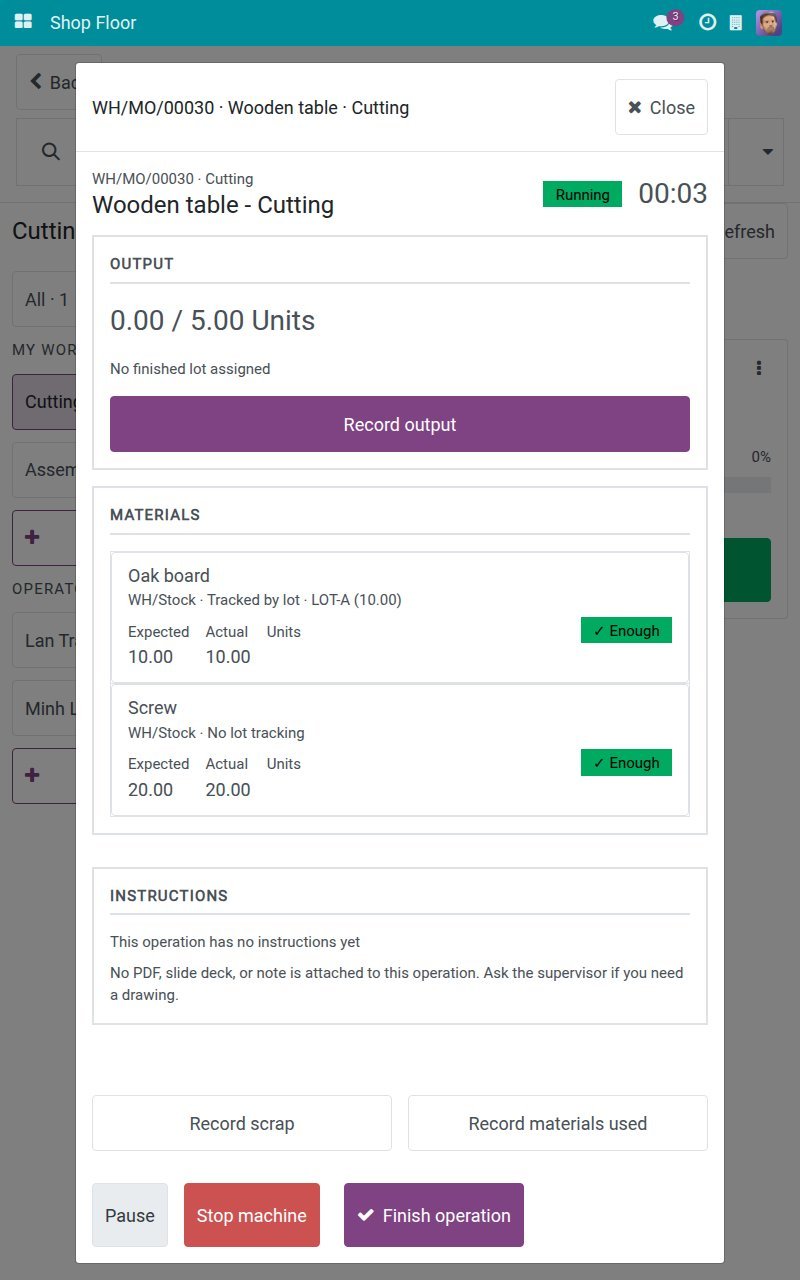
Example: the work screen at the station has an instructions panel; this operation has none attached yet, so the screen tells the operator to ask the supervisor.
A skill matrix: who can run which machine
Standard work answers how a job should be done. A skill matrix answers who can do it. It is a simple grid: people in rows, machines or operations in columns, and in each cell a level, from not trained to able to train others.
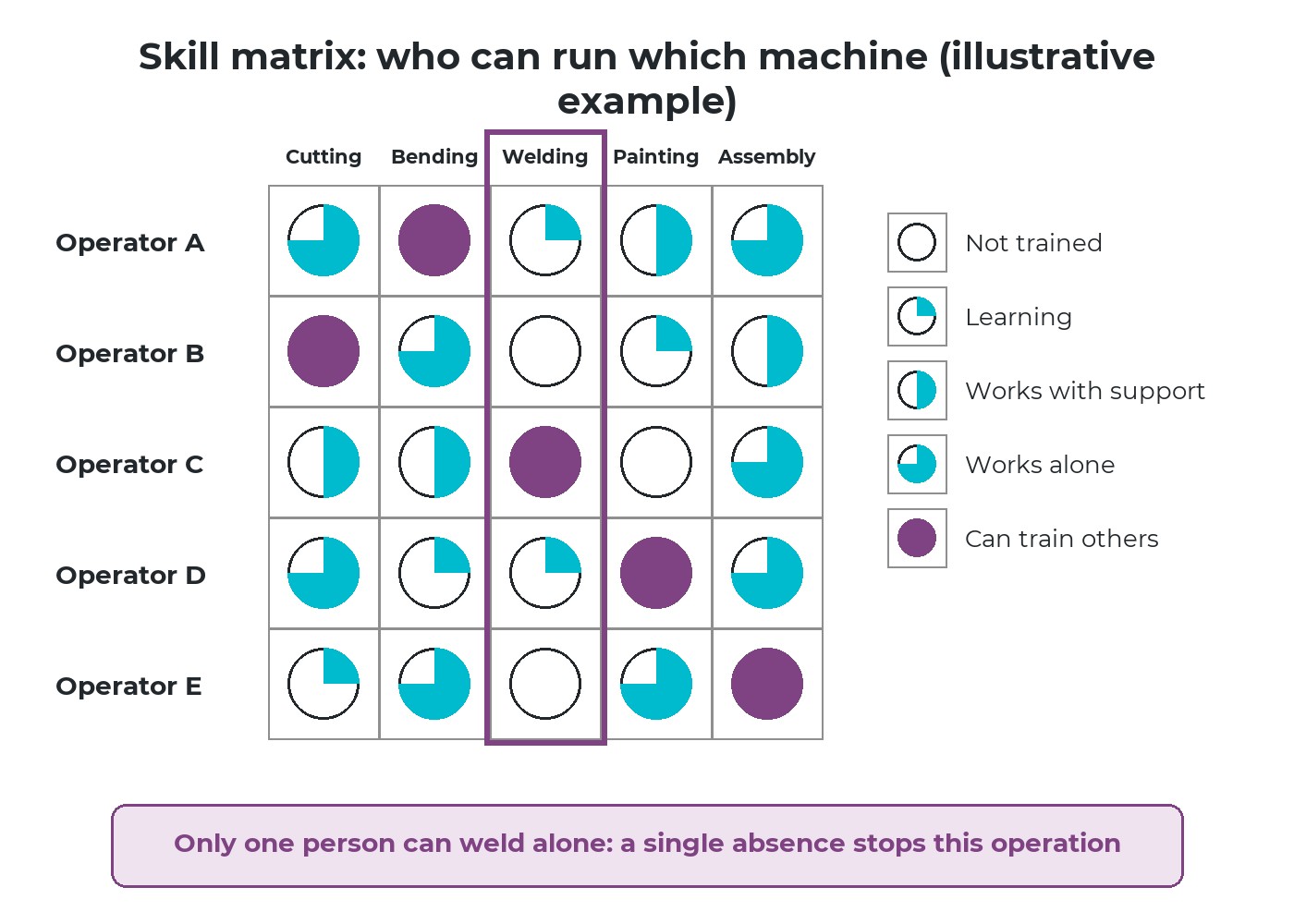
Illustrative example: a column with only one person able to work alone is a single point of failure.
Read by column, the matrix shows risk: an operation that only one person can run alone stops when that person is absent. Read by row, it shows each person's growth path. Read before the shift, it tells the team leader whom to assign where, and which pairing turns a busy day into a training day.
A common rule of thumb is to have at least two or three people able to run each critical operation alone. Levels should be confirmed by observation against the standard, not self-declared, and updated whenever the standard changes.
A plant does not own its know-how until it is written in the standard and spread across more than one person.
Technology for standard work, in three levels
The three levels from the pillar article apply here as well, and the order matters more than any single tool.
Level 1 - Digitize people's work
Instructions attached to each operation and opened at the station; work recorded by person; skill levels kept in one list instead of in the team leader's memory.
Level 2 - Connect machines
Machine settings and readings are captured from the machine, so the plant can compare how each operator actually runs the job against the standard.
Level 3 - Analyse and assist
Results compared by person and by method show which practice is best; assistants that answer questions from the plant's own standards come last, once those standards exist.
Signs it is time to move up a level: most critical operations already have a current instruction; skill levels are reviewed regularly; and the remaining differences between operators come from machine settings that are hard to see by eye. Using AI before that point means teaching it habits instead of standards, as discussed in when to use AI in Kaizen and ERP.
Six questions to assess standard work in your plant
Entries
What does an operator get back from each entry they make at the station?
Dependence
If your best operator left tomorrow, which operations would slow down or lose quality?
Instructions
How many critical operations have a current instruction at the station, with key points?
Changes
When someone finds a better method, who updates the instruction, and how fast?
Training
How long does a new operator take to work alone, and is that time measured?
Coverage
For each critical machine, how many people can run it alone today?
The question with the weakest answer is usually the best place to start.
How Viindoo supports standard work
At Viindoo, instructions, manufacturing orders and the tablet at the station share one platform, so the instruction an operator opens is the one attached to that operation. The table shows what exists today and what stays with the plant's own procedure.
| Topic | In Viindoo |
|---|---|
| Instructions | Available: a PDF, a slide deck or a written note attached to each operation of the bill of materials, opened full screen on the Shop Floor tablet; drawings and documents attached to the manufacturing order |
| Changes | Available: engineering change orders that create a new revision of the bill of materials and its operations, applied at once or from a chosen date, with an approval step as an option |
| People | Available: work time recorded per person at the station, and recording for someone else allowed only to production administrators; employee skills with levels, and required skills per job position |
| Not yet available | Step-by-step instructions confirmed by the operator, a code on the machine that opens its instructions, a matrix of who may run which machine, and shift rosters; skills are not linked to machines or operations. AI search across plant know-how is a direction of development |
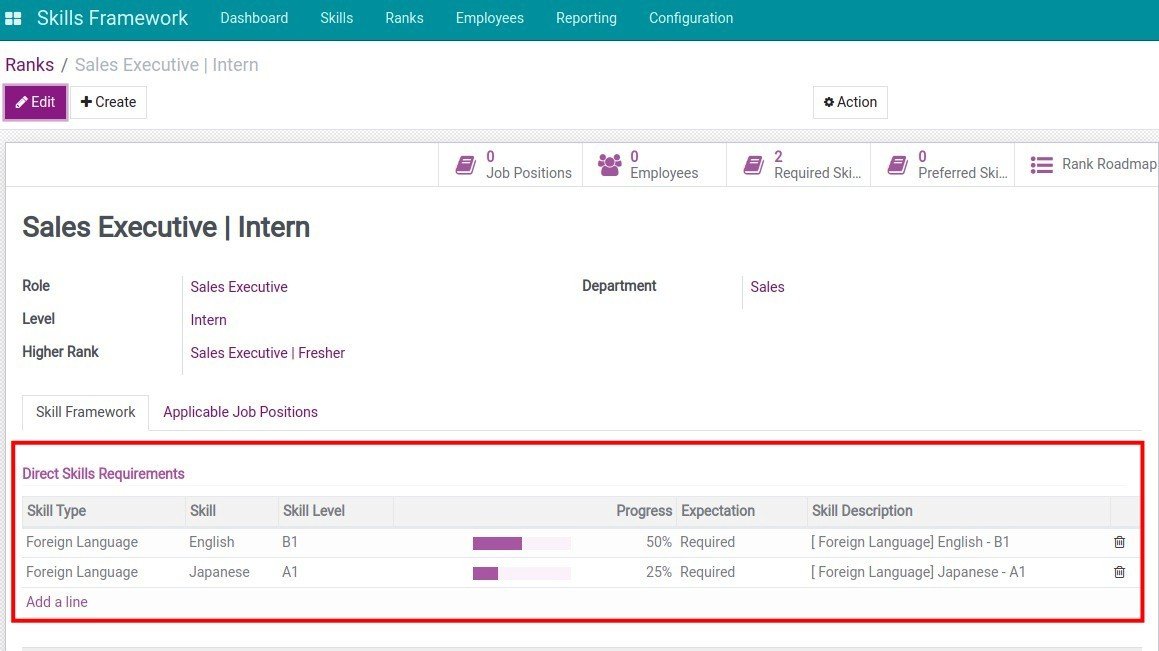
Example: a job position lists its required skills and the level expected for each; the skill matrix by machine is still kept by the plant's own procedure.
Frequently asked questions
Look for the reason first. Often they fear losing their value or being judged. Involve them as authors of the standard, recognise them as trainers, and make the skill matrix part of how seniority is rewarded.
A short video helps for movements that are hard to describe. Keep the key points in writing as well, because they are faster to check and easier to update when the method changes.
Start with the two or three operations that cause the most defects or depend on a single person. One page per operation, written with the best operator, is enough for a first round.
No, if changes have a clear path. The standard gives a fixed point to compare against, so a better idea can be proven and adopted by everyone instead of staying one person's trick.
Want to know which operations in your plant depend on one person? Book a shop floor assessment with Viindoo: we walk the line with you, map instructions and skills per operation, before talking about software.
Next in the series: step by step, when to connect machines, when to use AI, and why many plants stop halfway.
Related articles