Delegating authority is the half most people skip. You think your team lacks initiative. In fact you handed them the responsibility and kept the right to decide - so they cannot finish, they can only come and ask. Every time they ask, the work stops and waits for you.
A day in the life of the person in charge
Ten in the morning, someone knocks to ask whether they may order this. Eleven, someone else asks whether they may give that customer a discount. Early afternoon, a third person asks whether the delivery date can be moved.
Each question is small. Three minutes to answer. But they cut into whatever you were doing, and after each one you need another ten minutes to find your thread again. By the end of the day you have been busy without finishing anything of your own.
The familiar explanation is that people lack initiative. But look again at those three questions: not one of them asks how. All three ask whether they are allowed. That is not a question of ability. It is a question of authority.
Delegating means handing over three things, and most of us hand over one
When you hand out a task, in theory three different things travel with it:
Responsibility
The duty to get it done. This one is almost always handed over, because it is the easiest to say out loud: this one is yours.
Authority
The room to decide in order to finish: how much may be spent, what may be promised to a customer, how far a date may move. This one usually stays behind, often without anyone noticing it stayed.
Accountability
The duty to answer for the result. This one tends to be left hanging: when the work goes wrong, it is not clear who has to explain.
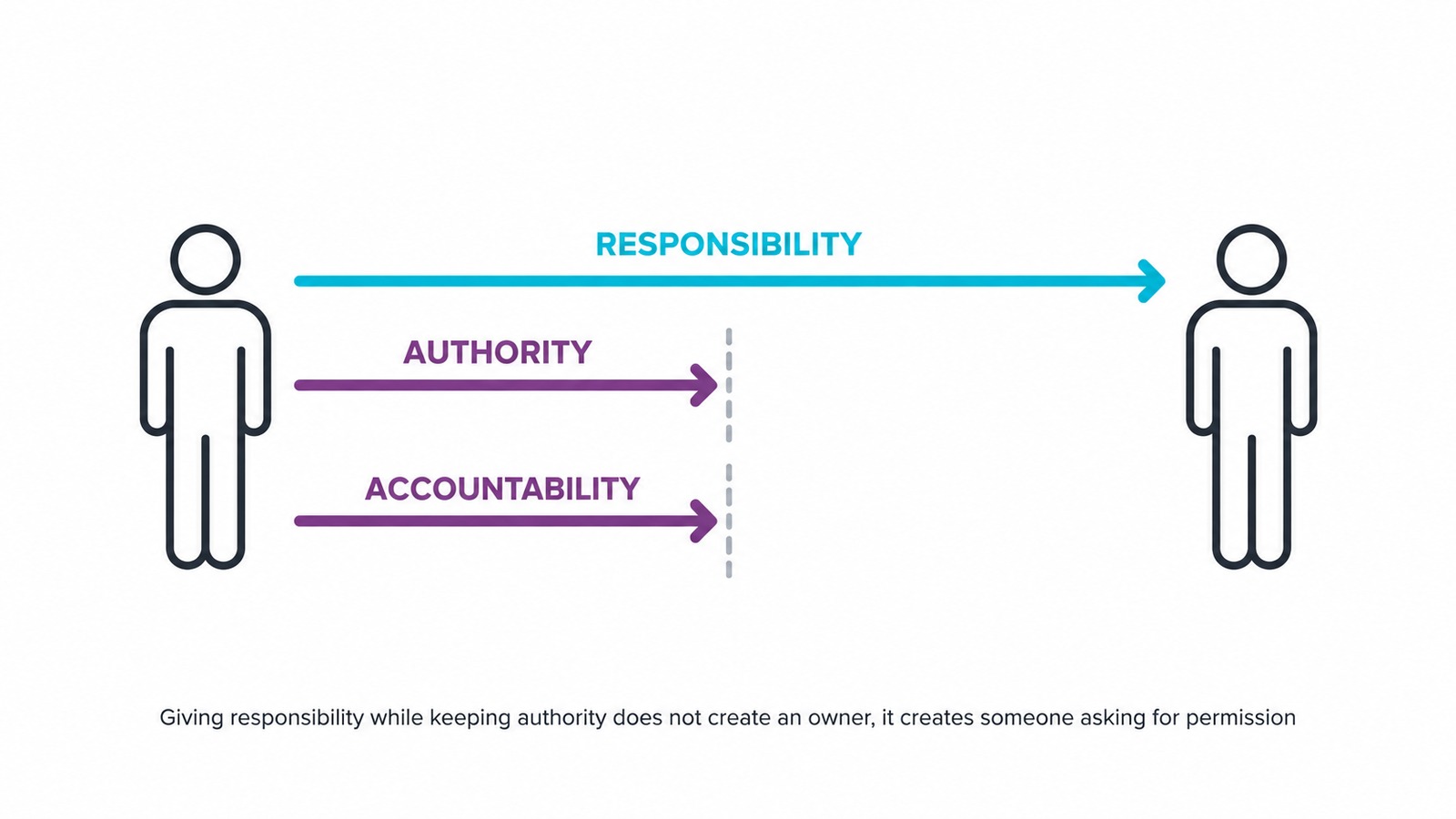
Responsibility travels. Authority and accountability usually do not.
The principle at work here is correspondence: authority has to be large enough to carry the responsibility handed over. Hand over responsibility while keeping authority and you do not create someone who owns the work. You create a messenger - someone running back and forth between the work and you.
And none of this shows up in any assignment list. An assignment list records who does what. It does not record who may decide how far.
Four signs an organization hands over work without the authority to do it
A queue outside your door
Every day someone comes in to ask about work that repeats. The same kind of question, only the number changes.
Work stops when you are away
Three days on a trip, and you come back to a pile of work standing still waiting for a signature. Nobody is at fault - they had no authority.
People ask about things they could decide
This one is easily misread as a lack of confidence. Usually they are simply being careful: nobody has stated the boundary, so asking is safer than deciding.
Nobody has to explain when it goes wrong
The doer says they asked first; the approver says they only nodded at what was proposed. Accountability falls into the gap between them.
Why leaders stop short of delegating authority, even knowing they should not
Few people hold back from delegating authority because they enjoy control. The reasons are usually more practical: nobody has written the boundary down, so "just be proactive" leaves both sides guessing; there is no way to tell who decided what, so letting go leaves no trail to follow when something breaks; and risk is not graded, so a decision worth a few hundred and a decision worth a few hundred million are treated the same and both have to pass through you.
None of these are personality problems. They are the absence of a place to record the boundary - and that is something software can provide.
How it gets solved
What you need is not the resolve to let go. You need somewhere that records how far each person may decide, so that anything beyond it is stopped by the system instead of by you.
A limit: below it they decide, above it they need you
This is the concrete part. In Viindoo's Purchase app you switch on two-step approval and set an amount. From then on, delegating authority stops being a speech and becomes a rule the system enforces:
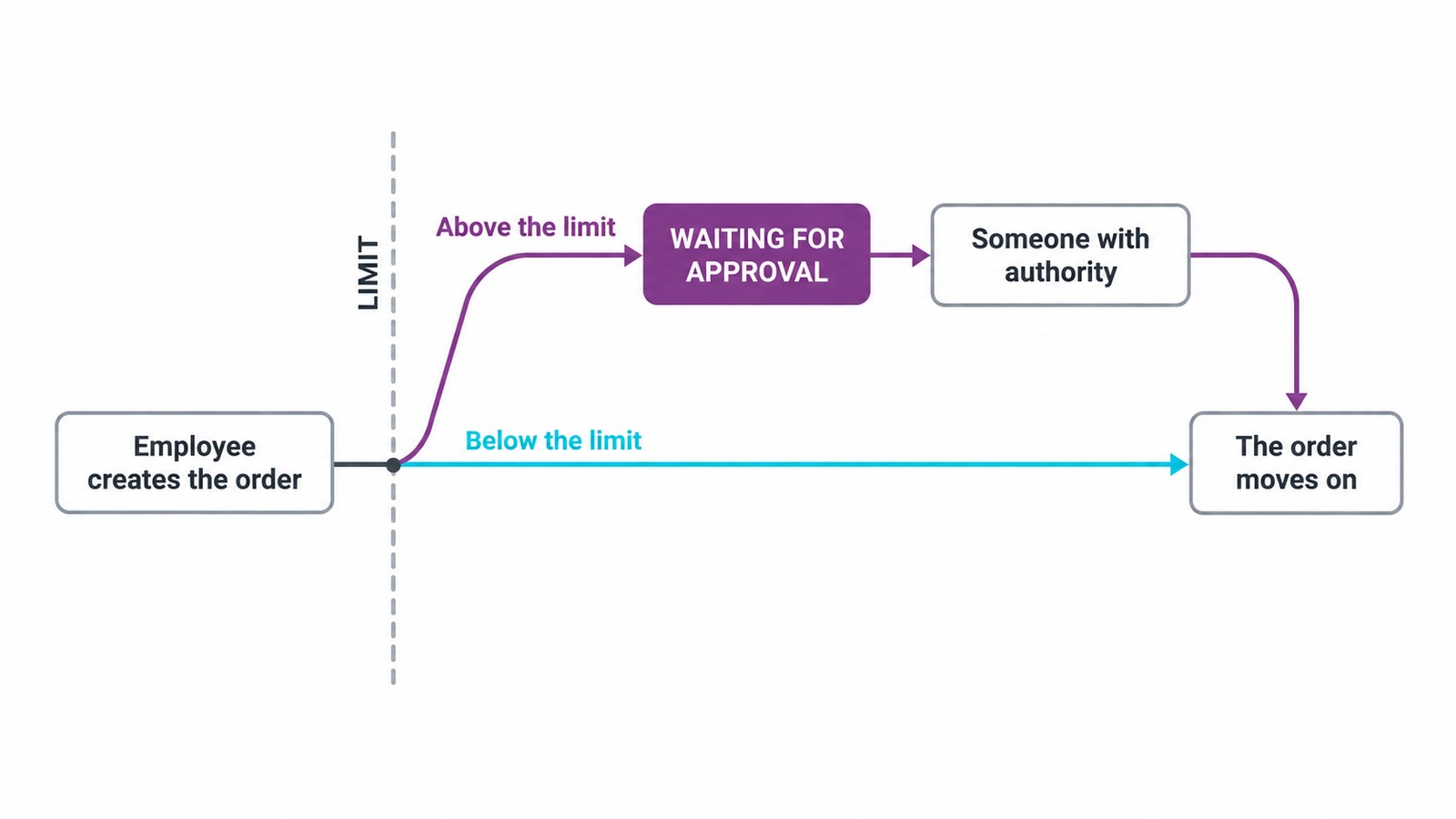
One rule, two paths. The short path is the point: most orders should take it.
- A purchase officer raises an order below the limit, hits confirm, and the order moves straight on. Nobody has to approve it.
- The same person raises an order above the limit, hits confirm, and the order does not move. It goes to Waiting for approval and stays there until someone with the right to approve handles it.
- Someone who holds purchase approval rights confirms straight through at either amount.
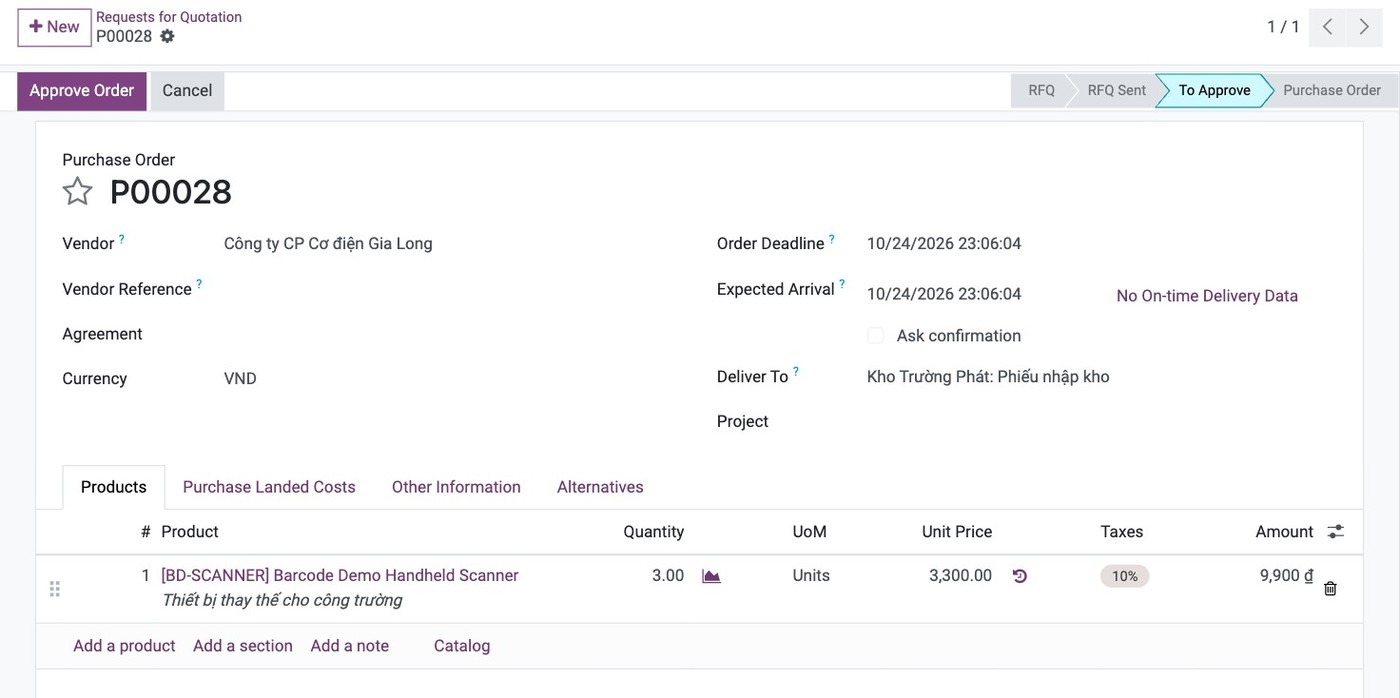
The order above the limit after the employee pressed confirm: it stopped at Waiting for approval.
That is delegating authority with a boundary the system can see, and it is the correspondence principle written into software. Within the limit the person holding the work has enough authority to finish it; beyond the limit the decision comes back to you. And it is a real stop, not a reminder.
Who does the approving
For the things that do need approval, Viindoo has a shared Approvals app. You create a request type, then pick the approver by one of several routes.
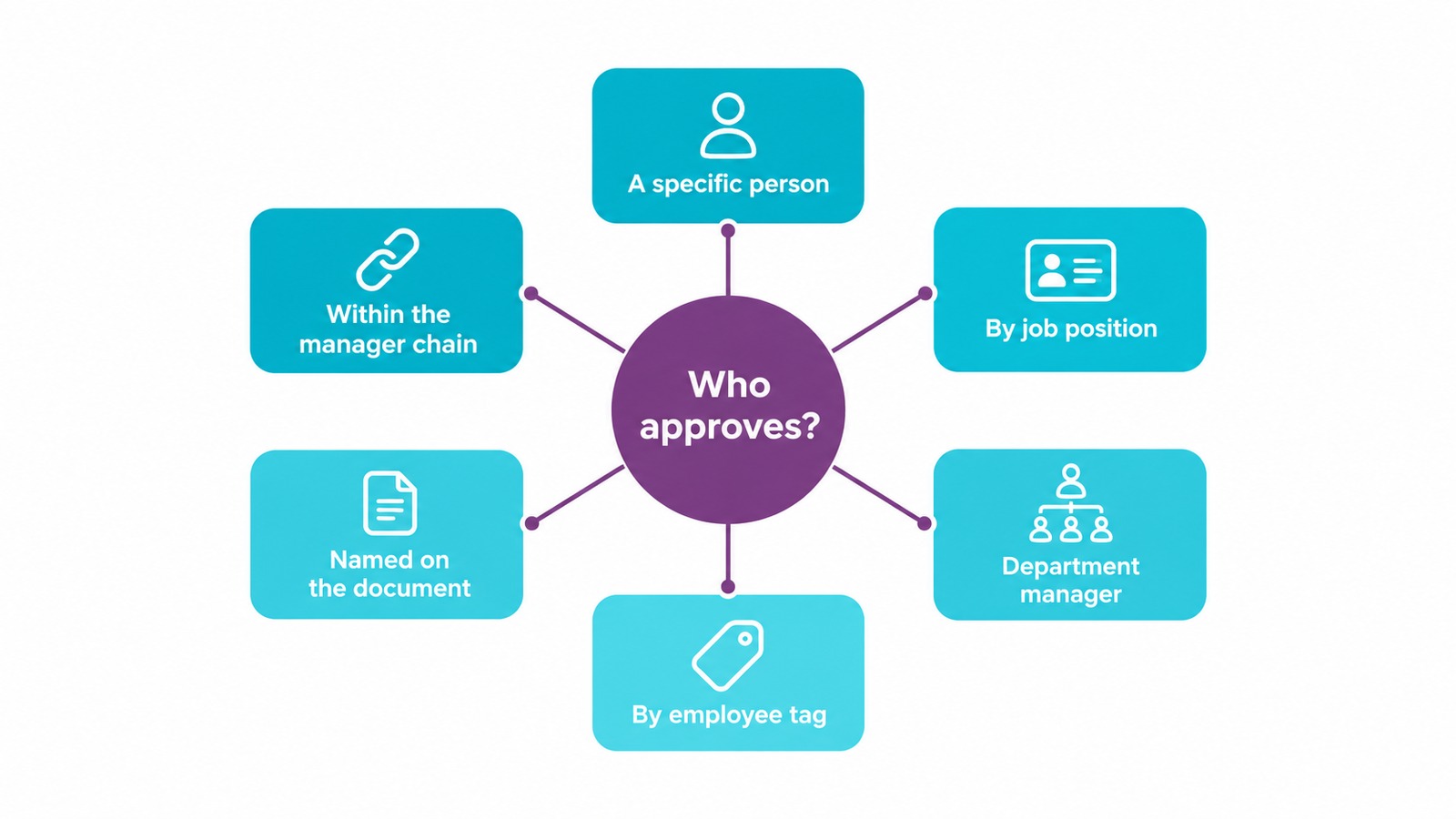
Choosing by job position or by department manager is the most durable: people change, the flow does not.
Several levels, and not every level needs everyone
One request type can hold several approval levels in sequence. At each level you set a minimum number of approvers, and you can switch on the option where any one person at that level is enough. That way urgent work does not wait for a full house.
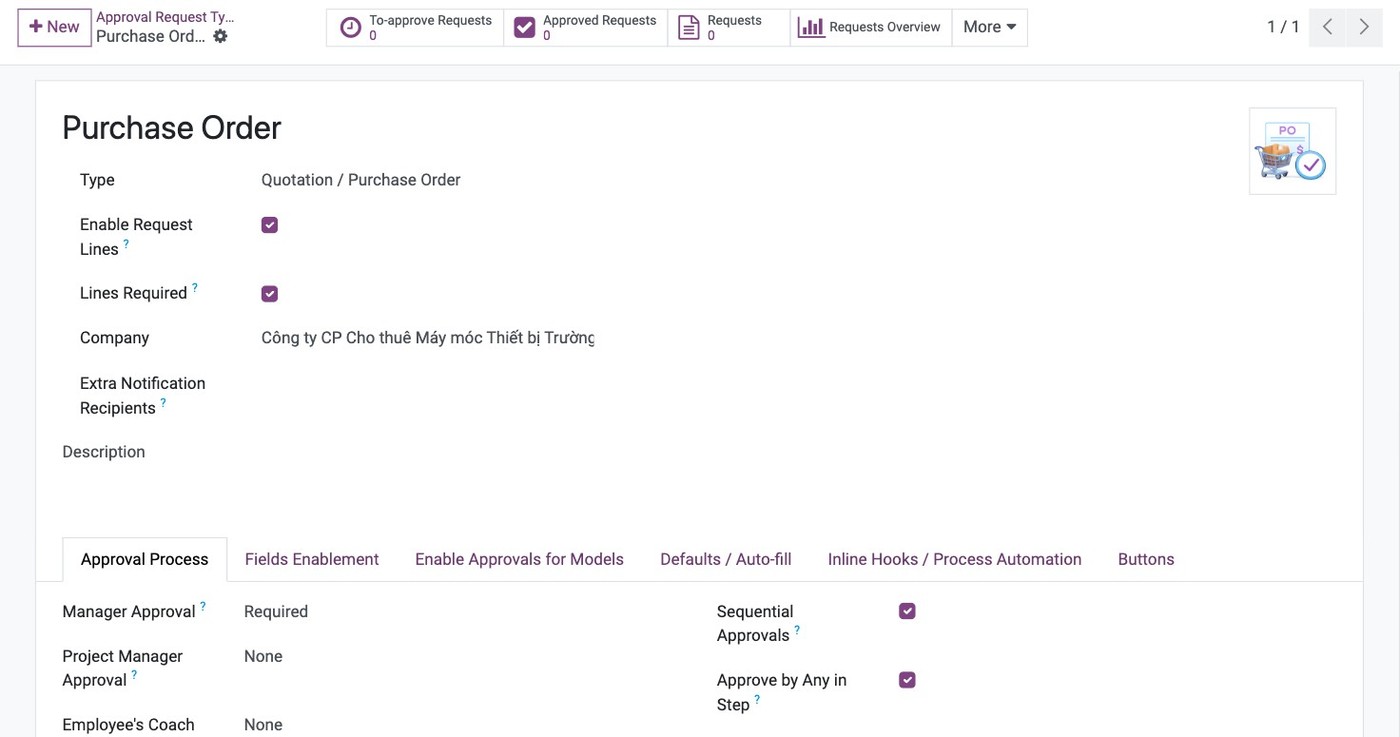
The approval flow of one request type: sequential, with any one approver per step being enough.
Document types that already ship with an approval flow: purchase orders, sales orders, customer invoices, vendor payments, refunds, internal transfers, deliveries, employment contracts, payroll, employee advances, maintenance, projects - and tasks. Which means the work you handed out in the previous article can be sent for approval too.
Refusing requires a reason, and everything leaves a trace
When an approver refuses, the system opens a box that requires a reason - it cannot be left blank. The reason stays on the request. Who approved, who refused and when are all recorded and shown in the message thread of the document itself. That answers the second reason above: you can let go of the decision and still follow the trail.
No stand-in approver while someone is away. Viindoo has no way to appoint a temporary approver for a period of absence. If an approver is off, an administrator has to approve in their place or edit the approver list by hand.
In the Approvals app, an amount threshold is not a plain number field. It is written as a condition on each approval level, and that box is only visible to users with approval administrator rights. The purchase threshold described above is different: it is an ordinary amount field that anyone who can configure Purchase may set.
On purchase and sales orders, the approval coverage state is there to be seen, not to block. The Approvals app shows a ribbon on the form plus a filter and a list column telling you whether a document has been fully approved. What actually stops a purchase order from moving on is the two-step threshold described above. When you design the flow, do not treat the two as one thing.
Four questions to test yourself
How, or whether
The last three questions your people brought you - did they ask how to do it or whether they were allowed?
Written down anywhere
Is there anywhere in the company that records how far each role may decide?
Three days away
If you are away for three days, what stops - and does it deserve to stop?
Who explains
The last decision that turned out wrong - who had to explain it?
Through a limit, not through approving every single item. Set the threshold where a mistake would not hurt, then raise it as you see the decisions coming out right. Anything above it still comes back to you.
There is no general number. A practical way is to look back at the requests you approved over the last three months and find the band you nodded through almost without thinking - that band is costing both sides time.
Every decision inside the limit leaves a trace on the document, with the person's name and the time. Abuse shows up when you review - which is a different situation from today, where nobody knows who decided what.
The sign is not the headcount, it is how many times a day you get asked. When the same kind of question comes back for the third time in a week, it is time to write the boundary down.
Yes, and this is the case to prepare for. The workable answer is to put several people at each approval level and switch on the option where any one of them is enough.
See it on a real system
Delegating authority is easy to nod along to, but you only see it work when one order below the threshold runs straight through and one above it stops. Book a session and we will open both cases on the system so you can compare.
Related articles
- Delegation Is a Closed Loop. Where Does Yours Break?
- Should Automation Come Before or After Standardization?
- What Does Digitalization Help a Business "See" for Kaizen?
- Why Does Digitalization Sometimes Add Tasks? Does It Go Against Kaizen?
- Kaizen and Digitalization: How They Connect in Business Improvement