An inventory discrepancy, where the books say 120 and the shelf holds 104, is rarely a counting mistake. It is the sum of goods that moved without a record, under the wrong code or into the wrong place, and the gap grows a little every day until someone counts.
The short answer to "why do the books and the warehouse disagree?" is that the record and the goods were allowed to travel separately. Keeping them matched means closing those gaps where they open: at receipt, at the shelf, at dispatch and at every loss, then counting regularly to catch what still slips through.
Why an inventory discrepancy appears
Book stock is a calculation: opening balance, plus what was received, minus what was issued. Every movement that is recorded late, recorded wrong or not recorded at all leaves the calculation and the shelf a little further apart. The causes fall into four groups.
Moved, not recorded
Goods leave before the delivery note is entered, or arrive and are used before the receipt is recorded. The longer the delay, the more often the two never meet.
Recorded under the wrong item
Two similar items, one item known by several codes, a sale entered under the nearest match. One item ends up too high on the books and the other too low.
Right item, wrong place or lot
The total is right but the goods sit on another shelf or belong to another lot. Pickers cannot find what the system says is there, and the count of that location comes up short.
Losses nobody writes down
Breakage, expiry, samples, items taken for repair or internal use. Each is small, none has a document, and together they become the gap that nobody can explain.
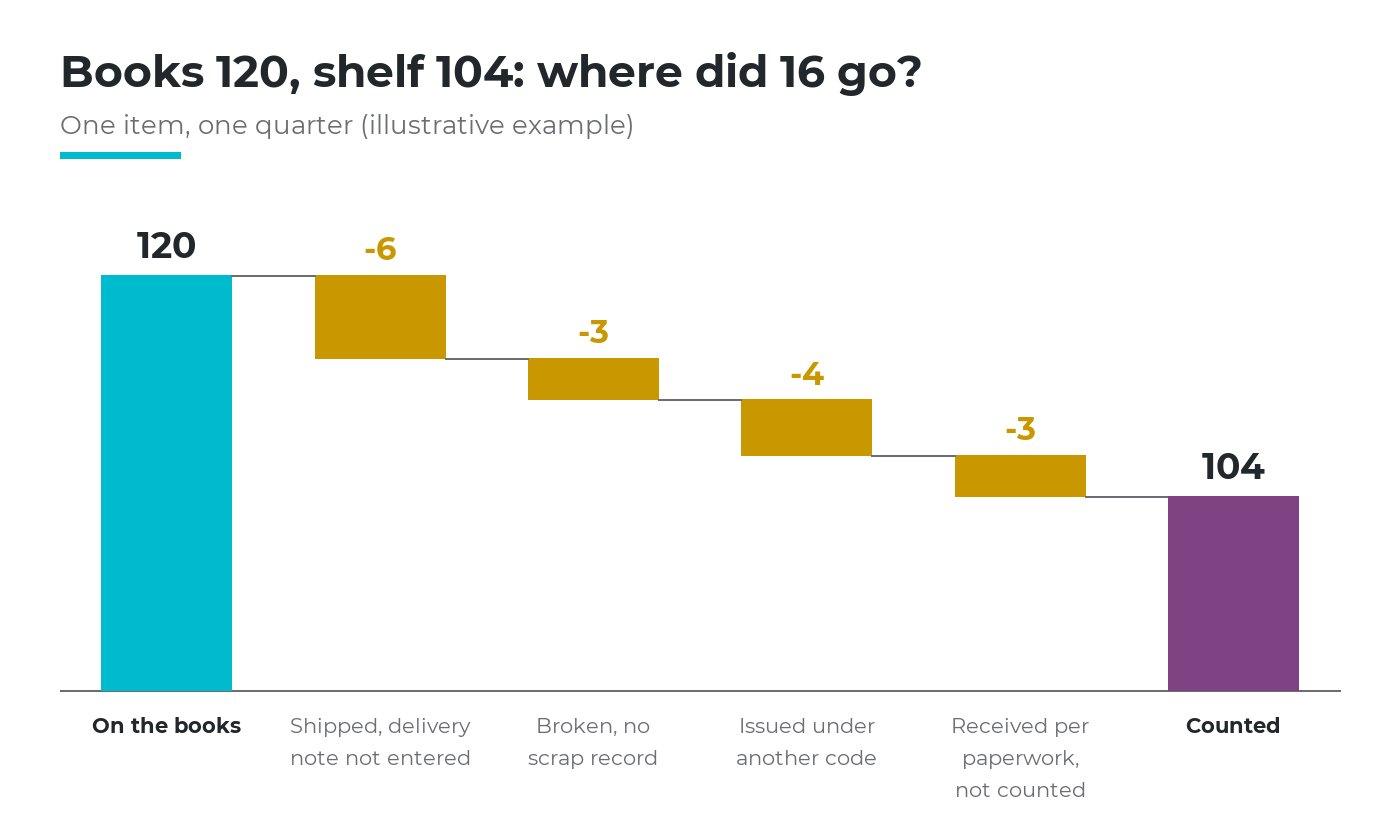
Books 120, shelf 104: the 16-unit gap is several small causes added together, not one big mistake (illustrative example).
None of these is about careless people. When the delivery note can only be entered at the office at the end of the day, it will be late. When one item has three codes, someone will pick the wrong one. When scrapping needs a form nobody has, breakage goes unrecorded. People bypass a process that does not fit the work; the fix is in the design of the process.
Control points that keep the books and the shelf matched
The principle behind a perpetual inventory system is simple: the record changes at the same moment the goods change. Each point where goods move needs one rule, and someone who owns it.
Receive what you count
Record the quantity actually received, not the quantity on the supplier's paperwork.
Store at an address
Every shelf or bin has a name and a label; goods are put away and moved by address.
Issue against a document
Nothing leaves without a delivery or issue record, entered when the goods leave.
Write off with a reason
Breakage, expiry and internal use each get a record and a reason, at the time they happen.
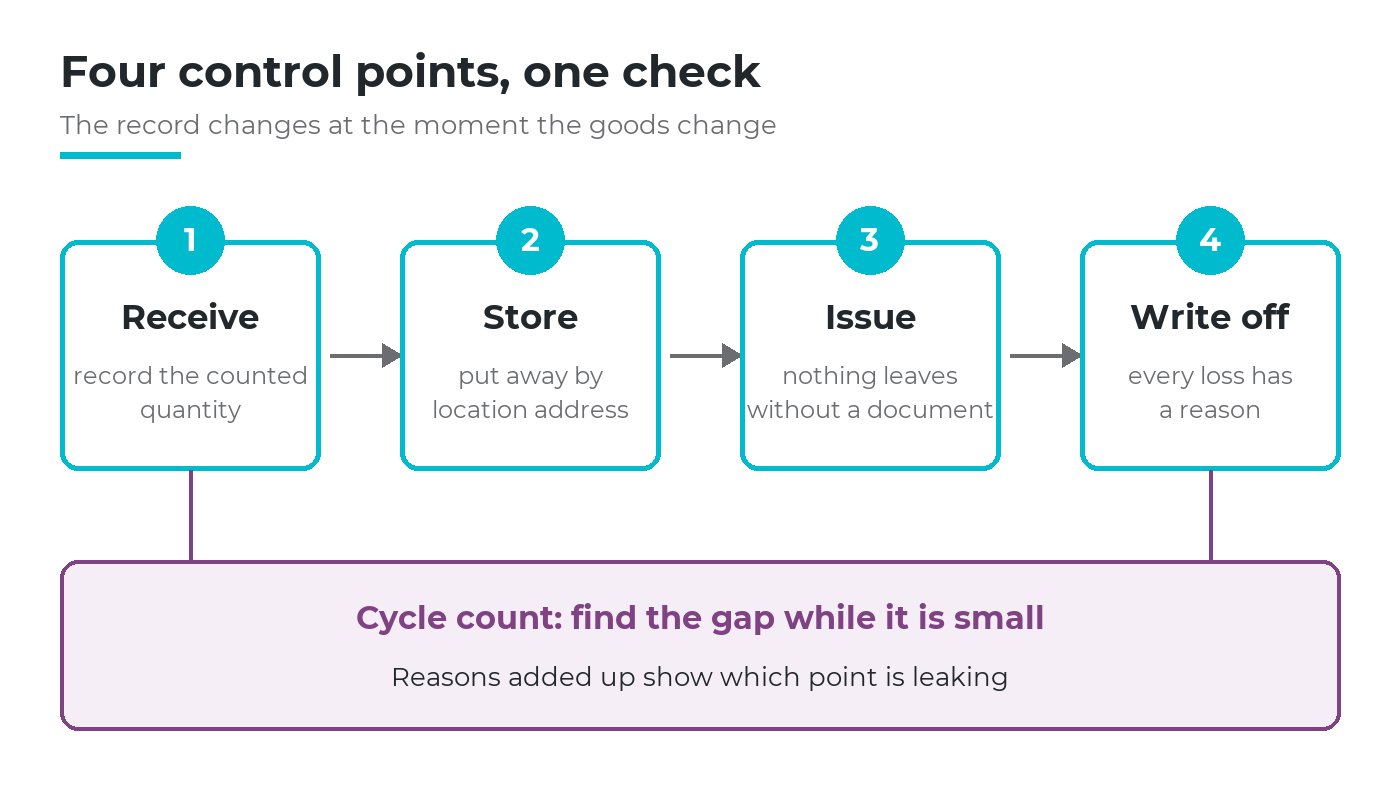
Four control points where goods move, and counting as the check that tells you which point is leaking.
One item, one code, many barcodes
Many items arrive with the manufacturer's barcode, carry a supplier barcode on the carton and an internal label on the shelf. The rule is that all of them point to one internal item code. If each barcode becomes its own item, the books split one stock into several, and every split is a future discrepancy.
Lots and serial numbers where traceability matters
For goods with expiry dates or warranty, tracking by lot (Lot) or serial number (Serial number) adds one more check: the right item is not enough, it must be the right lot. It costs a scan at each movement, so apply it to the items that need it, not to everything.
Negative stock and reserved stock are signals
A negative balance on the books means goods were issued that, according to the records, were never received. It is not a figure to correct at month end; it points to a receipt that was missed or an issue under the wrong item. Treat each one the day it appears.
Reserved stock works the other way. Goods promised to an order are still on the shelf, but are no longer free to sell. Separating on hand from available stops two salespeople from promising the same goods, a common source of disputes that later look like an inventory discrepancy.
Count to find the cause, not just to fix the number
A full count once a year produces one large difference that nobody can explain any more. Cycle counting, a few locations or items at a time on a fixed rhythm, finds an inventory discrepancy while it is small and the cause is still fresh. The method is covered in detail in the article on cycle counting.
Not every item deserves the same rhythm. Using the ABC principle, count high-value or fast-moving items often and the long tail rarely. The effort goes where a discrepancy costs the most.
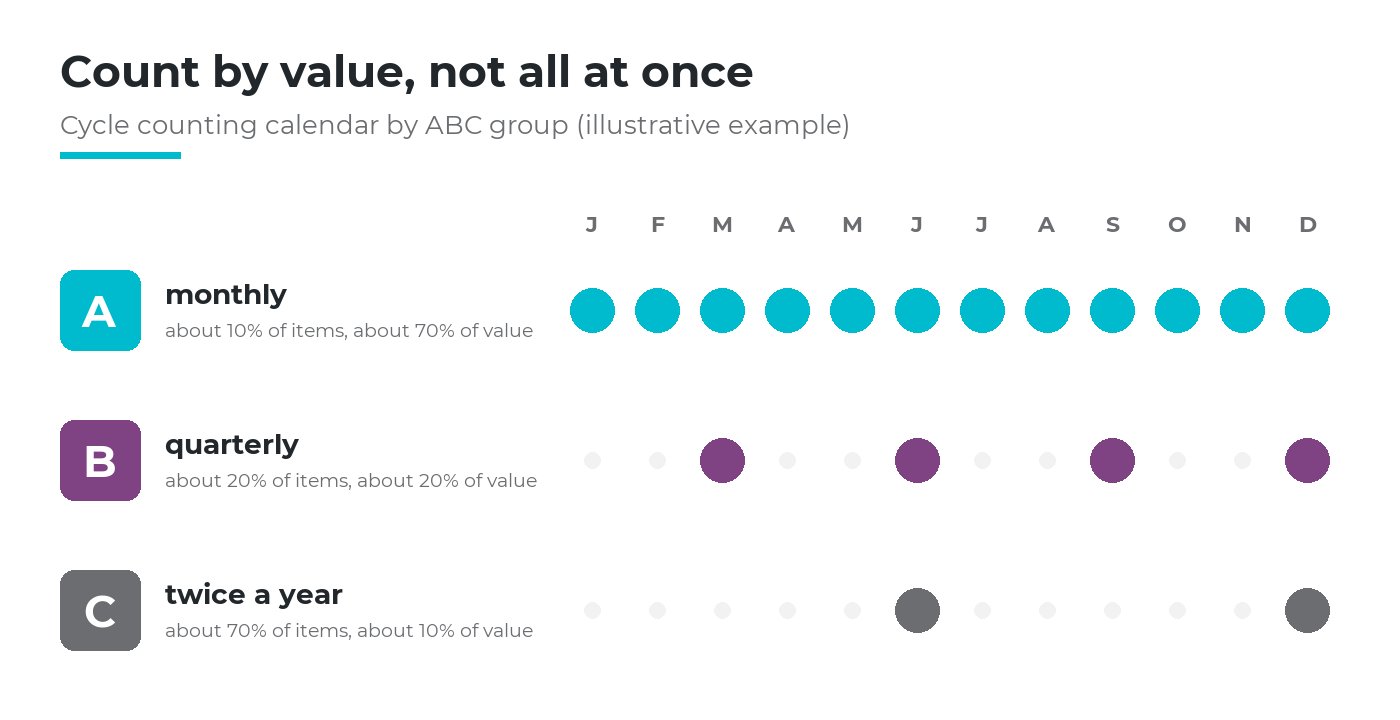
A counting calendar by ABC group: the few items that carry most of the value are counted every month (illustrative example).
Four rules make a count trustworthy. The general method, with templates, is in the guide to stock counting.
- Count without seeing the book figure. A counter who knows the expected number tends to find it. Hand out lists of locations and items, not quantities.
- Freeze or note movements during the count. Goods received or shipped while a shelf is being counted make the comparison meaningless unless the cut-off is clear.
- Separate counting from approving. The person who counts records the figure; a different person reviews large differences before the books are adjusted.
- Every adjustment carries a reason. "Breakage", "issued under wrong item", "receipt not entered". Reasons added up over months show which control point is leaking.
An adjustment fixes the number. Only the reason behind it fixes the process.
What an inventory discrepancy costs outside the warehouse
The warehouse feels a discrepancy first, but other departments pay for it. Sales promises goods that are not there. Purchasing reorders items that are already on a shelf somewhere. Accounting carries a stock value it cannot defend, and every adjustment moves the cost of goods sold.
Management numbers suffer too. Inventory turnover and days of stock are only as good as the stock figure they divide by. A business can believe it holds three weeks of stock while the shelf holds two. The general definition of what counts as stock is in the encyclopedia entry on inventory.
In manufacturing the same logic runs through raw materials, work in progress and finished goods, as discussed in material flow through the plant.
How software helps, and where it does not
Software cannot count the shelf for you. What it does well is make the right step the easiest one: scanning at the point of movement instead of typing later, one item record behind several barcodes, a location for every quantity, and a count list that is quick to prepare and compare.
It also keeps the trail. With a perpetual inventory record, every quantity on hand can be traced back to the receipts, issues and adjustments that made it, which is what turns an inventory discrepancy into a question with an answer.
An example on Viindoo
In Viindoo, the Inventory app records each control point described above. What it gives for each one:
| Control point | What Viindoo records |
|---|---|
| Receive and issue at the point of movement | The Barcode app lets staff receive, deliver, move, count and scrap goods by scanning products, lots and locations on a phone, tablet or scanner |
| One item, many barcodes | Additional Barcodes on the product: searching or entering any of them in a product field finds the same product |
| Locations and lots | Stock is held per location and, for tracked products, per lot or serial number; a transfer of a tracked product cannot be validated without one |
| Losses with a reason | Scrap orders with a scrap reason, moving the goods out of stock to a scrap location |
| Negative and reserved stock | A Negative Stock filter on stock quantities, and reserved quantity shown apart from quantity on hand |
| Counting | Count requests by date and person, a counting frequency per location and an annual count date, counted quantity against quantity on hand with the difference, and a reason entered when the count is applied |
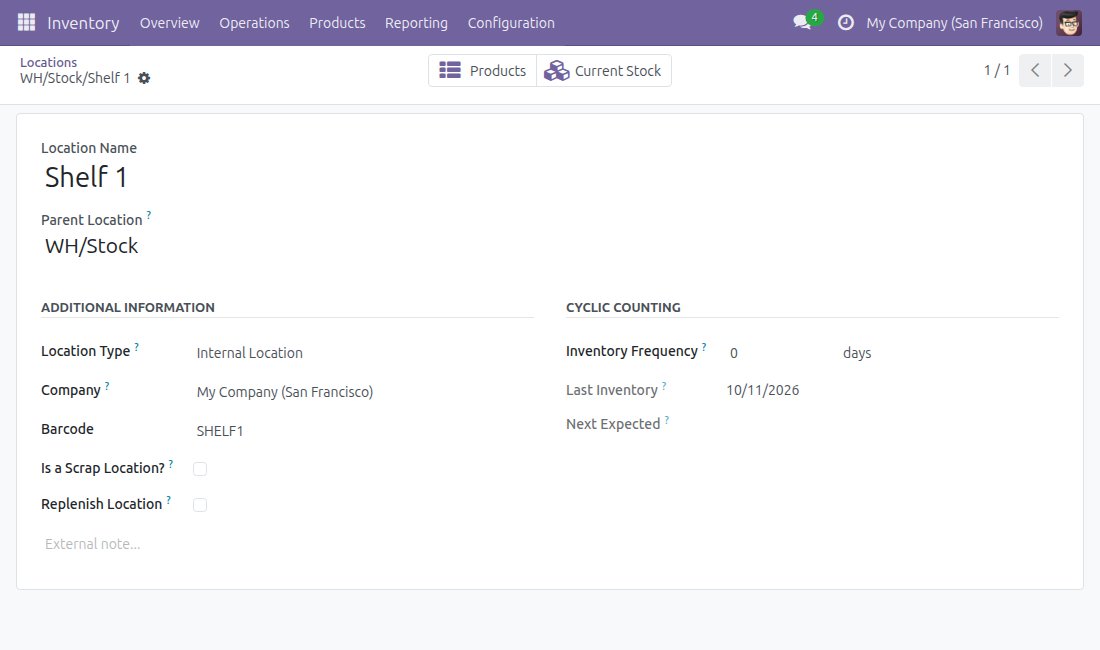
Example: each location has its own barcode and a cyclic counting section with frequency, last count and next expected count.
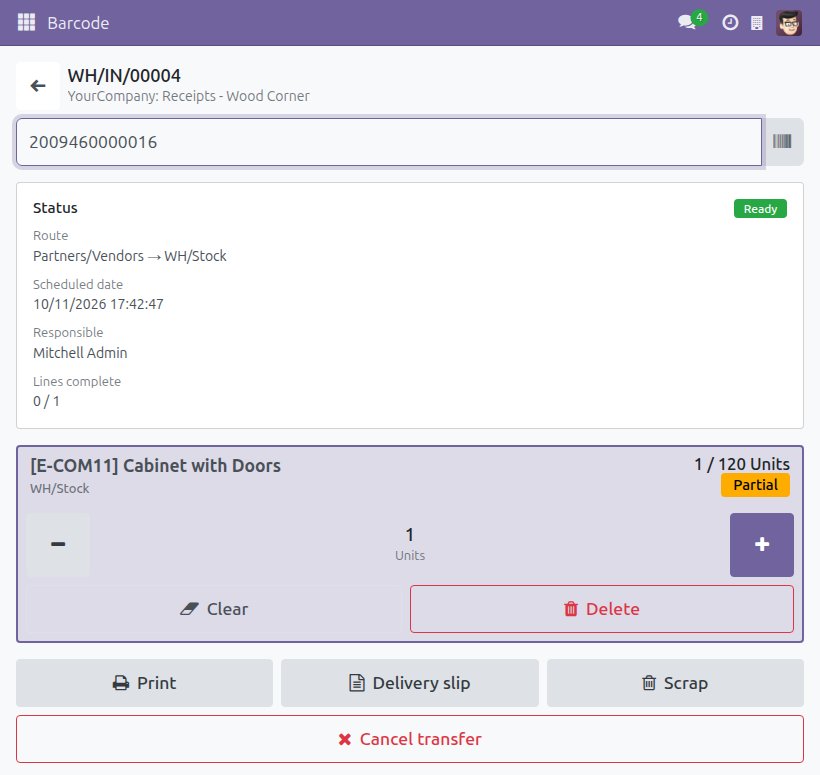
Example: on a receipt, each scan adds to the quantity received, so the record follows what actually arrived.
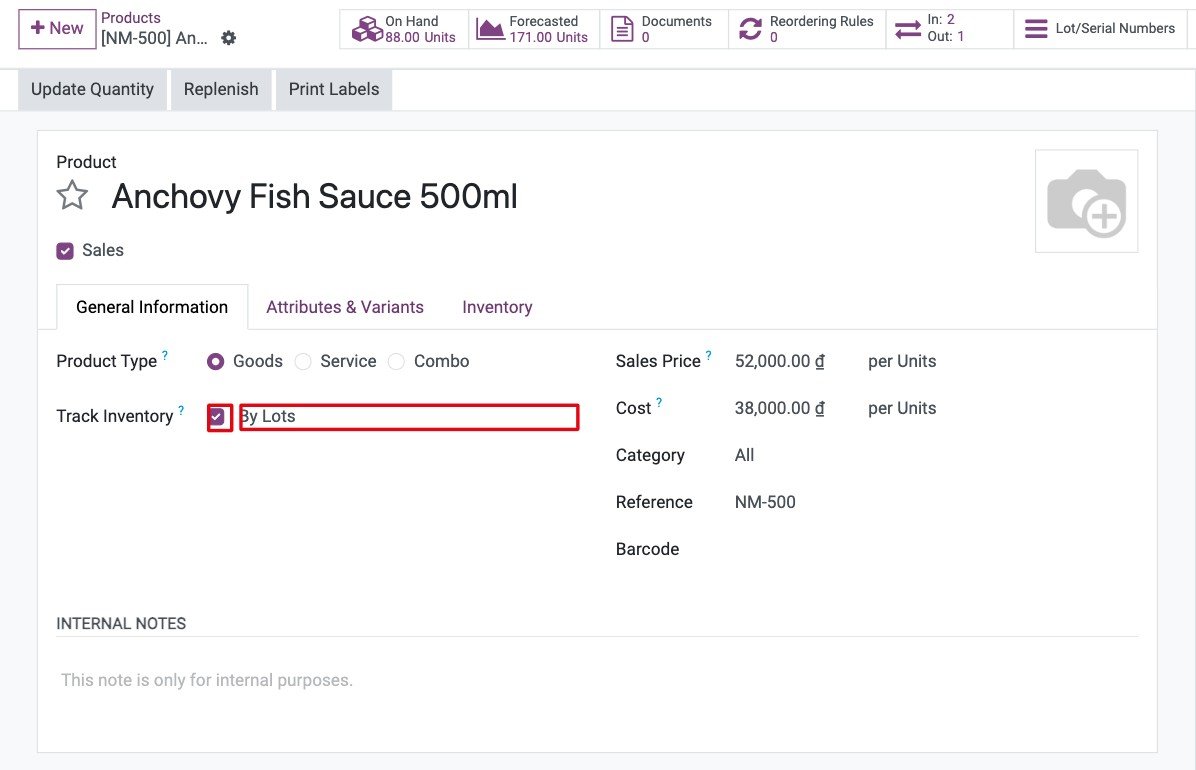
Example: a product set to track inventory by lot; every receipt and issue of it then needs a lot number.
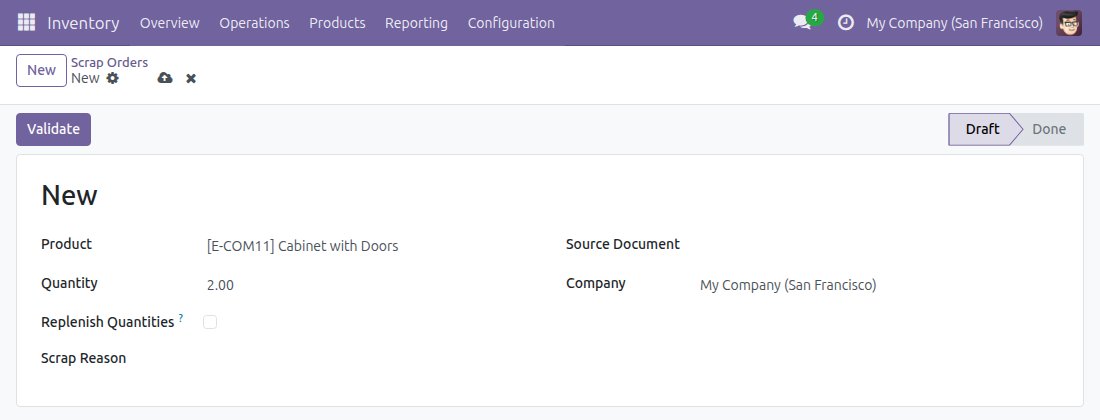
Example: a scrap order records the product, the quantity and the scrap reason, so losses leave a trail instead of becoming an unexplained gap.
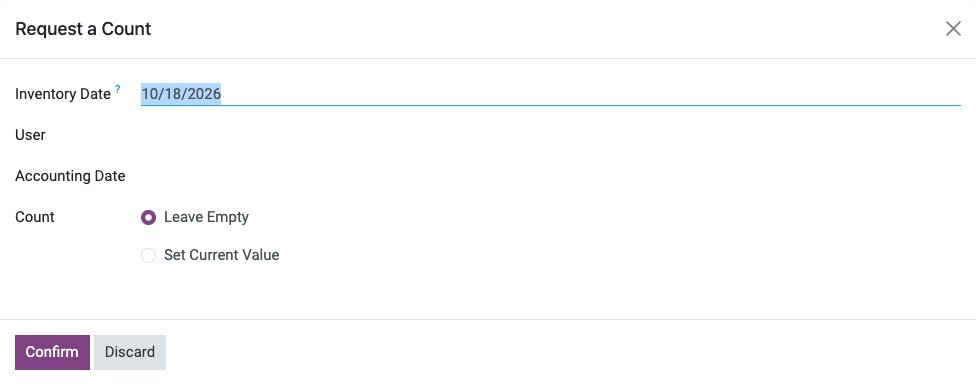
Example: a count request sets the inventory date and the person who counts. "Leave Empty" starts the count list without pre-filled quantities.
Two limits are worth knowing. By default, Viindoo does not stop an issue that takes the books below zero; it shows negative stock so that someone can investigate it. And the list of quantities shows the quantity on hand next to the counted quantity, so counting without seeing the book figure is a matter of how the count is organised, for example handing out lists of locations rather than the screen.
Asking AI about stock
Asked in plain language, Viindoo AI answers from the company's own inventory data, with sources you can click to open. Typical questions: which items have available stock below a threshold you give, which locations show negative stock, and how items rank in ABC groups by stock value.
AI only sees what the person asking is allowed to see: a warehouse employee does not see accounting figures without that permission. Finding the cause of a gap and deciding the adjustment stay with people.
Six questions to assess your inventory discrepancy risk
Timing
Are receipts and issues recorded when the goods move, or later at a desk?
Codes
Does every physical item have exactly one item code, whatever barcode it carries?
Locations
Can you say on which shelf a given quantity sits, not just in which warehouse?
Losses
Is breakage or internal use recorded with a reason on the day it happens?
Counting rhythm
Are high-value items counted more often than the rest, on a fixed calendar?
Reasons
For last quarter's adjustments, can you say which cause was most frequent?
Two or more "no" answers mean inventory discrepancy is being created faster than counting can find it. Start with the control point that answered "no" first.
Frequently asked questions
It depends on the item. Set a tolerance per group: tight for high-value or regulated items, wider for low-value consumables. What matters more is that every difference above the tolerance gets a reason.
Adjust once the difference has been checked: recount large gaps, look for unrecorded documents and goods in other locations first. Many apparent shortages turn out to be goods in the wrong place.
Accounting and tax rules may still require a year-end count. Continuous counting makes it shorter and calmer, because most differences have already been found and explained.
Is your warehouse never quite matching the books? Tell us where it hurts most. Book a consultation and we will look at one item's movements with you, or see the cost of starting with the Express package.
Related articles
- What is inventory turnover? Calculation formula and meaning
- Stock count: Method, process, and excel file template
- The Power of Cycle Count: Maximizing Inventory Accuracy
- Perpetual Inventory System: The Method and Application in Warehouse Management Process
- Inventory Reports: The Importance, Pain Points, and Solutions by Viindoo