Manufacturing BoM (Bill of Materials) is a crucial component in the production process, enabling efficient manufacturing management. By properly managing BoMs, manufacturers can streamline their operations, optimize resources, and ensure the timely delivery of high-quality products. In this article, we will explore the critical aspects of manufacturing BoM, discuss best practices for effective manufacturing management.
What is BoM (Bills of Materials)?
A Bills of Materials (BoM) is a comprehensive and structured list that outlines all the components, parts, materials, sub-assemblies, and instructions required to manufacture a final product. It serves as a critical reference document within manufacturing and production processes, providing a clear breakdown of the items needed for each stage of assembly.

A Bill of Materials (BoM) in manufacturing management
BoMs are utilized in various industries, such as manufacturing, engineering, construction, and electronics, to ensure accurate communication and coordination among different teams involved in the production cycle. They play a pivotal role in maintaining consistency, precision, and efficiency throughout the manufacturing process.
A typical BoM includes detailed information about each component, including part numbers, descriptions, and quantities, and often includes the relationships between components. This hierarchical structure allows for easy visualization of how parts fit together and how they contribute to the overall product.
There are different types of BoMs, each serving specific purposes:
- Engineering BoM (EBoM): Primarily used by design and engineering teams, an EBoM focuses on the product's design and structure. It includes all the components needed to create the product as conceptualized in the design phase.
- Manufacturing BoM (MBoM): This type of BoM is used by production and manufacturing teams. It includes additional details relevant to the manufacturing process, such as assembly instructions, manufacturing sequences, and specific quantities required for production.
- Sales BoM (SBoM): Used by sales and marketing teams, an SBoM emphasizes the final product as it will be sold to customers. It might include packaging details, optional components, or accessories.
>>>> Read more: Breaking Down the Differences: Production vs Manufacturing
BoMs are dynamic documents that can undergo revisions and updates as designs evolve, new materials are introduced, or improvements are made to the manufacturing process. Effective management of BoMs is crucial to ensure that all stakeholders have access to accurate and up-to-date information, minimizing errors, delays, and discrepancies during production.

Manufacturing BoM is an essential factor in the manufacturing industry
Confirming orders before the BOM is ready?
In Viindoo, confirming a sales order creates a draft production order even without a BOM. Engineering adds the BOM and confirms the order, so no order slips through.


How Does a Manufacturing BoM Improve Efficiency?
A manufacturing BoM is a comprehensive list of all the components, materials, assemblies, and sub-assemblies required to build a product. It serves as a roadmap for manufacturers, detailing the quantity and specifications of each item necessary for successful production. A well-structured BoM ensures accurate planning, efficient resource allocation, and seamless coordination throughout the manufacturing process.
By creating a detailed manufacturing BoM, companies can streamline their operations and enhance overall efficiency.
Precise Resource Allocation and Planning
A manufacturing BoM functions as a compass, guiding the allocation of resources with unparalleled precision. Detailing the requisite components and quantities empowers production managers to strategically plan material acquisition, labor allocation, and equipment usage. This meticulous foresight preemptively averts shortages, reduces wastage, and ensures a harmonious workflow, ultimately culminating in a more efficient production cycle.
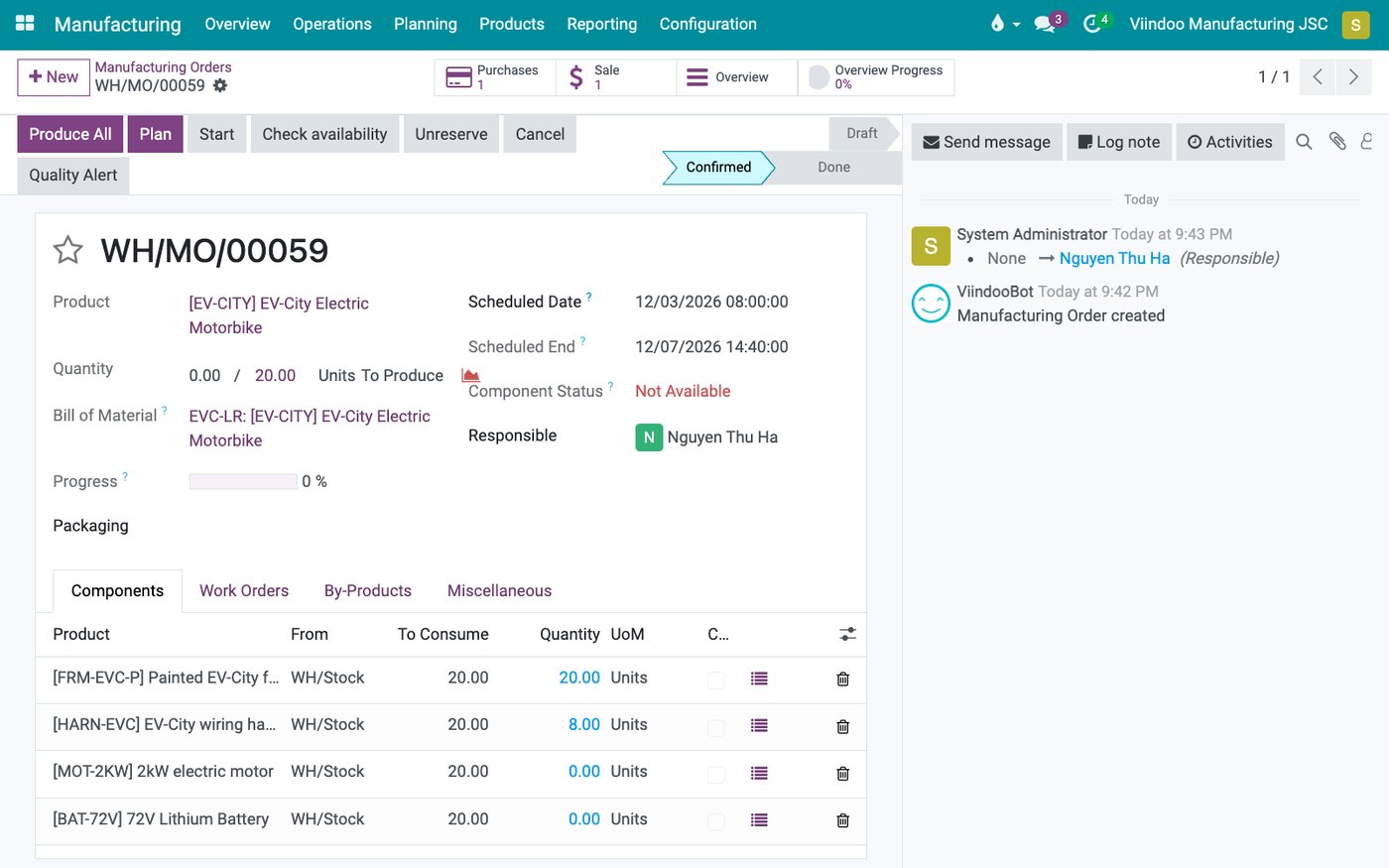
In Viindoo 18, a manufacturing order takes its components and quantities from the BoM: in this example, 20 motorbikes require 20 of each component. The manufacturing order also shows which components are not available in sufficient quantities.
>>>> Read more: Production Capacity Planning: Definition, Types, and Best Practices
Seamless Production Sequencing and Scheduling
Manufacturing BoMs are akin to a symphony conductor, orchestrating the intricate dance of production sequences. Each component's placement within the BoM delineates its chronological significance in the assembly process. This hierarchical arrangement aids in sequencing operations, optimizing the order of tasks, and minimizing idle time or bottlenecks. The result is a synchronized, uninterrupted workflow that accelerates throughput and expedites the manufacturing timeline.
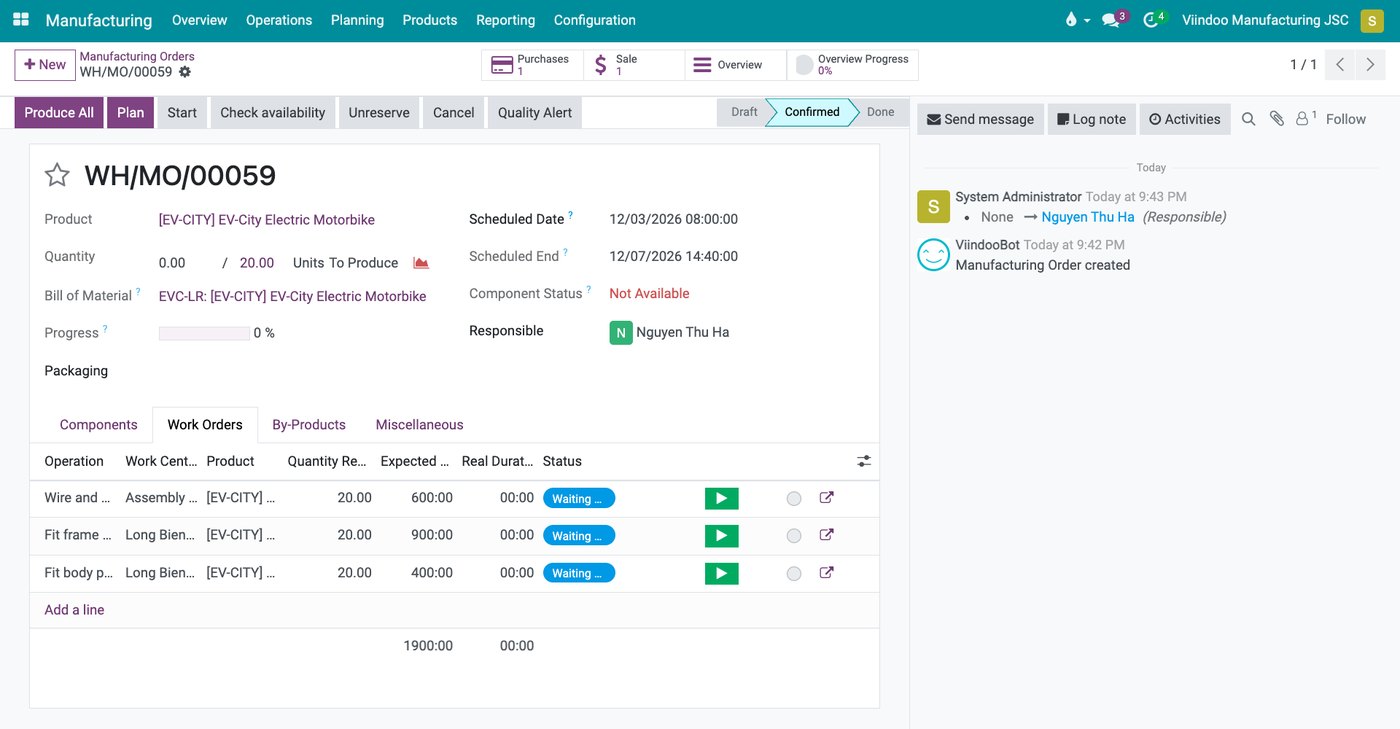
The operations defined in the BoM are used to generate work orders for the manufacturing order, each with its own work centre and expected duration.
Informed Decision-Making and Continuous Improvement
Informed decisions are the bedrock of efficiency. A comprehensive BoM empowers managers with a holistic view of the product's composition, allowing them to make data-driven choices. Whether it's evaluating alternative components, identifying cost-effective substitutes, or implementing design enhancements, BoM-driven insights fuel continuous improvement initiatives. This agile responsiveness enhances product quality, reduces lead times, and fosters an environment of perpetual refinement.

Manufacturing BoM is one of the important factors in Manufacturing management
Accurate Inventory Management
Effective inventory management hinges on precision and real-time visibility. Manufacturing BoMs serve as a compass for maintaining accurate inventory levels. By specifying required quantities, they enable inventory managers to align procurement with production needs. Timely replenishment and judicious stockpiling prevent stockouts and excess stock, striking an equilibrium that curtails carrying costs and optimizes cash flow.
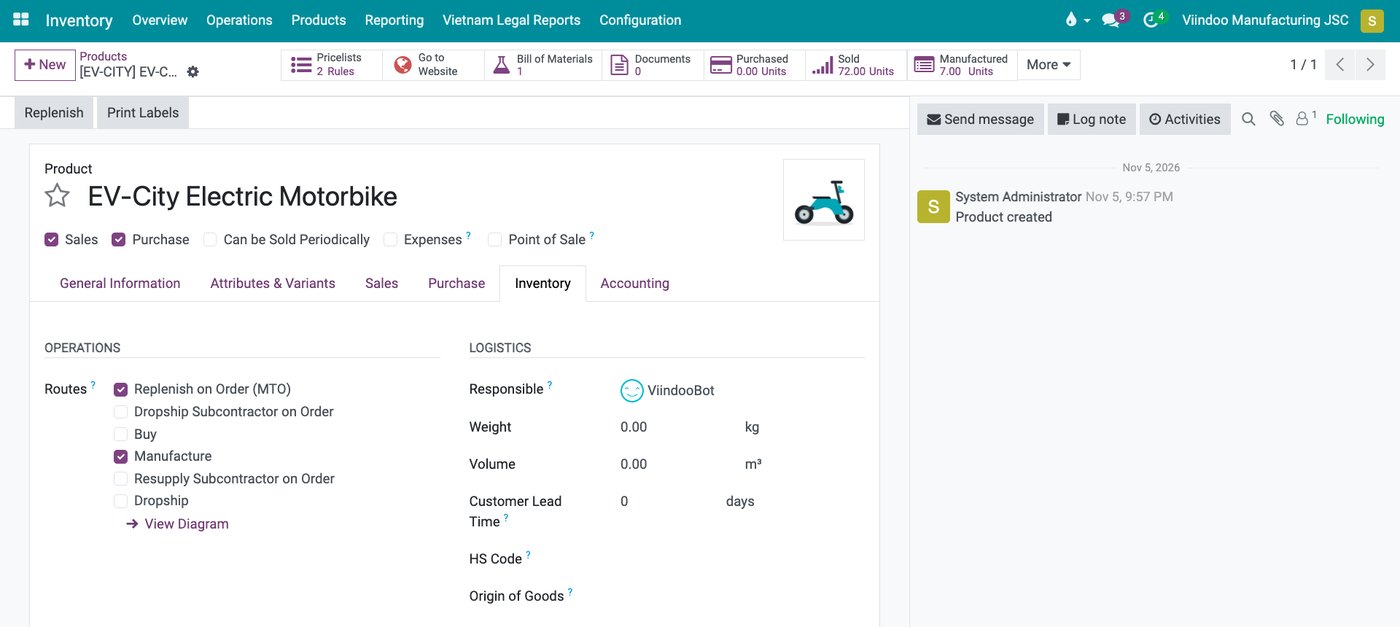
The supply routes configured for each product determine how it is replenished: Manufacture or Buy, either of which can be combined with Replenish on Order (MTO). In this example, the electric motorbike is made to order.
>>>> Read more: Manufacturing Inventory: Definition, Types, and Best Practices
Reduced Rework and Rework
Manufacturing BoMs serve as a beacon of accuracy, diminishing the likelihood of errors and rework. Clear instructions regarding component placement, specifications, and quantities mitigate the risk of assembly mishaps. By ensuring that each component fits seamlessly into the whole, BoMs minimize the need for rework, revisions, and corrective actions. This not only expedites production but also conserves resources and labor hours.
Enhanced Cross-Functional Collaboration
Efficiency flourishes in an ecosystem of collaboration. BoMs act as a lingua franca, facilitating communication across departments - from design and engineering to procurement and production. This shared understanding promotes cohesive teamwork, reduces misinterpretations, and fosters a culture of synergy. As a result, projects move forward cohesively, without undue friction, and with a collective drive towards operational excellence.
Consistency in Quality
By meticulously detailing every material component, specifying precise sequences, and providing comprehensive specifications, BoMs create a framework that guides manufacturing processes with pinpoint accuracy. This results in reduced errors minimized rework, and a standardized approach that guarantees consistent, top-tier product quality. Explore how harnessing the power of BoMs can elevate your manufacturing operations to new levels of excellence and reliability.
>>>> Read more:
- How to Implement Quality Control in Manufacturing
- Maximizing Efficiency of Byproducts in Manufacturing
- Manufacturing Scrap: Definition, Measurement, Accounting Treatment
How can Managers create and manage the Manufacturing BoM effectively?
A Manufacturing Bill of Materials (BoM) is the blueprint that guides the production process, ensuring accurate assembly and consistent product quality. Effective creation and management of BOMs require a systematic approach. Certainly, here are five key factors to help managers create and manage the Manufacturing Bill of Materials (BoM) effectively:
1. Clear and Detailed Component Information:
Ensure that each component in the Manufacturing BoM is accurately described with all necessary details such as part numbers, descriptions, quantities, and units of measure. This clarity prevents confusion during production.
2. Standardized BoM Structure:
Establish a consistent format for structuring BoMs. Clearly define parent-child relationships between assemblies and sub-assemblies, ensuring a logical and easy-to-follow hierarchy.
3. Version Control and Change Management:
Implement a robust version control system to track revisions and changes to the BoM. Establish a well-defined process for documenting and approving changes to avoid errors and ensure everyone is working with the latest information.
4. Cross-Functional Collaboration:
Foster collaboration between various departments, such as engineering, procurement, production, and quality control. Effective communication and coordination help prevent misunderstandings and ensure all teams are aligned.
5. BoM Management Software or ERP System:
Utilize specialized BoM management software or an Enterprise Resource Planning (ERP) system to centralize BoM data, streamline updates, and ensure real-time access for managers.

The flow of MRP management in Viindoo
Importantly, an Enterprise Resource Planning (ERP) system streamlines data flow, ensuring real-time updates and accurate synchronization across departments like design, engineering, production, and procurement. This synergy eliminates manual data entry, enhances inventory management with automatic updates, optimizes procurement processes, supports precise production planning, and enables efficient cost control through linked BoM data. The integration fosters consistency, reduces errors, and provides a comprehensive platform for collaborative BoM management, ultimately bolstering manufacturing efficiency and product quality.
By focusing on these factors, managers can enhance the accuracy, efficiency, and overall effectiveness of creating and managing the BoM, leading to smoother production processes and improved product quality.
>>>> Read more: Streamline Your Manufacturing with These Top MRP Software Solutions
Sample manufacturing BoM and how to calculate material norms
A material norm is the quantity of each component needed to make one unit of a product, including the loss the company accepts as normal; the full list of components and their norms makes up the bill of materials. The norm is the net quantity that ends up in the product plus the allowed loss, with the loss rate calculated on the net quantity: norm per unit = net quantity x (1 + allowed loss rate).
The table below shows a sample manufacturing BoM for a steel filing cabinet (illustrative example). The last column shows the quantities of materials required for a manufacturing order of 100 cabinets.
| Component | Unit | Net quantity per cabinet | Allowed loss | Norm per cabinet | For 100 cabinets |
|---|---|---|---|---|---|
| 0.8 mm steel sheet | kg | 18.5 | 6% | 19.61 | 1,961 |
| Powder coating | kg | 0.60 | 10% | 0.66 | 66 |
| Hinge | piece | 4 | 0% | 4 | 400 |
| Lock set | set | 1 | 0% | 1 | 100 |
| M4 screw | piece | 24 | 4% | 24.96 | 2,496 |
A norm can be fractional, such as 24.96 screws per cabinet, because it is used to calculate requirements; the quantity actually issued follows the unit and rounding rules of the material. Bought-in parts such as hinges and locks can carry a 0% rate when the company's records show no significant loss, while materials that are cut, coated or mixed, and small parts used in large numbers such as screws, usually carry a rate. Either way, the rate should come from the company's own records rather than from a rule of thumb.
To set the allowed loss, measure what actually happens over several normal batches. The actual loss rate of a batch = (actual quantity consumed - net quantity) / net quantity. For example, if 20 cabinets used 392 kg of steel against a net quantity of 370 kg, the actual loss rate is 22 / 370, about 5.9% (illustrative example). To combine batches of different sizes, divide the total loss by the total net quantity instead of averaging the batch rates, and leave out batches with a known abnormal cause. Past loss is the starting point; the allowed rate can be set lower as a target. Review it whenever the material, the supplier or the process changes.
In Viindoo, the MRP Standard Consumption app adds a Standard Quantity and a Loss Rate to each line of a bill of materials. The Standard Quantity holds the net quantity, the Loss Rate holds the allowed loss, and the quantity to consume (Qty. Included Consumption) is calculated as the standard quantity plus the loss, which matches the norm per unit in the table above.
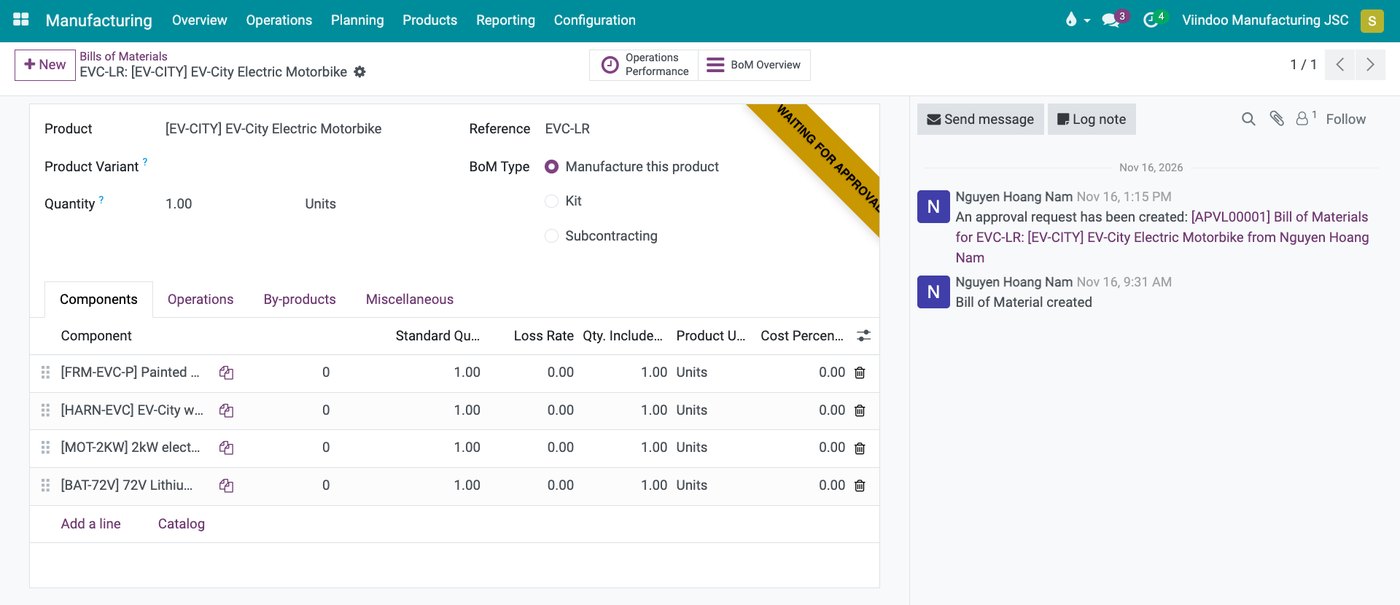
A manufacturing BoM in Viindoo 18 showing the standard quantity and loss rate for each component.
What to do when consumption exceeds the manufacturing BoM
When material consumption for a batch exceeds the quantities allowed by its manufacturing BoM, investigate the variance rather than simply accepting it. Confirm the figures, identify the cause, determine who approves the release of additional materials, and then either correct the process or revise the norm through an approved change.
For example, if the order of 100 cabinets uses 2,000 kg of steel against 1,961 kg in the norm, consumption is 39 kg, about 2%, above the norm (illustrative example). The steps below turn that figure into a decision.
- Confirm the figures. Check that consumption was recorded against the correct manufacturing order and in the correct unit of measure, and that returned materials were recorded as received back into stock.
- Find the cause. Common causes include material quality, machine settings, new operators, changes to the cutting layout, or an inaccurate initial norm.
- Determine who approves additional material issues. Set a threshold beyond which the production manager must give approval before additional materials are issued from the warehouse.
- Fix the process or revise the norm. If the process is the cause, correct it and retain the existing norm. If the old norm does not reflect actual requirements, revise it through an approved change and document the reason.
- Review by product every month. Compare standard, actual and difference for each product, not only for each order, and count how many batches went over the norm, so low batches do not hide high ones.
Approving extra issues before material leaves the warehouse is a company procedure. In Viindoo, the control at the end is set by the Flexible Consumption option of each bill of materials: Allowed; Allowed with warning, the default, which summarises the differences when the manufacturing order is closed; or Blocked, where only a manager can close an order whose consumption does not match the BoM. The Loss Components Analysis compares standard, actual and difference by order, product, operation or date, and a bill of materials can be sent for approval before a revised norm is used.
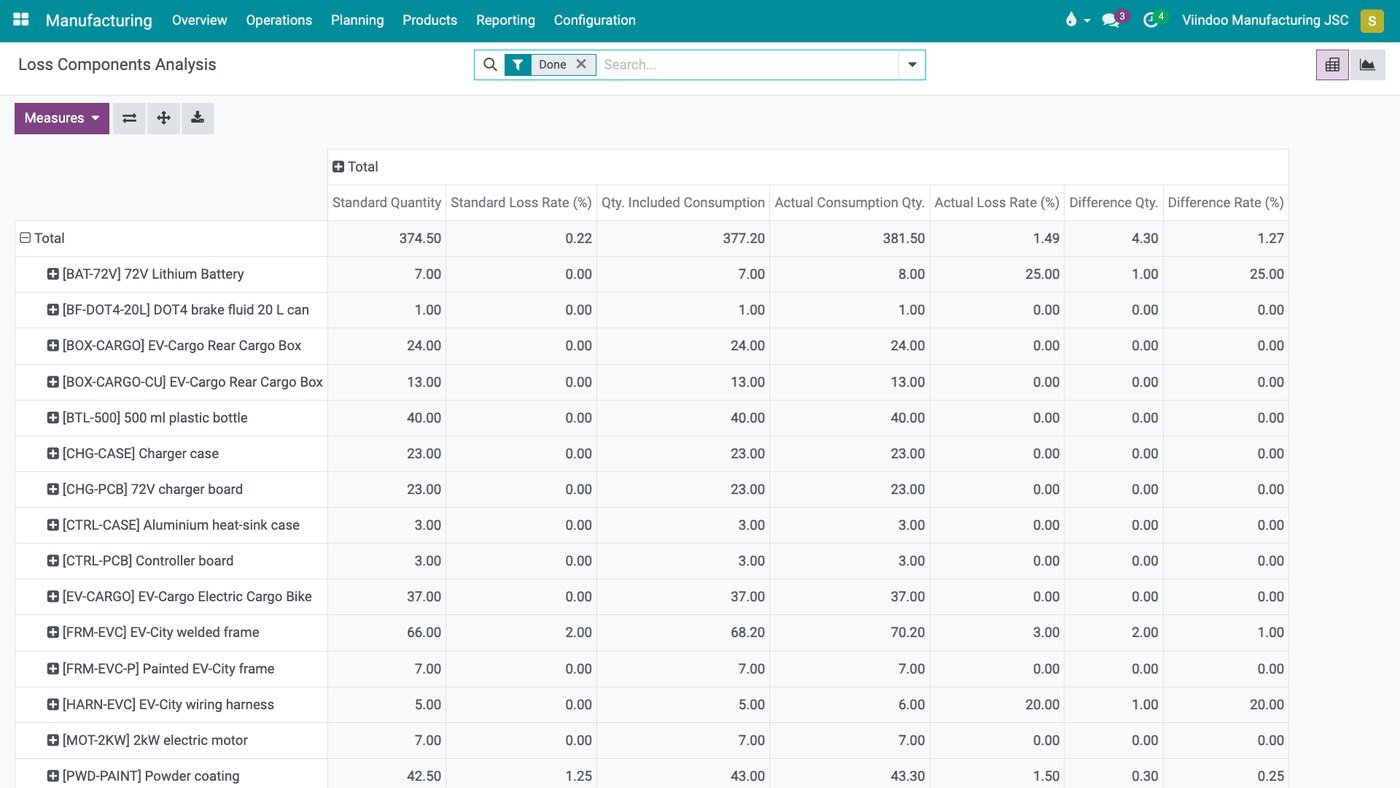
Loss Components Analysis in Viindoo 18: standard quantity, standard loss rate, actual consumption and variance for each component.
Frequently asked questions about manufacturing BoM
The norm is the total quantity of a component planned for one unit of product. The allowed loss is the part of that quantity expected to be lost in cutting, coating or handling. Norm = net quantity + allowed loss.
Review the material norms whenever the material, supplier, machine or process changes. Compare standard consumption with actual consumption every month to detect deviations early.
There is no universal loss rate. Material loss depends on the material and the process, so the allowed rate should be based on data from your own production batches, calculated using the formula above.
Typically, the production engineer prepares the proposed change and the production manager approves it. Every change should be documented along with the reason, so that subsequent manufacturing orders and product costing figures can be explained.
Yes, while the norms rarely change and nobody needs to compare them with actual consumption per order. Once you want to see loss per batch or control who changes a norm, the BoM needs to be linked to the manufacturing orders, and keeping both in one system is the simplest way to do that.
Viindoo - The optimal solution for effective Manufacturing BoM management
In the ever-evolving landscape of modern business, seizing opportunities and maximizing potential is essential. Viindoo stands as a comprehensive software solution designed to unlock your enterprise's capabilities and drive growth.
Viindoo goes beyond conventional software systems. It's a dynamic toolset engineered to streamline your operations, enhance collaboration, and amplify your overall efficiency. Whether you're a startup, a growing company, or an established industry leader, Viindoo is tailored to meet your diverse needs.
Moreover, Viindoo steps in as your trusted partner, offering a range of cutting-edge features designed to empower your organization with streamlined and effective BoM management.
Viindoo Empowers Managers to create, Apply, and Reuse Manufacturing BoM with Ease
Viindoo allows users to create the Manufacturing BoM. A finished and semi-finished product is a technical product in the system. Once the Manufacturing order is created, the system will automatically check and show every component's availability, resulting in the automation of supply rules in order to fulfill the components. Moreover, with the miscellaneous manufacturing features in Viindoo, the managers can define when the manufacturing order will be ready to process, and when either all components are available for components for 1st operation are available.
In Manufacturing, flexibility plays an important role. The consumption of materials can be changed because of many objective reasons. When using Viindoo, the users can allow flexible consumption of materials: allowed, allowed within warning, and blocked.

Viindoo provides tools for the user to create and manage the Manufacturing BoM
Viindoo automatically generates the rules for components fulfillment
Based on the Manufacturing BoM configures, Viindoo will automatically generate the supply-chain rules and routes to fulfill insufficient quantities in case the components are not available for the Manufacturing order such as creating a purchase order, a child manufacturing order,...Thereby, the chain including Purchase-Inventory-Manufacturing can be ensured with a smooth process.
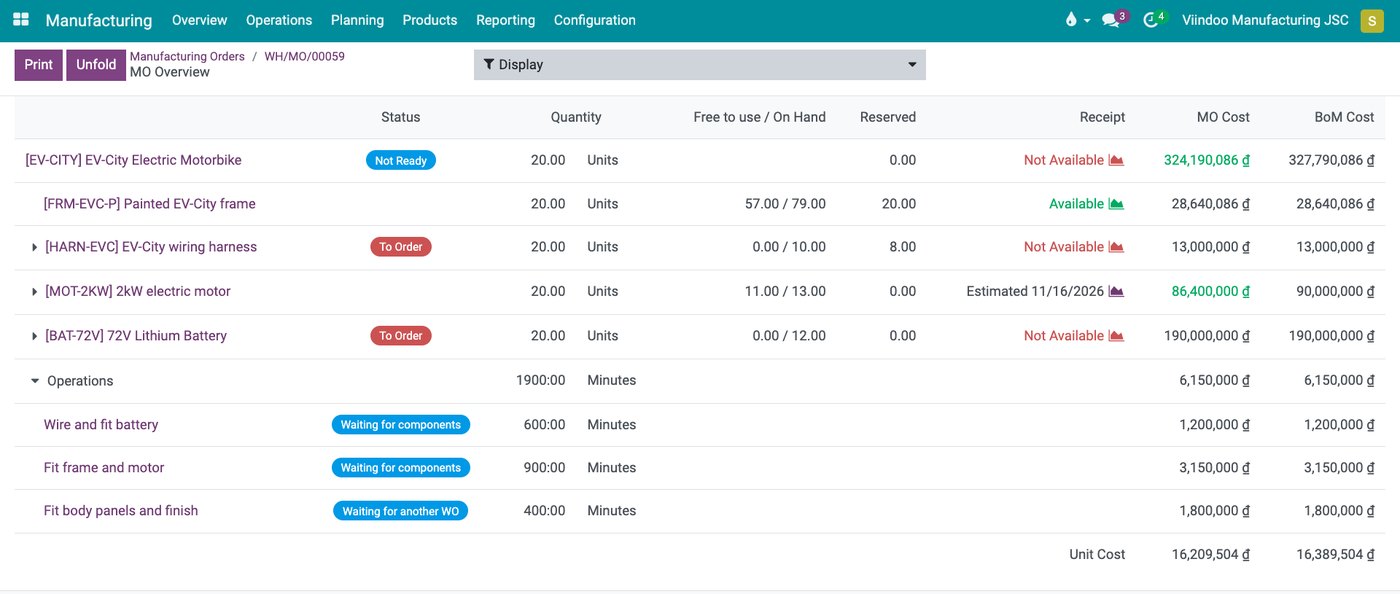
MO Overview before production: components that need to be ordered are marked To Order, components already on purchase orders show their expected receipt dates, and the manufacturing order cost is displayed alongside the BoM cost.
Viindoo unlocks the BOM Management with BoM Structure & Cost
Because of the real-time data, generating BoM Structure and cost can be easy in Viindoo system. After creating BoM for the product, the managers can have a view of the product cost and BoM cost computed by summing the costs of the components and operations needed to build the product. Viindoo's real-time cost tracking keeps you updated on cost fluctuations, ensuring that you have a pulse on the financial aspect of your manufacturing operations. Thereby, armed with Viindoo's cost insights, managers and users can make data-driven decisions that optimize resources, enhance profitability, and drive efficiency. The managers can even add information on the product quantity that they would like to view the structure cost for more details.
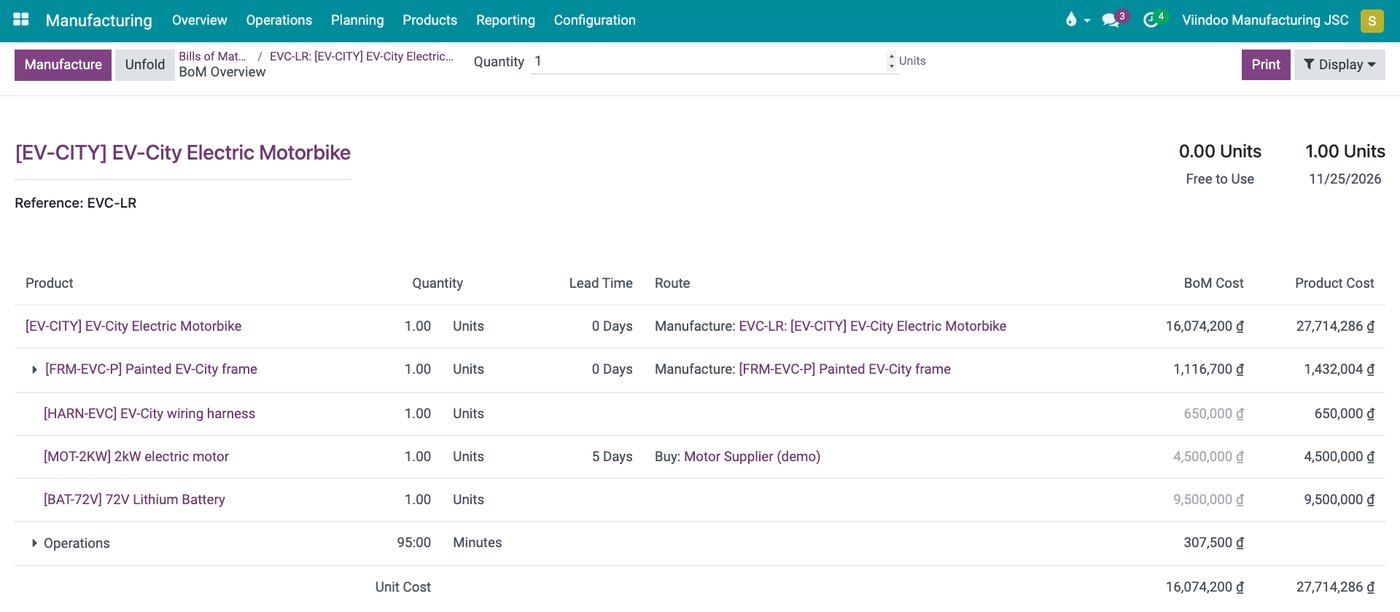
BoM Overview in Viindoo 18 shows each component with its lead time, supply route and cost. The BoM cost is displayed alongside the product cost.

In addition to BoM management, Viindoo offers a robust Manufacturing Resource Planning system) designed to optimize your production processes, inventory control, and resource allocation. Viindoo MRP empowers manufacturers to:
- Demand Forecasting: In the Master Production Schedule, the planner enters the demand forecast figures for each product and period. The system uses these figures together with the safety stock target and the minimum and maximum replenishment quantities to calculate the quantity to replenish, helping planners plan production and purchasing ahead of time. The forecast figures are entered by users; the system does not generate forecasts from historical data.
- Production Scheduling: Clicking Plan on a manufacturing order schedules each work order in the earliest suitable free time slot at its work centre, after the scheduled completion of the operations it depends on and within the work centre's working hours. If alternative work centres are configured, the system selects the one where the work order can be completed earliest. Manufacturing orders and work orders can then be viewed on a Gantt chart. Viindoo does not automatically reorder manufacturing orders by priority; the planner determines their sequence.
- Inventory Optimization: Viindoo MRP helps you strike the right balance between maintaining adequate inventory levels and avoiding excess stock, reducing carrying costs.
- Resource Allocation: Allocate resources such as labor, machinery, and materials efficiently to maximize utilization and minimize downtime.
- Order Tracking: Monitor orders from creation to fulfillment, ensuring timely delivery and customer satisfaction.
- Performance Analytics: Viindoo MRP provides insights into your manufacturing performance, helping you identify bottlenecks, inefficiencies, and areas for improvement.
With Viindoo's advanced BoM management and MRP capabilities, you can elevate your manufacturing operations to unprecedented levels of efficiency and effectiveness. Embrace a future where BoMs are seamlessly managed and production processes are optimized for success. Explore Viindoo today and embark on a journey toward manufacturing excellence.

Comprehensive Manufacturing software
FREE TRIAL - NO CREDIT CARD REQUIRED
Comprehensive Manufacturing software fulfills the production management needs of enterprises in the 4.0 era.
Conclusion
Manufacturing BoM and manufacturing management are critical elements in optimizing production processes, reducing costs, and ensuring high-quality output. By understanding the intricacies of BOM creation and implementing effective manufacturing management techniques, manufacturers can streamline their operations, minimize errors, and enhance overall efficiency. With proper attention to detail, continuous improvement, and the utilization of modern software tools, manufacturers can unlock the full potential of their manufacturing processes and achieve greater success in the competitive market.
>>>> See more:
- Lean supply chain: Its bright future with technology
- Production Reports: Overcome Pain Points with Viindoo MRP
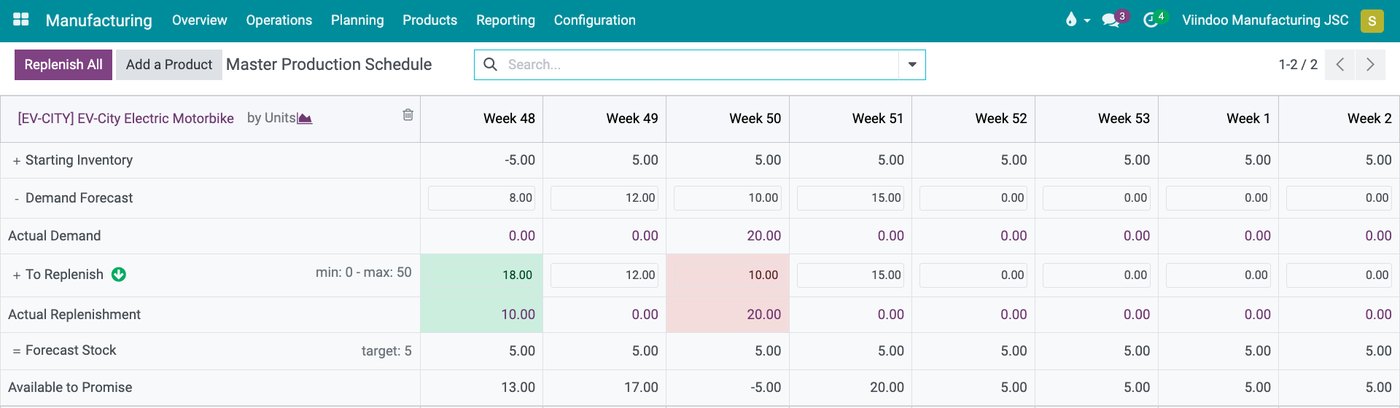
Master Production Schedule in Viindoo 18: the planner enters the demand forecast for each week; the schedule shows the quantity to replenish, calculated based on the safety stock target and the minimum and maximum replenishment quantities.