Shadow AI in the workplace, meaning staff using AI tools outside what the company has approved, is far more common than most CEOs think. A University of Melbourne and KPMG survey of 48,340 people in 47 countries (2025) found that 48% of people using AI at work had put company information into public AI tools, and 57% used AI in ways they did not disclose, such as hiding its use or presenting AI output as their own.
Most of it starts with good intentions: AI helps people work faster, and the gain for each person is real. But many personal gains do not add up to a company capability. This is the hidden side of shadow AI in the workplace: when sales prices quotes with one AI assistant, accounting matches payments with another and admin drafts contracts with a third, part of how the company runs has moved into personal chat windows that nobody designed, checks or can hand over.
A ban does not solve it, because the need is still there. This article looks at why staff use AI on their own, what it costs the company, why a total ban backfires, and a seven-point policy framework that turns good personal uses into the company's way of working.
A personal experiment is not a business process
Most shadow AI in the workplace begins as a personal experiment: someone tries a chatbot to rewrite an email or summarise a document. The risk is small and the benefit goes to that person. Then the line moves quietly. Once a salesperson sends ten AI-drafted quotes a week, it is no longer an experiment. It is how the company quotes.
| Question | Personal experiment | Business process |
|---|---|---|
| Who benefits | The person using it | The company and the customer |
| What data it uses | Whatever the person pastes in | The company's current data |
| If the result is wrong | The person redoes the work | A customer, a payment or a contract is affected |
| Who can check it | Only the person | The manager, accounting, the auditor |
| When the person leaves | The method leaves too | The method stays with the company |
Common signs: sales drafts quotes with an AI assistant, using a price list pasted in last month. Accounting matches customer payments with another tool, on an invoice list exported at month end. Admin drafts contracts with a third tool, from an old template. Each department gains speed. The CEO sees faster work but cannot answer three questions: which customer data has been pasted outside, whether the price in a quote matches the price accounting will invoice, and who checked the contract clauses. Each department is acting reasonably. The conflict is between speed for each department and consistency and control for the company.
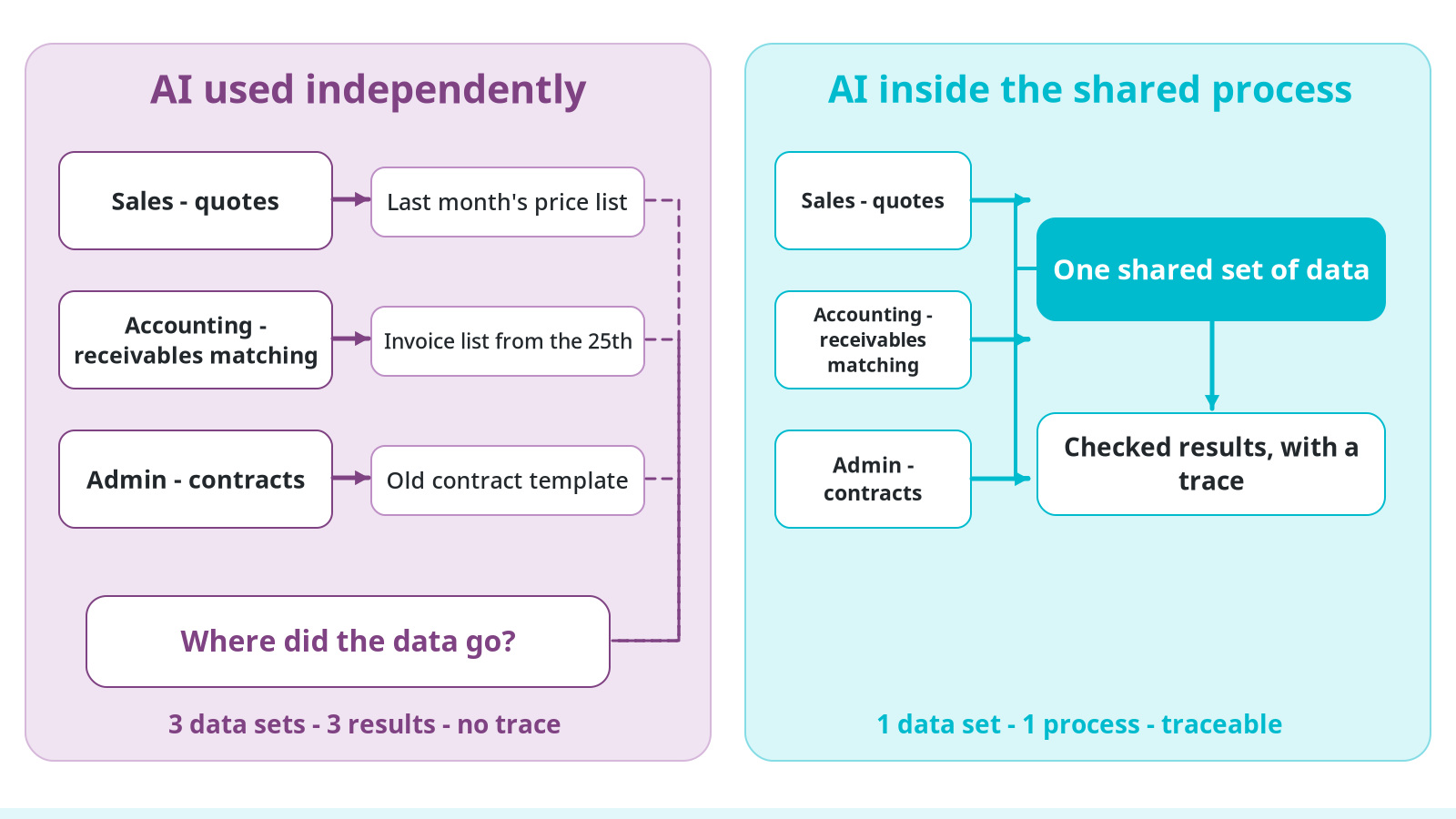
Fragmented AI use gives each department speed; shared AI use gives the company one set of data and one trace.
This view stops being true under one condition. If the AI only touches public information and its output is checked against company records before use, the experiment stays harmless. Shadow AI in the workplace becomes an operating problem at two points: when company data goes in, and when the output goes to a customer, a payment or a record.
Shadow AI in the workplace: why people do it, what it gains, what it risks

Most AI use at work starts at one desk, for one person's tasks.
Employees rarely use AI on their own to break rules. Three motives are more common: it is faster than waiting for an official tool; the company has given no tool or rule; and some people do not want to be seen relying on AI. None is bad faith. Each points to a gap in the company.
Large surveys show how widespread this is, though none covers Vietnam in full detail:
| Survey | Finding |
|---|---|
| University of Melbourne and KPMG, 48,340 people in 47 countries, Nov 2024 - Jan 2025 (32,352 employed; Vietnam not included) | 70% of employees who use AI at work use free public tools. Only about two in five say their company has a policy or guidance on generative AI, and almost one in five do not know. Among employees who use AI: 48% have uploaded company information such as financial, sales or customer data into a public AI tool; 57% have hidden their AI use or presented AI content as their own; 56% have used AI without knowing whether it is allowed |
| Work Trend Index 2024, 31,000 knowledge workers in 31 markets including Vietnam, Feb - Mar 2024 (run by a software vendor; read as an observation) | 78% of AI users bring their own AI tools to work; 80% in small and mid-sized companies. 52% are reluctant to admit using AI for their most important tasks |
Both surveys are self-reported. The first excludes Vietnam; the second includes it but comes from a company that sells AI tools. Together they show a pattern, not the size of the issue in your company: most AI use starts outside company tools, much of it is invisible to managers, and company data is part of what goes out.
The gain is speed for the individual. The risk comes from three limits that any AI standing outside the company's system has, however good the tool is:
AI does not see the real numbers
It works only on what someone pasted in, at the moment they pasted it. It does not know today's stock, today's debt or the price agreed yesterday.
Data leaves without control
Customer lists, prices and contract terms go to a service the company has no agreement with. Nobody can say what was sent, by whom, or where it is kept.
Results do not enter the process
The quote drafted in a chat window is retyped into the system. Nobody knows which part the AI wrote, and the next person cannot reuse it.
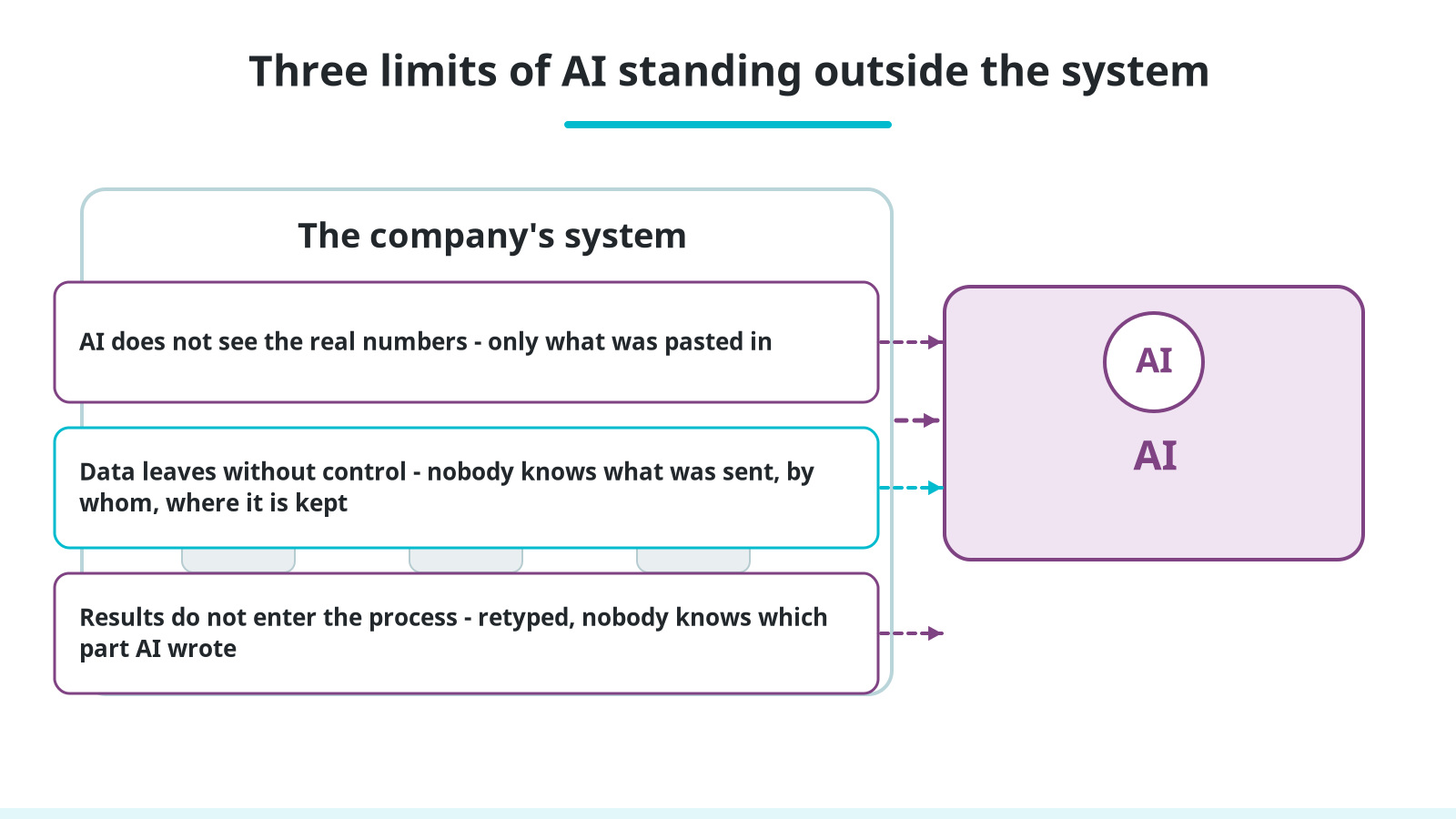
The tool can be excellent; the limits come from where it stands, outside the company's system.
Scattered data, several versions of the truth
Every AI conversation outside the system starts from a file someone exported at a given moment. From then on the file stops updating, so the AI can give a correct answer from wrong data without any sign of it.
Take receivables. Accounting exports the invoice list on the 25th and has an AI match it against bank receipts. The customer pays one invoice on the 27th. On the 28th, a salesperson asks a different chatbot how much that customer still owes, using an email thread as the source. The customer now hears two different figures from the same company, both produced by AI and both looking confident.
The trade-off is plain. Exporting a file is fast and needs nobody's permission. Keeping one set of data that every department and every AI reads from takes setup and discipline. The risk falls if every AI output is checked against the system before it leaves the company, but that check eats much of the time AI was meant to save. That is why shadow AI in the workplace often looks productive in each department and costly for the company as a whole.
Each department may reconcile against a different copy of the same data.
Work nobody recorded is hard to audit and hard to hand over
In an official process, each step leaves a trace: who made the quote, from which price list, who approved it. With shadow AI in the workplace, the most important step, how the draft was produced, stays in one person's chat history. The company keeps the result but loses the method.
Consider a contract. A late-payment clause is drafted by AI from an old template, edited a little and signed. A year later there is a dispute. Nobody can show which template was used, what the AI was asked, or who checked the clause against current regulations. For an internal auditor or a tax inspector, a step that left no trace is a step that cannot be defended.
Handover suffers the same way. When the employee leaves, their prompts and personal templates leave with their account. The successor asks differently, and quotes or reconciliations start to change without anyone deciding they should.

When the method lives in a personal account, the handover covers the result, not how it was made.
The problem shrinks if employees save what they asked and what came out in a shared folder. But that is already the start of an official process, and it is better designed on purpose than left to form by accident.
Why a total ban pushes shadow AI in the workplace further underground
Banning shadow AI in the workplace removes visibility, not the need. The workload and the deadline are the same, and a personal phone is within reach. What changes is that people now hide the use, so the company loses the one thing it needed most: knowing where AI is used.
The University of Melbourne and KPMG study points the same way. Uploading company information or copyrighted material to public AI tools was most common among employees whose organisation had banned generative AI (67%), then where a policy guided its use (56%), against 33% where there was no policy. The authors conclude that outright bans may be ineffective and that a policy alone does not guarantee compliance; clear guidance and training are needed. This is a correlation, not proof that bans cause leaks, since companies that ban may handle more sensitive data. But it is enough to drop the belief that a ban makes the problem go away.
Large companies do ban. In 2023, after engineers uploaded sensitive internal code to ChatGPT, Samsung temporarily restricted generative AI on company computers, as Bloomberg reported and Samsung confirmed to CNBC. Samsung had the means to look for safe internal alternatives. A small company that bans without offering one only loses sight of what its people do.
A narrow ban is different and often right: never paste customer lists into a public tool, never send an AI-drafted document to a customer without a named checker. Bans on a type of data or action work. A ban on a whole technology mostly works on paper.
Designing a safe space to experiment instead of shadow AI in the workplace
Shadow AI in the workplace is not always dangerous. Treating every personal tool the same either blocks harmless uses or lets risky ones through. Two questions are enough to sort them: how sensitive is the data, and how large is the impact if the result is wrong?
| Data and impact | Example | Rule |
|---|---|---|
| Public data, internal use | Summarise a public article, draft an internal notice | Free to use with approved tools |
| Non-sensitive data, goes outside | Customer email, marketing post | Allowed; the sender checks before sending |
| Sensitive data, internal analysis | Sales by customer, margin by product | Only tools under a company agreement or inside the system |
| Sensitive data, affects money, customers or law | Prices, receivables, contracts, payroll | Only inside the official process, with a named checker |
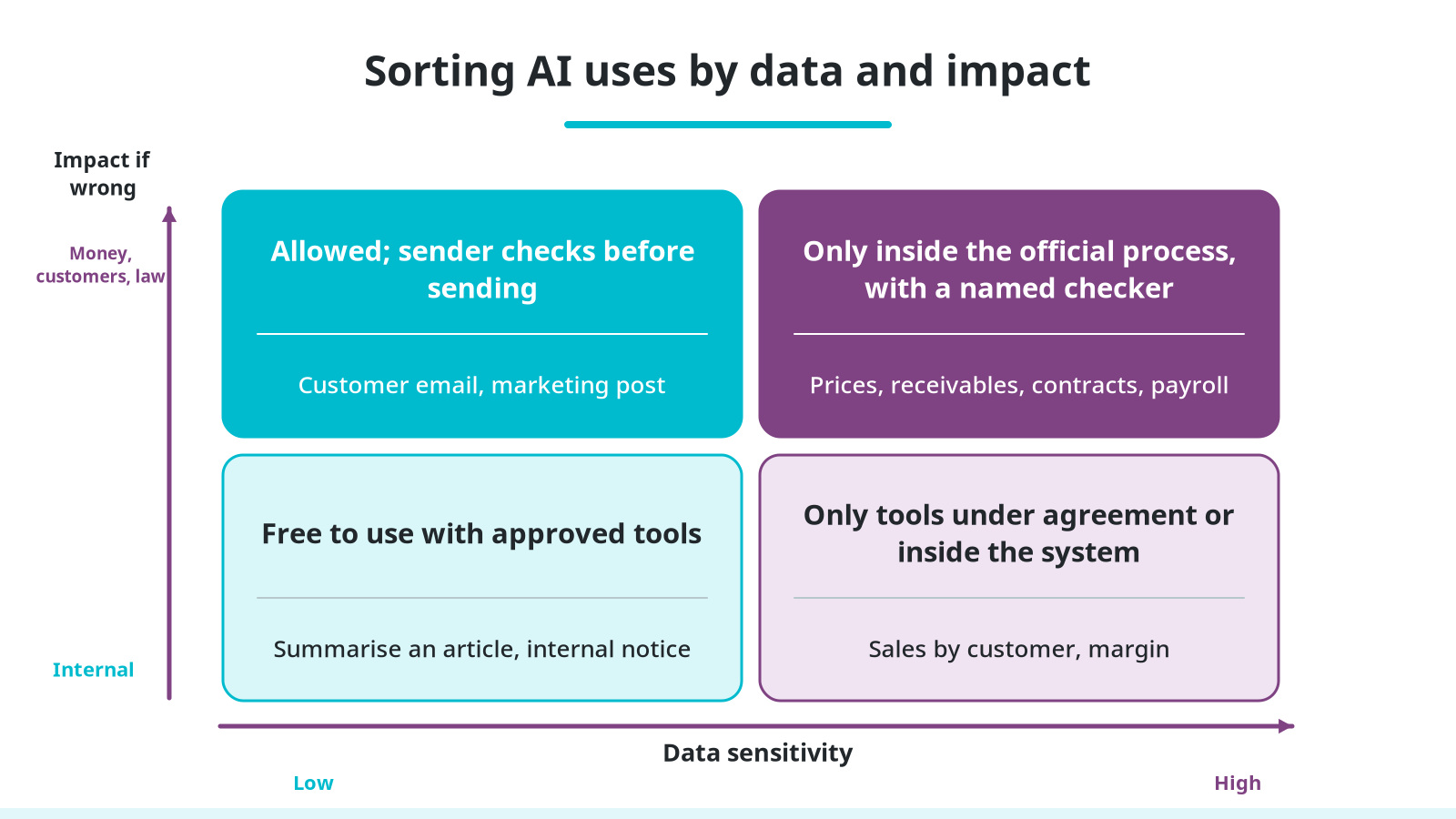
Most uses fall in the two lighter rows; control should concentrate on the last one.
Between free use and official process there is room for a sandbox: staff try a new use with sample or masked data, register what they are testing, and show the result after a fixed period. A hidden experiment becomes a visible one that the company can judge before it becomes routine.
An AI acceptable use policy for your company: seven items
An AI acceptable use policy for a small or mid-sized company does not need to be long. One or two pages that answer seven questions are enough to replace guessing with clear rules. The template below can be adapted department by department:
- Allowed tools. List the AI tools staff may use and which accounts: company accounts rather than personal ones, with settings that keep company data out of model training where the tool offers it. Name one person who keeps the list up to date.
- Data never to paste into public tools. Customer lists and contact details, non-public prices and discounts, receivables and bank details, payroll and personal data of staff, contracts under negotiation, source code, passwords and access keys.
- Approval for new uses. Any use where AI output goes to a customer, touches money or changes a record needs approval from the department head before it becomes routine.
- Sandbox and registration. New experiments are registered in one shared list: who is testing, what, with which data (sample or masked), and until when.
- Logging. For approved uses, keep what was asked, which source data was used and who checked the result, in a place the company owns, not in a personal chat history.
- Turning good initiatives into shared process. When an experiment works, the person who found it writes it up, it moves into the official tool and process, and the credit is recorded in their evaluation.
- Review cadence. Review the tool list and the data rules every quarter, and after any incident. Tell staff what changed and why.
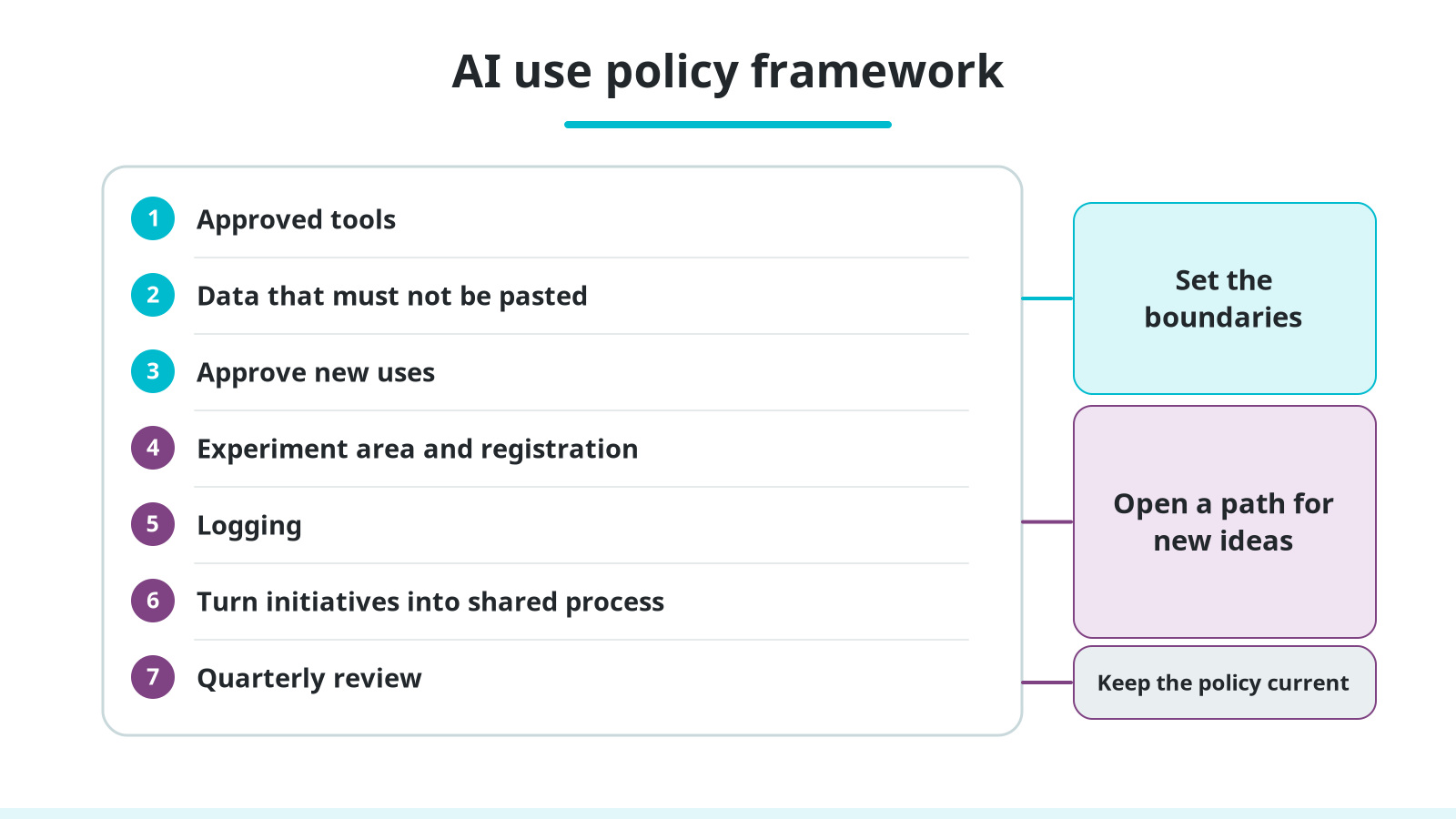
Seven items, one or two pages: enough to make AI use visible without stopping it.
A policy that only says "no" teaches people to hide. A policy that says "yes, with these tools, for this data, checked by this person" lets the company see.
Items 1 to 3 set the boundaries. Items 4 to 6 are what keep the policy from becoming a ban in disguise: they give employees a legitimate path for new ideas and a reason to use it. Without them, shadow AI in the workplace simply continues under a new name.
The policy is a management decision: which data, which uses, who checks.
Points to keep in mind
Not every personal tool is a risk. Rewriting an internal email or summarising a public report carries little danger. Treating every use as a threat wastes management attention and pushes people to hide harmless work too.
The numbers are global and self-reported. The large academic survey did not include Vietnam; the survey that did comes from a software vendor. Use them to recognise the pattern, then find out what actually happens in your own company, for example with an anonymous question to staff.
A policy without a usable tool will not hold. If the approved option is slower than the personal one, people go back to the personal one. The policy needs at least one tool good enough for daily work.
The direction Viindoo has chosen
Often sales, accounting and admin each find a faster way to work with their own AI tool, on their own copy of the price list, invoices or contract template. Each department gains speed; the CEO loses three answers: what data has left the company, whether the quoted price matches the invoiced price, and who checked the contract. Shadow AI in the workplace is a signal that people are looking for better ways to work where the company's systems fall short.
Viindoo sees the lasting answer not in banning, but in bringing AI into the system the company already runs on, so one person's good way of working has a path to becoming everyone's. That is why Viindoo is developing an Agentic AI business management platform: AI works inside the shared process rather than in each person's chat window, and the company chooses its own AI provider and keeps control of its data and costs.
When AI sits inside the system, the three gaps above close at their root. The quote, the invoice and the contract are drafted from the same price list and the same customer data, so there is one version of the truth. Results flow back into the process instead of staying on one person's computer. And the safe testing corridor and seven-point policy in this article stop being documents on the wall: what AI may be used for, on which data and with whose approval become rules staff follow as they work.
If employees are to give up their own tools, the AI inside the system must be at least as easy as what they already use. That is what Viindoo pursues: AI supports each department within its daily work, while Viindoo acts as the backbone that holds data, access and the trail, so using technology is convenient as well as stable and safe.
A platform cannot replace an AI usage policy or training, and it will not connect to every tool employees already use. Writing the policy and choosing which initiatives to scale remain leadership's work in handling shadow AI in the workplace.
Four questions to check where you stand
- Do we know in which departments, and for which tasks, AI is already used today?
- Is there a written list of information that must never be pasted into a public AI tool, and do employees know it?
- When an employee finds a good way to use AI, what path does it take to become the way the whole team works?
- If a key employee left tomorrow, which AI-made templates and instructions would leave with them?
Frequently asked questions
Employees using AI outside the tools and rules the company has approved, usually through personal accounts of public chatbots. The term comes from "shadow IT". It is not wrongdoing in itself; it becomes a risk when company data goes in or results go to customers.
A blanket ban usually reduces visibility more than use. In the University of Melbourne and KPMG study, uploading company data to public AI was most common where generative AI was banned. Narrow bans on specific data plus an approved tool work better.
Allowed tools, data never to paste, approval for uses that affect customers or money, a sandbox with registration, logging, a path from good experiments to shared process, and a review cadence. One or two pages is enough.
Customer lists, non-public prices, receivables and bank details, payroll and staff personal data, contracts under negotiation, source code and passwords. Personal data is also protected by law, so write the rule down rather than leave it to judgement.
Often sooner, because few have an IT team watching which tools are used, and one person often handles prices, debt and contracts at once. A short policy costs little and removes most of the guessing.
Next in this series: once AI is visible, approved and working inside the company's processes, it is no longer just a tool employees use. It starts to act like part of the workforce. When AI becomes part of the workforce, what must a CEO manage differently?
Sources
- Gillespie, N., Lockey, S., Ward, T., Macdade, A., & Hassed, G. (2025). Trust, attitudes and use of artificial intelligence: A global study 2025. The University of Melbourne and KPMG. 48,340 people in 47 countries, Nov 2024 - Jan 2025.
- Microsoft & LinkedIn (8 May 2024). AI at Work Is Here. Now Comes the Hard Part. Work Trend Index 2024, 31,000 knowledge workers in 31 markets, Feb - Mar 2024. Vendor source, cited as an observation.
- Bloomberg (2 May 2023). Samsung Bans Staff's AI Use After Spotting ChatGPT Data Leak.
- CNBC (2 May 2023). Samsung bans use of AI like ChatGPT for employees after misuse of the chatbot.
- Wikipedia. Shadow IT.