What level of data detail does an ERP really need to manage well without overloading users? Article 7 of the "From Data to Kaizen" series looks at the most concrete case: the Sales Order, the BOM and production.
How detailed should data be?
Once a business understands, as discussed in the previous article, that:
More data is not always better. You only need enough to manage.
another practical question comes up:
"How much is enough?"
This is where debates usually start between business leaders, operational users and the ERP implementation partner.
Leaders want
things kept simple, little data entry and few process changes.
The implementation partner sees
that if the Sales Order is too sketchy, the BOM too simple and production operations not split enough, the business downstream cannot plan, calculate material needs, measure progress, measure consumption, analyze cost or run Kaizen.
The issue is not which side is more right. The issue is:
Each level of data detail protects a different management capability.
The problem to solve is finding the lowest level of data detail that still lets the business manage its flow.
A typical example: a make-to-order mechanical manufacturer
Suppose a customer orders:
10 sets of machine frame assembly A
Seen only from sales, the Sales Order can be very simple: machine frame assembly A, quantity 10 sets, selling price, delivery date. For sales, that may be enough to close the deal.
But to deliver the order, the business still has to answer:
Materials
What does assembly A consist of? How much steel is needed? What must be purchased? Which materials are missing?
Production
Which operations does it go through? How long does each take? Which one is running late?
Results
What is the defect rate? What is the actual cost?
These questions cannot be answered from the Sales Order alone. So the data has to be "broken down" further through the layers:
Sales Order
Product / BOM
Material
Routing / Work Order
Quality
Cost
That is why the level of data detail at the start of the flow affects every management capability downstream.
1. How detailed should the Sales Order be?
The Sales Order should not become a heavy technical form. But it should not be so sketchy that the people downstream do not know what to do. A minimum Sales Order should protect four things:
1. The product or configuration to deliver
The business must know exactly what the customer buys: which configuration, which version, which variant. For make-to-order products, there must be a way to identify the real configuration of each order.
2. Quantity
This is the input for material needs, production planning, capacity and delivery.
3. Commitment date
Without a commitment date, the business cannot measure whether it delivered on time, its lead time, its on-time delivery rate (OTD) or the effect of improvements to delivery time.
4. Special customer requirements
For example: specific materials, paint color, quality standards, dimensions, packaging requirements. If these are not captured on the Sales Order, it is very easy to get things wrong downstream.
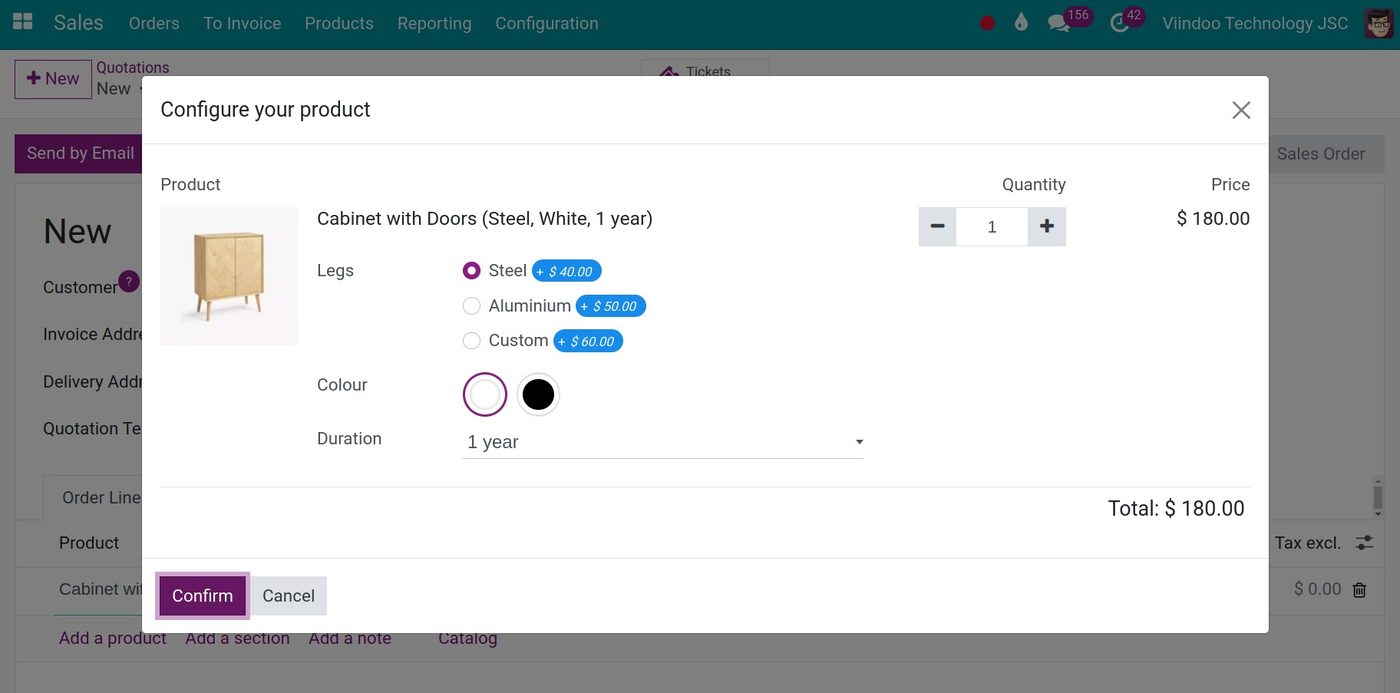
On a sales order line, the salesperson picks the configuration through product attributes and variants declared on the product.
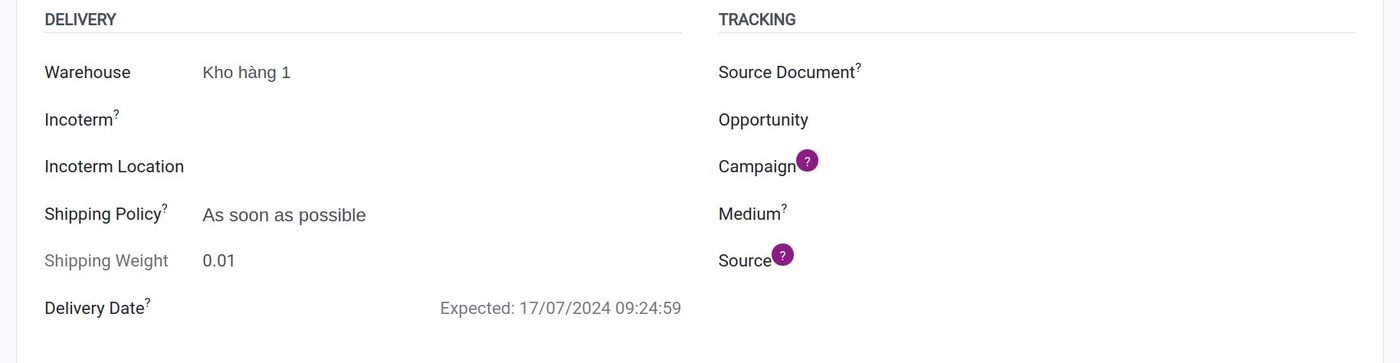
The Delivery Date field holds the date committed to the customer; when it is empty, Viindoo shows the expected date computed from lead times.
In Viindoo, the variant and the product attribute values chosen on the order travel down to the manufacturing order and the delivery order. Free-text notes on the order do not. Requirements that production or the warehouse must act on are best declared as product attributes.
What should the Sales Order not contain?
Not every piece of data belongs on the Sales Order. For example: the details of each machining step, time per machine, scrap allowances or internal QC procedures. That data belongs to the engineering and production layer.
The Sales Order should be enough to define the customer's demand clearly, without turning sales into production engineers.
2. From Sales Order to Product/BOM: the most important transition
The Sales Order answers
What does the customer need?
The BOM answers
What does it take to make it?
This is an extremely important transition. If the BOM (bill of materials) is too sketchy, the system downstream loses a great deal of capability. For example, a BOM that only lists "steel, bolts, paint" while in reality the product needs:
- SPCC steel sheet 1.5 mm,
- 40x40x2 steel box section,
- M8 bolts, property class 8.8,
- RAL 7035 powder coating,
- a specific quantity of each.
If the business manages materials by item code, the BOM must be detailed enough to create demand, issue materials, control consumption and calculate cost.
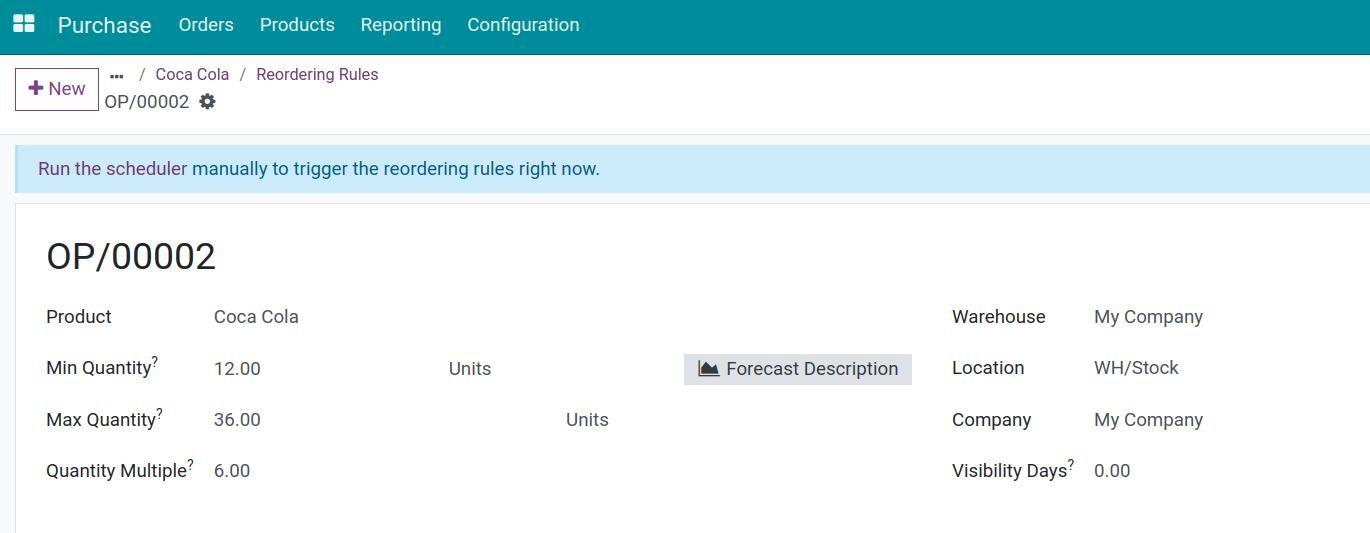
A minimum/maximum reordering rule creates replenishment demand when a material falls below its minimum stock; it only works when the material has its own item code.
How detailed should the BOM be?
A practical rule is:
Detailed down to the level the business needs to manage independently.
A component deserves its own code if the business needs to:
Buy it
It is purchased on its own.
Stock it
Its stock is tracked on its own.
Issue it
It is issued to production on its own.
Trace it
It must be traced on its own.
Cost it
Its cost is calculated on its own.
Control its defects
Its defects are controlled on their own.
Without such a need, creating more codes may only make the system more complex. For a closer look at setting up a BOM, see this BOM handbook.
3. When do you need a multi-level BOM?
A multi-level BOM is very useful when the product has semi-finished goods, sub-assemblies or several structural levels. For example:
Machine assembly A
Frame
Drive assembly
Electrical assembly
Control assembly
If each assembly is produced separately, stocked separately or has its own process, a multi-level BOM makes sense. But if the business does not manage each assembly independently, splitting into too many levels can make the BOM harder to maintain and change, and increase the number of manufacturing orders and the amount of data entry.
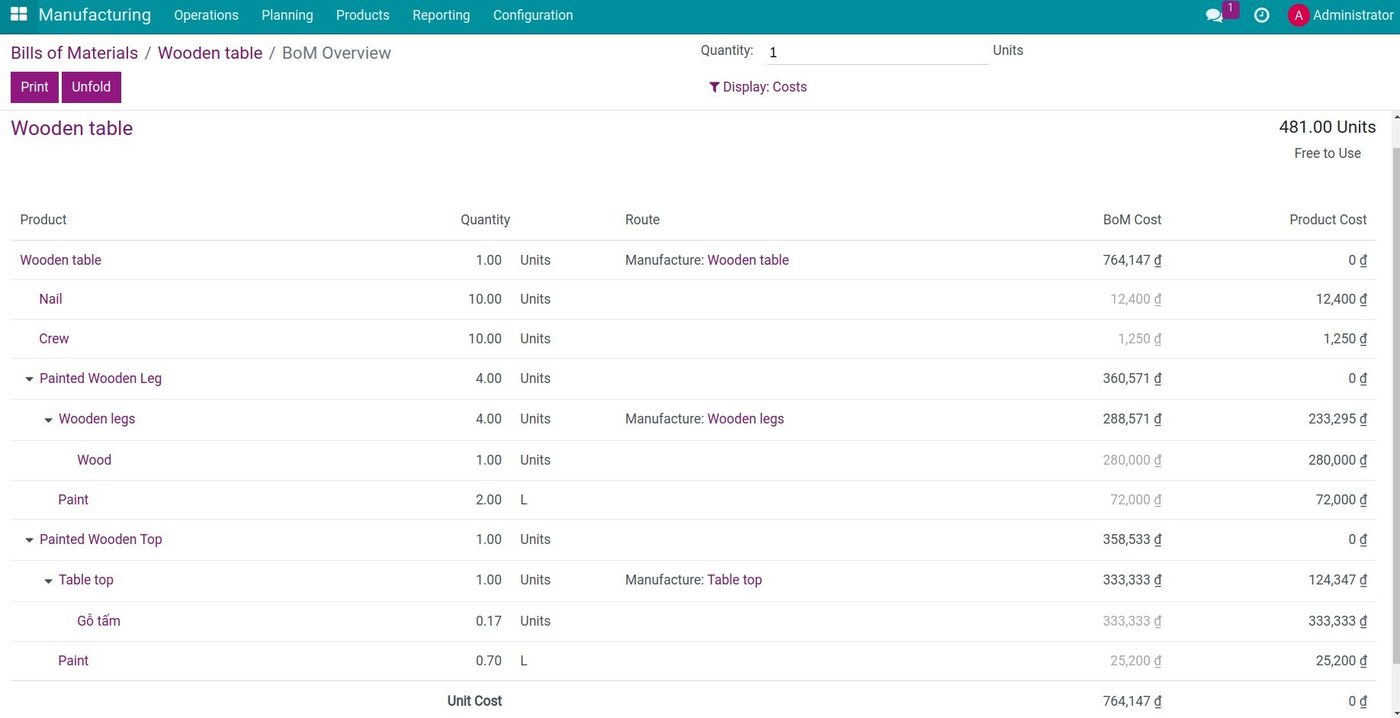
The BoM Overview shows each level of a multi-level BOM with its quantity, route and cost.
Split the BOM into levels when that level has its own management meaning.
4. How detailed should the routing be?
The routing answers: which operations does the product go through? A full routing for a mechanical product might be:
Cutting → Turning → Milling → Drilling → Welding → Grinding → Painting → Assembly → QC
Do you need to record every one of them? Not always. The previous article showed that when the business only needs to know which area the order is in and which major operation is late, the steps can be grouped into Machining, Welding, Painting, Assembly and QC. That reduces tasks in the early stage. The question here goes one step further: at what point is it worth splitting them again?
When should operations be split?
Only split when the business needs to manage separately:
Machine capacity
How much each machine can take.
Time
How long each step really takes.
Bottlenecks
Where the flow really gets stuck.
Quality
Where defects arise.
Cost
What each step costs.
Ownership
Who is responsible for each step.
If "Machining" is running fine, there is no need to split it yet. But if the data shows that machining takes 60% of the lead time (illustrative example), that is the moment to split it into Cutting → Turning → Milling → Drilling to find out where the real bottleneck is.
Don't measure deeply everywhere. Only dig deeper where the data shows a problem. That is the spirit of Kaizen.
5. Does a Work Order need every minute?
When implementing ERP, many businesses immediately want to measure start time, end time, downtime, setup time and every minute of operation. This can be very useful, but only when the business really needs to measure productivity, has the discipline to record it, or has automation.
Without that foundation, forcing users to record too much detail easily leads to box-ticking entries, inaccurate data and user pushback. A more practical roadmap:
Stage 1
Record only status, quantity and whether the work is done.
Stage 2
Add start and end times.
Stage 3
Add downtime, stop reasons and causes of delay.
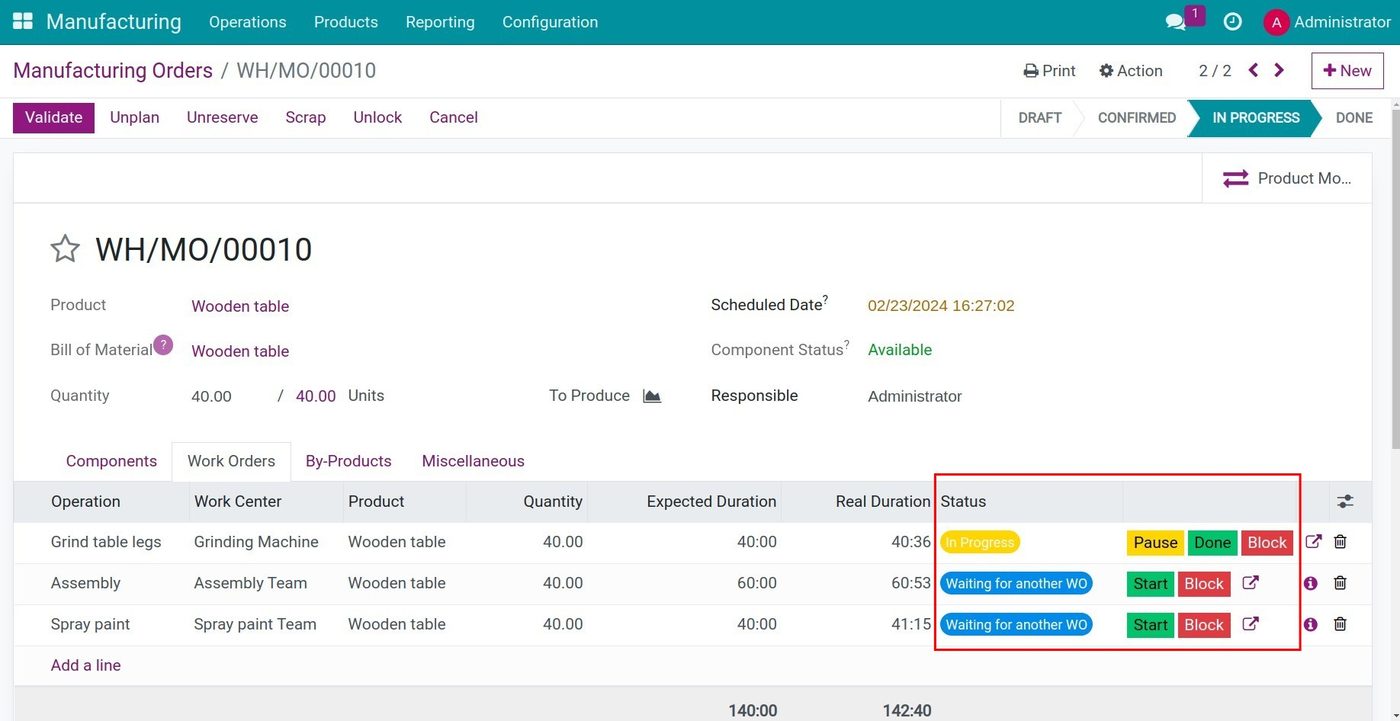
Each work order on the manufacturing order shows its status, expected duration and real duration; the Block button records a stop.
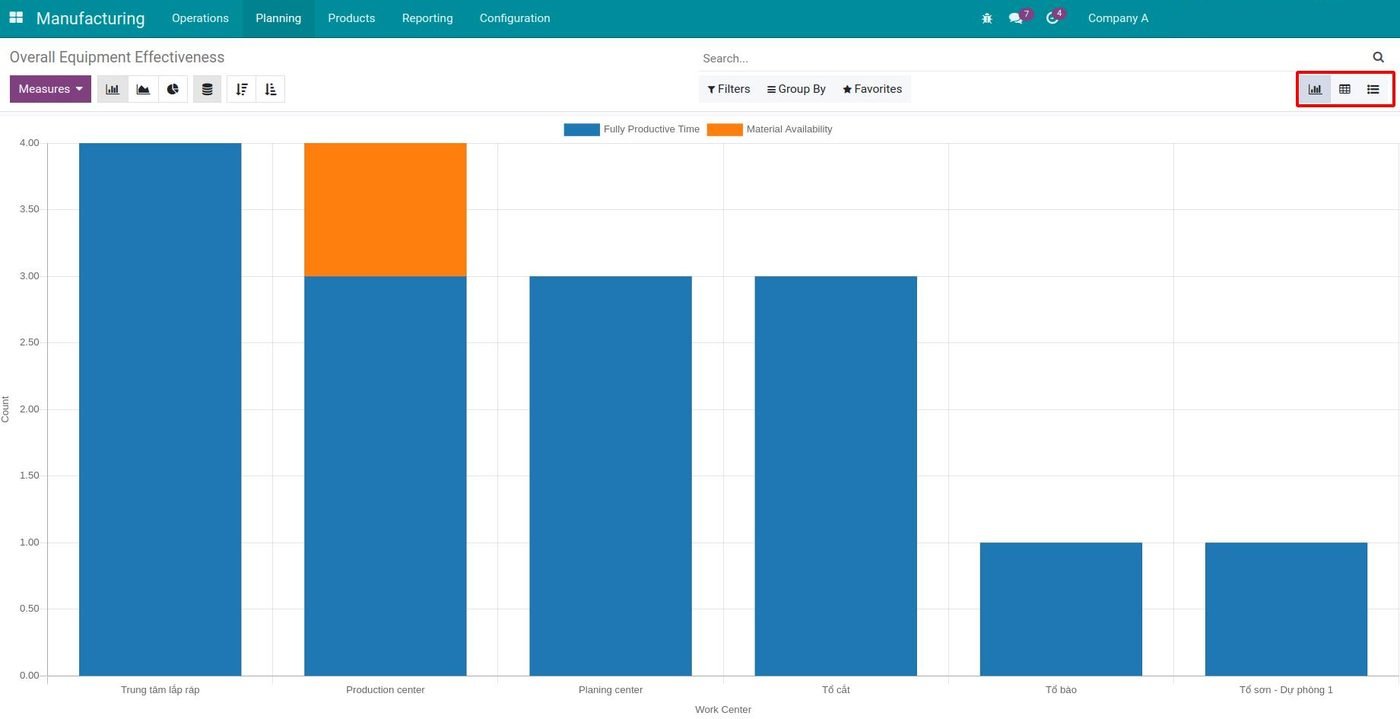
Stage 3: the Overall Equipment Effectiveness report separates productive time from time lost to each stop reason, such as material availability.
The level of data detail grows with the ability to use the data.
6. How much should Quality record?
Quality also has several levels of data detail:
Basic level
Pass / fail, number of defects.
Intermediate level
Main defect types, the operation where they arise.
Deep level
Root cause, corrective action, preventive action, defect photos, the person handling it, handling time.
Not every business needs the deep level from day one. But without at least pass/fail results and the number of defects, it is very hard to measure quality and run Kaizen.
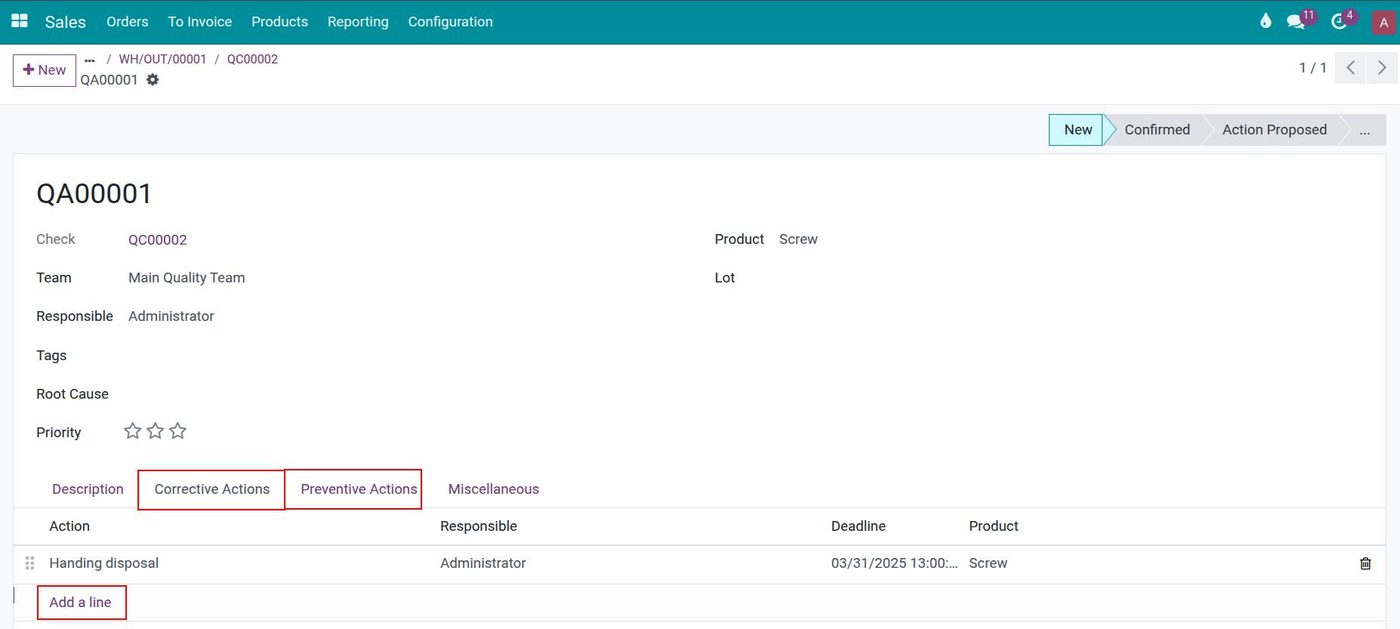
Deep level: a quality alert records the root cause, the person responsible, and corrective and preventive actions, each with its own owner and deadline.
7. Must all data be entered at the start of the flow?
No. This is a very important point. Many ERP projects fail because they try to push too many fields onto the Sales Order or the BOM. In reality, data should be created at the moment it arises:
Sales
enters customer requirements.
Engineering
creates the BOM.
Warehouse
records material issues.
Production
records output.
QC
records defects.
Accounting
records costs.
Data should be created by the person who knows it best, at the moment closest to the real event.
This both lightens the load on any single department and improves data quality.
8. The minimum level of data detail that keeps the data flow unbroken
For a make-to-order manufacturer, a practical backbone could be:
Sales Order
Product/configuration, quantity, commitment date, special requirements.
BOM
Main materials, quantities, units of measure, semi-finished goods only if truly needed.
Routing
Main operations, work centers, expected times if needed.
Manufacturing Order
Status, planned quantity, actual quantity.
Quality
Pass/fail, number of defects.
Delivery
Expected date, actual date, status.
Cost
Materials and the main direct costs.
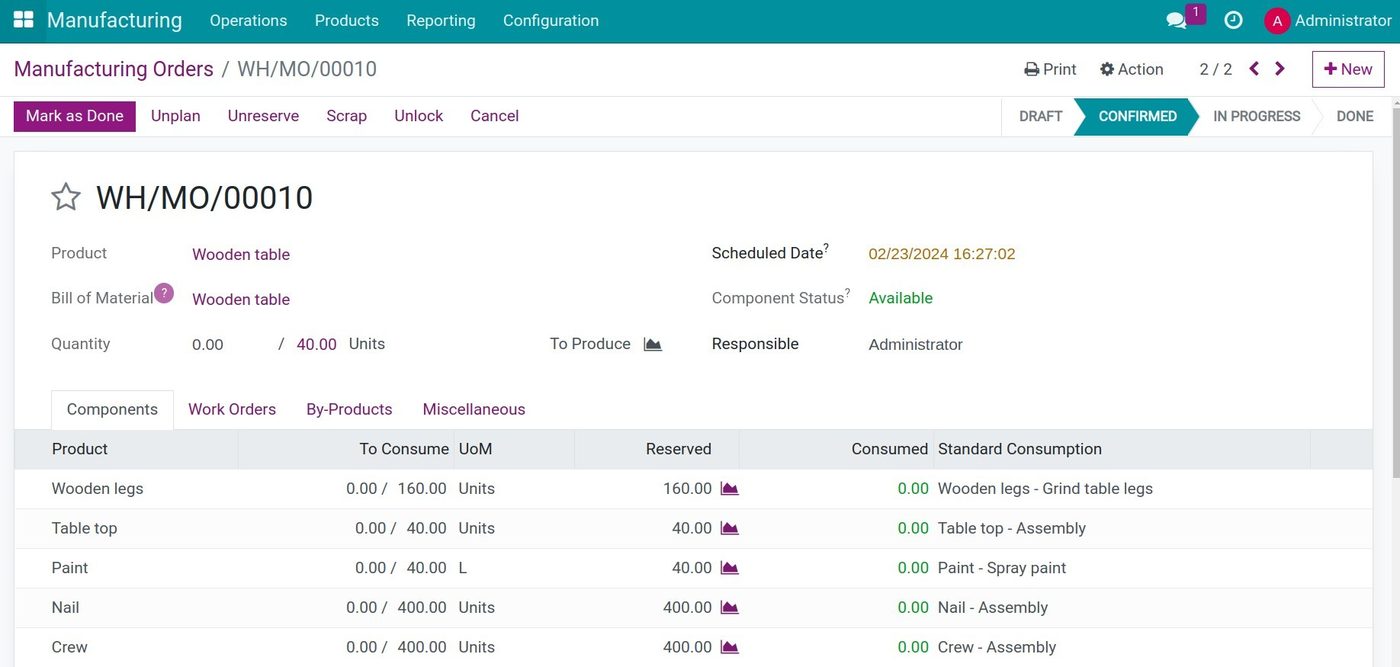
Component status on the manufacturing order shows whether materials are available, with quantities to consume, reserved and consumed.
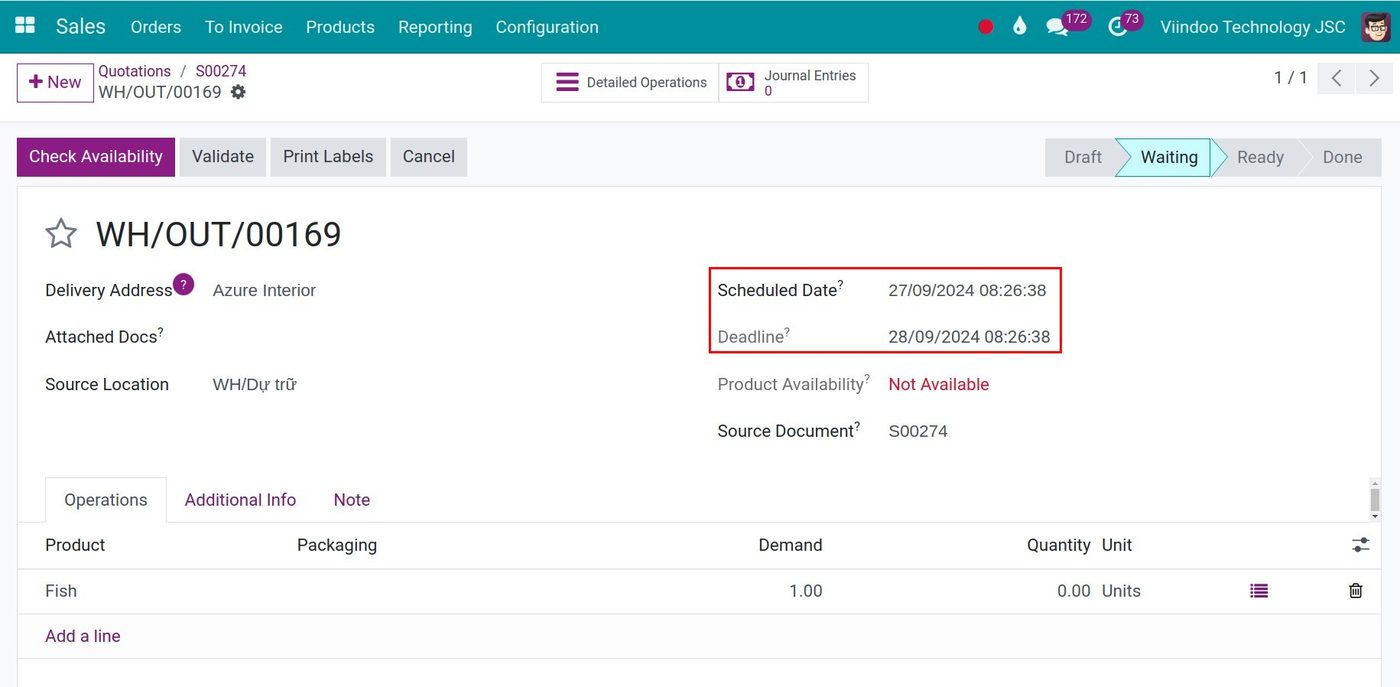
The delivery order keeps its scheduled date and deadline; once validated, it records the actual transfer date, so planned and actual dates can be compared.
As long as this backbone runs end to end, the business can already track, measure and start Kaizen.
9. Configure Viindoo by data layer
A suitable approach is to split Viindoo into three data layers:
Layer 1: Core transaction data
Data required to operate: sales orders, BOMs, manufacturing orders, deliveries, stock moves. Goal: the business flow runs.
Layer 2: Management data
Data for management: commitment dates, times, consumption, quality check results, planned versus actual variances. Goal: deviations can be measured.
Layer 3: Improvement data
Data for Kaizen: causes, bottlenecks, downtime and stop reasons, root causes, corrective actions. Goal: analyze and improve.
The business does not need to roll out all three layers at once.
10. A very practical rule: only add data when a new management question appears
"Where is the order?"
Only the work status is needed.
"Why are orders often late?"
Now the time of each step is needed.
"Why is machining slow?"
Only now are downtime or a deeper routing needed.
This is how data grows together with management needs. It should not be reversed into:
Collect everything first and hope it will be used later.
11. Kaizen helps decide where data should be more detailed
Kaizen does not only use data. Kaizen also helps decide which data to collect next.
The loop can be:
Track
See the problem
Dig deeper into the data
Improve
Standardize
For example:
- Orders are late.
- The data shows the delay is in production.
- The production routing is split further.
- A bottleneck is found in milling.
- Kaizen is applied to milling.
- The improvement is standardized.
- There is no need to expand data anywhere else.
This is how to avoid over-digitalization.
12. When is a business too detailed?
Some signs:
- users enter data without understanding its purpose,
- many fields are often left empty,
- data is entered afterwards just to fill the form,
- many material codes that nobody uses independently,
- too many operations without matching reports,
- workflows longer than reality.
If you see these signs, ask: is the system creating management value, or just "digital detail"?
13. When is a business too simple?
Conversely, a business may be too simple if it:
- does not know which material is delaying an order,
- does not know which operation an order is at,
- cannot measure the gap between plan and actual,
- cannot calculate product cost,
- cannot trace defects.
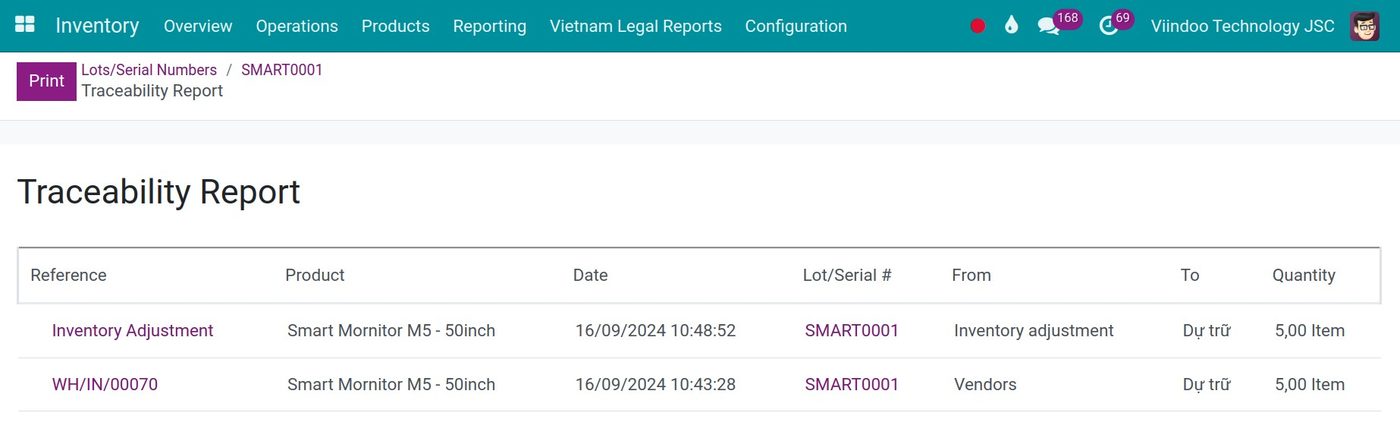
When lots or serial numbers are tracked, the traceability report follows a lot back through each receipt and move, so defects can be traced.
This is a sign that the level of data detail is not yet enough to manage.
14. How to implement Viindoo in balance
Step 1: Draw the main flow
Sales Order → BOM → Material → Manufacturing → Quality → Delivery → Cost.
Step 2: Define the minimum data
Keep only the data needed for the flow to run and be tracked.
Step 3: Go live
Let the business operate for real.
Step 4: Observe the data
See which points are slow, off or invisible.
Step 5: Add detail in the right place
Only expand data where Kaizen is needed.
This is a much lighter implementation method than trying to design a perfect system from day one.
Conclusion: data must be deep enough to manage, but no deeper than decisions require
There is no single right level of data detail for every business. Each business's Sales Order, BOM and routing will differ. But there is one common principle:
Only go into detail to the level the business needs to manage, measure or decide on independently.
Sales Order
clear enough to pass on demand.
BOM
clear enough to manage materials and cost.
Routing
clear enough to follow the production flow.
Quality
clear enough to measure defects.
After that:
Only dig deeper when the data shows a problem that needs Kaizen.
This is how Viindoo stays strong enough to manage without becoming too heavy a system for SMEs.
Frequently asked questions about the level of data detail
Enough to clearly define the product or configuration, quantity, commitment date and the customer's special requirements.
When the business needs to buy, stock, issue, trace or cost that component independently.
No. Only split when the business needs to manage time, capacity, cost, quality or bottlenecks separately.
When the business needs to measure cycle time, productivity or bottlenecks and can keep the data accurate enough.
Not necessarily. Start with the minimum data to operate and track, then raise the level of data detail based on real management and Kaizen needs.
Next in the series: Does ERP take away SME flexibility?
Once data and processes start to be standardized, another concern often appears: "SMEs live on flexibility. Will putting processes into ERP make the business more rigid?" The next article looks at whether standardization and flexibility really conflict, and how Kaizen helps balance the two.