In our test, AI for accounting answered "How much do customers owe us, and who owes the most?" in 15 seconds, and the total matched the ledger to the last dong. The speed is the least interesting part. What matters is where the figure came from: posted entries, the same records the chief accountant would have added up by hand, read with the asker's own access rights.
For a director or a chief accountant, the real question is therefore not whether AI is clever enough. It is which accounting questions can safely be handed to it, what the books must contain for the answers to hold, and where the accountant's judgement still has to come in.
Two kinds of AI for accounting, and which one pays off first
The phrase covers two different jobs. The first kind reads documents: it turns scanned invoices or receipts into data. The second kind works on records already in the books: it reads posted invoices, payments, bills and payslips, answers questions about accounts receivable, payables and costs, and prepares documents for a person to approve.
| AI that reads documents | AI that answers from the books | |
|---|---|---|
| What it reads | Scans and photos of invoices and receipts | Posted invoices, payments, vendor bills, payslips |
| What it saves | Typing data in | Collecting and adding up figures before a decision |
| Typical question | "What is the total on this invoice?" | "Which invoices are overdue, and whom should we call first?" |
This article is about the second kind. Most companies already record their invoices; the time goes into pulling figures together each time someone asks. That is where AI for accounting removes the most work, and it is also where its mistakes would cost the most, so it deserves a careful look.
The weekly questions AI for accounting should help answer
The figures behind these questions are already in the books. The cost lies in retrieving them: filtering reports, exporting to a spreadsheet, separating currencies and explaining the basis. By the time the answer arrives, it may already be out of date.
The director
How much do customers owe us, and how much of it is overdue? How much do we owe suppliers, and what falls due soon?
The chief accountant
Does the receivable balance match the invoices? Which old items need a decision to collect or write off?
Receivables staff
Which customers do we call first this week, and what reminder do we send?
Payroll and HR
What did payroll cost last month by department, and who is allowed to see those figures?
What AI for accounting answered: six requests we tested
We put these requests to AI for accounting on Viindoo, using the data of a test company that assembles electric bikes. The figures belong to that test company and only show how the AI answers; every figure we checked against the records matched.
| Request | What the AI returned |
|---|---|
| "Total receivables, and the five customers who owe the most?" | 18,354,573,433 VND and a table of five customers |
| "Which invoices are overdue, and whom should I call first?" | 75 overdue invoices, a call list in order, and the reasons |
| "Which supplier do we owe most, and which bills fall due in 14 days?" | A table of suppliers, the bills due, and the overdue bills by currency |
| "Payroll cost for October, by department?" | A table by department, with the highest one |
| "Draft a polite email reminding this customer to pay. Let me read it first." | A draft held on a confirmation card, not sent |
| "A one-page PDF summary of October sales with a weekly bar chart" | A PDF file; the AI reported that its first draft ran to two pages and that it cut it to one |
An answer built from records comes with a Sources list: the invoices, bills or payslips it drew on, limited to those the asker may open. The accountant can click through and check before anyone acts. The more useful habit, visible in the excerpts below, is that the AI also states its basis: which entries it counted, which it left out, and in which currency.
Five real situations: AI for accounting in a finance team's month
The situations below show how a finance team uses an answer: the request typed, what came back, the next step on Viindoo, and what the answer reveals about the company's own books. Answers are shortened excerpts from our test on the electric bike test company.
Situation 1: the receivables position before the Monday meeting
Request typed: "What is the total receivable now, and which five customers owe the most?"
What came back, in 15 seconds. A total of 18,354,573,433 VND, the remaining balance of 147 posted receivable lines not yet reconciled, across 45 customers. The five largest:
| Customer | Open lines | Still receivable (VND) |
|---|---|---|
| Kien An Trading JSC | 2 | 5,600,000,000 |
| Hoa Binh Electric Vehicles Co., Ltd | 4 | 3,604,600,000 |
| Le Chan Auto Co., Ltd | 2 | 3,200,000,000 |
| Niem Nghia Transport Co., Ltd | 1 | 1,890,000,000 |
| Dinh Vu Infrastructure JSC | 1 | 1,785,000,000 |
The AI added that these five account for about 87.6% of the total, and explained its basis: posted lines on the receivable account that are not yet reconciled, with draft and cancelled entries excluded and customer prepayments already netted off. It then offered to split the overdue part from the part not yet due.
Next step on Viindoo. The chief accountant opens the aged receivables report to see the same balance by due-date band.
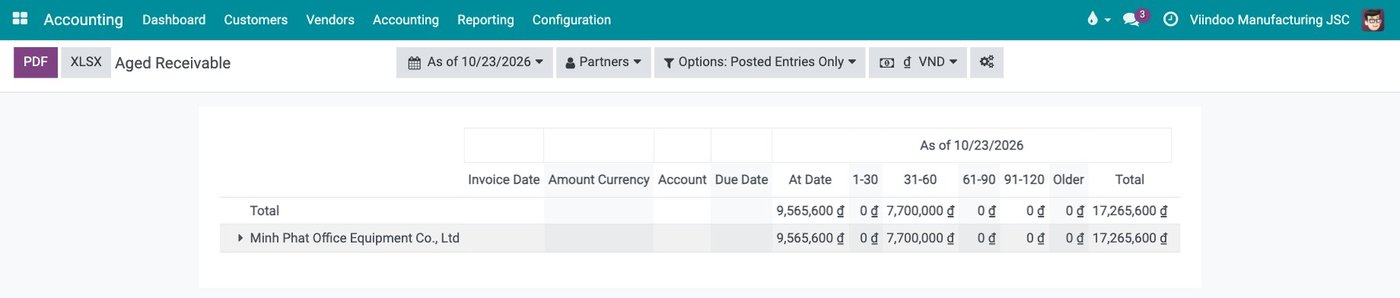
Example: the aged receivables report splits what each customer owes into not yet due and overdue bands.
What to apply in your company. The AI's total is only as clean as your matching. A payment received but not matched to its invoice stays as an open line, so receivables look higher on one side and the customer disputes the figure on the other. Match payments to invoices every week, not at year end.
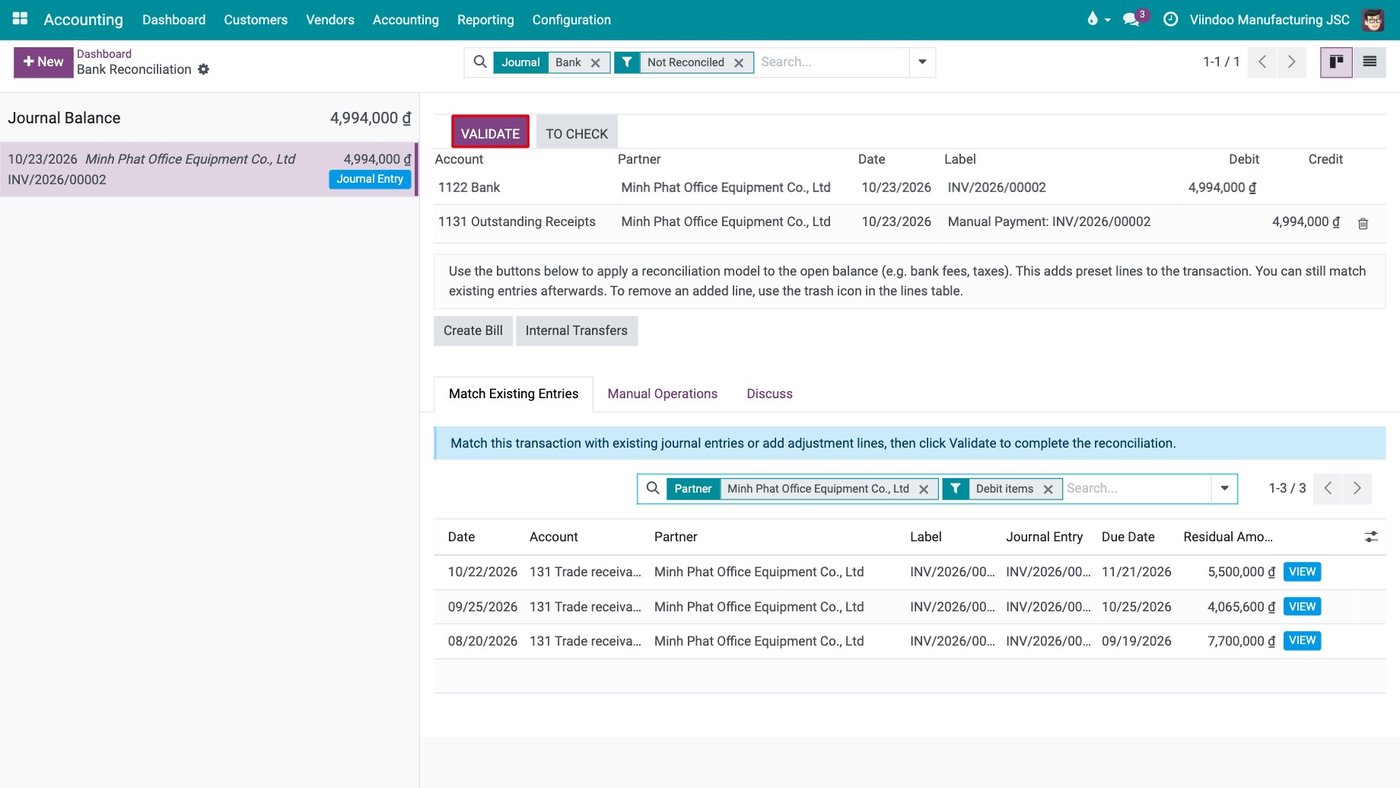
Example: when reconciling the bank statement, the customer's open receivables are listed with their due dates, ready to be matched.
Situation 2: overdue invoices, and whom to call first
Request typed: "Which sales invoices are overdue? Which customer should I call first, and why?"
What came back, in 28 seconds. 75 posted invoices still unpaid and past due, from 39 customers, totalling 19,298,305,192 VND, including invoices that were partly paid. Then a call order:
| Order | Customer | Overdue | Reason given by the AI |
|---|---|---|---|
| 1 | Kien An Trading JSC | 5.6 billion VND, 2 invoices | The largest amount, about 29% of everything overdue |
| 2 | Hoa Binh Electric Vehicles | 3.64 billion VND, 2 invoices | One invoice overdue for 35 days, in the large-debt group |
| 3 | Le Chan Auto | 3.2 billion VND, 2 invoices | Includes an acceptance-stage invoice of 1.28 billion |
The AI explained its focus: six companies held about 88% of the overdue amount, so collecting from them would help cash flow far more than calling dozens of small dealers, who could be reminded in a batch. It flagged one line to check before any call: an invoice of 186,186,000 VND due in January 2024, overdue for more than 1,000 days and probably an old balance or a dispute. And it named what it had not looked at: contact history, payment promises and credit limits.
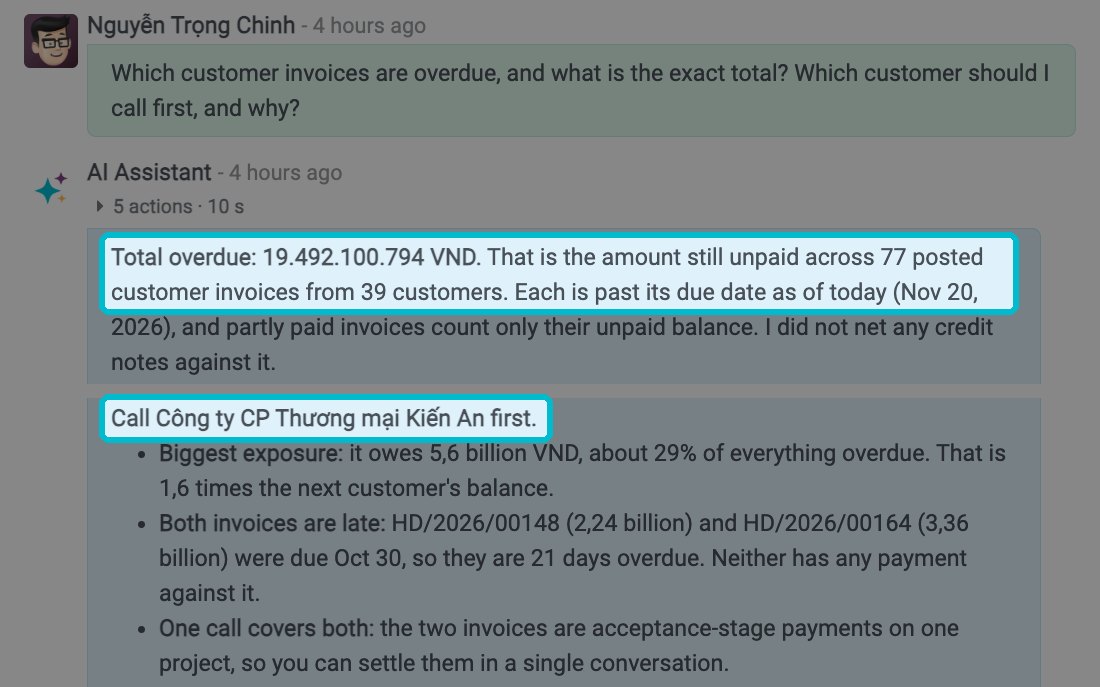
From our test, a similar request asked in English two days later: two more invoices had passed their due date (77 invoices, 19,492,100,794 VND), and the customer to call first was the same.
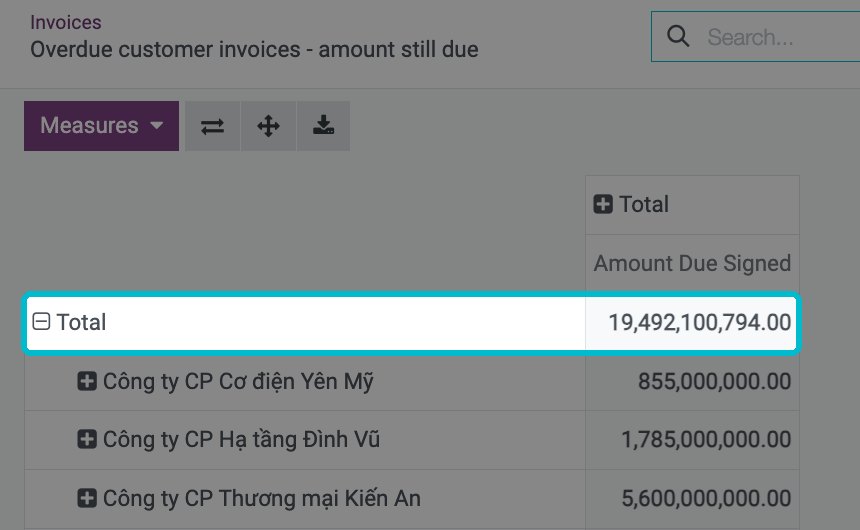
The overdue invoice report opened on the same day shows the same total as the AI's answer.
Set the two answers side by side and something stands out: the overdue invoices add up to 19.30 billion, more than the 18.35 billion of all receivables. Both are correct on their own basis. The first adds up the unpaid balance of each overdue invoice; the second is the net balance of the receivable account, after prepayments and credits. A gap like this, about 0.94 billion, usually comes from prepayments, credit notes or payments not yet matched to their invoices. The chief accountant should be able to explain it line by line before the director quotes either figure.
What to apply in your company. Treat the call order from AI for accounting as a first draft: it ranks by amount and due date only, as the AI itself said. The person who owns the customer adds what the books do not hold, such as last week's promise to pay. The 1,000-day invoice needs a decision from the chief accountant and the director: collect it or write it off.
Tracking debt by due date rather than invoice date, and setting reminder points, is covered in the article on debt age and the article on accounts receivable management.
Situation 3: a payment reminder drafted, but not sent
Request typed: "Draft an email to Hoa Binh Electric Vehicles reminding them to pay the latest invoice, in a polite tone. Let me read it before it goes."
What came back, in 28 seconds. No email left the system. After nine steps, the AI had the draft ready and stopped at a confirmation card for sending. The message goes out only if the person reads it and confirms; they can also cancel it.
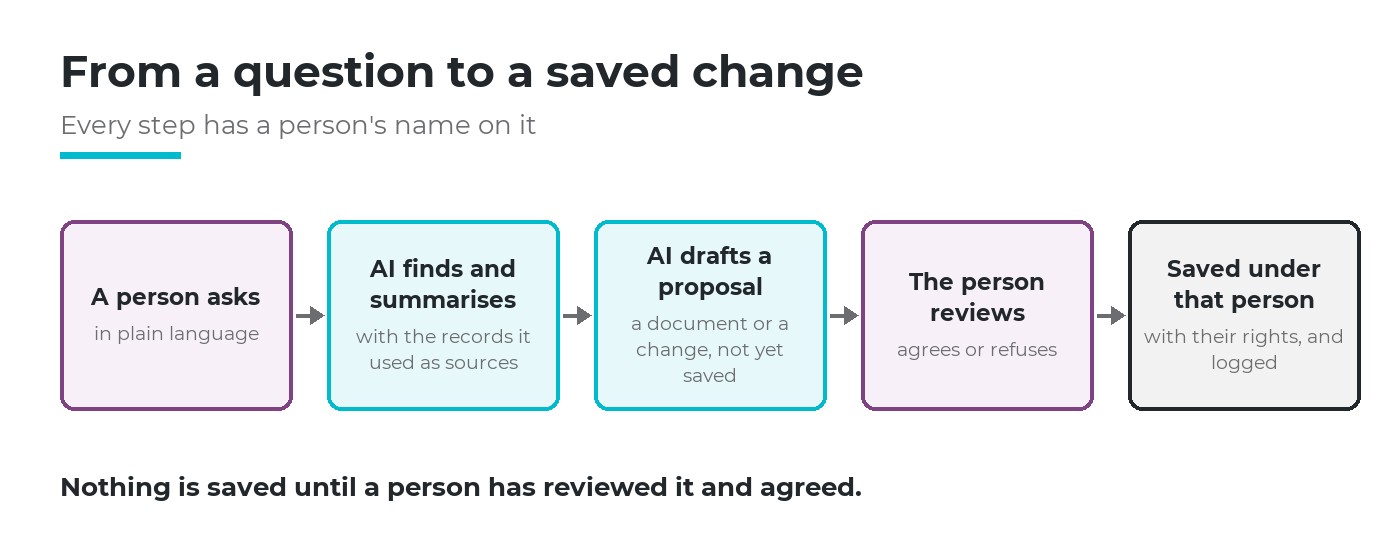
AI finds, summarises and drafts in the middle steps. A person starts the chain and closes it.
What to apply in your company. Agree who may confirm a reminder: the receivables accountant for routine reminders, the chief accountant or the director for a customer in dispute. The person who confirms is the one accountable for what the customer receives.
Situation 4: supplier payables, and a payment plan that is overdue
Request typed: "Which supplier do I owe the most, and which bills fall due in the next 14 days?"
What came back, in 14 seconds. The largest creditor was owed 15,975,000,000 VND across 16 bills, followed by four suppliers owed between 60 million and 590 million VND each. Debts in USD and CNY were ranked separately, not added to VND. Then the answer to the second half of the question:
| Bills | Count | Still owed |
|---|---|---|
| Due in the next 14 days | 0 | - |
| Already overdue, VND | 44 | 17,495,724,872 VND |
| Already overdue, CNY | 7 | 107,353.40 CNY |
| Already overdue, USD | 3 | 1,725.25 USD |
Two caveats came with it. Bills without a due date could not appear in the 14-day list. And the ranking covered 10 of the 23 supplier and currency groups; the AI offered to go through the rest.
Next step on Viindoo. "Nothing due in 14 days" sounds reassuring until the next line: 44 VND bills already overdue. The real task is a payment plan for those bills, agreed by the chief accountant and the director, with each bill first checked against ordered and received quantities.
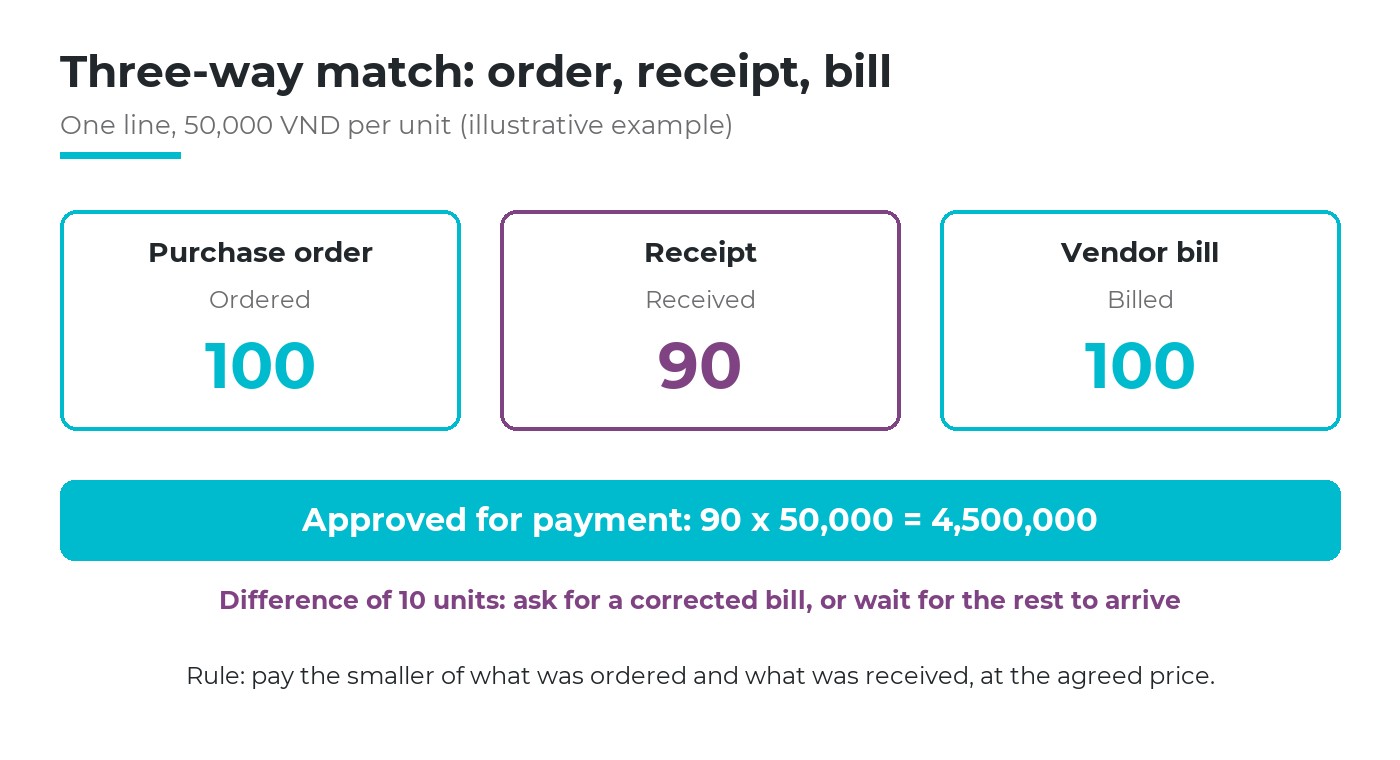
Ordered 100, received 90, billed 100: only 90 should be recorded for payment (illustrative example).
What to apply in your company. Make the due date a required habit on every vendor bill. Without it, the question "what falls due next week?" has no reliable answer, from AI or from anyone. How bills are checked before payment is covered in the article on purchase approval limits.
Situation 5: payroll cost by department, and who may see it
Request typed by the director: "Payroll cost for October 2026 by department: which one is highest?"
What came back, in 15 seconds. A table of twelve departments from 211 payslips, all in Done status, using the company cost measure: 3,157,032,500 VND in total. The two production workshops came first, about 67% of the total, because they hold 174 of the 211 payslips. The board of directors had only four payslips but ranked third, so its cost per person was the highest. The AI noted that a thirteenth-month salary was not counted, and that any payslip without a department would be missing from the table.
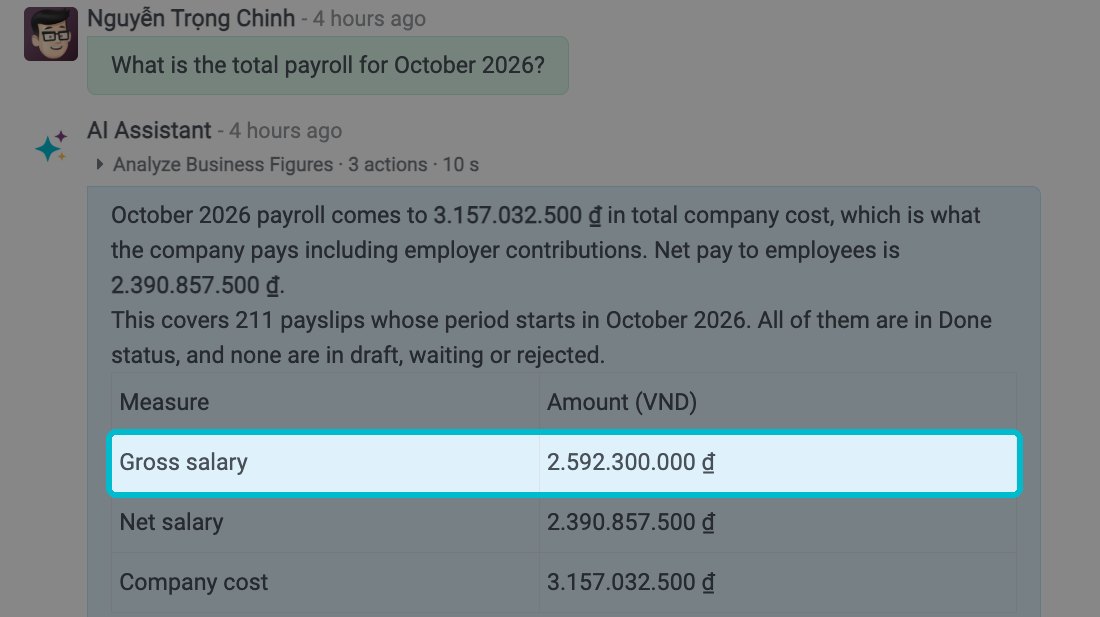
From our test: asked for the payroll total, the AI gives gross pay, net pay and company cost, and the same company cost total of 3,157,032,500 VND.
The same question, asked by a salesperson, got a different answer: the AI found no payslips in the records that person may read, and said payroll might not have been run or the account might lack access. The AI has no access of its own; it reads with the rights of whoever is asking.
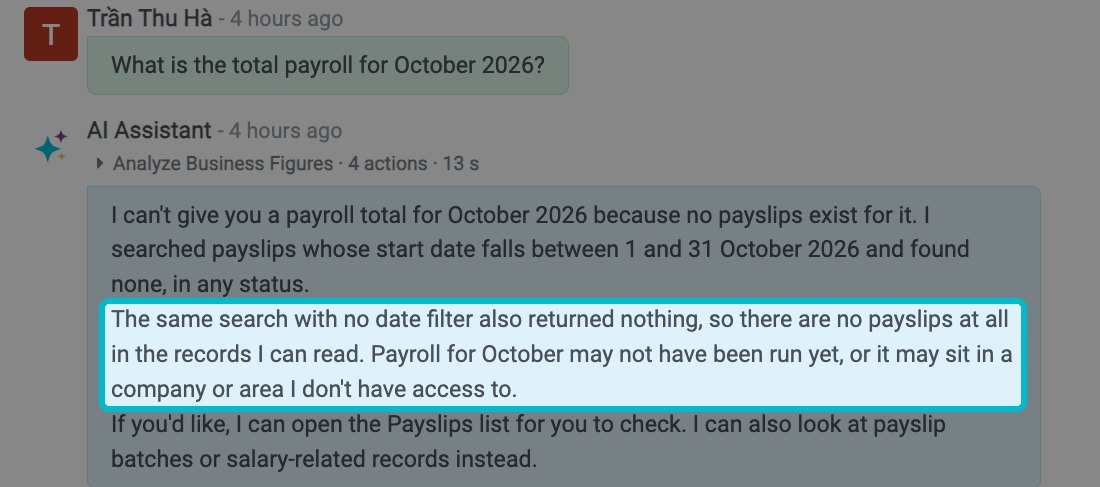
From our test: with a sales user's rights, the AI finds no payslips it may read and says it may not have access.
What to apply in your company. Review access rights before switching AI on, starting with payroll and margins. In the same test, the salesperson could get the cost and gross margin of each bike model, because the default sales rights allow reading product cost: the AI exposes exactly what the rights leave open. In some runs it also said "no payslips exist" rather than "none in the part you may see", so teach users that an empty answer may be a rights question.
Setting access rights before AI is switched on is discussed in the article on AI data governance.
What the books must contain for AI for accounting to answer correctly
Every caveat in the answers above points back to a habit in the books, not to the AI. AI for accounting counts what has been posted, matched and dated; anything still in a spreadsheet or a drawer does not exist for it. Four habits make the difference.
1. Post on time
Draft and cancelled entries are left out of every total. An invoice issued but left in draft is invisible to the receivables figure.
2. Match payments to invoices
Unmatched payments leave invoices open and create gaps like the 0.94 billion in situation 2.
3. Date every invoice and bill
Overdue lists and payment plans rest on due dates. A bill without one never falls due.
4. Keep departments and currencies clean
A payslip without a department drops out of the department table; foreign-currency debts are reported separately, not converted silently.
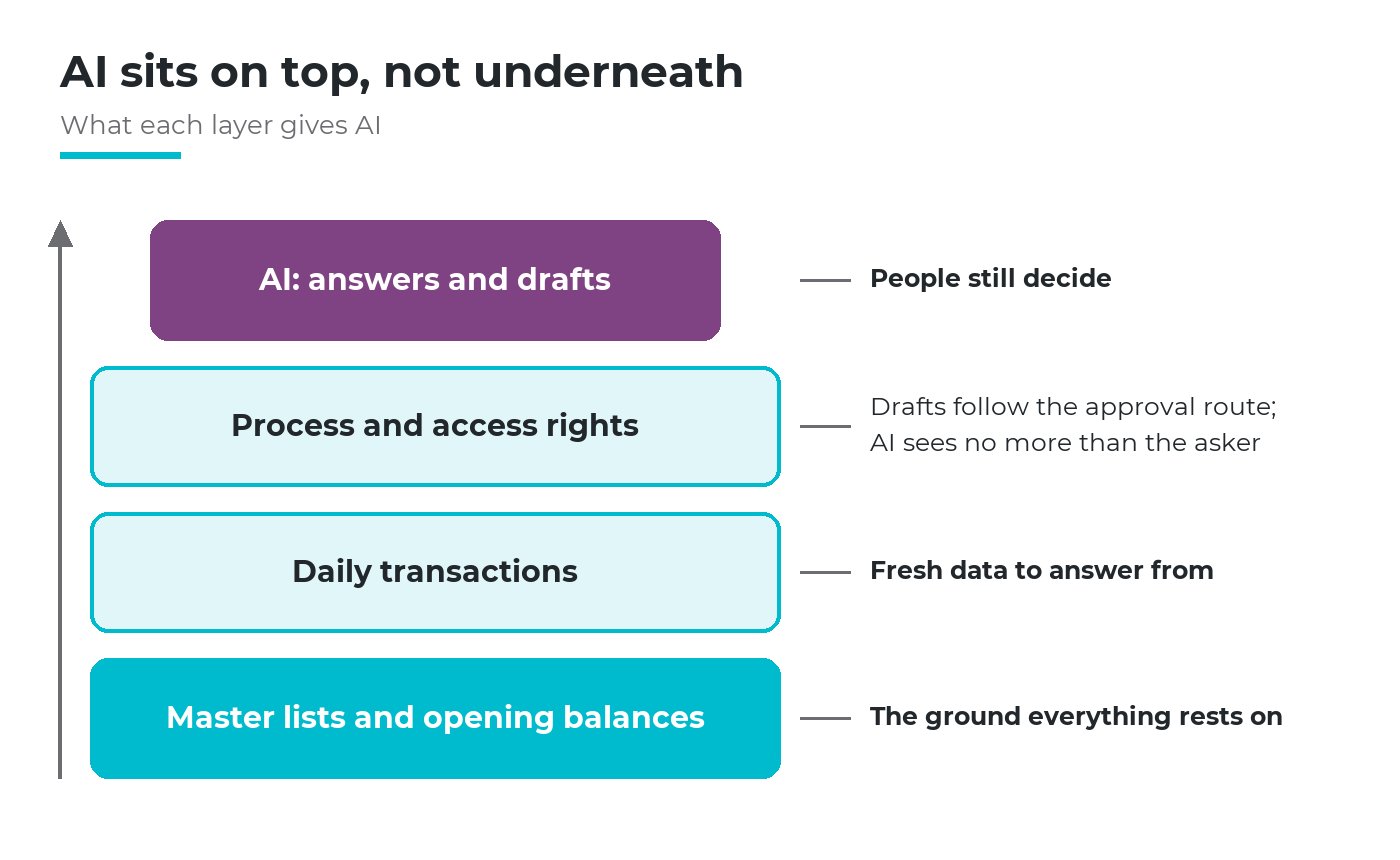
AI sits on the top layer. Without the records beneath it, its answers are fluent but have nothing to rest on.
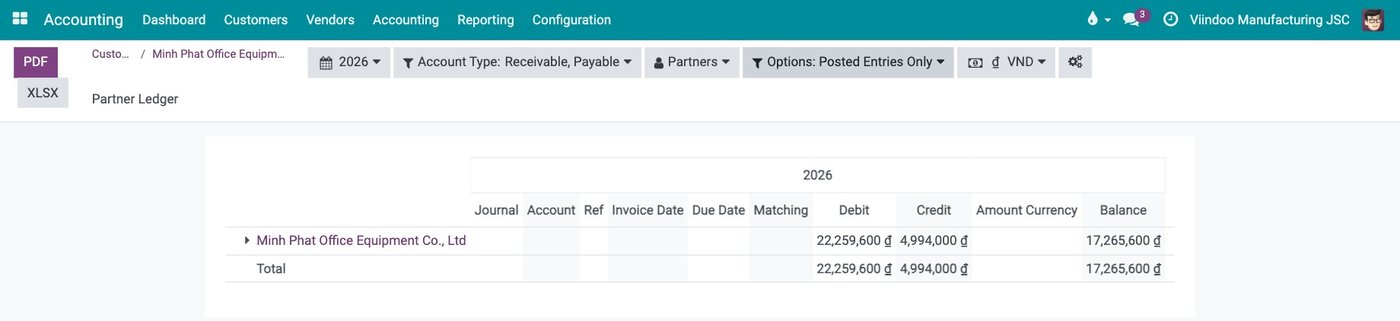
Example: the customer ledger shows what was invoiced, what was collected and the balance, the basis for a balance confirmation with the customer.
AI prepares, the accountant approves: rights, costs and a record of every call
Finance is where an AI acting on its own would do the most damage, so control matters more for AI for accounting than anywhere else. On Viindoo, by default, an action that sends, schedules, creates or changes something stops at a confirmation card, as the reminder email in situation 3 did. Reading follows the asker's rights, as the payroll question in situation 5 showed. Two further controls matter to a chief accountant.
Cost caps. The company sets a spending cap per person per day, per company per day, and an amount per question, plus an alert threshold before a cap is reached. According to the module documentation, a request over the cap is blocked with a notice; we have not yet tested that case ourselves.
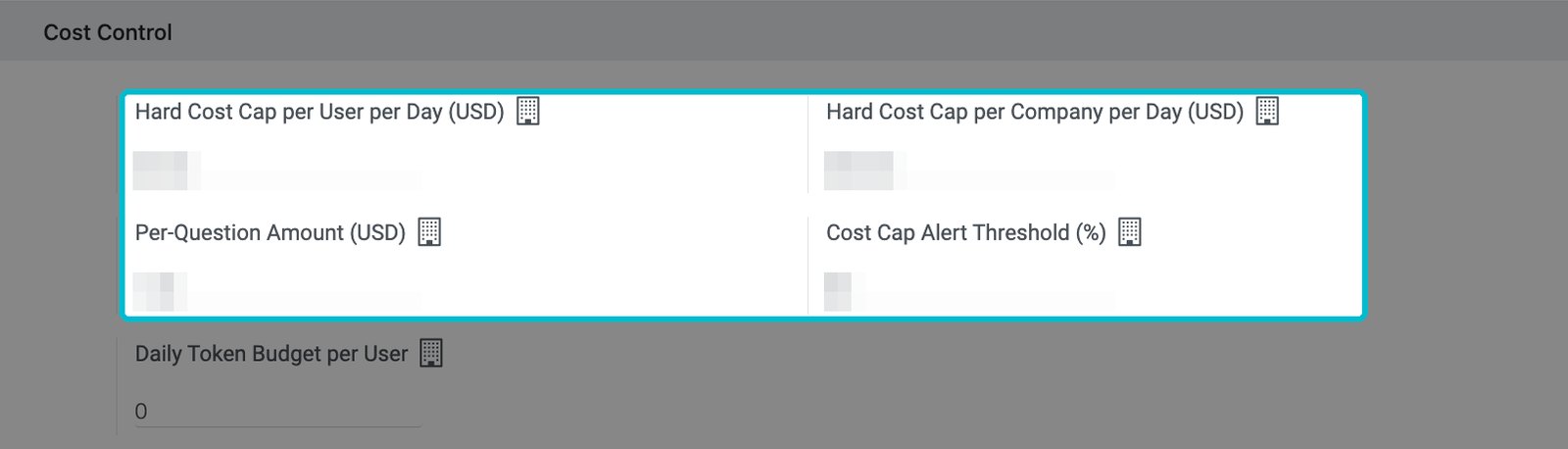
The cost control settings, with the values hidden: each cap is set by the company.
A record of every call. Each call to the AI provider is logged with its date, the user, the provider and model, the type of request, the tokens used, the cost and the status. When an auditor asks who asked what, and at what cost, the answer is a list.
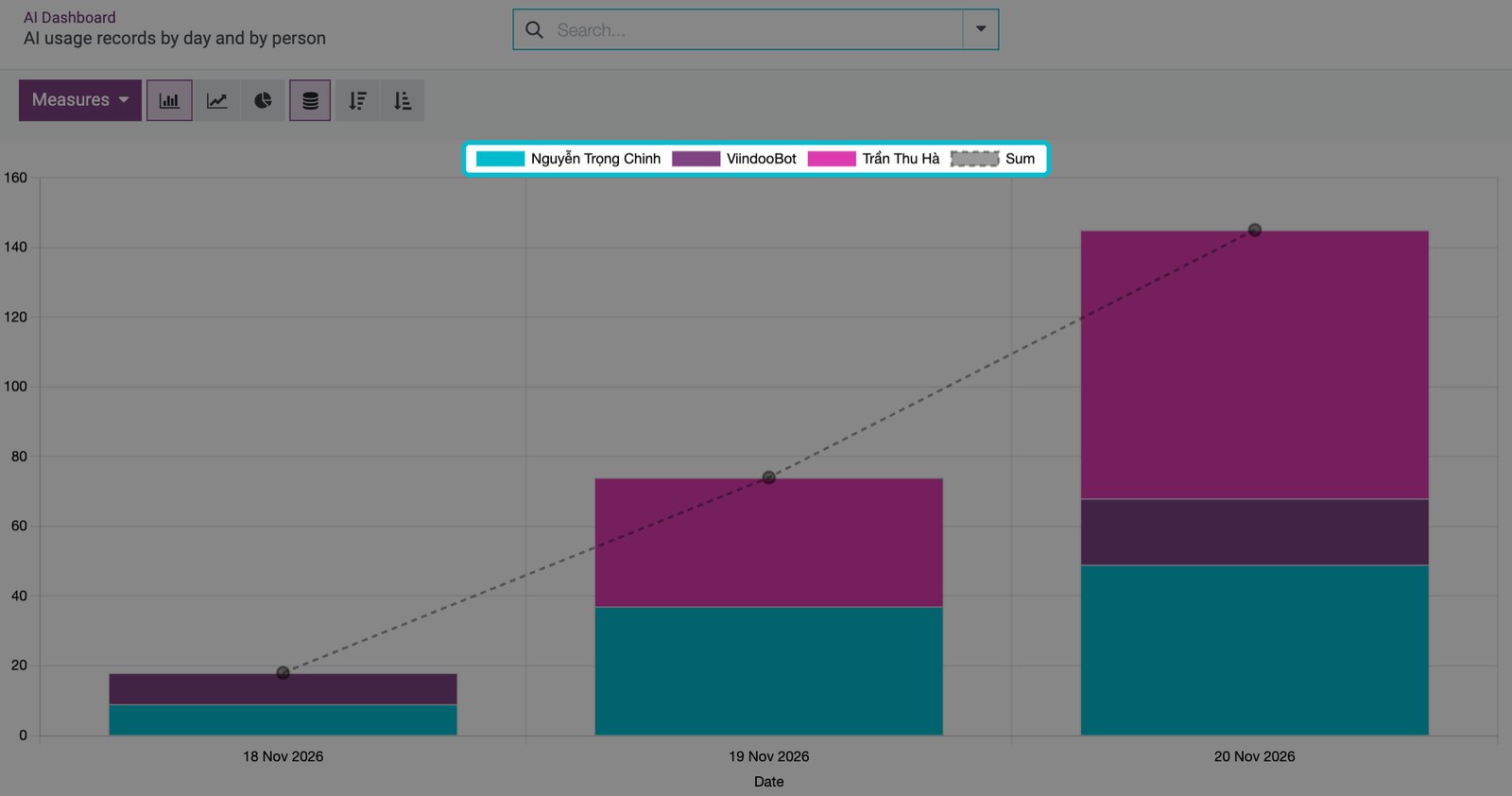
Example: the AI usage records grouped by day and by user; each record opens the details of one call.
Who answers for an AI-assisted decision is discussed in the article on AI accountability.
What AI for accounting does not do yet
Being clear about the limits of AI for accounting saves disappointment later. On Viindoo today:
- It does not replace the accountant's judgement. Whether to write off a 1,000-day invoice, which supplier to pay first, how much credit to give: the AI lays out the figures, a person decides.
- It only knows what has been recorded. Draft entries, a promise made on the phone or a spreadsheet on someone's laptop are outside its view.
- The core bookkeeping stays with the accountant. We have not tested the AI on posting journal entries, reconciling the bank, preparing tax returns or closing a period. In this article these remain the accountant's work in the accounting app, as they are today.
- It is not always right. The figures we checked matched the records, but an answer still needs an accountant to read it before it reaches a bank, a customer or the board.
Where a finance team should start
1. Clean up matching
Match open payments to invoices so the receivable balance means what it says.
2. Date every bill
Due dates on every customer invoice and vendor bill, from today on.
3. Review access rights
Payroll and product cost first, then set the cost caps.
4. Ask three questions a week
Receivables, overdue invoices, bills due, each read by a named accountant.
What agentic AI is, and the conditions it needs inside a business system, is explained in the article on what agentic AI is.
Would you like to see AI answer questions about your own receivables and payables? Tell us where it hurts most. Book a consultation and bring last month's aged receivables list, or see the costs first.
Frequently asked questions about AI for accounting
By default, actions that create or change records stop at a confirmation step, where a person confirms or cancels. Posting entries, bank reconciliation and period close were not part of our tests and remain the accountant's work.
No. It removes the time spent collecting and adding up figures. Explaining a gap between two totals, deciding a write-off or a payment order, and signing off figures for the board stay with the chief accountant.
The company connects the AI provider it chooses with its own key and pays that provider directly. The question and the data needed to answer it are sent to that provider; each connection shows its data storage region. Viindoo does not resell AI.
Related articles
- What Is Agentic AI, and How Does It Work Inside a Business Management System?
- Build Business Software with AI, or Use a Platform with AI Built In?
- Separate Software Plus Spreadsheets, or One Platform for the Whole Business?
- AI for Manufacturing Companies: What Agentic AI Can Do from Order to Shop Floor
- Accounts Receivable: Where to Look, When to Remind, No Re-keying from Sales to Accounting
- Payables and receivables management in Viindoo software
- AI in Sales: What Agentic AI Can Do from Opportunity to Quotation
- AI in Inventory Management: What Agentic AI Can Do from Stock to Delivery