Accounts receivable management in most growing companies starts with the same question from the director: how much do customers owe us, and who is late? The answer often takes a day, because sales keeps one list, accounting keeps another, and the two never quite agree.
The short answer: look at one ledger per customer, read by due date rather than invoice date. Remind on a schedule agreed before the debt is due, with a named person for each step. And let the invoice come from the sales order, so nobody types the same amount twice.
Receivables, or accounts receivable, are money the company has earned but not yet collected. Until it is collected, it is the company's money sitting in the customer's bank account.
Why receivables slip: gaps in design, not careless people
When a customer pays two months late, the usual reaction is to ask who forgot to remind them. Forgetting is a symptom. The cause is usually one of four gaps in how the work was set up.
Two versions of the numbers
Sales keeps orders in a spreadsheet, accounting types them again. Every re-keyed line can carry a wrong amount or a missed discount.
No agreed due date
Terms are agreed by phone and never written on the order. Without a due date there is no "late", only a vague feeling that it has been a while.
Nobody owns the reminder
Sales assumes accounting will call; accounting assumes sales knows the customer better. Both are reasonable, and the call never happens.
Credit decided blind
A new order is accepted without anyone seeing what the customer already owes, including orders delivered but not yet invoiced.
Each gap is a design choice, not a personal failing. That is good news: a design can be changed in weeks, while blaming people changes nothing. Good accounts receivable management closes the four gaps in order: one source of numbers, a due date on every invoice, a reminder schedule with owners, and a visible credit position before each new order.
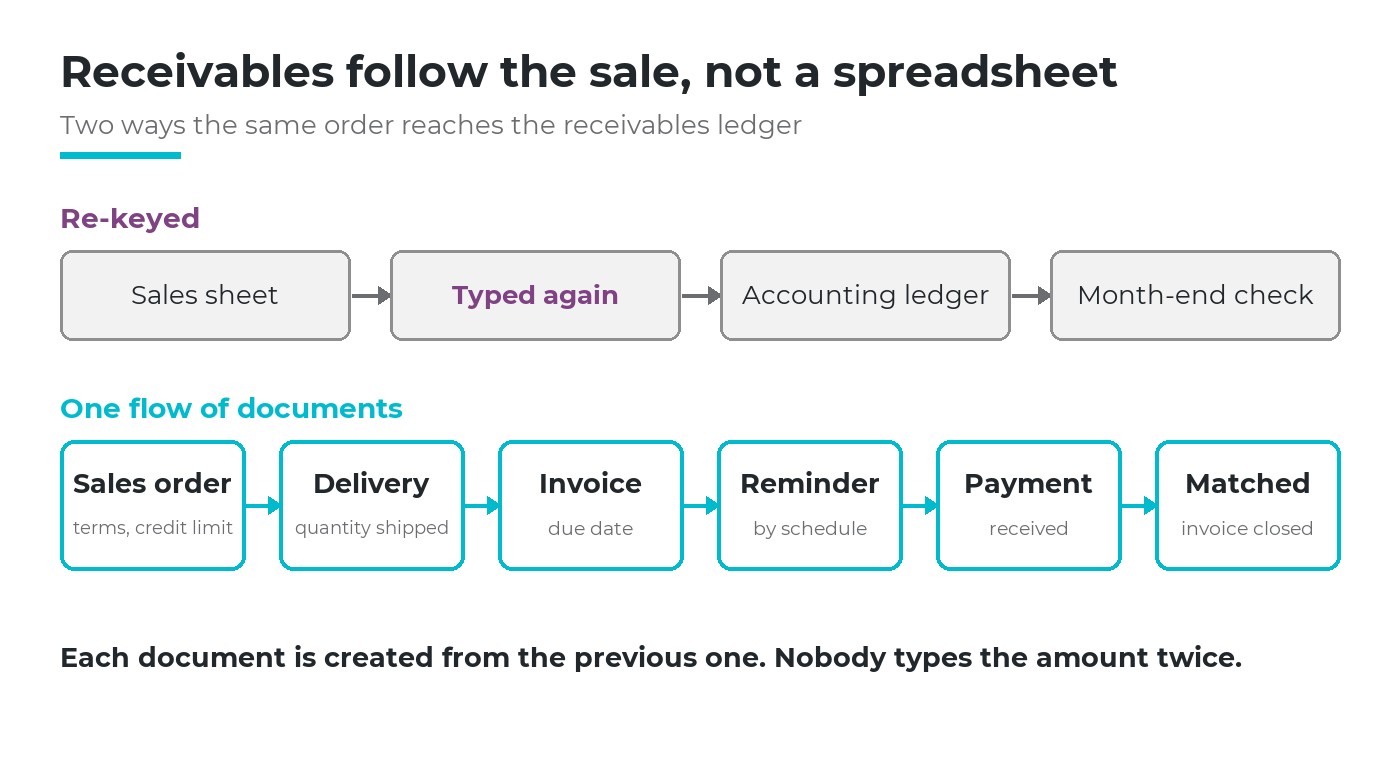
Two ways the same order reaches the receivables ledger. In the second, each document is created from the previous one.
Where to look: one ledger per customer, read by due date
Accounts receivable management needs only two views, and each answers a different question.
| View | Question it answers | Who reads it |
|---|---|---|
| Aged receivables: open amounts grouped by days past due | Who is late, by how much, and how long | Director weekly; credit controller daily |
| Customer ledger: every invoice, payment and adjustment in date order | How did this balance come about | Accountant; the customer, when confirming balances |
The aging view, called debt age in accounting, should count from the due date, not the invoice date. An invoice issued 40 days ago on 60-day terms is not late. One issued 20 days ago on 7-day terms is. Counting from the invoice date mixes the two and sends reminders to the wrong customers.
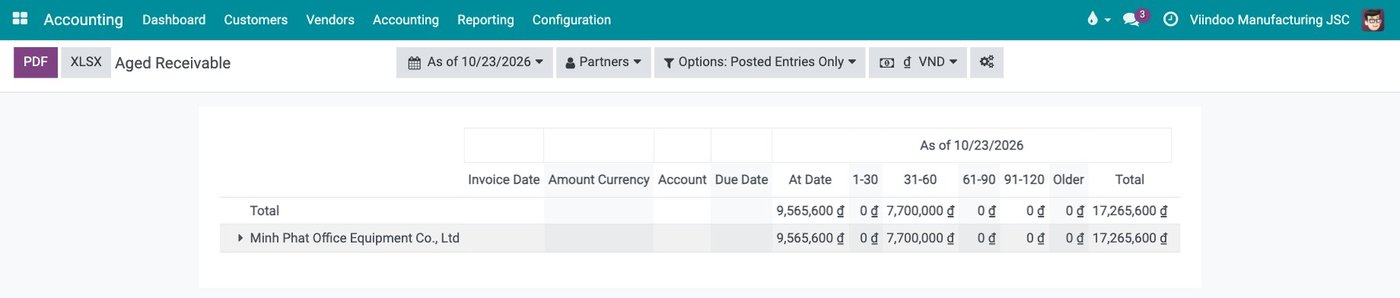
Example: the aged receivables report splits what a customer owes into not yet due and overdue bands by due date.
The ledger view matters at the end of each period, when the company and the customer confirm the same balance in writing. If both sides start from documents, it takes minutes, not a week of emails. The steps of the receivables accounting process are worth agreeing once, in writing, between sales and accounting.
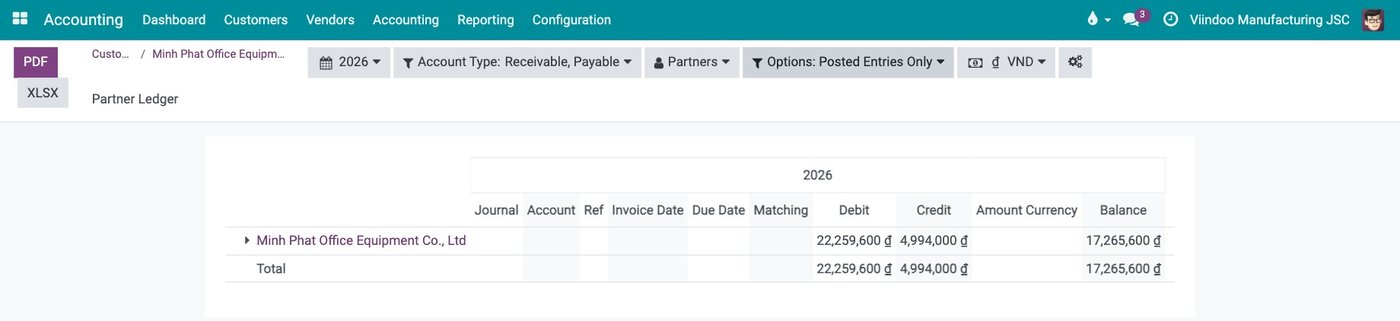
Example: the customer ledger shows the total invoiced, the total collected and the balance still owed, and can be printed or exported for a balance confirmation.
For the director, one trend number is enough: how many days of sales sit in receivables. If it creeps up each quarter, collection is slowing. The receivables turnover ratio measures the same thing from the other side.
When to remind: a schedule set before the debt is due
Reminders work when both sides can predict them: the customer knows what happens and when, the company knows who acts at each step. The schedule is decided once.
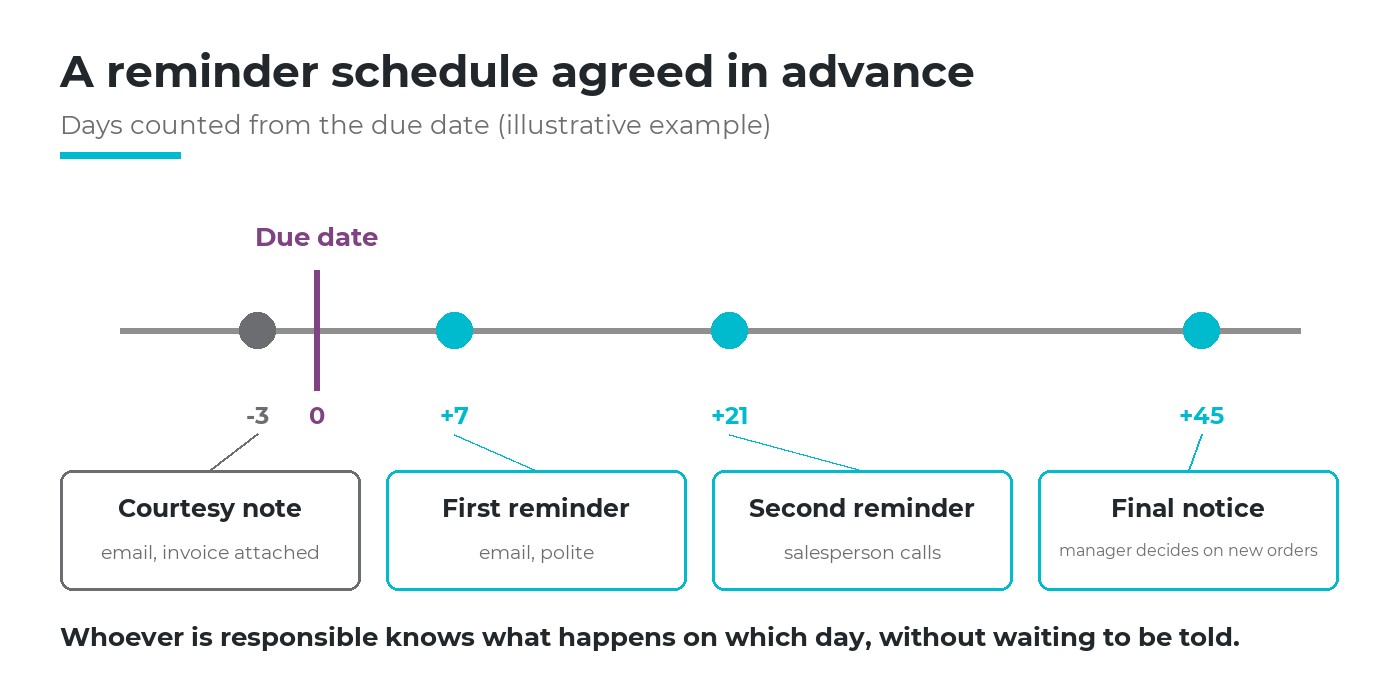
A reminder schedule with four steps, counted from the due date (illustrative example).
Before the due date
A courtesy note with the invoice attached; many late payments are invoices that never reached the payer.
Soon after
Accounting sends a polite reminder listing open invoices, the same way to every customer.
A few weeks late
The salesperson calls. They know the customer and have the next order to protect.
Long overdue
A formal notice, and a manager decides on new orders for this customer.
Three rules keep the schedule fair. First, the due date must be on the invoice, which means payment terms (Payment Terms) are set on the order, not remembered. Second, an invoice under dispute is set aside from reminders. Third, the salesperson sees which of their own customers are overdue, without access to the whole ledger.
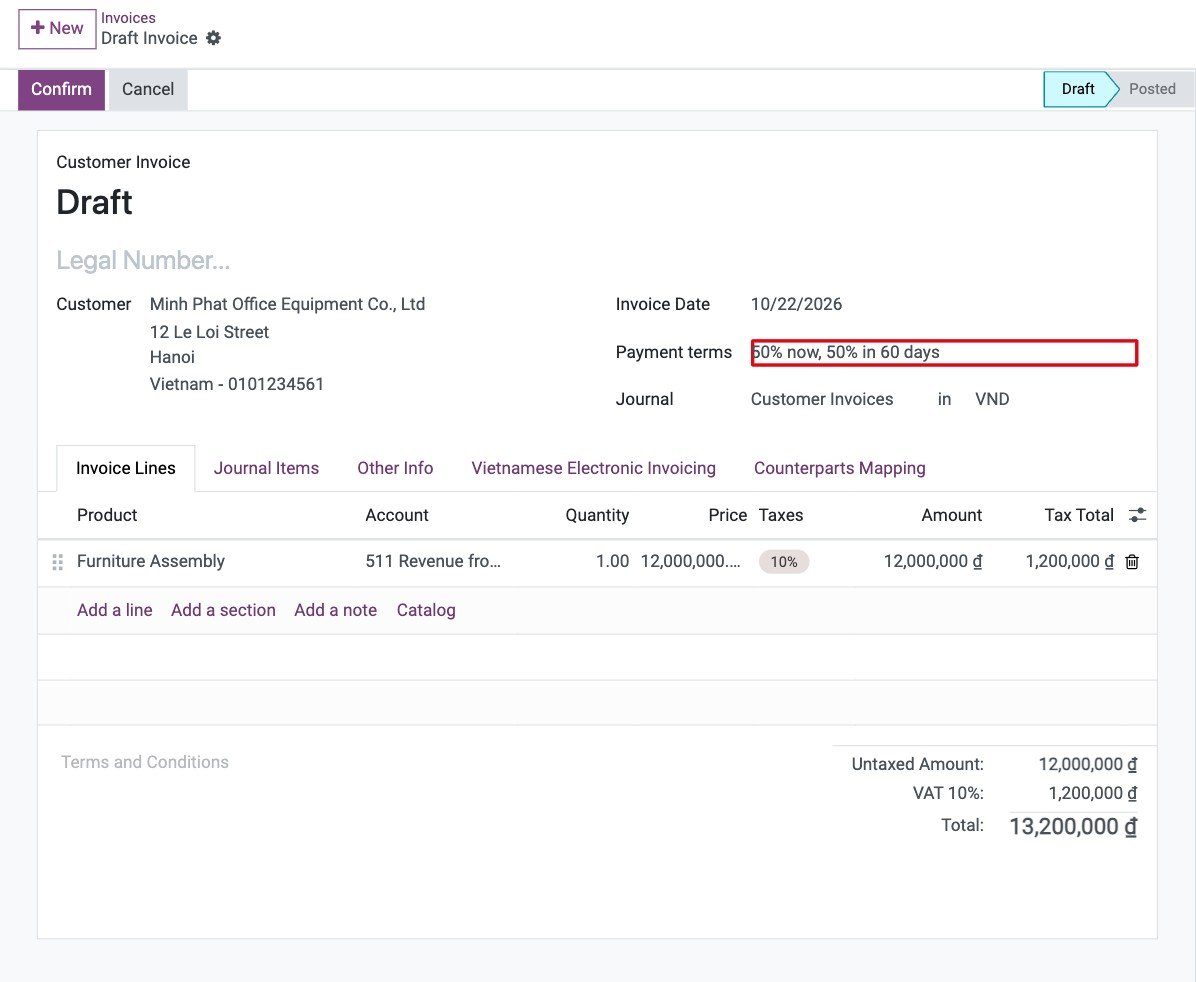
Example: payment terms chosen on the invoice decide its due dates, here half on issue and half later.
A reminder is not a sign of distrust. It is part of the service: the customer pays on time because the company made it easy to know what is due and when.
No re-keying: invoice from the order, payment matched to the invoice
The most effective step in accounts receivable management is the least visible: each document is created from the one before. The sales order carries customer, prices, discounts and payment terms; the invoice is created from it, so the amount owed is exactly what was sold.
One policy decision comes first: invoice what was ordered, or what was delivered. Selling services or custom goods often invoices on order. Shipping goods in several deliveries usually invoices on what actually left the warehouse, so the customer is never billed for goods still on the shelf.
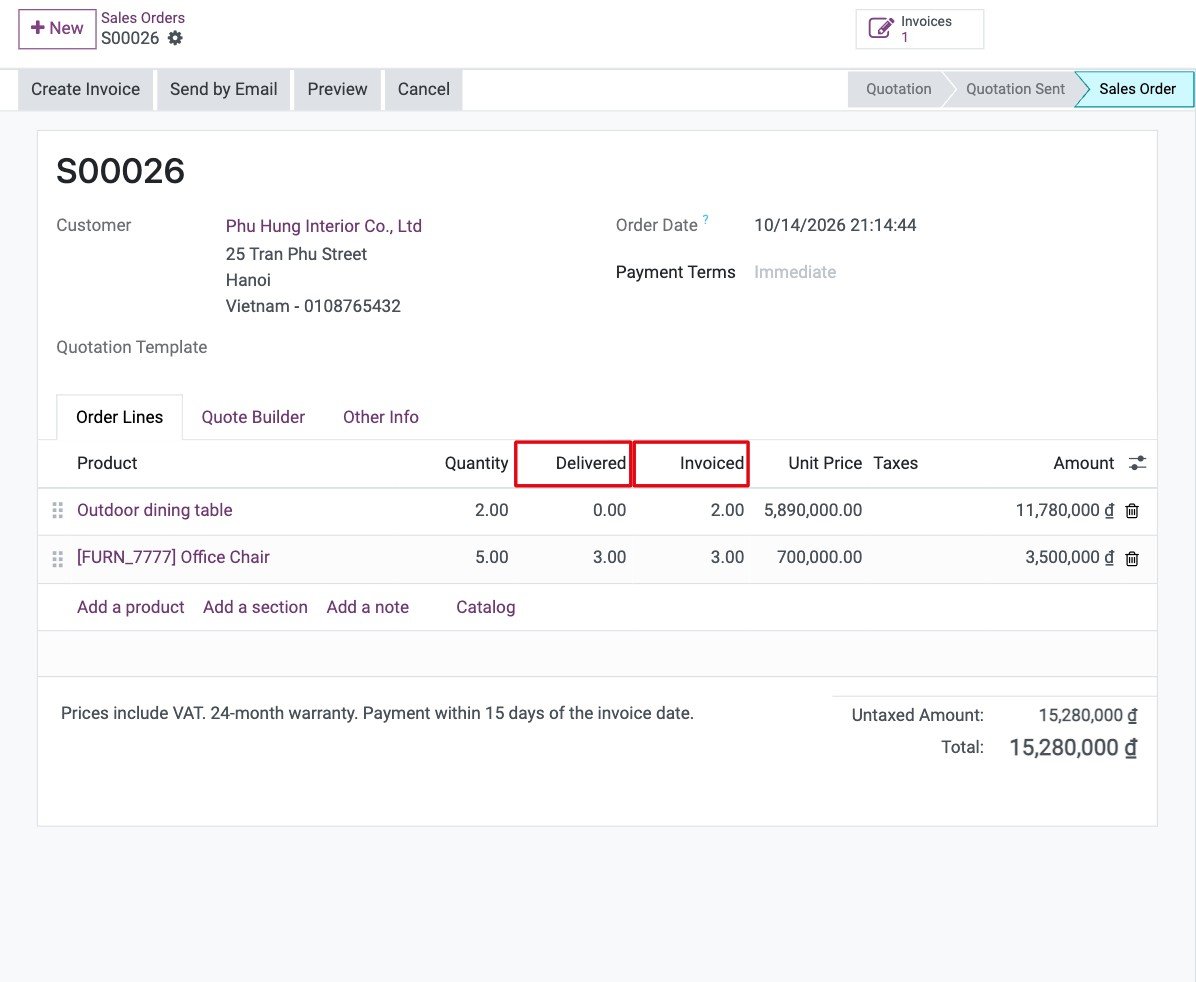
Example: on the sales order, the Delivered and Invoiced columns sit side by side. One line is invoiced on ordered quantity, the other only on what was delivered.
The same logic applies to money coming in. A bank transfer should be matched to the invoices it pays. Unmatched payments are why the ledger differs from what the customer thinks they owe.
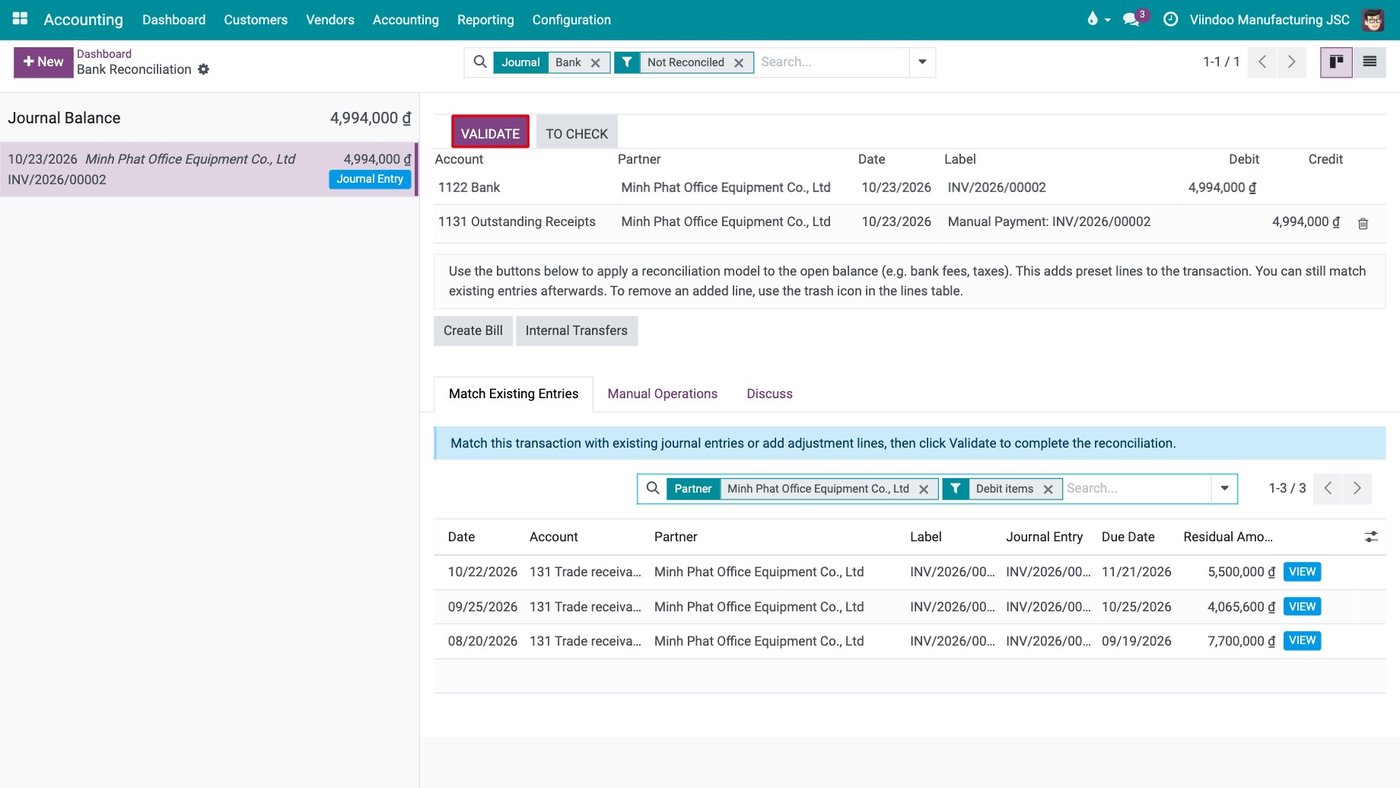
Example: when reconciling the bank statement, the customer's open receivables are listed with their due dates, ready to be matched to the incoming transfer.
Advances and prepayments
Money received before the invoice, a deposit or a prepayment, causes the most confusion. Record it at once as a customer payment, linked to the order where possible, and apply it when the invoice is issued. Kept in a separate notebook, it is forgotten and the customer is reminded of money already paid.
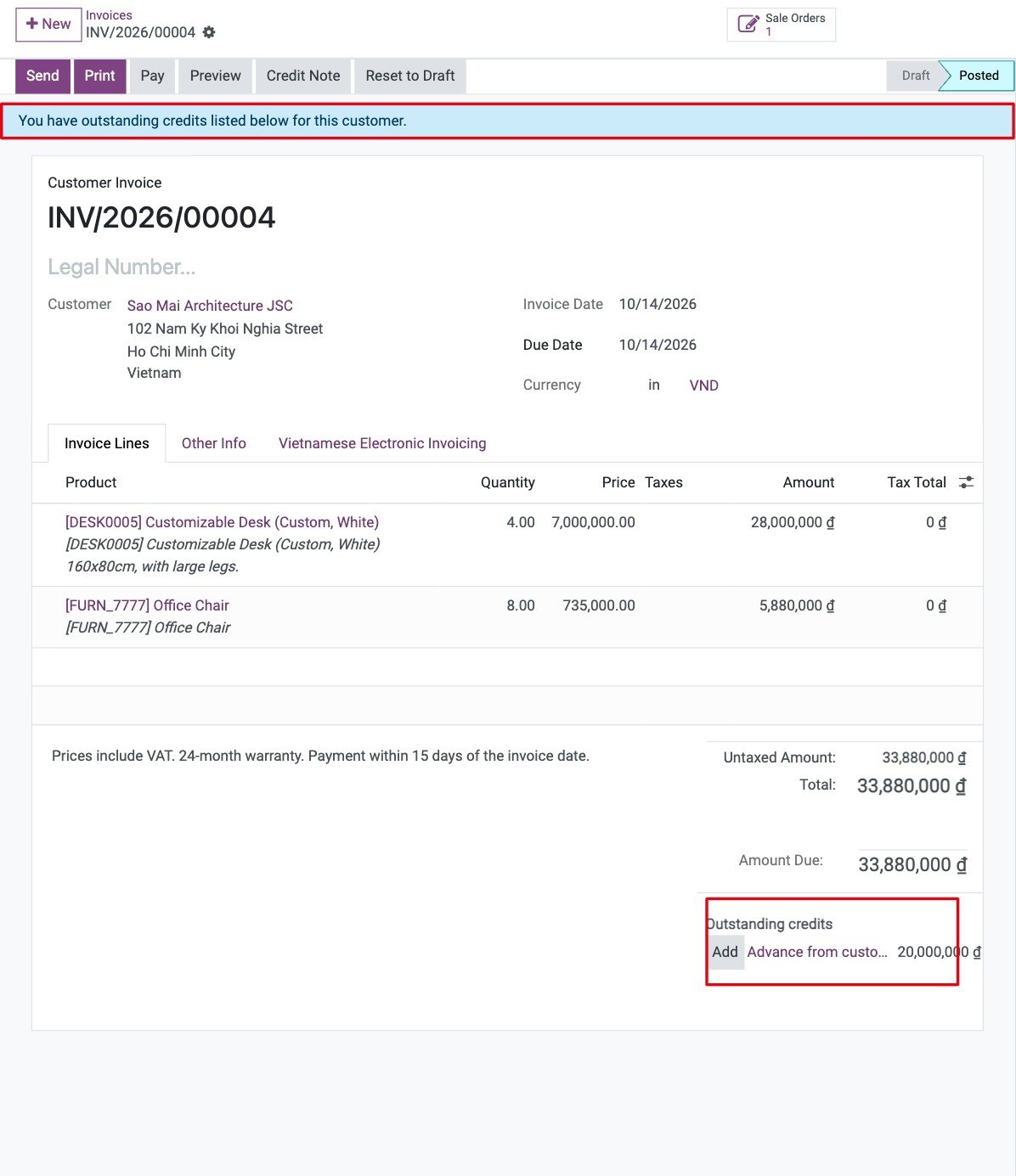
Example: the invoice reminds the accountant that this customer has an unapplied prepayment, which can be added to the invoice in one click.
If the company is moving to the chart of accounts under Circular 99, it is a good moment to review how receivables are tracked as well, since the account mapping is being checked anyway.
Credit limit: warn or block, and who decides
A credit limit (Credit Limit) is the most a company is willing to let one customer owe. The common mistake is to compare the limit only with invoices already issued. The real exposure also includes orders confirmed but not yet invoiced, and the order being quoted right now.
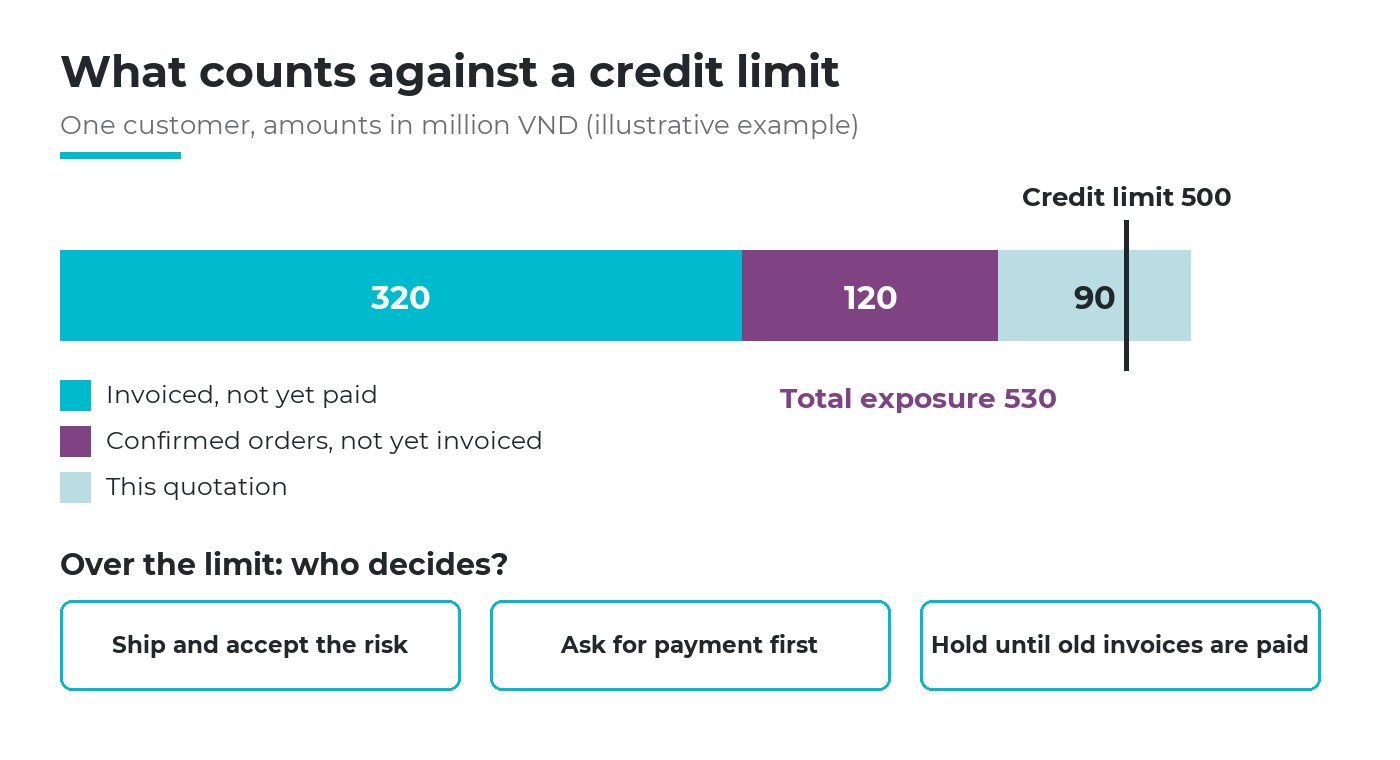
Invoiced 320, confirmed orders 120, this quotation 90: within the limit on invoices alone, over it in reality (illustrative example).
Warn or block is a business decision, not a software setting. A hard block protects cash but can stop a good customer whose payment is still in transit. A warning keeps sales moving but only works if someone must act on it. In accounts receivable management for most mid-sized companies, a warning plus a clear rule works well: above the limit, the sales manager or director decides between three options: ship and accept the risk, ask for payment first, or hold until old invoices are paid.
How software helps, and where it stops
Software takes over what depends on memory: turning the order into the invoice, due dates, aging, routine reminders on the right day. It does not decide the terms, the schedule or what to do when a good customer goes over the limit. Write those decisions down before setting it up.
Accounts receivable management in Viindoo
In Viindoo, sales, delivery, invoicing and collection share one set of data, so accounts receivable management reads from the documents themselves. What it gives for each question in this article:
| Question | What Viindoo does |
|---|---|
| No re-keying? | Invoices are created from the sales order, on ordered or on delivered quantity per product, carrying the order's payment terms; the due date follows from the terms |
| Who owes what, how late? | Aged receivables by due date (not yet due, 1-30, 31-60, 61-90, 91-120 days, older) and a customer ledger, both exportable to PDF and Excel |
| When to remind? | Reminder levels in days before or after the due date; each can email the invoices to the customer and schedule a task for the person in charge; disputed invoices can be held; salespeople see their own customers' follow-ups |
| Credit limit? | When enabled, a warning on the quotation and the draft invoice once receivables plus uninvoiced orders plus the current document pass the customer's limit; it warns, it does not block, and the decision stays with people |
| Prepayments? | Down-payment invoices from the sales order; customer payments not yet applied appear on the next invoice to add in one click; an advance can be tied to specific sales orders |
More detail on the screens is in receivables and payables in Viindoo.
What you can ask the AI assistant
Viindoo's AI assistant answers questions in plain language from the company's own accounting data, with links to the source records: "Which customers owe us the most?" or "Which invoices are overdue and still unpaid?". It only sees what the person asking is allowed to see, so a salesperson without accounting rights does not get the ledger. The assistant answers and suggests; reminders and credit decisions stay with people.
Six questions to check your accounts receivable management
One number
Can you say how much customers owe, and how much is overdue, within five minutes?
Re-keying
Does anyone type an order amount a second time to create the invoice?
Due dates
Does every invoice carry a due date that comes from agreed payment terms?
Reminder owner
For an invoice 20 days late, is it clear who acts today, without a meeting?
Prepayments
Are deposits applied to the invoice, or kept in a separate list?
Credit
Before confirming a large order, does anyone see what the customer already owes?
Two or more "no" answers usually point to the same starting point: let the invoice come from the order and put a due date on it. Every other step of accounts receivable management depends on those two.
Frequently asked questions
Both, at different steps. Accounting sends the routine reminders the same way to everyone; the salesperson calls when an invoice is several weeks late, because they hold the relationship. Write the hand-over point into the schedule.
At least at each period end for active customers, and before any dispute grows. If invoices come from orders and payments are matched to invoices, the confirmation is mostly a formality.
Start small, roughly one typical order, and raise it after a few invoices are paid on time. A limit is easier to raise than to cut.
Not sure where your receivables process loses time? Tell us where it hurts most. Book a consultation and we will walk through one overdue invoice with you, from order to cash, or see the costs first.
Related articles