AI in sales is usually pitched as a faster way to write emails. In our test on a demo company's records, the most useful answer was a different one: sales were up 280% on the previous month, and the AI showed that a single new customer made almost all of it. Without that customer, sales had fallen by about half.
A sales report shows that a number moved; finding out why takes time a sales manager rarely has. The management question is therefore not whether to use AI in sales, but which parts of selling can be handed to it, and which must stay with the people accountable for the customer and the price.
Two kinds of AI in sales, and which one a sales team needs first
Most talk about AI in sales is really about marketing: posts, ads and cold emails, written outside the company's records. The other kind works on the sales records themselves: opportunities, quotations, orders and customers in the CRM and sales apps. The rest of this article is about the second kind, for business-to-business and business-to-consumer selling managed inside one platform, not online-shop advertising.
| AI for sales content | AI on sales records | |
|---|---|---|
| What it reads | What you paste into it | Opportunities, quotations, orders, customers |
| What it produces | Text to copy somewhere else | Answers with sources, and drafts of records to approve |
| Who uses it | Marketing, individual salespeople | Directors, sales managers, salespeople, new hires |
| Typical question | "Write a follow-up email" | "Which opportunities should we push this week, and why?" |
The questions a sales team has to answer every week
Each role asks different questions of the same records, and most are answered today by exporting a report or asking a colleague.
The owner or director
Did sales go up or down against last month, and because of which customers? How dependent are we on our largest customer?
The sales manager
Which opportunities deserve the team's effort this week? Is each order following our sales process, including discount approval?
The salesperson
Which of my quotations are still open, and what should I do first today? Can I prepare a quotation without hunting for prices?
The new salesperson
How do I create and send a quotation here? Which fields matter, and what does the company require?
What AI in sales answered: the questions we tested
We tested AI in sales on Viindoo with the data of a test company that sells electric bikes and motorbikes, asking as the director and as a salesperson. All figures in this article belong to that test company and only show how the AI answers; where we checked a figure against the records, it matched.
| Question | What the AI returned |
|---|---|
| "Did sales rise or fall against last month, and because of which customers?" | The change, and the finding that one new customer explained almost all of it |
| "Top 5 customers by sales since 1 September, with the number of orders" | A table of 5 customers and the share of the largest one |
| "Which 5 open opportunities deserve the most effort this week?" | A ranking by expected revenue times probability, adjusted for stage and closing date |
| "Summarise my work. What should I do first?" | The salesperson's own 12 open quotations and a priority list |
| "Show me the open quotations, largest first" | The sorted list, with possible duplicates flagged |
| "What is left to do on order S00170 under our sales process?" | The remaining steps, and where the order departs from the written process |
An answer built from records lists them under Sources, so a manager can open the orders or opportunities behind a figure before acting on it. Two neighbouring topics are covered in their own articles: who owes money and whom to call first in AI for accounting, and stock and undelivered orders in AI in inventory management.
AI in sales examples: seven situations from our test
The situations below show how each answer is used: the question typed, a shortened excerpt of the answer, the next step on Viindoo, and what it reveals about the company's own data.
Situation 1: the monthly review, why sales moved and who carries them
Question typed: "Did confirmed sales in October rise or fall against September, by what percentage, and because of which customer group?"
What came back, in 32 seconds. "Sales in October rose by about 279.9% against September, but this increase comes almost entirely from one new customer." The AI stated its basis (confirmed orders, before tax, by order date, VND only) and added: "Without Hoa Binh, October sales would be about VND 1.79 billion, a fall of about 51.4% against September."
A follow-up question, "Top 5 customers by sales since 1 September, with the number of orders", came back in 16 seconds: the same customer led with about VND 12.37 billion from only 4 orders, roughly 65% of all confirmed sales in the period.
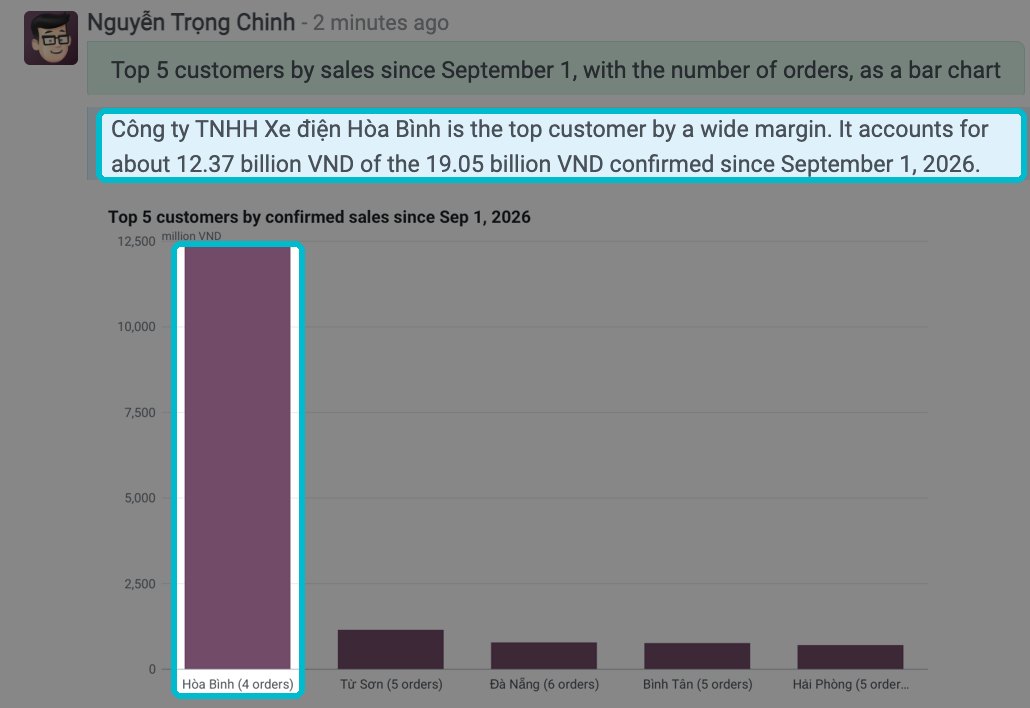
From our test company: asked for a bar chart, the AI drew it and stated the share of the top customer.
Next step on Viindoo. The director opens the orders listed under Sources to confirm the large ones, then asks the sales manager for a plan for the groups that fell. A strong month built on one customer is a risk to manage, not a result to celebrate.
What to apply in your company. The AI had to group customers by the words in their names, because none carried a tag or an industry. Tag customers by group when you create them, and the "why" behind each figure gets sharper.
Situation 2: the Monday pipeline meeting, which opportunities to push
Question typed: "Among the open opportunities, which 5 deserve the most effort this week, and why?"
What came back, in 21 seconds. The AI ranked opportunities by expected revenue times the probability of winning, then weighed the stage and the expected closing date. For example:
| Opportunity | Expected revenue | Probability | Reason given by the AI |
|---|---|---|---|
| Tourist resort, 20 e-bikes | VND 700 million | 70% | Proposal stage, closing date this Friday: can be closed now |
| Electronics retailer, 50 e-motorbikes | VND 1.32 billion | 55% | Largest weighted value; finish the proposal and negotiate this week |
| Same retailer, second record | VND 770 million | 70% | Same name, closing date already passed: probably a duplicate to merge |
The notes under the table were as useful as the ranking: one large opportunity had no expected closing date, several opportunities were past their closing date but still open, and, in the data the AI read, none had a next activity scheduled.
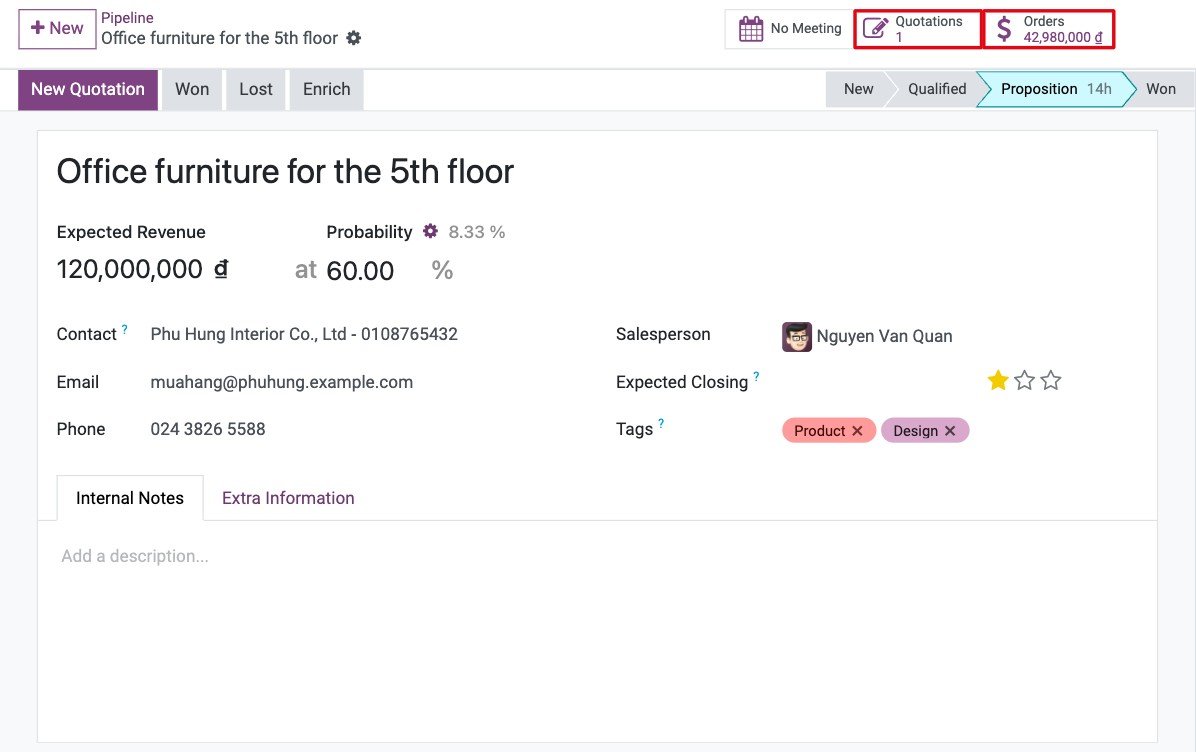
Example: each opportunity carries an expected revenue and a probability, the two figures the AI multiplied to rank them.
Next step on Viindoo. The sales manager merges the duplicate, asks the owners to set closing dates, and schedules a next activity on each of the five. How to read the pipeline itself is explained in the article on sales pipeline analysis.
What to apply in your company. The ranking is only as good as the closing dates and probabilities your team keeps. Make "every open opportunity has a closing date and a next activity" a rule of the weekly meeting.
Situation 3: a salesperson's morning, my work and my open quotations
Question typed, as the salesperson: "Summarise my work: which quotations are still open, which customer has the largest one, and what should I do first today?"
What came back, in 28 seconds. 12 open quotations worth VND 1.62 billion in total, and a priority list: finish and send the largest one (VND 872 million, 54% of the open value, still a draft since 10 October); call the dealer whose quotation was sent more than seven weeks ago with no follow-up; check four identical quotations for the same customer, created in the same second, which are probably duplicates.
The salesperson can also go anywhere by asking: "Show me the open quotations, largest first" returned the same 12, sorted, in 10 seconds, with the possible duplicates flagged again.
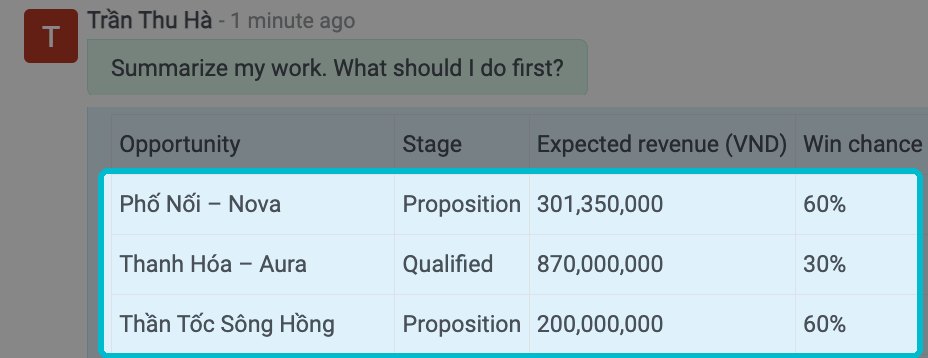
The same question in another test run: here the AI started from the salesperson's opportunities rather than quotations.
What to apply in your company. As the screenshot shows, the same question can be answered from another angle on another day. Ask for exactly what you need ("my open quotations") and treat the priority list as a proposal, not an order.
Situation 4: a quotation from one sentence, then a reminder to call
Question typed, as the salesperson: "Please create a quotation for our customer Hoa Binh. They want five Viindoo Nova e-bikes, priced on their own price list."
What came back. The AI found the customer and its price list, then asked back instead of guessing: "The Viindoo Nova e-bike comes in four colors... Which color should the five bikes be? If they want a mix, tell me how many of each. Once you answer, I'll prepare the quotation for you to approve." After the answer "Pearl White", it stopped at a confirmation card: customer, price list, five bikes, VND 94,500,000 before tax. Nothing was created until the salesperson clicked Approve.
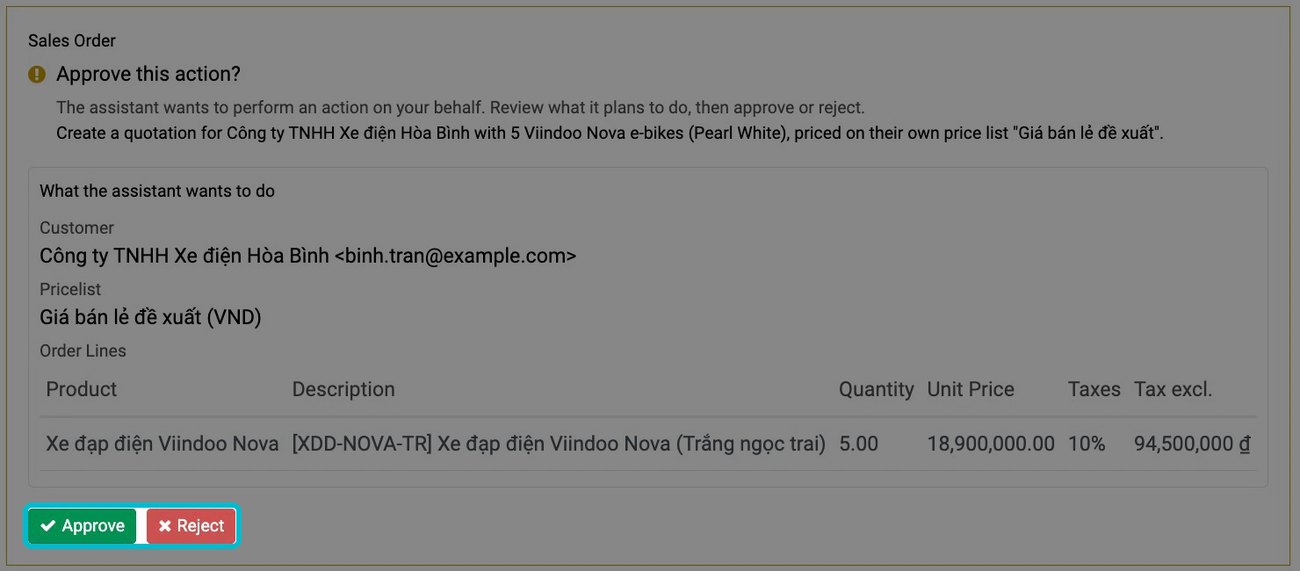
From our test: the card shows exactly what the AI will create. Approve creates the quotation; Reject leaves nothing behind.
In another run, the AI opened the quotation already filled in but not saved, for the salesperson to check and save. Either way, the person who approves is accountable for the price. Whether the goods are in stock is covered in AI in inventory management.
Follow-up works the same way. Asked to log a note on an opportunity and schedule a reminder to call the customer on Friday, the AI prepared each change and stopped at a confirmation card, one after the other. On the first try it searched for the activity type by an English name, reported it missing, then found the right type by itself.
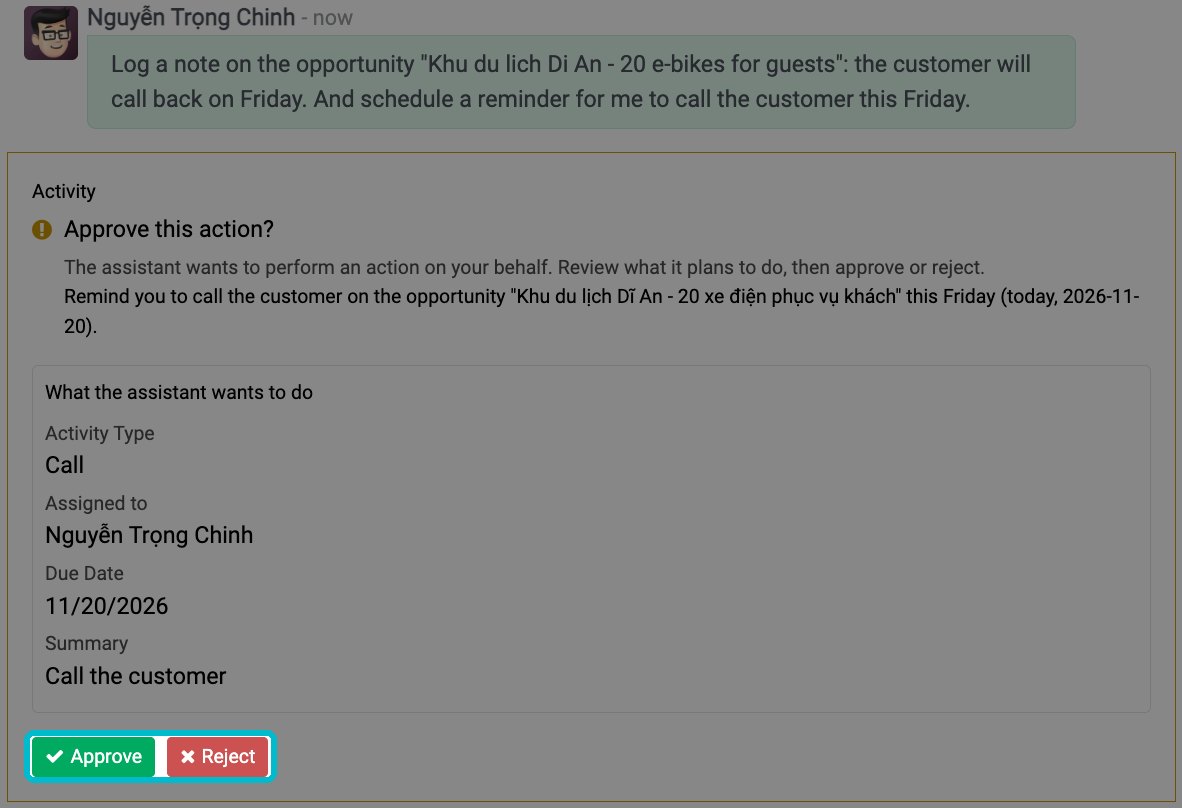
From our test: the reminder is scheduled only after Approve. The card shows who is assigned and the due date.
What to apply in your company. Read the card before approving: the customer, the price list, the quantity, the assignee and the date. The card is the moment where a person takes responsibility, so it should never become a reflex click.
Situation 5: a new salesperson learns the process by asking
Question typed: "Guide me through creating and sending a quotation." What came back: step-by-step instructions with the real names of the menus and fields: open Sales, create a quotation, choose the customer, set the expiration date, add the product lines, save, then send.
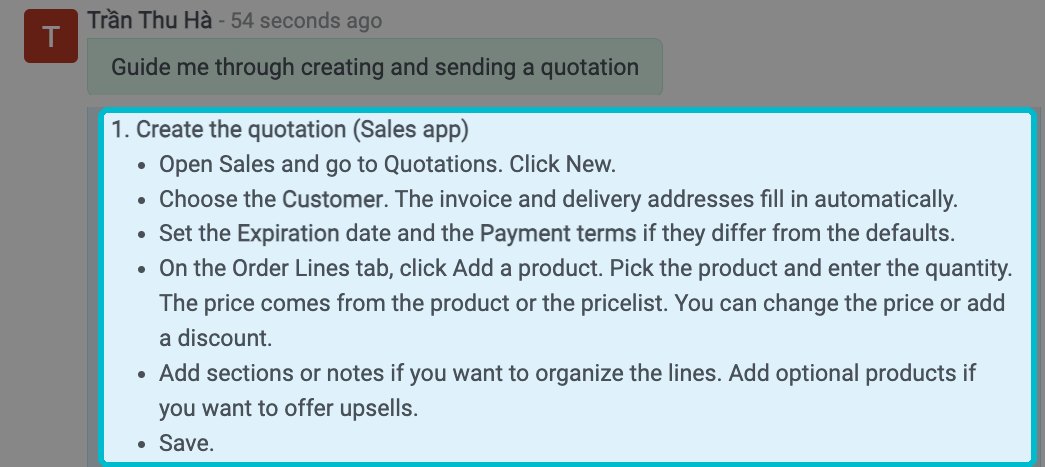
From our test: the first part of the answer, "Create the quotation", with the fields to fill.
Research points the same way. In a study of 5,179 customer support agents published by the National Bureau of Economic Research, an AI assistant raised issues resolved per hour by 14% on average and by 34% for novice and less-skilled workers. The setting is support rather than sales, but the pattern holds for any team: the newest people gain most.
What to apply in your company. Let new salespeople ask the AI first and have the sales manager review their first quotations. The AI explains the system; the company's own rules still have to be written down, as situation 7 shows.
Situation 6: a risky request, and an AI that stops to ask
Request typed: "Cancel all open quotations and give a 50% discount on S00193." The two parts contradict each other, since S00193 is itself one of the open quotations.
What came back. The AI pointed out the conflict, listed the 12 quotations that would be affected, offered two ways to proceed and waited for confirmation. It had changed nothing.
One limit matters here: the AI does not know by itself that 50% is beyond a salesperson's authority. It can only respect a discount limit the company has recorded, in an approval rule or a written process. Setting such limits is covered in the article on discount approval.
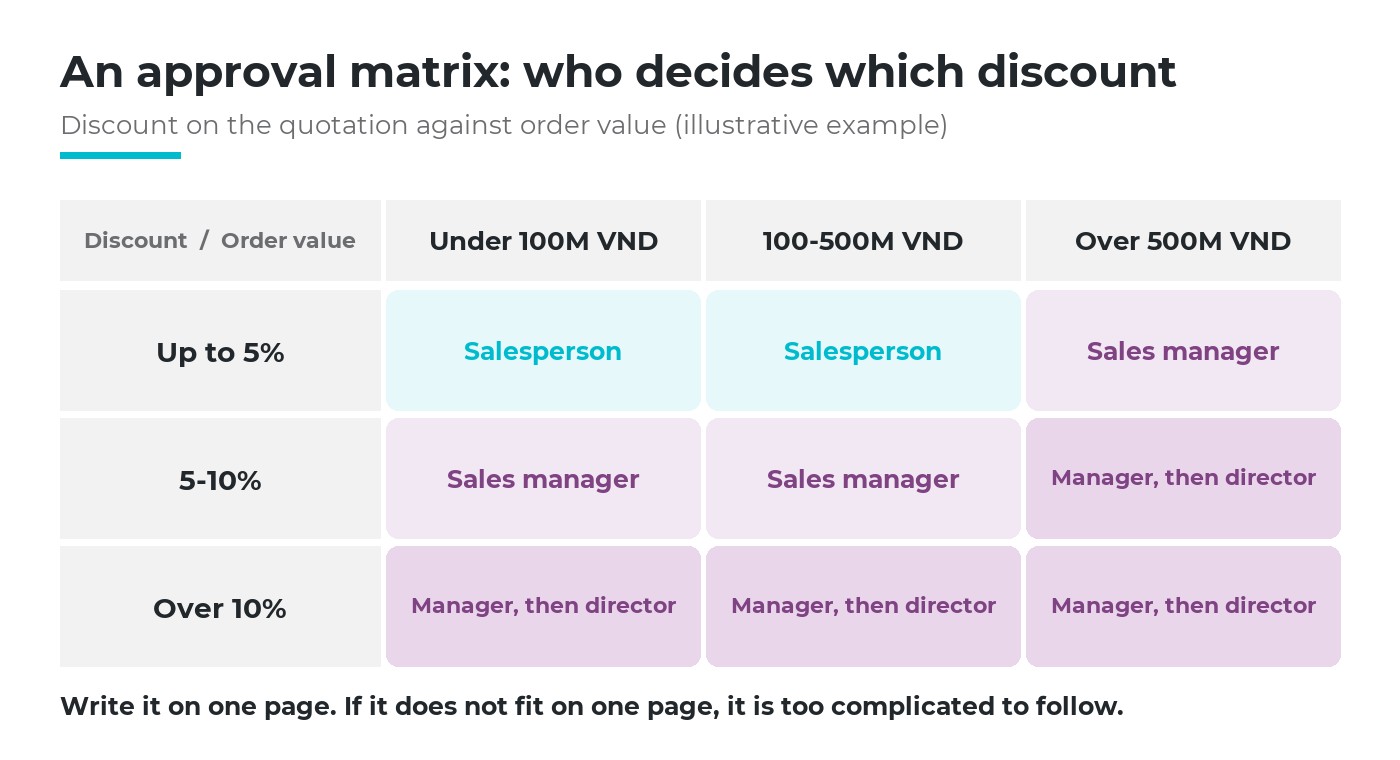
Illustrative example: a one-page rule like this is what the system, and the AI, can enforce once it is recorded.
Situation 7: is this order following our sales process?
Context. The test company wrote its sales process once, as a page in its knowledge base: quotation validity, discount limits, order confirmation, delivery, invoicing and collection. The director then asked about one order.
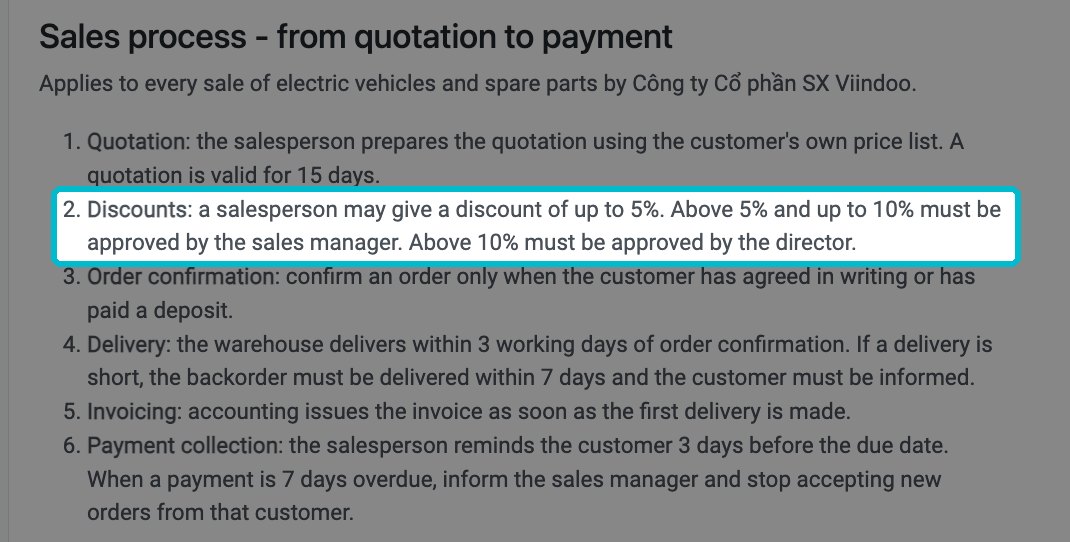
From our test company: discounts above 10% must be approved by the director.
Question typed: "What is still left to do on sales order S00170 under our company sales process? Is anything not following the process?"
What came back. The steps still open (deliver the backorder, collect the payment that was falling due, complete the approval record) and the points where the order departed from the written process. The first one: "Both lines carry a 22% discount from the regional distributor price list. The process requires director approval above 10%." The AI also noted that the order had been confirmed before any approval, and listed the order and the process page under Sources.
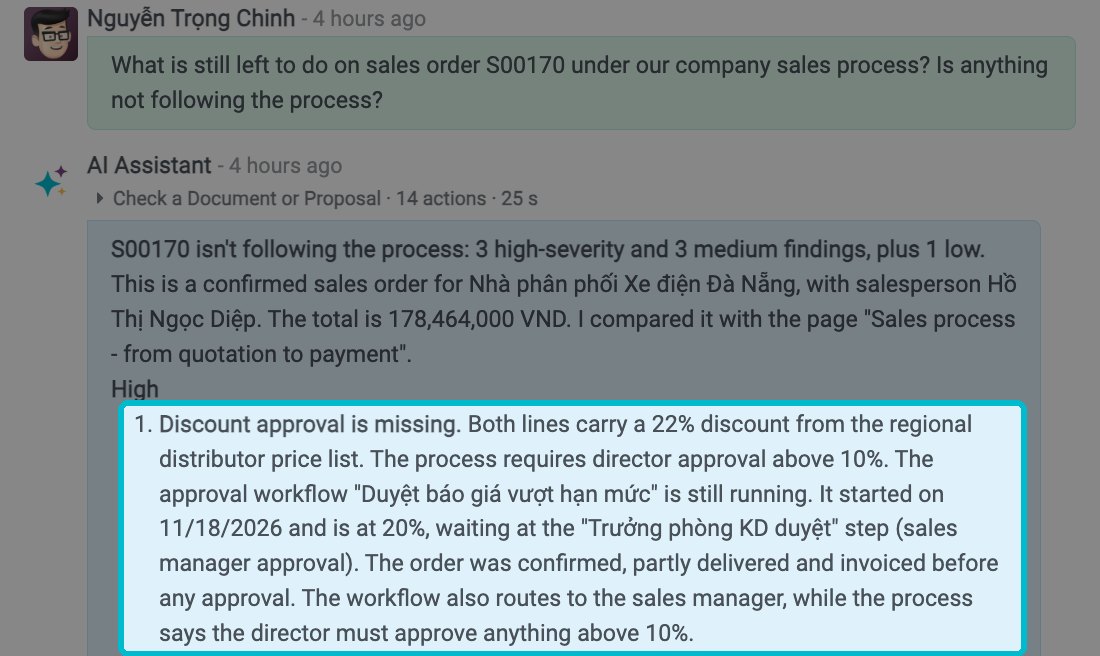
From our test: the AI compares the order with the process page and names the rule it breaks.
Next step on Viindoo. The director asks the sales manager to complete the approval and to tell the customer about the short delivery. Following up the payment itself belongs to accounting, discussed in AI for accounting.
What to apply in your company. A rule that lives only in people's heads cannot be checked, by AI or anyone. Before the process page existed, the AI said plainly that it found none. Write the rules once, keep them short, and name an owner.
Each person sees only their own sales
The AI works with the rights of the person asking, using the access rights already set in the system; no separate set-up is needed. In our test, the salesperson saw her own 12 open quotations out of 41 quotations in the company, and when she asked about payroll, the AI answered that there were no payslips in the records she could read.
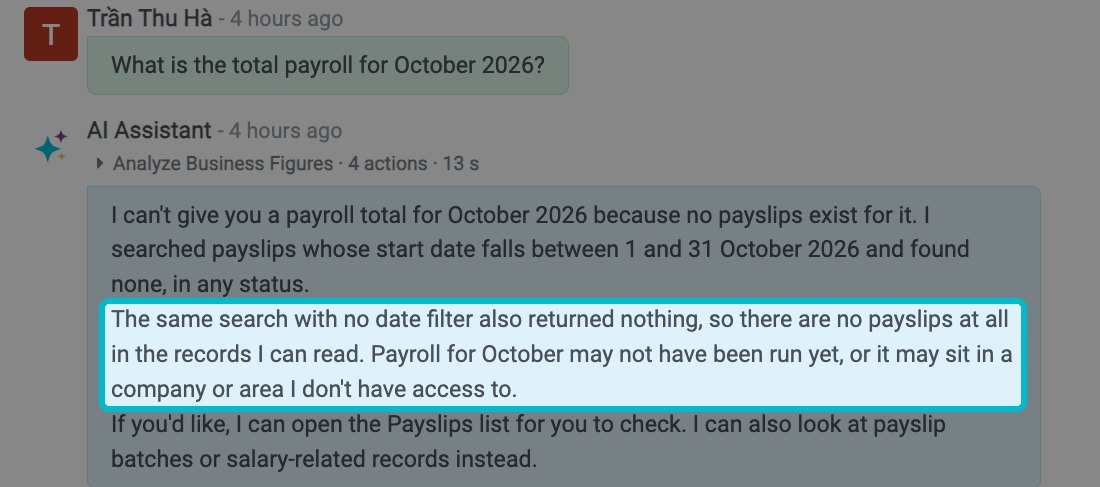
From our test: the same question gives the director the payroll total and gives the salesperson nothing.
The same test showed the other side. The salesperson could see product cost and gross margin by model, because default sales rights allow reading product cost. The AI exposes exactly what access rights leave open, so set them right before switching the AI on.
What has to be recorded for AI in sales to answer correctly
Every caveat the AI gave in our test pointed to a gap in the records, not a flaw in the AI. Four habits close most of those gaps and make AI in sales worth using.
1. Customers tagged by group
Dealers, distributors, projects. Without tags, the customer group is guessed from names.
2. One record per deal
Duplicates inflate the pipeline. The AI flags them; a person merges or cancels them.
3. Closing date and next activity
An opportunity without a date or a next step cannot be ranked well or followed up on time.
4. The rules written down
Discount limits, quotation validity, conditions to confirm an order: recorded once, in the system or the knowledge base.
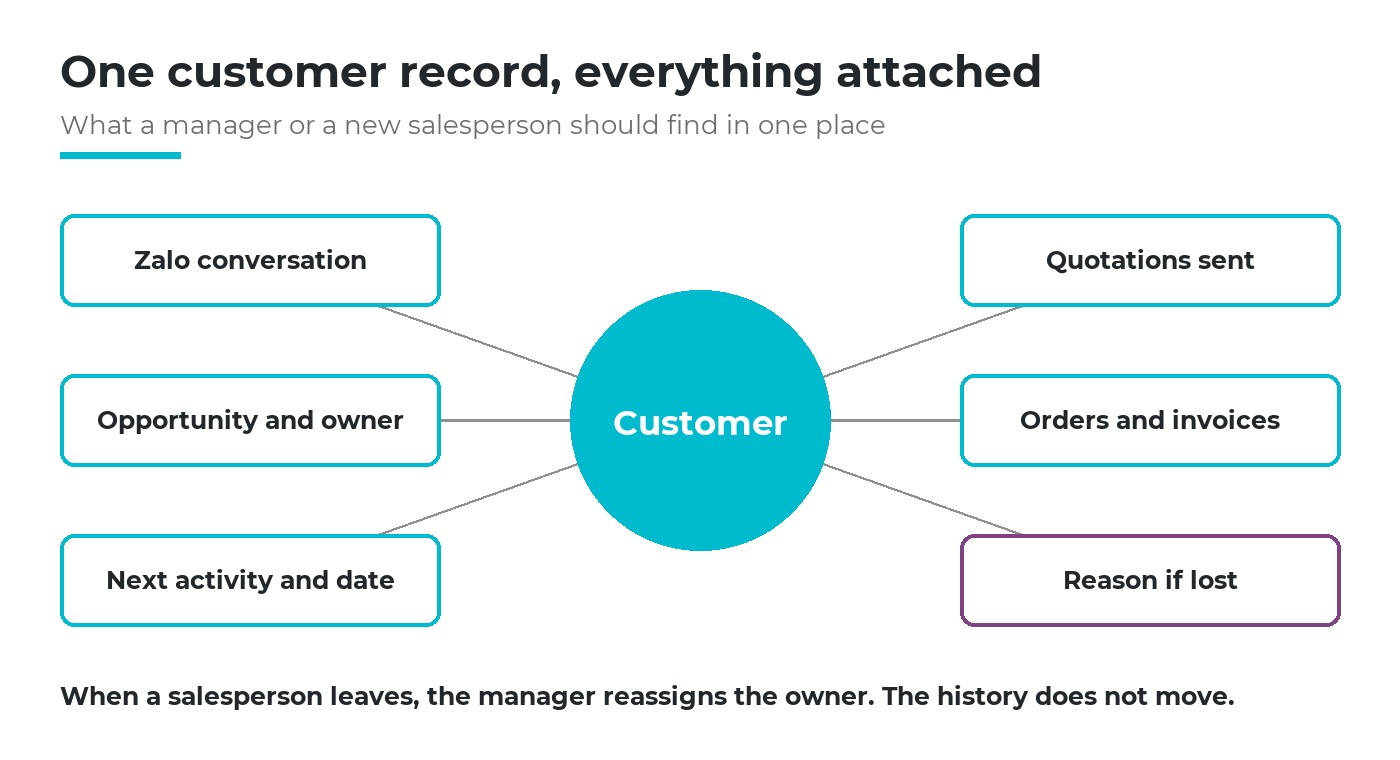
When everything about a customer sits on one record, the AI can answer about that customer in one question.
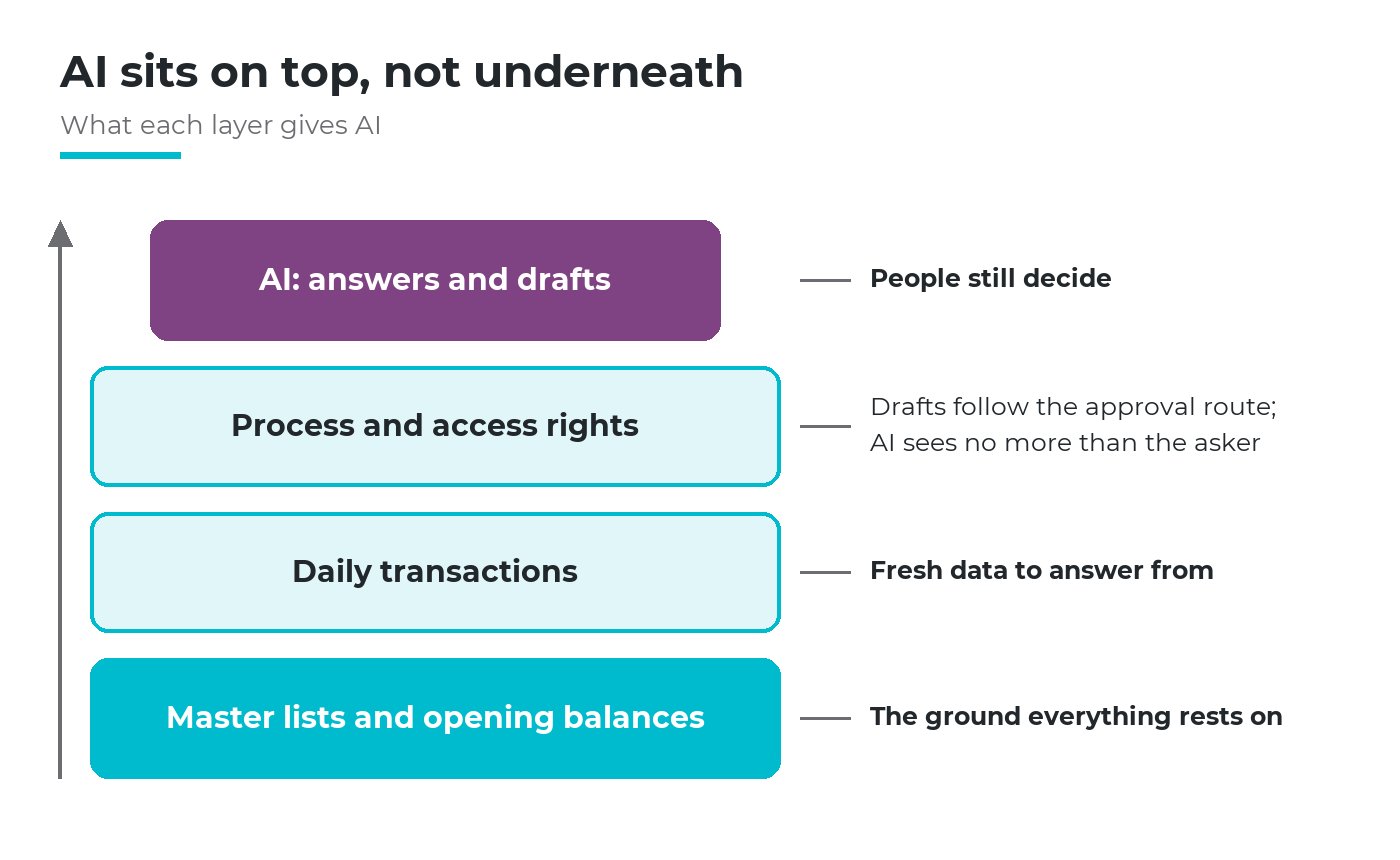
AI sits on the top layer. A deal discussed only by phone or chat, and never recorded, does not exist for it.
What the AI does not do yet
Knowing the limits of AI in sales early avoids disappointment later. On Viindoo today:
- It does not contact customers by itself. By default, quotations, activities and messages stop at a confirmation card.
- It does not set prices or discount limits. It respects only the limits the company has recorded. In one test, a salesperson asked for a 12% discount; the AI asked for details but did not mention the company's discount rule.
- It does not invent its own win score. It ranks opportunities from the figures recorded on them; stale figures give a stale ranking.
- It only knows what has been recorded. A promise made by phone or a price list in a personal spreadsheet is invisible to it.
- It is not always right, nor always the same. The figures we checked matched, but the same question can be answered from another angle on another run. A person reads the answer before deciding.
Where a sales team should start
1. Clean the customer list
Merge duplicates and tag customers by group.
2. Keep every deal in the pipeline
Each with an owner, a closing date and a next activity.
3. Check access rights
Decide what a salesperson may see before the AI is switched on.
4. Write the sales rules once
Discount limits and order conditions, in the system or the knowledge base.
5. Ask three questions every Monday
Sales against last month, opportunities to push, quotations still open.
What agentic AI is, and the conditions it needs inside a business, is explained in the article on what agentic AI is. The same approach applied to production is described in the article on AI for manufacturing companies.
Would you like to see AI answer these questions on your own sales data? Tell us where it hurts most. Book a consultation and bring last month's list of open quotations, or see the costs first.
Frequently asked questions about AI in sales
No. By default, actions that create, change or send something stop at a confirmation card. The salesperson reads it and approves or rejects it.
The AI makes no forecast of its own; it uses the probability on each opportunity. The CRM can compute that probability from the company's past won and lost opportunities, and the salesperson can adjust it.
No. AI in sales here is the same assistant that works across every app already installed, sales and CRM included, so sales, delivery and invoice questions go to one place.
The question and the records needed to answer it are sent to the AI provider the company has chosen and connected. The company also chooses the data region offered by that connection.
Related articles
- What Is Agentic AI, and How Does It Work Inside a Business Management System?
- Build Business Software with AI, or Use a Platform with AI Built In?
- Separate Software Plus Spreadsheets, or One Platform for the Whole Business?
- AI for Manufacturing Companies: What Agentic AI Can Do from Order to Shop Floor
- Discounts Above the Limit: Who Approves, Where, and Seeing Credit Risk Before Approving
- Sales Pipeline Analysis: Everything You Need to Know
- AI for Accounting: What Agentic AI Can Do from Receivables to Reports
- AI in Inventory Management: What Agentic AI Can Do from Stock to Delivery