When people talk about AI for manufacturing companies, they usually picture robots, cameras and smart machines. For a plant with a few dozen to a few hundred workers, a more useful starting point is closer at hand: the orders, work orders, stock and maintenance records the company already keeps.
This article explains the difference between AI on the machines and AI in production management, shows the questions a production manager can ask and the answers we got in a test, sets out what has to be recorded on the shop floor, and is clear about what AI does not do yet.
Two kinds of AI for manufacturing companies, and which one to start with
The word AI covers two very different things in a factory. The first works on the machines themselves: cameras that inspect parts, or sensors that predict when a machine will fail, often called predictive maintenance. The second works on the records of the business: it reads orders, work orders, stock and maintenance tickets, answers questions and prepares documents.
| AI on the machines | AI in production management | |
|---|---|---|
| What it reads | Images and sensor signals | Orders, work orders, stock, maintenance records |
| What it needs first | Sensors, cameras and machine connections | Production recorded in one system |
| Who uses it | Engineers and technicians | Directors, production, warehouse, purchasing, maintenance |
| Typical question | "Is this part defective?" | "Which work orders are short of components?" |
Most small and mid-sized manufacturers do not yet have the sensors and machine connections the first kind needs. Almost all of them already have orders and stock to manage. That is why AI in production management is usually the right first step, and it is the subject of the rest of this article.
The questions a production manager has to answer every day
In most plants, these questions are answered by walking the floor, calling colleagues and opening several spreadsheets. Each answer takes time, and by the time it arrives the situation may have changed.
The director
How much did we produce last month, by product? Which customer orders are late, and why?
The production manager
Which work orders are open, which are overdue, and which cannot start because components are missing?
Warehouse and purchasing
How much of this product is in each warehouse? Which items are short for the orders we must deliver?
Maintenance
Which maintenance requests are still open, and which machine breaks down most often?
What AI for manufacturing companies can answer: six questions we tested
We asked these questions to the AI on Viindoo, using the data of a test company that assembles electric bikes. The figures belong to that test company and only show how the AI answers; where we checked a figure against the records, it matched.
| Question | What the AI returned | What it saves |
|---|---|---|
| "Which work orders are open, and which components are short?" | 29 open work orders, 17 of them short of components, and the overdue ones | Checking each work order against stock by hand |
| "How many work orders were completed in October, by model?" | 39 completed work orders, split by model | Counting the orders completed in the month |
| "Which orders are not fully delivered, and which items are short?" | 35 orders not fully delivered and a table of short items | Calling the warehouse before answering a customer |
| "How many Nova bikes are in stock, by warehouse?" | 26 bikes, split by colour and warehouse | Opening the stock report and filtering it |
| "Which maintenance requests are open, and which machine fails most?" | 16 open requests, the one that needs attention most, and machines ranked by corrective requests | Going through the maintenance list one by one |
| "Where is order S00170 now, and what is left to do?" | The steps already done and the two remaining: the overdue partial delivery and a payment due in two days | Following one order across sales, warehouse and accounting |
Each answer comes with a Sources list. Clicking a line opens the work order, the delivery or the maintenance request the figure came from, so the manager can check it before acting.
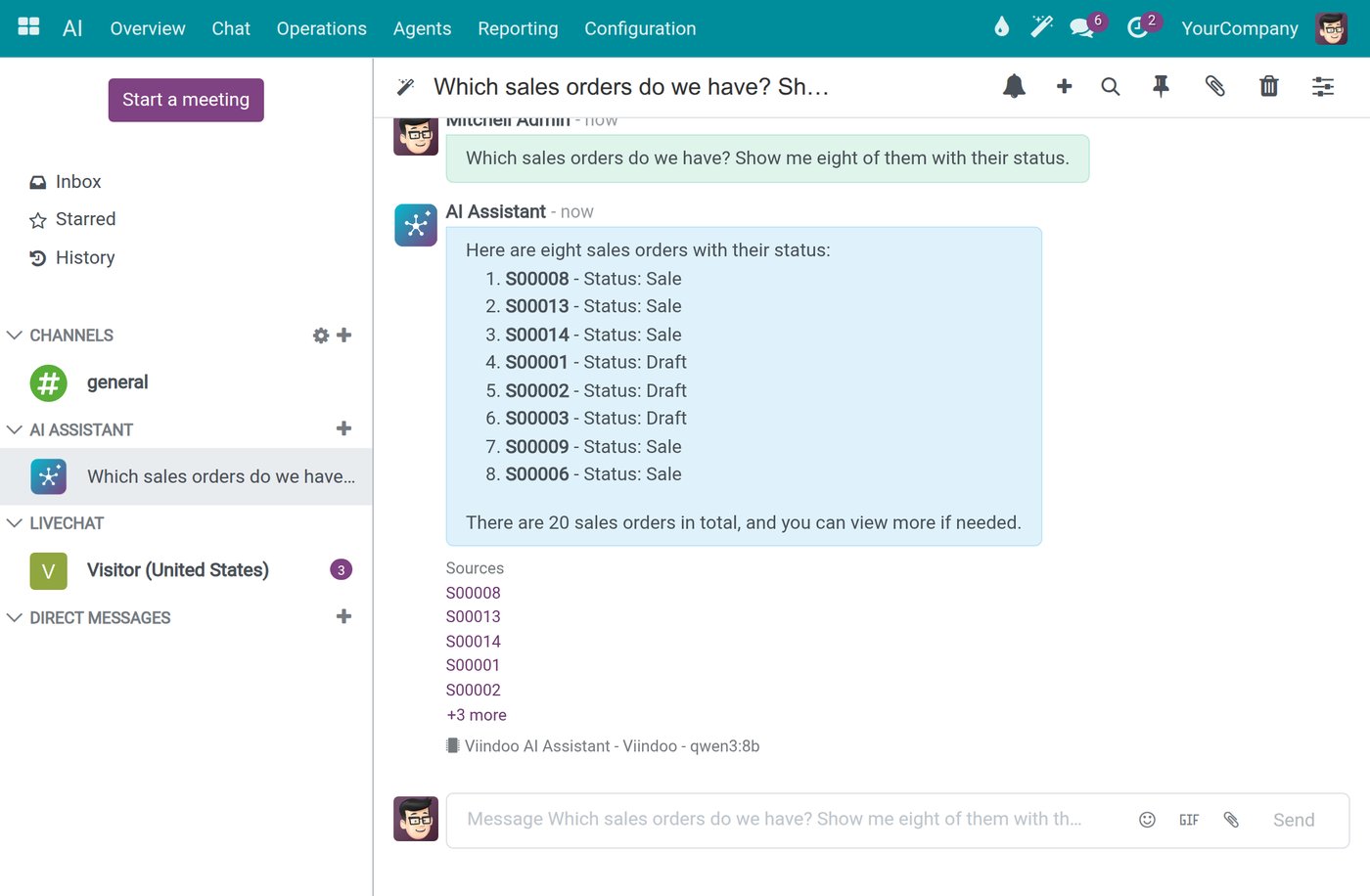
Example: the AI answers with a Sources list; clicking a line opens the record.
The AI follows each person's access rights. A user who may only see part of the data gets answers about that part only, exactly as when they open the software themselves. In our test, a salesperson asking about open quotations saw only their own.
Four real situations: what AI for manufacturing companies looks like in daily use
A summary table only shows that the AI can answer. The four situations below show how a manager actually uses the answer: what they type, what comes back, what they do next on Viindoo, and what the answer teaches about their own data. The questions are typed exactly as shown; the answers are shortened excerpts from our test on the electric bike test company.
Situation 1: Monday morning, which work orders are blocked and what to buy first
Context. The production manager prepares the weekly meeting. Several work orders have not started and nobody is sure whether the cause is missing parts.
Question typed: "Which work orders are open, which components are short for them, and what should I order first?"
What came back, in 39 seconds. 29 open work orders, 17 of them short of components. Two orders for the V6 and V8 bikes had been waiting since mid-September. The AI then ranked what to buy:
| Priority | Component | Short by | Reason given by the AI |
|---|---|---|---|
| 1 | Nine parts of the V6 and V8 bikes | 1 of each | Only one missing, but they block two orders overdue for almost two months |
| 2 | 60V 20Ah charger | 63 | The largest shortage, needed by many order lines |
| 3 | 60V 20Ah charger, version 2 | 36 | Large shortage |
| 4 | 60V 1200W controller | 27 | Large shortage |
Two remarks in the answer matter as much as the figures. The AI counted a component as short only when its forecast stock stayed negative, that is stock on hand plus incoming goods minus everything already committed. And it left out the Zeta frame assembly, explaining that it is a semi-finished product made in-house, so it should be produced rather than bought.
Next step on Viindoo. The manager sends the list to purchasing. Purchasing raises requests for quotation for the first four lines; where approval limits apply, the request goes to the approver before it becomes a purchase order.
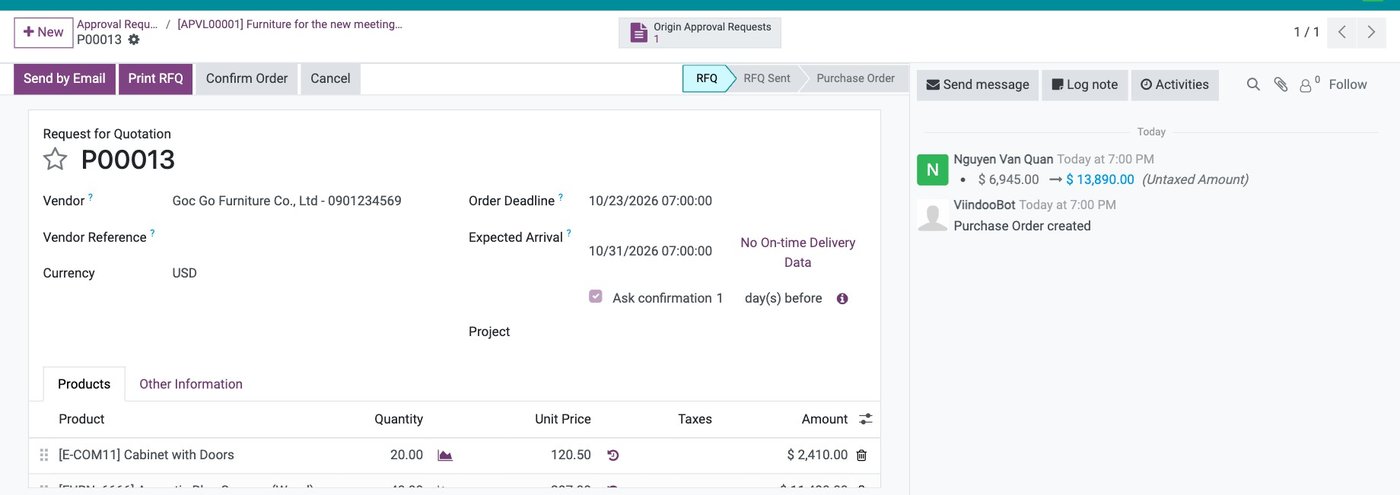
Example: the request for quotation keeps a link to its source approval request, so the order can be traced back to the need.
What to apply in your plant. Ask this question every Monday before the production meeting. If many orders cannot start although each is short of only a few components, check the purchasing lead time, not only the stock level.
Situation 2: a customer calls to ask when the goods will arrive
Context. A distributor calls the salesperson about a late order. Before, the salesperson would call the warehouse and promise to call back.
Question typed: "Are there confirmed sales orders not fully delivered? Which items are short?"
What came back. 35 confirmed orders not fully delivered; only one of them, S00170, had been partly delivered. A table of items with not enough stock, for example:
| Item | Still to deliver | In stock | Short |
|---|---|---|---|
| Zeta electric bike, burgundy | 23 | 2 | 21 |
| Mira fashion electric bike | 50 | 35 | 15 |
| Nova electric bicycle, matte black | 15 | 6 | 9 |
The AI added two warnings on its own. It added up the demand of all orders for the same item, so each order on its own might still be covered. And the stock figure did not yet include goods arriving or work orders in progress, so some items at zero might simply be made to order. This is a different basis from situation 1: here the AI compared demand with stock on hand, not with forecast stock.
Next step on Viindoo. The salesperson asks a second question about the customer's own order, for example "Where is order S00170 now, and what is left to do?", and gets the steps already done and what remains. They open the order to check the delivered and invoiced quantities, and can then answer the customer on the same call.
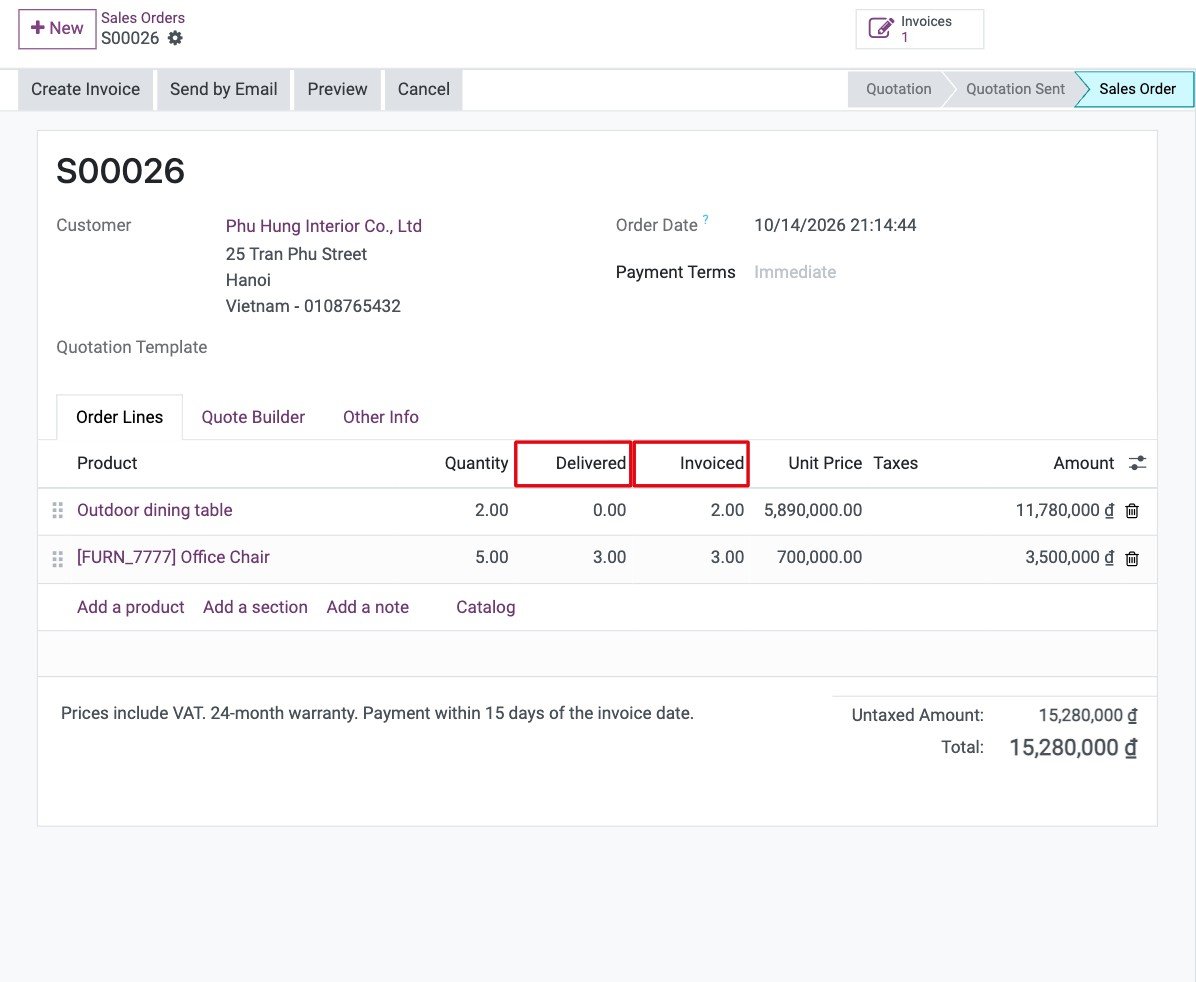
Example: on the sales order, the Delivered and Invoiced columns sit side by side.
What to apply in your plant. The warnings the AI gives are part of the answer. Read them before promising a date: they tell you which figures still need a check with the warehouse or production.
Situation 3: the monthly output report, and a gap in the data
Question typed: "In October, how many work orders did the plant complete, how many bikes did it make, by model?"
What came back, in 12 seconds. 39 completed work orders. 29 of them produced finished bikes (13 Lumi, 9 Aura, 7 Nova); the other 10 produced semi-finished assemblies and machined parts, listed separately.
The most useful line was a caveat: the AI explained that the number of bikes was the quantity planned on each order, not the quantity actually recorded. In other words, the test company was not recording real output at the workstation, and the AI said so instead of hiding it.
What to apply in your plant. If your answer carries the same caveat, the fix is not in the AI. It is in recording output at each step on the shop floor, described in the next section.
Situation 4: maintenance, which request first and which machine fails most
Question typed: "Are there open maintenance requests, and which machine has broken down most since early September?"
What came back, in 13 seconds. 16 open requests. The one to watch was a forklift reported for an unusual noise when lifting, marked high priority and in progress, but with no technician assigned. Machines were ranked by the number of corrective requests: the screw air compressor and the pneumatic screwdriver led with 4 each, followed by the hydraulic press with 3.
Again the AI added a caveat: the count of corrective requests only approximates the number of breakdowns, because some routine services, such as safety checks or oil changes, had been filed as corrective.
What to apply in your plant. Assign a technician to every high-priority request, and separate corrective from preventive work when you create a request. The ranking of machines is only as good as that classification.
A morning in the life of a production manager, before and after
An illustrative example of how the same morning can look different.
Before
At 7:30 the manager walks the floor to see which lines are running. At 8:00 they call the warehouse to ask about missing components, then open the order spreadsheet to see which customers are waiting. By 9:30 they have a picture of the situation, and the first decisions are made with information that is already an hour old.
After
At 7:30 the manager asks: "Which work orders are open, which are overdue, and which are short of components?" The answer arrives with its sources. The manager opens the two most urgent orders, asks purchasing to look at the short items, and goes to the floor to deal with the problems that need a person there.
The AI does not replace the walk through the plant. It removes the part of the morning spent collecting figures, so the walk is used for decisions.
What has to be recorded on the shop floor for AI to answer correctly
AI for manufacturing companies can only answer from what has been recorded. If output is written on paper and typed in at the end of the week, the AI sees last week. Four kinds of record make the difference.
1. Bills of materials and work orders
Each product has a bill of materials and each job is a work order. Without them, the AI cannot tell which components an order needs.
2. Work recorded at each step
Workers start, pause and finish each step on a tablet at the workstation, and record quality checks there. The figures are current, not typed in later.
3. Stock moves
Receipts, issues to production and deliveries are recorded as they happen, so stock in the system matches stock on the shelf.
4. Maintenance requests
Every breakdown or service is a request linked to its machine. Over time this is what tells you which machine fails most.
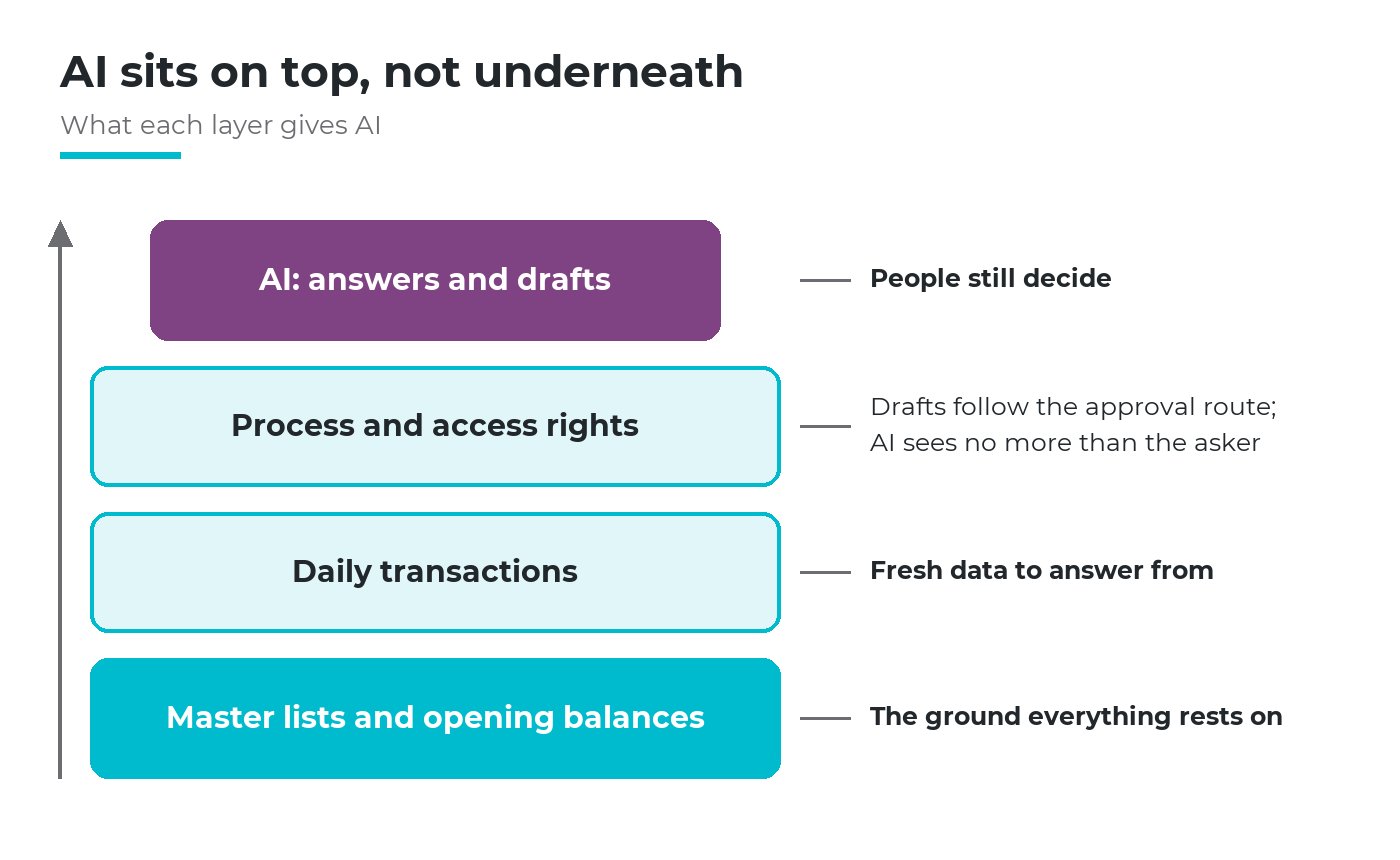
AI sits on the top layer. Without the records beneath it, its answers are fluent but have nothing to rest on.
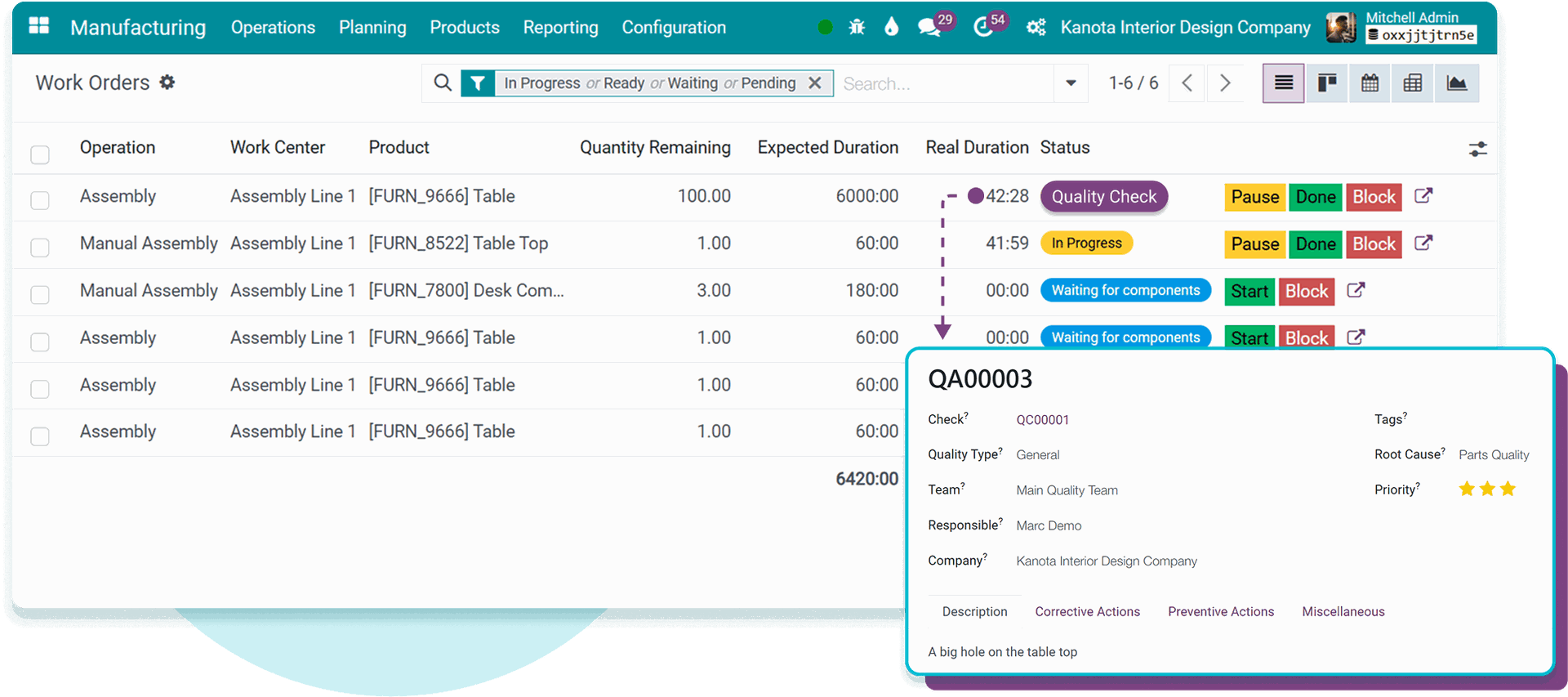
Example: each work order shows its status, and a quality check is recorded at the step where the work is done.
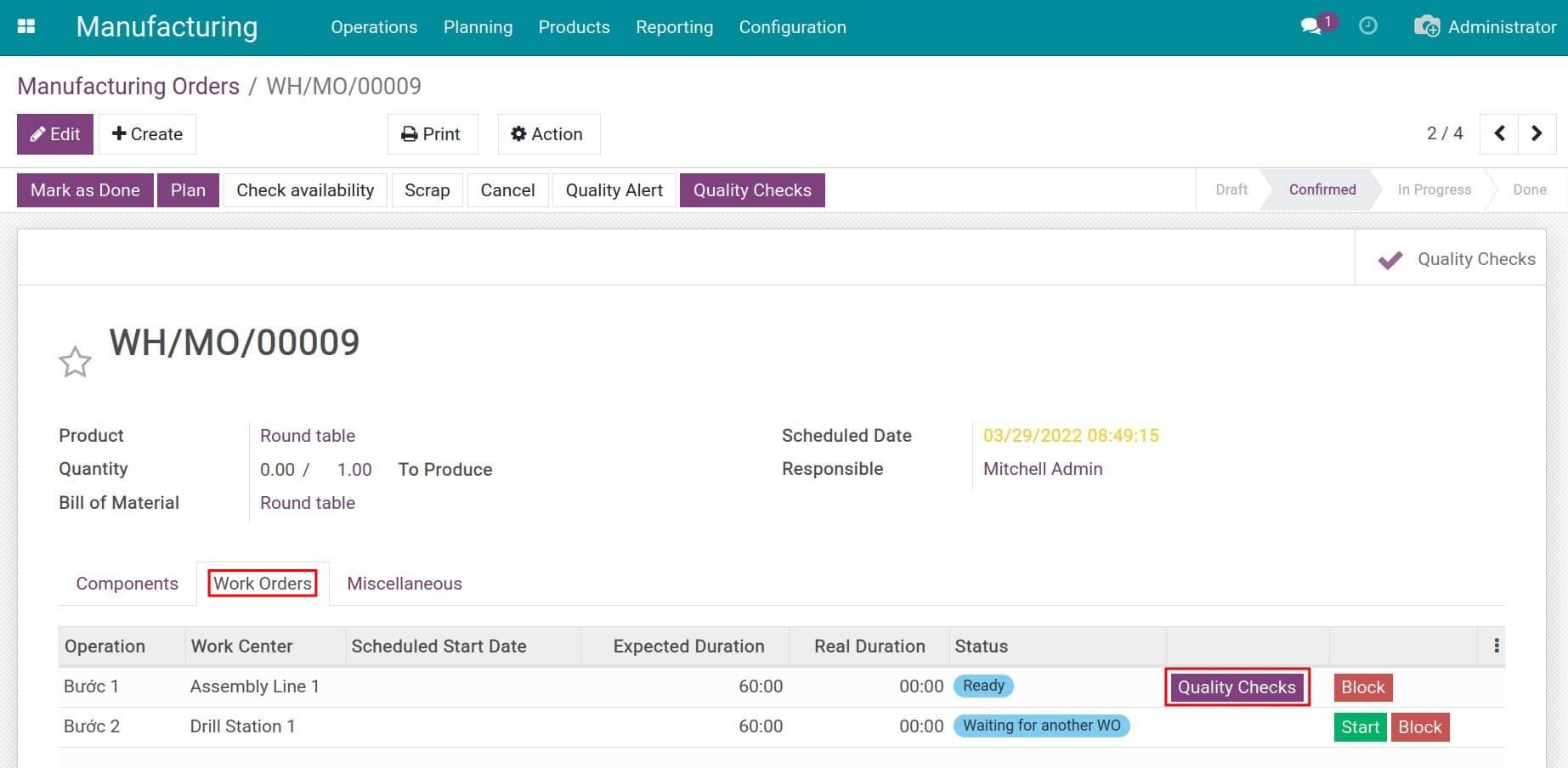
Example: on the manufacturing order, the quality check is opened from the work order where it applies.
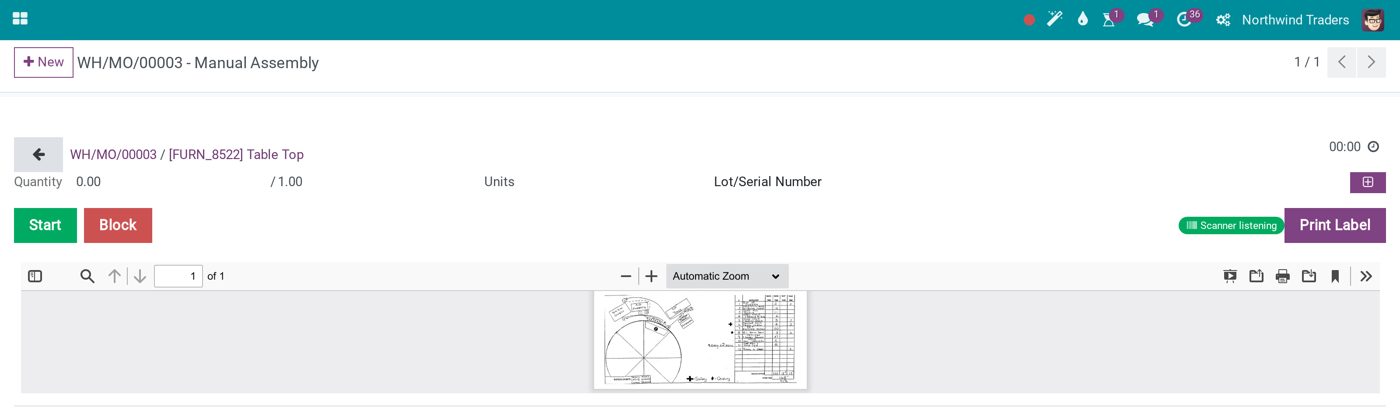
Example: the worker starts or blocks the step on a tablet at the workstation; a barcode scanner can be used.
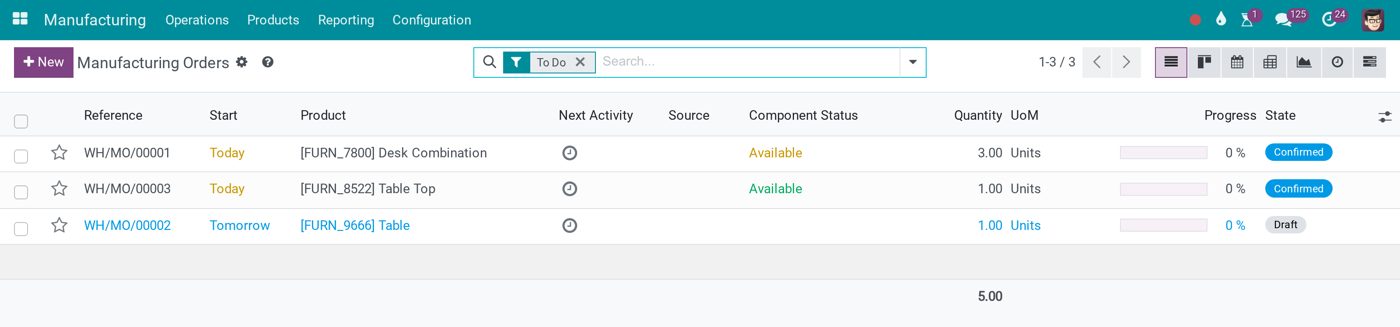
Example: the list shows for each manufacturing order whether its components are available.
Planning works on the same data. A master production schedule built from the sales forecast shows, period by period, how much to produce and buy, so manufacturing orders and purchase orders can be created ahead of time.
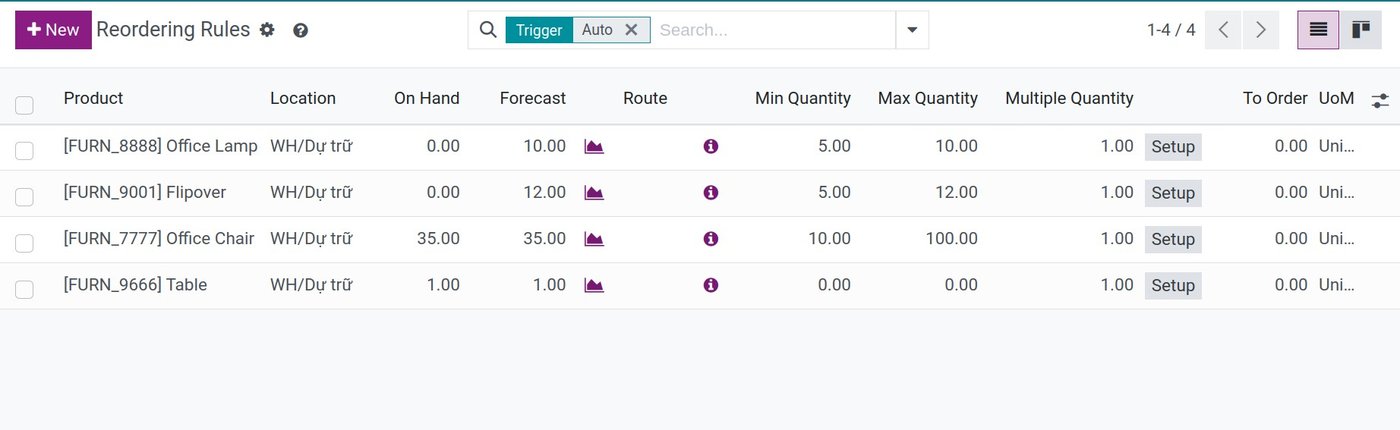
Example: each reordering rule keeps a minimum, a maximum and an order multiple for one product in one location.
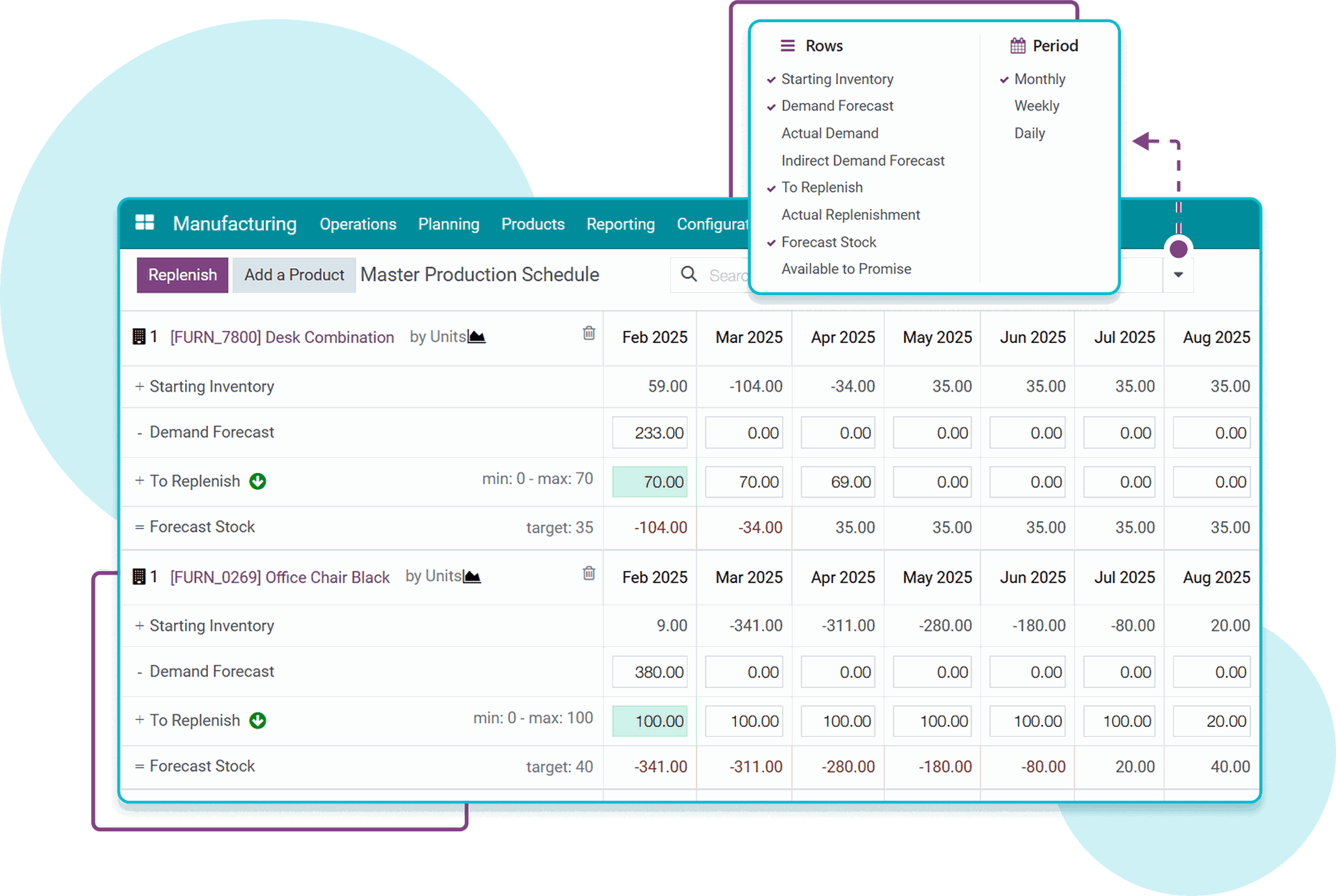
Example: the schedule shows, month by month, the demand forecast, what to replenish and the resulting stock.
How materials move through the plant, from raw material to finished goods, is covered in the article on material flow in manufacturing.
AI prepares, a person approves
Answering is only half of the work. When the AI is asked to create or change something, such as drafting a quotation for a customer or an email reminding a supplier, it prepares the draft and stops at a confirmation card. The person who confirms is the one accountable.
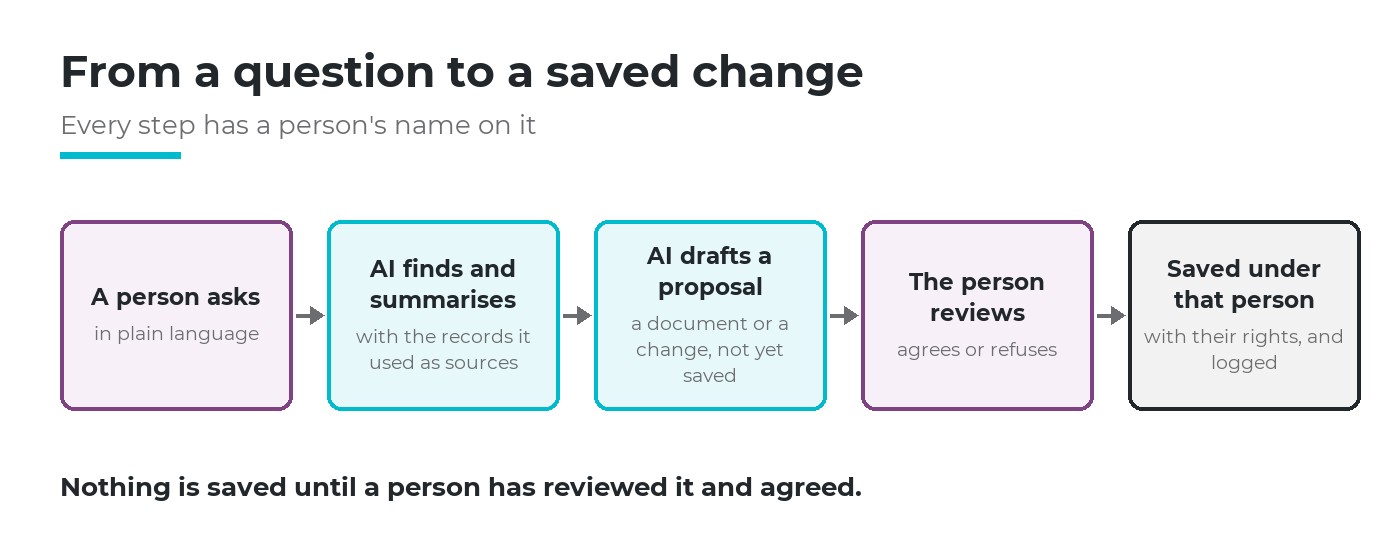
AI finds, summarises and drafts in the middle steps. A person starts the chain and closes it.
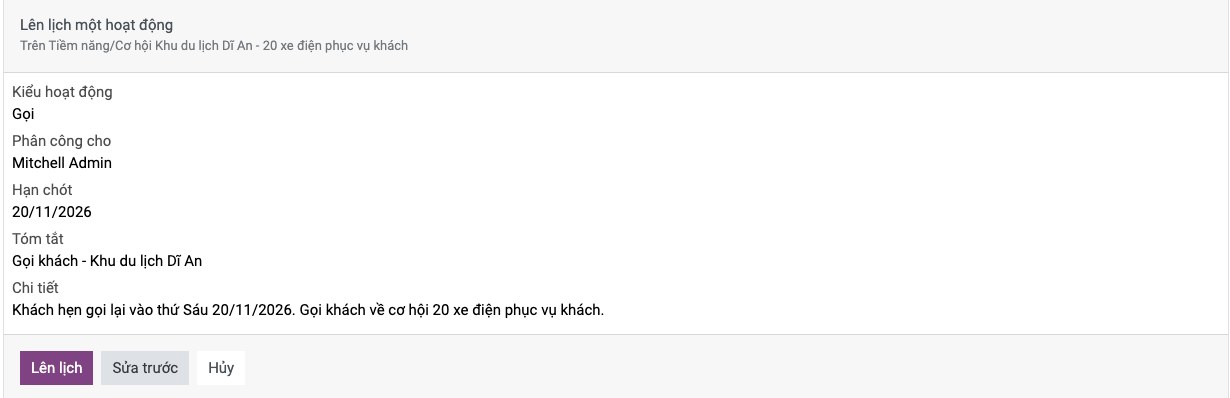
From our test: asked to remind a salesperson to call a customer on Friday, the AI prepared this card and waited. Nothing was saved until the person clicked Schedule.
What AI for manufacturing companies does not do yet
Being clear about the limits saves disappointment later. On Viindoo today:
- It does not read machines or sensors. The AI answers from records in the system. It is not connected to machine controllers or sensors, so it does not watch machines in real time.
- It does not predict breakdowns. It can rank machines by past corrective requests, but it does not forecast when a machine will fail.
- It does not reschedule production by itself. It shows which orders are late and which are short of components; deciding the order of work stays with the production manager.
- It only knows what has been recorded. Output written on paper, or a spreadsheet kept on someone's computer, is invisible to it.
- It is not always right. The figures we checked matched the records, but an answer still needs a person to read it before a decision.
Where a manufacturing company should start
1. Bills of materials and work orders
Put the products you make most often into the system first.
2. Record work at the workstation
Start with one line and one tablet, not the whole plant.
3. Keep stock moves current
Issues to production and receipts recorded the same day.
4. Ask the AI three daily questions
Open orders, short components, late deliveries, checked by a named person.
The manufacturing side of Viindoo, from planning to the shop floor, is described on the manufacturing management software page. What agentic AI is, and the conditions it needs, is explained in the article on what agentic AI is.
Would you like to see AI answer questions about your own production? Tell us where it hurts most. Book a consultation and bring the bill of materials of one product you make often, or see the costs first.
Frequently asked questions about AI for manufacturing companies
No. The AI described here works on records the company keeps: orders, work orders, stock and maintenance requests. Sensors are needed only for AI that watches machines directly.
The shop floor screen shows one work order at a time with a few large buttons, and a barcode scanner can be used. Most companies start with one line and the team leader, then extend.
Actions that create or change records stop at a confirmation step. A person reads the draft and approves, edits or cancels it.
The company connects the AI provider it chooses with its own key and pays that provider directly. The question and the data needed to answer it are sent to that provider. Viindoo does not resell AI.
Related articles
- What Is Agentic AI, and How Does It Work Inside a Business Management System?
- Separate Software Plus Spreadsheets, or One Platform for the Whole Business?
- Build Business Software with AI, or Use a Platform with AI Built In?
- Material Flow Through the Plant: Raw Materials, Work in Progress, Finished Goods
- AI for Accounting: What Agentic AI Can Do from Receivables to Reports
- AI in Sales: What Agentic AI Can Do from Opportunity to Quotation
- AI in Inventory Management: What Agentic AI Can Do from Stock to Delivery