An AI operating model is the biggest gap in the current AI wave. In 2024, 78% of organisations reported using AI, up from 55% a year earlier (Stanford AI Index 2025). In the same period, a survey of 1,000 senior executives by the consulting firm BCG found that 74% of companies had yet to see tangible value from AI.
The gap is not in the tools. It is in turning scattered pilots into a shared way of working: who owns each process AI touches, which data it may use, who checks its output and how results are measured. Without those decisions, each successful pilot depends on one capable person quietly carrying all these jobs, and the success stops at the edge of that person's team. In the same BCG survey, the leading companies put 70% of their effort into people and processes and only 10% into algorithms.
The seven earlier articles in this series each looked at one tension. This final article brings them together into a way of managing that fits a small or mid-sized company: a map of decision rights, four new roles, four layers of management and a 90-day path from pilot to responsible operation.
Seven paradoxes, one missing operating model
Common signs: a few AI pilots work well, such as quotes drafted with AI, bank receipts matched with AI, reorder suggestions from AI. The department that succeeded wants to scale at once; the chief accountant hesitates to sign any figure AI has touched without seeing where it came from; and the CEO cannot yet say who owns these processes, how much to invest, whether the company is really more productive, or what happens when AI is wrong at scale. Each manager is right about their own part. This is the moment an AI operating model becomes the CEO's job.
Each of the seven paradoxes in this series is a decision that a single pilot can leave unmade, and a company cannot:
| Paradox | In one line | Article |
|---|---|---|
| Trust | The people whose experience AI needs most have the most to lose by sharing it. | 01. Do Employees Really Want to Teach AI Their Job? |
| Gains | Time saved quietly becomes higher targets, so people stop improving. | 02. AI Raises Productivity, but Who Owns the Gains? |
| Staffing | AI replaces tasks, not positions; cutting people also cuts exceptions and judgement. | 03. Cutting Staff with AI: What a CEO Saves, and What the Company Loses |
| Knowledge | Documents describe the normal case; money is lost in the exceptions only experts know. | 04. If AI Learns Every Process, Do You Still Need Your Best People? |
| Accountability | Handing a step to AI does not hand over responsibility for it. | 05. When AI Gets It Wrong, Who Is Accountable? |
| Control | The more data AI can see, the more useful it is and the more ways it can be wrong. | 06. The Smarter the AI, the Harder It Is to Control? |
| Fragmentation | Many personal AI gains do not add up to a company capability. | 07. One AI per Employee: Is Your Company Building an Invisible Operating System? |
The mechanism behind all seven is the same. In a pilot, one motivated manager is at once process owner, data keeper, checker and judge of whether it works. When the pilot spreads, those four jobs do not spread with it, because nobody was named to them. An AI operating model is, at its core, the act of naming them.
A pilot proves that AI can do a step. An AI operating model decides who answers for it.
This view is weaker in a company of fifteen people where the owner still approves every quote and payment: the four jobs already sit with one person. The paradoxes grow with each layer of management between the CEO and the work.
An AI operating model maps the work and decision rights before the tool

The unit of an AI decision is a step in a process, not a job title.
AI takes over steps, not positions. So the first management tool is not a list of AI products but a map of one process: who does each step today, what AI could do there and who decides. Without it, the CEO argues about job titles while real change happens one step at a time.
This is also where Agentic AI becomes concrete: AI that takes on a task with several steps, rather than answering one question. A business example: a customer asks on Zalo whether an item is in stock. AI checks stock, proposes a delivery date, drafts a quote from the current price list and hands it to the salesperson to approve. If the discount requested is above the salesperson's limit, the draft goes to the sales manager. Every step needs a decision about who owns it.
| Step in quote-to-order | What AI may do | Who decides |
|---|---|---|
| Answer a stock enquiry | Look up and reply within the salesperson's view | Salesperson |
| Draft the quote | Draft from the current price list | Salesperson |
| Approve a discount | Suggest and flag unusual levels only | Sales manager, within the limit set |
| Confirm delivery date | Propose from stock and schedule | Warehouse lead |
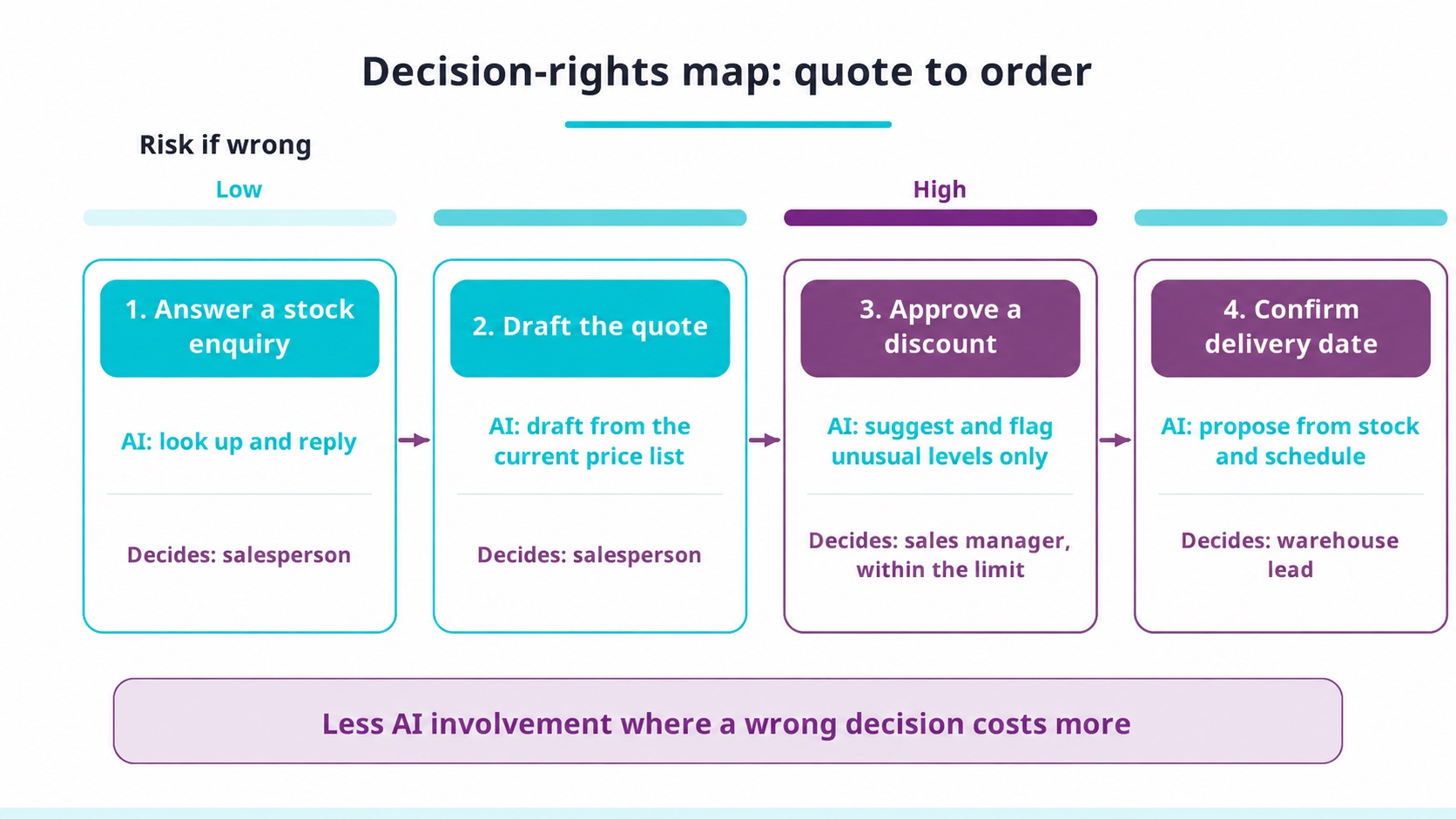
The map is drawn per step; the level of AI involvement falls as the risk of a wrong decision rises.
The trade-off is time: a few working sessions with the people who do the work. For a process one person runs end to end, a short list is enough. The map earns its cost when work passes through several hands, because that is where responsibility gets lost.
New roles in an AI operating model: process owner, data owner, checker, AI operator
The map reveals four jobs the pilot was hiding. None needs a new hire; each is a responsibility added to someone already in the process:
Process owner
Decides how the process runs and which steps AI may take on, and answers for the result. Usually the head of the department where the process ends.
Data owner
Keeps one set of data correct and current: price lists, stock, customer terms. Decides who, and which AI, may see it.
Checker
Reviews a sample of AI output on a fixed schedule and reports error patterns. Should not be the person whose target depends on speed in that step.
AI operator
Sets up the AI's instructions and access, collects user feedback and can switch AI off in that area when something goes wrong.
In a company of fifty to a few hundred people, one person often holds several roles. For instance, the sales director can own quote-to-order. The chief accountant owns price and receivables data and checks a sample of AI-drafted quotes each week. One staff member good with systems operates the AI for sales and accounting. Four roles, three people, no new department.
One combination should be avoided: the person who gains from speed should not be the only checker of the same step. The sales director who wants faster quotes is not the right person to confirm AI prices. This is old internal-control practice, and it applies to AI for the same reason. Where the team is too small to separate, the CEO can check a small sample each month.

In a mid-sized company, the chief accountant is often both data owner and checker for prices and receivables.
The AI risk framework of the United States National Institute of Standards and Technology (NIST AI RMF) points the same way: document roles and responsibilities for AI risk, define roles when people and AI work together, and keep a way to deactivate an AI system that does not behave as intended.
Four layers of an AI operating model: data, process, AI, control
Most AI problems show up in the AI layer and start below it. A wrong quote is usually a stale price list or a discount nobody was assigned to approve. A simple way to read an AI operating model is four layers, each resting on the one below:
| Layer | The question it answers | Typical failure | Article |
|---|---|---|---|
| Data | Is there one current, owned set of figures that people and AI both read? | Two departments, two figures for the same debt | 06, 07 |
| Process | Which steps, which approval routes, which limits? | A discount nobody was assigned to approve | 03, 05 |
| AI | In which steps does AI suggest, draft or carry out, using which knowledge? | A fluent answer based on last year's policy | 02, 04 |
| Control | Who checks, what is logged, who can stop it, how often is it reviewed? | An error found by the customer, not by the company | 01, 05, 06 |
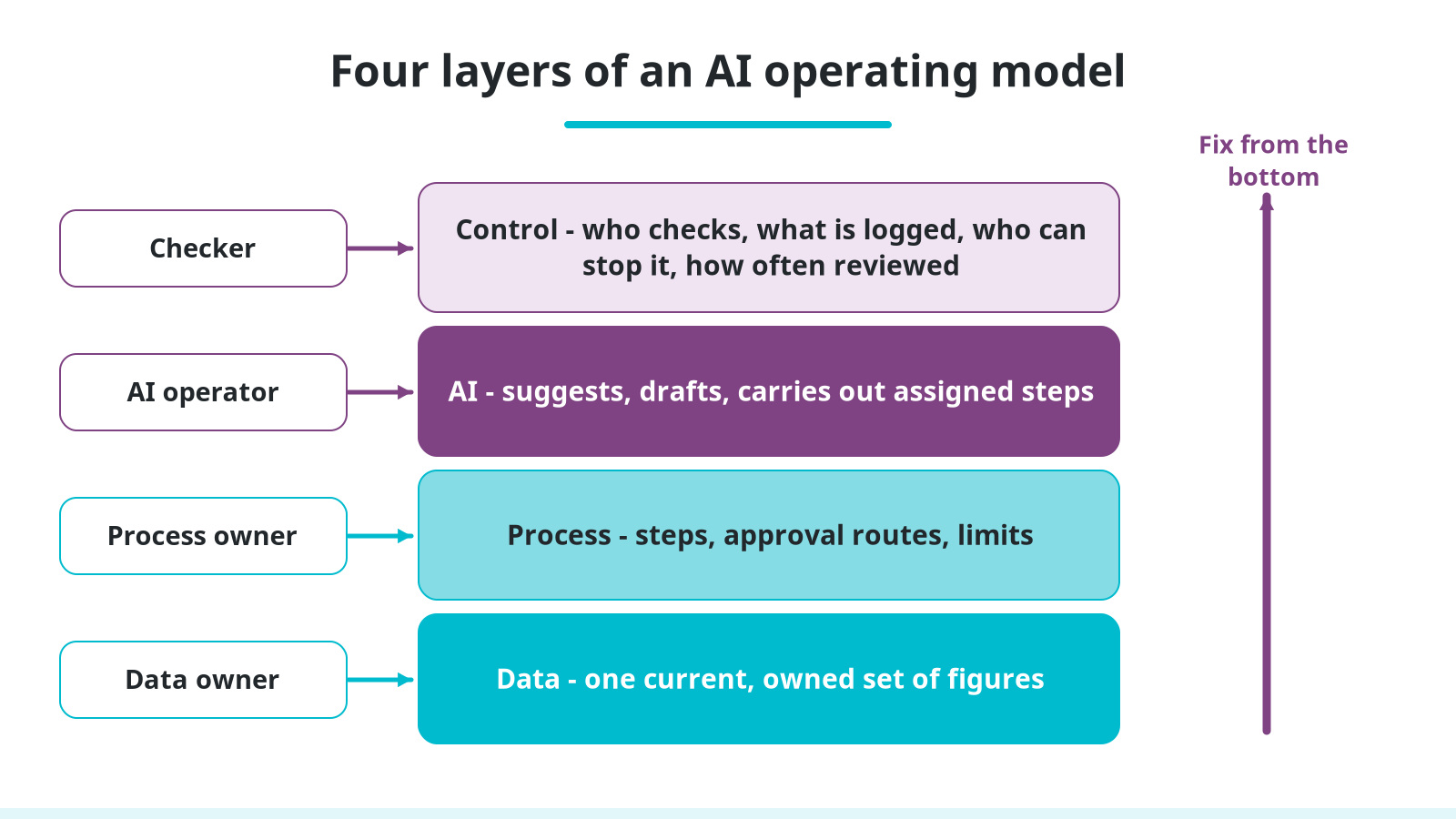
Control is not a fourth floor on top; it reaches into every layer. People hold each layer through a named role.
The practical rule of an AI operating model is to fix from the bottom. If AI answers are often wrong, look at the data before changing the AI. If AI output is correct but nobody acts on it, look at the process. A better model on a stale price list buys a more convincing wrong answer.
From pilot to responsible operation in 90 days

Value appears when the whole process changes, not when one desk works faster.
Adoption is not the hard part. The AI Index 2025 of Stanford University reports that 78% of organisations said they used AI in 2024, up from 55% a year earlier. Value is the hard part. A survey by the consulting firm Boston Consulting Group of 1,000 senior executives in 59 countries, published in October 2024, found that 74% of companies had yet to show tangible value from AI.
of companies had yet to show tangible value from AI
BCG, 1,000 executives, 59 countries, 2024
of resources that leading companies put into people and processes
BCG, same survey
of resources the same leaders put into algorithms
BCG, same survey
A consulting firm survey of large companies; read it as a direction, not a benchmark for Vietnamese SMEs.
Leaders in that survey put about 20% of resources into technology and data on top of the 10% for algorithms. Economic research explains the 70%. A peer-reviewed study of the productivity J-curve finds that technologies like AI need large complementary investments in redesigning work and skills, slow to show in the figures. An older study of US firms found that information technology paid off together with new ways of organising work.
So rolling out at once, as the sales director wants, is the wrong first move, and so is waiting for a perfect plan. The AI operating model of an SME works in short cycles: start where the work hurts most, measure on real data, then decide.
Choose one process
Pick where work hurts most, data is clean enough and there is one main user group. Map the steps, name the four roles.
Set the baseline
Record lead time, errors, rework and complaints before AI changes anything, rebuilding from recent records if needed.
Put risk controls in place
For each step, set what AI may do, limits, approval route, logging and who can switch AI off. Agree what counts as good enough.
Run and measure
Run on real work. The checker reviews a weekly sample; the process owner compares with the baseline every two weeks.
Decide: scale, fix or stop
Scale only if results beat the baseline without more errors. Otherwise fix the lowest broken layer, or stop. Then choose the next process.
Stopping is a valid result: it saves the cost of rolling out to every branch. The cycle also makes resources concrete: each process gets a named owner, a few hours a week of checking and a fixed date to decide, instead of an open-ended AI budget.
Measure business results and quality, not how often AI is used
Counting AI use is easy and tells the CEO almost nothing. A team can use AI a thousand times a month while quotes go out with wrong prices, and rewarding usage pushes people to use AI where it helps least. The scorecard of an AI operating model needs four groups of measures, each read against the baseline:
| Group | Example measures | Who reads it |
|---|---|---|
| Business result | Days from enquiry to order, days to collect receivables, orders won | CEO, process owner |
| Quality | Error rate in AI-assisted documents, rework, customer complaints | Checker, process owner |
| Control | Share of AI output sampled, edits made by people, incidents and time to stop them | Checker, AI operator |
| People | Where the saved time went, checker workload, staff view of the change | CEO, department heads |
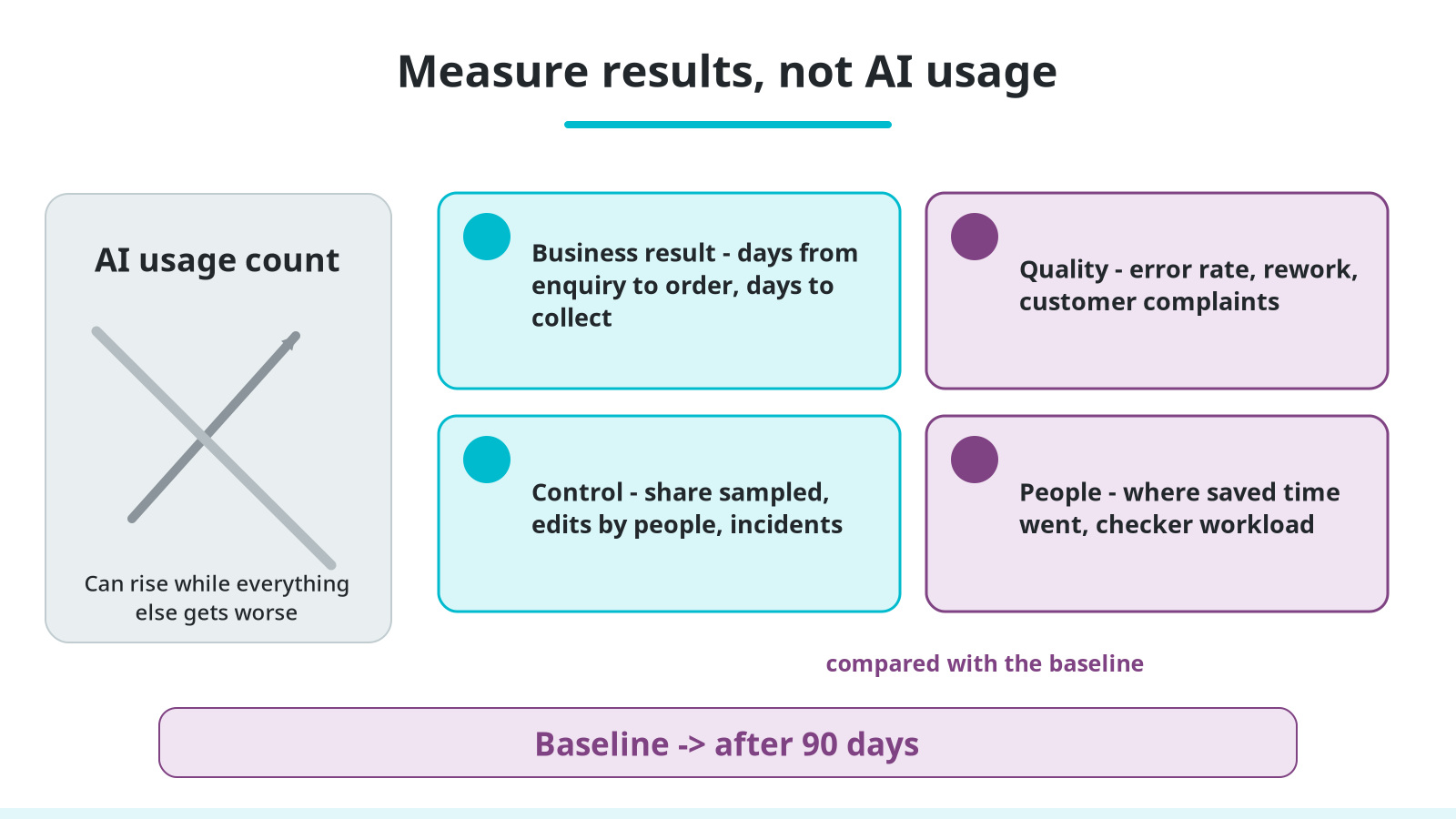
Usage counts can rise while every one of these four groups gets worse.
The people group is most often skipped, and it links back to the first three articles. If checkers carry extra work without recognition, or saved time silently becomes higher targets, quality falls a few months later. A quote assistant that is faster but raises the chief accountant's checking time by half is not yet a gain. Usage counts belong in the AI operator's notes, not in the CEO's report.
Four decisions to run AI across the company
One process at a time, on a 90-day cycle
No process gets an AI budget without an owner, a baseline and a decision date.
A person-AI responsibility matrix
One page per process: who decides, keeps the data, checks, runs the AI and may stop it. AI never holds a limit higher than the person using it.
A monthly loop to update knowledge and rules
Errors found by checkers go back to the data and process owners, and are corrected at the source with the name of the person who changed them.
A decision forum sized for an SME
One hour a month: the CEO, process owners and chief accountant review the scorecard and decide what to scale, fix or stop. No committee, no AI department.
The responsibility matrix for the quote-to-order process fits on one page:
| Decision | Process owner (sales director) | Data owner and checker (chief accountant) | AI operator | Monthly forum |
|---|---|---|---|---|
| Which steps AI may take on | Decides | Consulted | Sets up | Approves scaling |
| Price list and discount limits | Proposes | Keeps correct | Connects AI to the current version | Approves changes |
| Weekly sample check | Reads the result | Checks | Fixes AI instructions | Reviews trend |
| Stopping AI after an incident | May stop | May stop | Carries out | Reviews the cause |
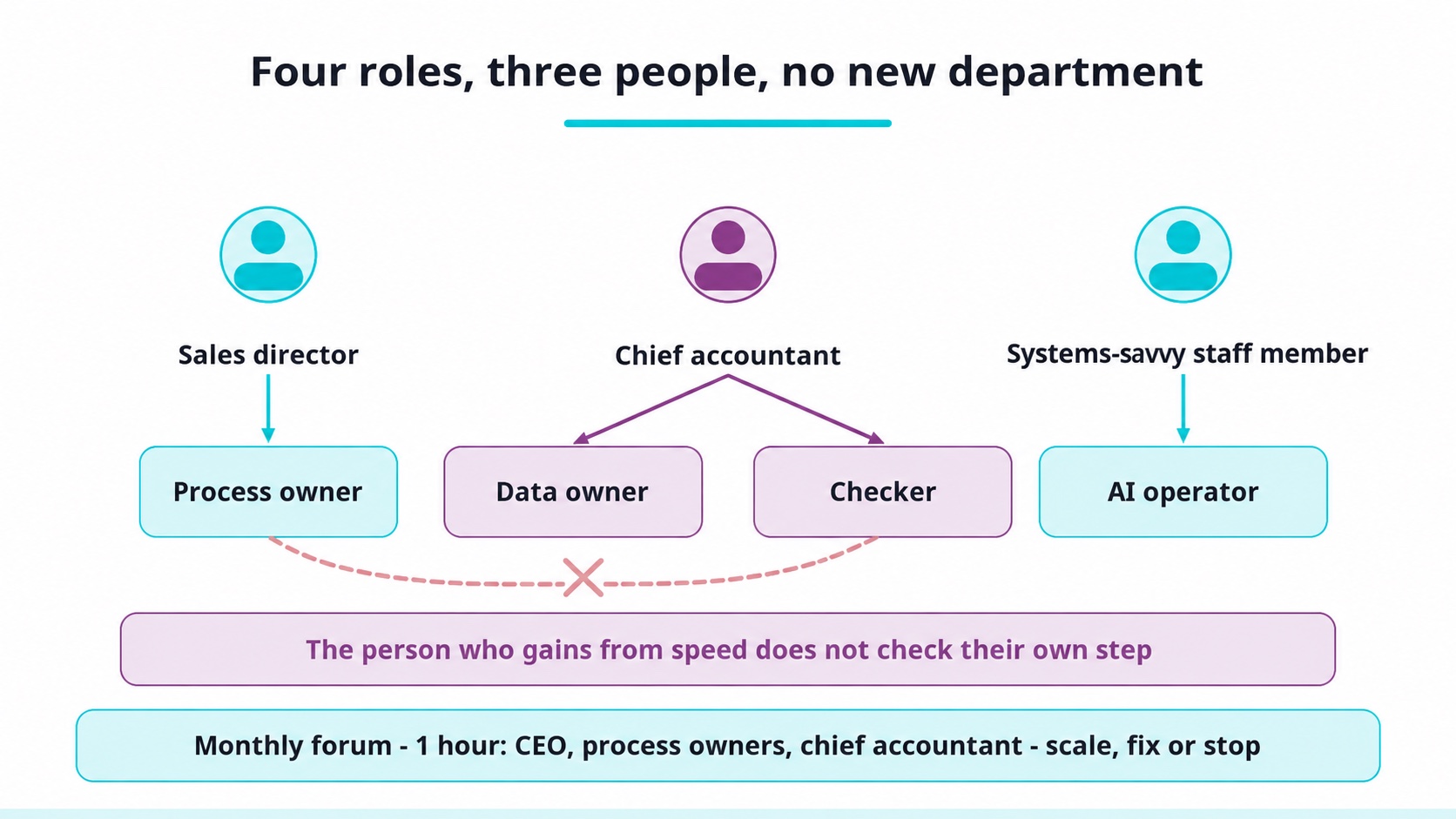
One page per process is enough; the point is that every decision has a name next to it.
The forum keeps the AI operating model from turning into paperwork. Its only job is to decide with the scorecard in front of it and to note what was decided and why, the record the company will need when someone asks why AI was allowed to do a step.

The decision forum is a monthly hour, not a new department.
Points to keep in mind
Do not build more machinery than the problem. Four roles, one map per process and one monthly hour are enough for most SMEs. An AI operating model copied from a large bank will be ignored within a quarter, and AI use will move back into personal tools. NIST AI RMF and ISO/IEC 42001 (published in December 2023 and applicable to any organisation regardless of size) are references for checking that nothing important is missing, not structures an SME must adopt in full.
The evidence has limits. The adoption and value figures come from surveys of large organisations, one run by a consulting firm, and none measures Vietnamese SMEs. The economic studies describe earlier technologies. They support the direction of this article, not a forecast for your company.
Not every process should be scaled. Some steps depend on relationships or judgement that AI supports but cannot carry. Keeping AI in a drafting role there is a sound decision.
The direction Viindoo has chosen
When the first AI pilots work, that is exactly when the hard questions arrive: who owns these processes now, how much to invest, whether the company is really more productive, what happens when AI is wrong at scale. The seven earlier articles lead to the same place. Companies do not lack AI tools; they lack an AI operating model in which people and AI know who does what, under which rules.
Viindoo's whole direction rests on that observation. Viindoo is building an Agentic AI business management platform because it believes AI only becomes a real part of the workforce when it works on the same data as people, within the authority the company grants, and leaves a trail like any employee. The whole company on one platform, the company setting the rules, AI suggesting, warning and drafting while people decide: this is not a feature list but a view of how to manage a team made of both people and machines.
That view maps onto the four layers of this article. Data: one set for every department, so the chief accountant can see where a figure came from before signing. Process: each process has an owner, a checker and an AI operator, as in the new roles above. AI: it works within the authority set for each process. Control: every step leaves a trail. It is also why Viindoo argues for starting small, one process that hurts most, measured from a baseline, on the 90-day cycle above: an AI operating model is built from controlled trials, not from a grand design drawn up on day one.
One more layer sits on the user's side. When a quoting assistant goes to every branch, each salesperson should be able to use it within their own work, without a team of AI specialists standing in between. Viindoo is the backbone of the whole system, carrying data, authority, approvals and the trail underneath, so a company can scale AI while operations stay stable and safe.
No platform can take the hardest decisions off a leader's desk: how to share the gains, which capabilities to keep, how much risk to accept. What a platform can do is let those decisions be made on a system where everyone sees the same picture.
Four questions to check where you stand
- In which process is AI creating value today, and which figure against which baseline shows it?
- For each step AI takes part in, who is accountable, who keeps the data correct and who checks the output?
- If AI made the same mistake in every branch tomorrow, who would notice first, and who could stop it?
- How will we scale the next pilot and keep control, and who decides it is ready?
Frequently asked questions
The decisions on which processes AI joins, who owns them, which data it uses, who checks it, how results are measured and who can stop it. For an SME, an AI operating model fits in a process map, four roles, a scorecard and a monthly review.
Usually not. The four roles are responsibilities added to people already in the process, and one person can hold several. Avoid only one combination: the person who gains from speed being the sole checker of the same step.
AI that takes on a multi-step task, such as answering a Zalo stock enquiry by checking stock and drafting a quote for the salesperson to approve. Each step still needs an owner and a limit.
When it beats the baseline on business result and quality, without more errors or hidden checking work, and every step has a named owner. If there is no baseline, rebuild one from recent records first.
Tell us where it hurts most. The process losing the most time or money right now is where the first 90 days should go. Describe it to us and we will look at it with you, process, data and people first, before any tool: contact Viindoo.
Sources
- Boston Consulting Group (24 Oct 2024). AI Adoption in 2024: 74% of Companies Struggle to Achieve and Scale Value. Report "Where's the Value in AI?"; 1,000 executives, 59 countries. Consulting firm survey.
- Stanford Institute for Human-Centered AI (2025). AI Index Report 2025, top takeaways.
- Brynjolfsson, E., Rock, D., & Syverson, C. (2021). The Productivity J-Curve: How Intangibles Complement General Purpose Technologies. American Economic Journal: Macroeconomics, 13(1), 333-372.
- Bresnahan, T. F., Brynjolfsson, E., & Hitt, L. M. (2002). Information Technology, Workplace Organization, and the Demand for Skilled Labor: Firm-Level Evidence. The Quarterly Journal of Economics, 117(1), 339-376.
- National Institute of Standards and Technology (Jan 2023). Artificial Intelligence Risk Management Framework (AI RMF 1.0), NIST AI 100-1: GOVERN 2.1, GOVERN 3.2, MANAGE 2.4.
- ISO/IEC (18 Dec 2023). ISO/IEC 42001:2023 Information technology - Artificial intelligence - Management system, edition 1.0.