The short answer to the question of ERP and Kaizen is:
No. A business can do Kaizen without ERP.
Kaizen starts with observing the shop floor, spotting waste, trying better ways of working and sustaining continuous improvement. A small production team can do Kaizen with visual boards, checklists, charts, short start-of-shift meetings, defect slips or simply by observing directly on the shop floor (Gemba). Many good improvements do not need to start with software.
But as the business grows and the number of orders, products, materials, people and operations increases, a different problem appears:
The business can still do Kaizen, but it becomes very hard to sustain data-driven Kaizen continuously and consistently.
This is where ERP starts to play a role. In the relationship between ERP and Kaizen, ERP does not replace Kaizen. It provides the data and operational infrastructure that lets Kaizen run at a larger scale, across departments and with clearer measurement.
Kaizen can start without ERP
By nature, Kaizen is not software. It is a way of thinking and a way of organizing improvement. A small business can spot problems very directly:
- The supervisor sees stock piling up between two operations.
- A worker points out an unnecessary motion.
- A warehouse clerk notices that one material is often short.
- Sales realizes quotations take too long.
- Engineering sees that one design keeps needing corrections.
The business then tries changes: a new layout, a different sequence of motions, standardized forms, a revised approval process, adjusted stock levels or reassigned responsibilities. That is already Kaizen, and it does not need ERP to begin. In fact, if the business lacks basic operational discipline, introducing ERP too early will not automatically create improvement.
The problems begin as the business grows
When the business is small, one manager can know quite well which orders are late, who is working on what, which machine has a problem and which material is short. But with hundreds of orders, thousands of material codes, several warehouses, many operations, production teams, customers and projects running at the same time, the ability to "see with your own eyes" drops sharply. The business then usually faces five major problems.
1. Data is scattered
Sales has one file, engineering another, purchasing has email and its own tracking sheet, the warehouse uses Excel, the workshop has a planning board and accounting has its own system. Every place has data, but there is no single stream of data.
2. Each department has its own "version of the truth"
Sales says the order is ready. Engineering says the BOM is still being revised. Purchasing says it has not received all material requests. The warehouse says the materials are there but not yet issued. Production says it has not received the order. When data is not linked, it is very hard to know the real status.
3. End-to-end time cannot be measured
The business may know the date an order was received and the date it was delivered, but not how long it waited for engineering, for purchasing or for materials, how long production actually took or how long it waited for QC. Kaizen then easily relies on gut feeling.
4. Root causes are hard to trace
Knowing that an order is late is not enough. The business needs to know why it is late. If data sits in many systems, tracing back the cause takes a lot of time.
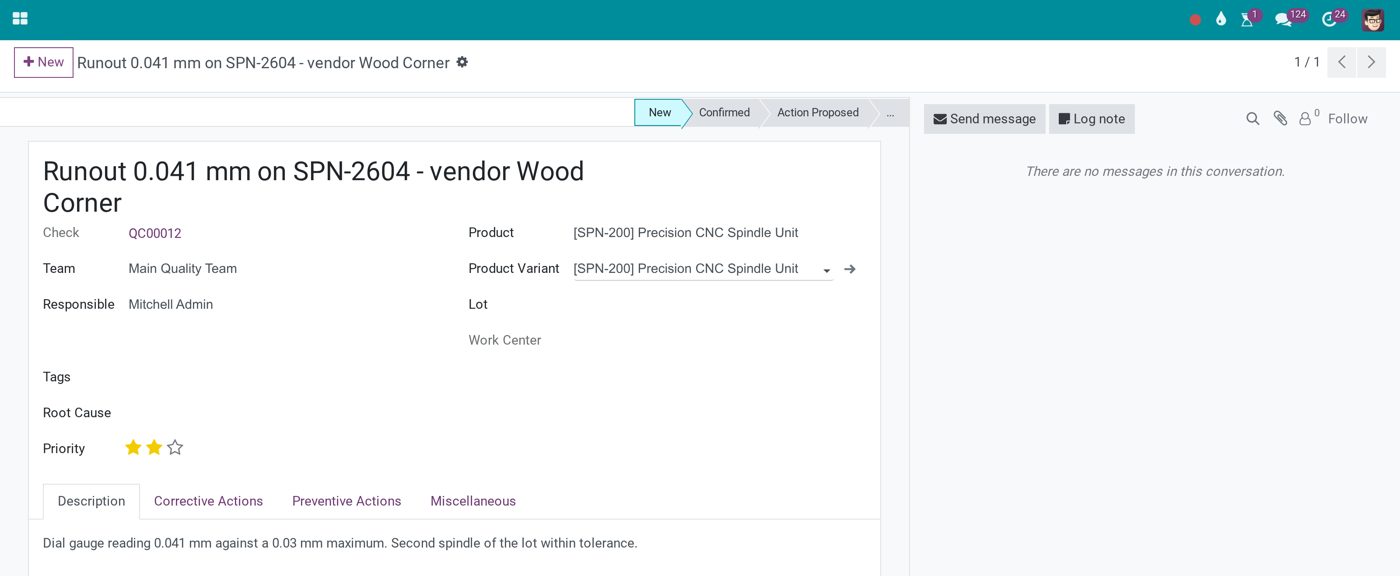
When a defect is recorded with its root cause and actions, tracing back no longer depends on memory.
5. The effect of an improvement is hard to measure
An improvement is applied, but afterwards the business has no reliable figures to answer: did lead time really drop, did work in process (WIP) go down, did the defect rate fall, did cost decrease, did productivity rise? Without measuring before and after, Kaizen easily stops at "it feels better".
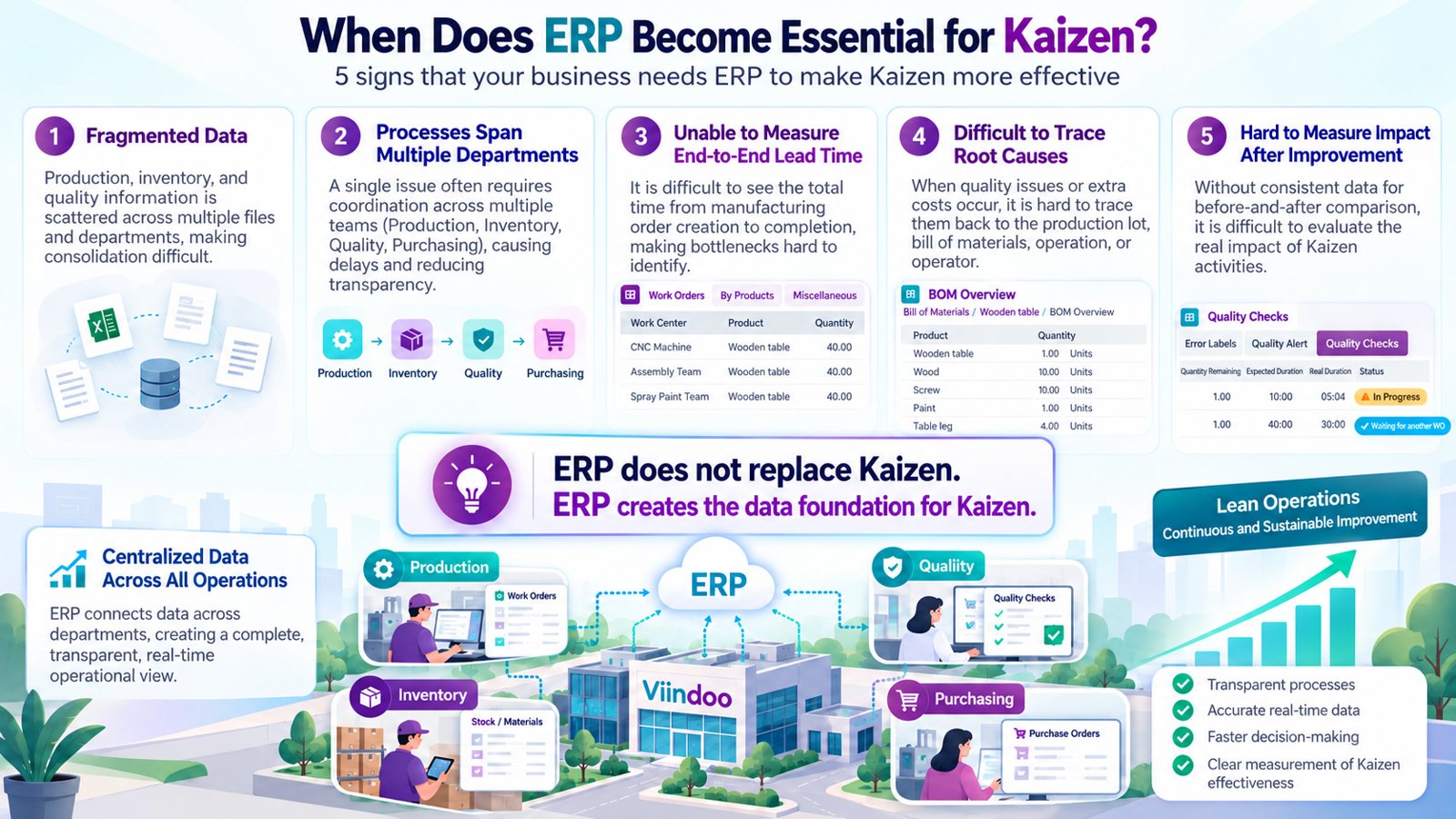
Illustration: five signs that a business needs ERP to make Kaizen more effective.
ERP does not create Kaizen, but it creates the data foundation for Kaizen
This distinction matters. ERP does not automatically find problems, propose improvements, change processes or build a Kaizen culture. People still have to do that. But ERP can help the business:
- Record activities
- Connect data
- Follow the flow of work
- Measure deviations
- Analyze causes
- Evaluate results after an improvement
In Viindoo, for example, every work order records its expected and real duration and its status, such as waiting for components, in progress or under quality check, so the flow of work and its deviations are recorded as the work happens.
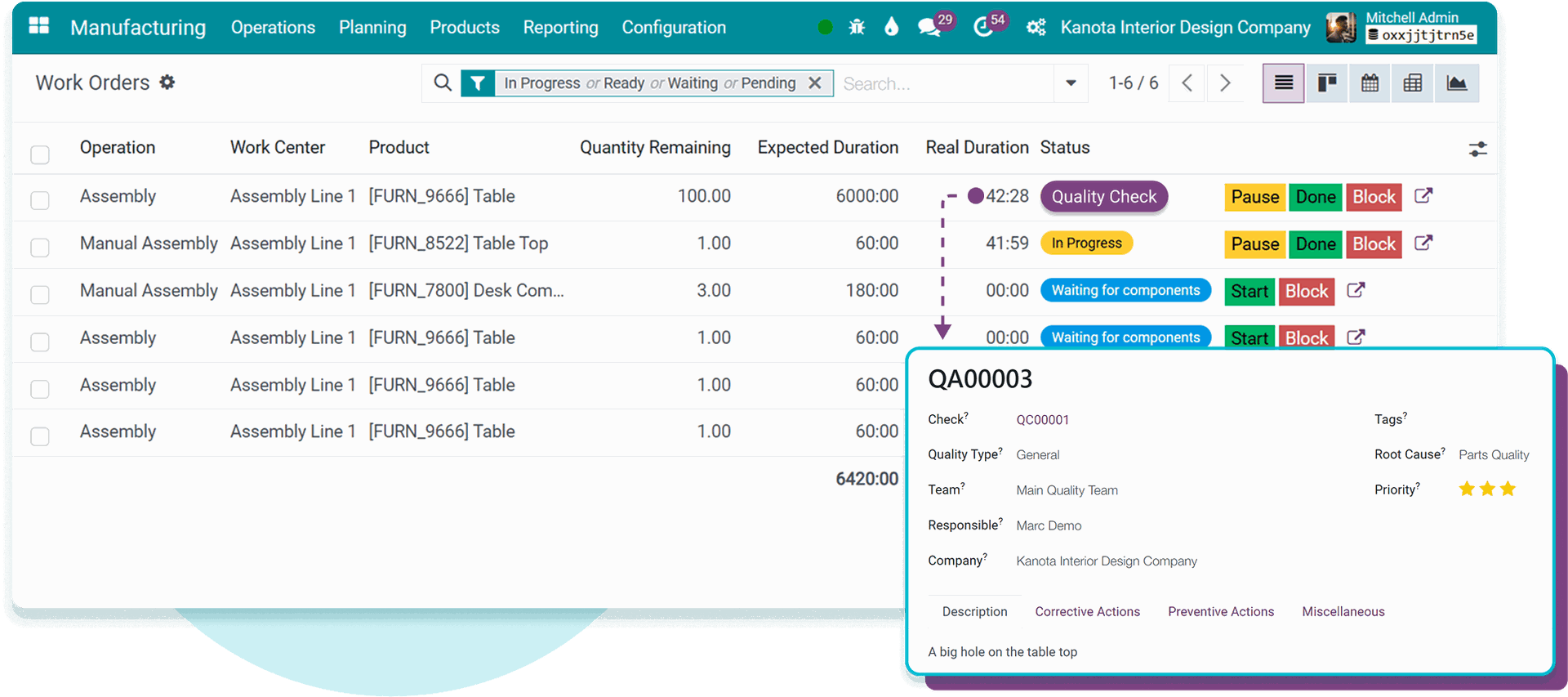
Work orders record expected versus real duration and status for every operation.
Kaizen answers "What needs to be improved?" ERP helps answer "What is the data telling us?"
That is how ERP and Kaizen complement each other.
When does ERP become an important foundation for Kaizen?
There is no fixed number, but a business usually starts to clearly need ERP when one or more of the following signs appear.
1. Processes run across many departments
For example, one order passes through Sales → Engineering → Purchasing → Warehouse → Production → QC → Delivery → Accounting. If each department uses a different tool, improving the whole flow is very hard. ERP links these steps into one consistent chain of data.
2. Transaction volume exceeds what can be tracked by hand
With a few dozen orders, Excel may still be enough. With hundreds of orders and thousands of material lines, managing with separate files easily leads to duplicated data, wrong versions, missing updates and history that is hard to trace.
3. The business wants to measure, not just observe
Small-scale Kaizen can start with observation. But to measure lead time, cycle time, WIP, on-time delivery (OTD), defect rate, consumption, cost of goods sold and productivity, structured data becomes essential. In Viindoo, each work center shows indicators such as overall equipment effectiveness (OEE), lost time and load.
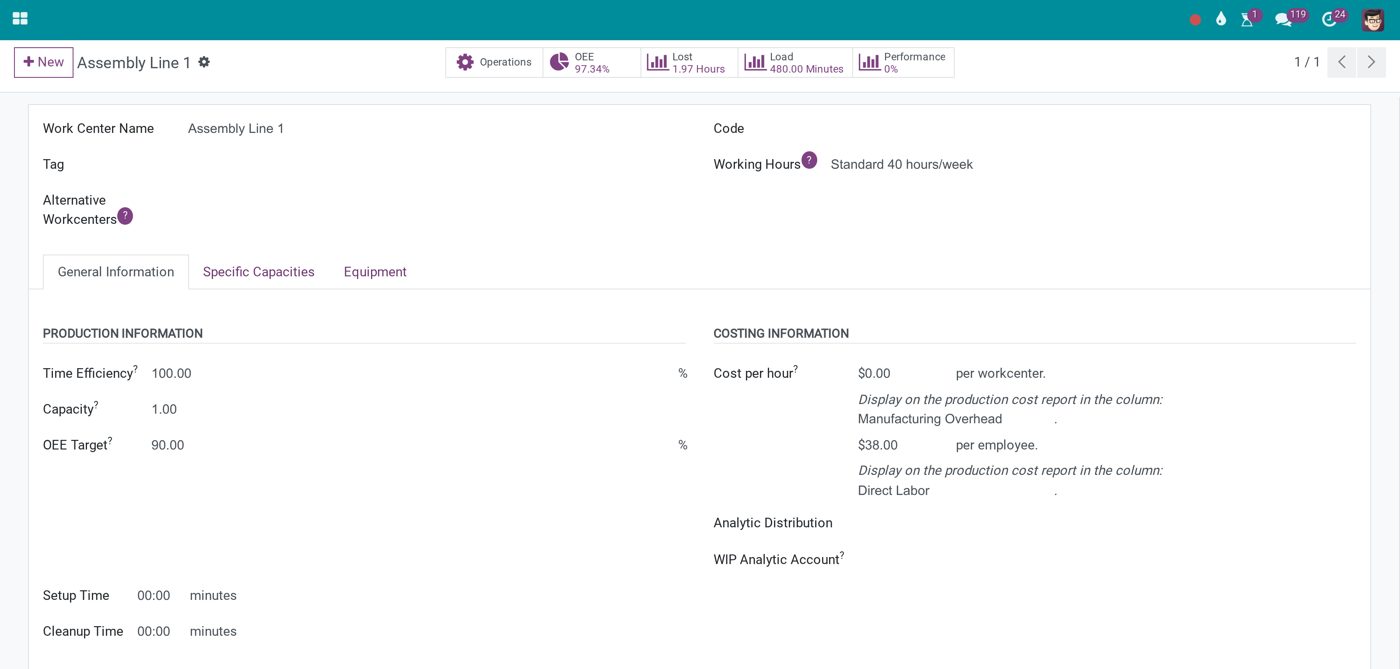
A work center in Viindoo with OEE, lost time, load and performance, the basis for measuring before and after an improvement.
4. The business wants Kaizen across departments
An improvement in production sometimes does not lie in production. The bottleneck may come from a late BOM, material shortages from a weak forecast, late delivery from changing customer requirements, high stock from the purchasing plan. ERP helps see problems along the value stream instead of department by department.
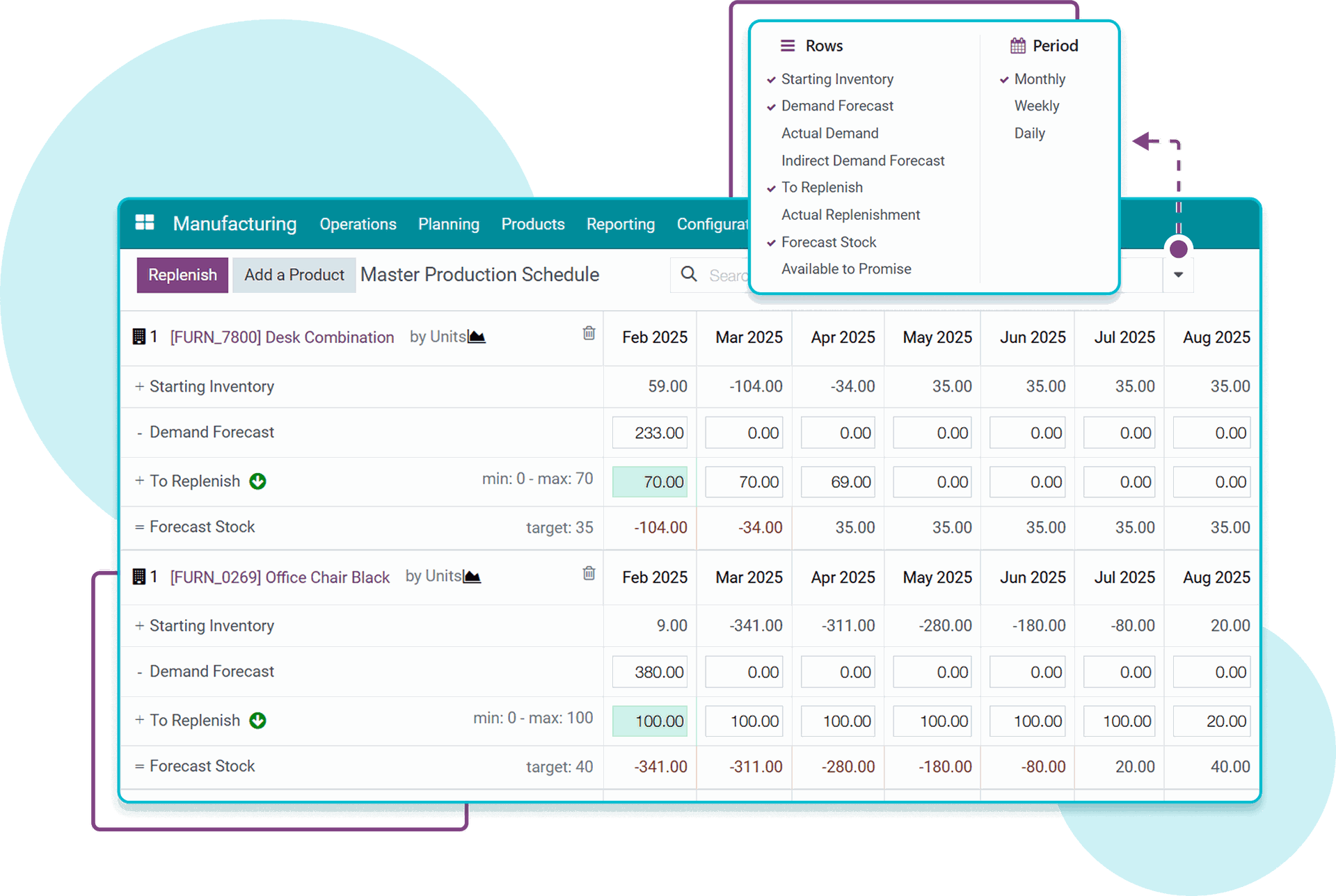
The Master Production Schedule links demand forecast, replenishment and forecast stock, where many cross-department problems start.
5. The business wants to sustain improvement over time
A Kaizen event can be run as a workshop. But for Kaizen to become a regular activity, the business needs data that is updated continuously. That is when ERP starts to act as:
the operating infrastructure for continuous improvement.
Example: how far can a mechanical company go with Kaizen without ERP?
Take a mechanical company that manufactures to order. At first it can do Kaizen quite well by reviewing the layout, reducing travel distance, standardizing tools, organizing work areas with 5S and balancing a few operations. None of this needs ERP.
But when it wants to answer questions like these, observing the shop floor is no longer enough:
- Which orders are often late?
- Which product models often run over time?
- Which BOMs change most often?
- Which materials are often short?
- Which operation is creating WIP?
- Which products have a high rework rate?
- Which customers often request design changes?
- Which orders are actually profitable?
The business needs a stream of data:
Sales Order → BOM → Procurement → Inventory → Manufacturing → Quality → Delivery → Cost
This is exactly where ERP starts to create value. The BOM is the first link: it defines not only components but also operations, work centers and standard durations, which later become the baseline for measuring.
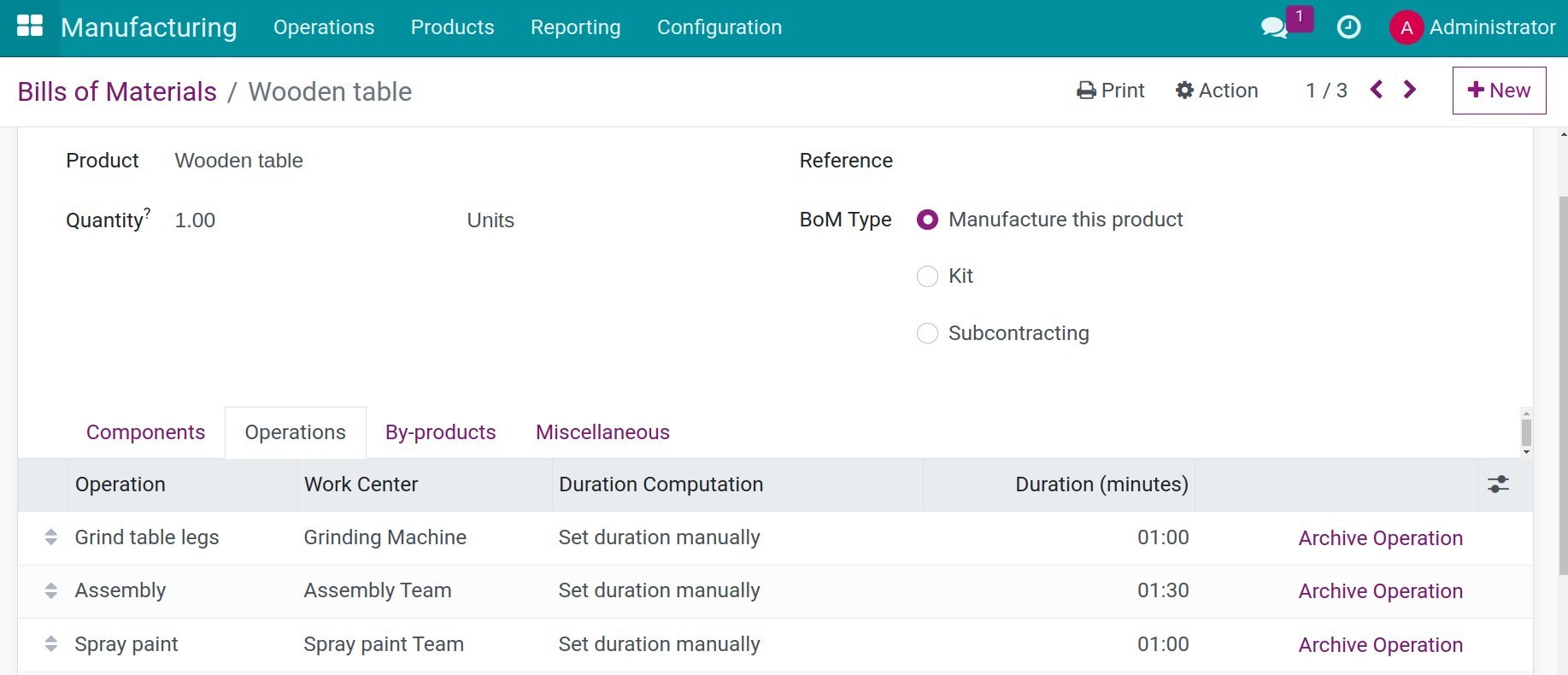
A BOM in Viindoo with operations, work centers and standard duration for each step.
Where does Viindoo fit between ERP and Kaizen?
Viindoo should not be seen simply as software to replace Excel. The greater value lies in connecting the activities of the business on one unified platform:
- Sales: creates real demand from customers.
- BOM and engineering: define what the product needs to be made.
- Purchasing and warehouse: supply materials.
- Manufacturing: records how production is carried out.
- Quality: records defects and inspection results.
- Delivery: shows the ability to meet commitments.
- Accounting: reflects cost and financial results.
When this data is linked, the business can trace back from the result to the cause, exactly what Kaizen needs and what we described in the previous article on seeing the flow of work.
Don't implement ERP just to have data
There is an opposite risk. If more data is assumed to always be better, the business can turn ERP into an overly complex record-keeping system, where users enter too many fields, confirm too many steps and record data nobody uses. That raises operating cost and goes against the Kaizen spirit of removing waste. So ERP supporting Kaizen well does not mean:
The more digitalization, the better.
It has to be:
Digitalize enough to see and control the flow of work.
Only then add more detail at the points that truly need deeper analysis.
What logic should a Viindoo implementation follow?
A practical way is to go through three levels.
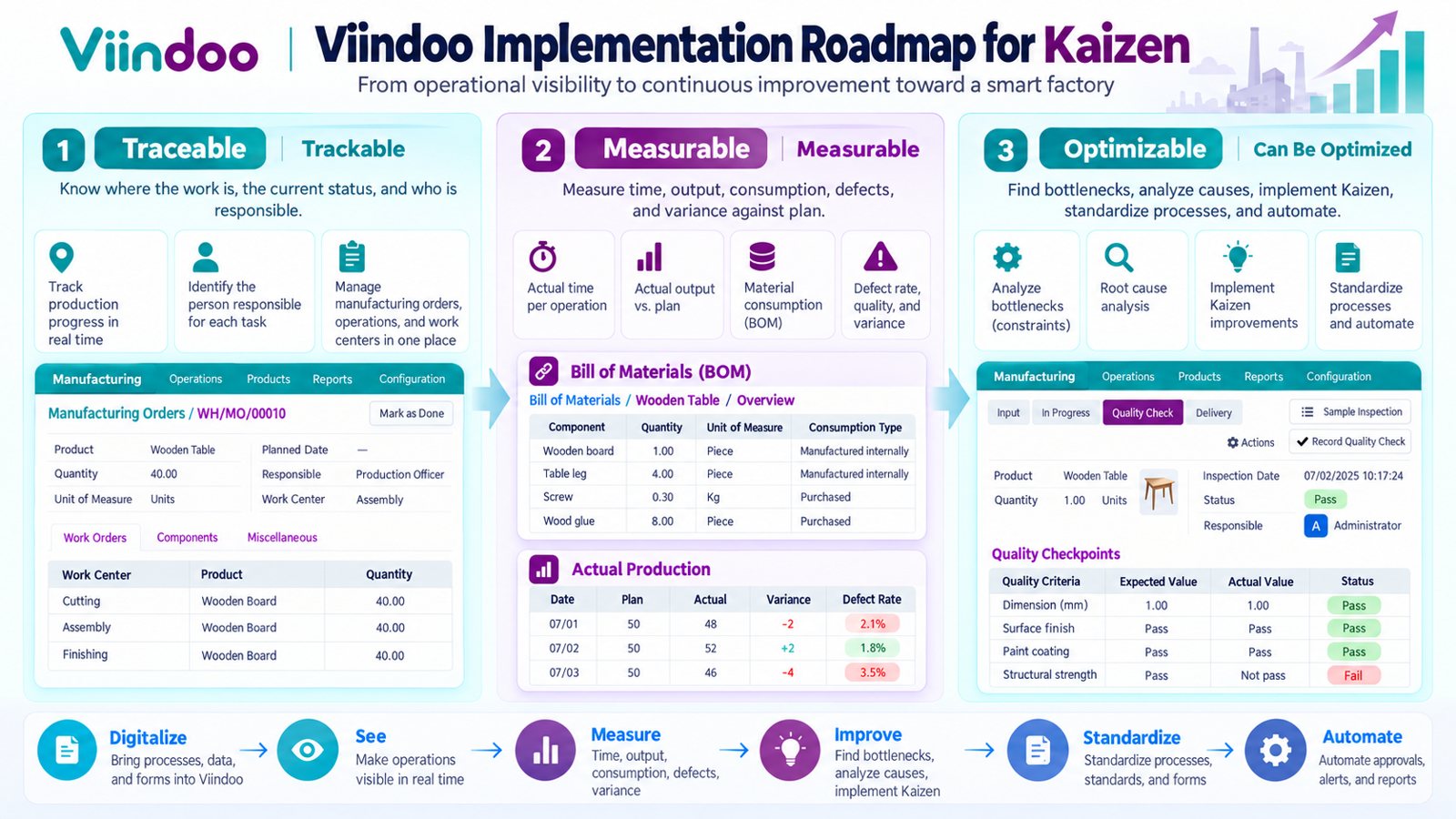
Illustration: from traceable to measurable to optimizable operations.
Level 1: Traceable
The business knows where the work is, its current status, who is responsible and whether it is done. Goal: see the flow of work.
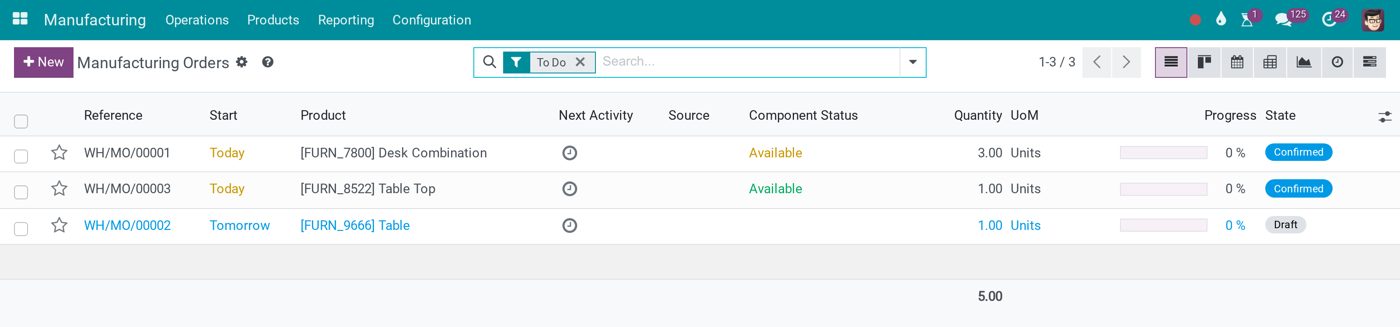
Level 1 in practice: manufacturing orders with component status and progress in one screen.
Level 2: Measurable
Add data such as time, output, consumption, defects and deviations. Goal: measure deviations.
Level 3: Optimizable
With good enough data, the business starts finding bottlenecks, analyzing root causes, running Kaizen, standardizing and automating. Goal: data-driven improvement.
Not every business needs to start at level 3. This approach keeps an ERP project from turning into an oversized strategy consulting project from day one.
ERP and Kaizen: neither should go first absolutely
There are two common misunderstandings.
Misunderstanding 1: optimize every process first, then implement ERP
This is not realistic. Many businesses do not yet have enough data to know where to optimize. If they wait for everything to be perfect before digitalizing, the project may never start.
Misunderstanding 2: implement ERP first and the system will optimize the business
This is not right either. ERP can digitalize a process that is still poor, and the business simply moves from an unoptimized manual process to an unoptimized digital process. A more sensible path is:
Digitalize enough to see → measure → Kaizen → standardize → keep digitalizing and automating.
ERP and Kaizen should develop together in a loop.
The ERP and Kaizen loop
The relationship can be described in six steps:
- Digitalize operations: create data from real operations.
- Observe: see the flow of work, deviations and bottlenecks.
- Analyze: find the causes.
- Kaizen: carry out the improvement.
- Standardize: turn the new way of working into a standard process.
- Automate: use ERP, workflows, APIs, barcodes, IoT or AI to reduce manual steps.
In Viindoo, automation at this step can rely on existing apps: OmniApproval for approval workflows, Stock Barcode and MRP Barcode for scanning on the shop floor and in the warehouse, IoT connections for work orders and quality checks, an API for integrations and Viindoo AI. Then the loop continues.
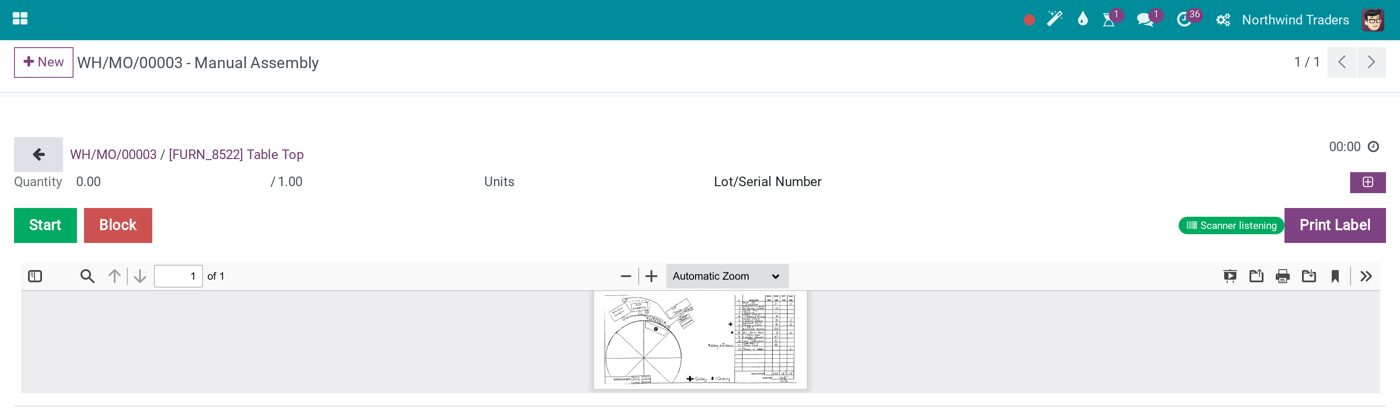
A shop-floor work order screen with the drawing, Start and Block buttons and barcode scanning, which cuts manual data entry.
Digitalize → See → Measure → Improve → Standardize → Automate
When does a business not yet need ERP for Kaizen?
ERP may not be a priority if the business is still very small, has simple processes, few departments and few transactions, if managers can directly observe all activities, and if the need for improvement lies mainly on the shop floor. In that case, simple tools can be more effective. Between ERP and Kaizen, Kaizen should not depend on technology; technology should only be used when it solves a real management problem.
When should a business consider ERP?
A business should consider ERP when it starts to see signs such as:
- data lives in too many files,
- the status of an order is hard to know,
- you have to ask several people to get information,
- figures between departments do not match,
- lead time cannot be measured,
- the causes of delays cannot be traced,
- deviations from standards are unknown,
- cost per order is hard to determine,
- dashboards have to be compiled by hand,
- or improvements are made but their effect cannot be measured.
These are not just signs that software is needed. They are signs that the business lacks a management data infrastructure.
Does Kaizen need ERP? A fuller answer
If the question is simply "Does Kaizen need ERP?", the answer is: not necessarily. But if the question is "Can an increasingly complex business sustain data-driven Kaizen without a unified management platform?", the story is completely different. ERP becomes important when the business needs to see across departments, measure across processes, trace back causes and sustain continuous improvement at scale.
Kaizen creates the need to improve. ERP creates the data foundation so that improvement can be seen, measured and sustained.
That is also the role Viindoo aims to play between ERP and Kaizen in the digital transformation of businesses.
Frequently asked questions about ERP and Kaizen
Does Kaizen require ERP?
No. Kaizen can be done through shop-floor observation, visual boards, checklists and simple tools. ERP becomes important as the scale and complexity of the business grow.
Does ERP automatically create Kaizen?
No. ERP provides data and an operating platform. People still have to identify problems, analyze causes and carry out improvements.
Does a small business need ERP to do Kaizen?
Not always. If processes are still simple and managers can directly observe all activities, simple tools can be more effective.
When is ERP truly useful for Kaizen?
When data is scattered, processes run across departments, and the business needs to measure lead time, bottlenecks, deviations and cost, or wants to sustain improvement at scale. That is when ERP and Kaizen truly need each other.
How does Viindoo support Kaizen?
Viindoo connects data across sales, BOM, purchasing, inventory, manufacturing, quality, delivery and accounting, helping the business see the flow of work and measure the results of improvements.
Next in the series: Why does digitalization sometimes add more steps?
This is one of the most common contradictions in ERP implementation. Businesses expect technology to reduce people, work and cost. Yet during implementation, users are asked to confirm statuses, enter more detailed BOMs, record output, enter defect causes and confirm times. So if Kaizen is about removing waste, why can digitalization add more steps? That will be the topic of the next article.
Related articles
- What Does Digitalization Help a Business "See" for Kaizen?
- Kaizen and Digitalization: How They Connect in Business Improvement
- Digital Transformation vs. ERP Implementation: What's the Difference?
- ERP, WMS, MES, IoT: Where Should Businesses Begin?
- A Guide to Implementing Kaizen in Manufacturing with Viindoo