Does ERP flexibility for SMEs really disappear once processes move into a system? Article 8 of the "From Data to Kaizen" series looks at how to balance standardization, flexibility and Kaizen.
ERP flexibility for SMEs: where does the worry come from?
One of the most common concerns when an SME rolls out ERP is:
"Small businesses live on flexibility. Will putting processes into a system make everything more rigid?"
It is a very practical question. Small and medium-sized enterprises usually win on speed, while ERP usually brings structure.
What SMEs are good at
Fast decisions, flexible handling of exceptions, quick process changes, few approval layers, and people who can talk to each other directly.
What ERP usually brings
Standard processes, clear statuses, access rights, required data, approval flows and controls.
On the surface, the two look contradictory. But the real issue is not whether standardization kills flexibility. The real issue is:
Which parts is the business standardizing, and which parts is it keeping flexible?
Standardization does not mean every case must look the same
A common misunderstanding is that standardization equals rigidity. In practice, standardization should only cover what needs to be done consistently, for example: how orders are confirmed, how a BoM is created, how materials are issued, how defects are recorded and how expenses are approved.
If everyone does these things their own way, the data becomes inconsistent, and the business finds it hard to train, control, measure and, above all, run Kaizen.
To improve, a business must know how the work is done today, how long it takes, where it deviates and whether a change is actually better.
Imagine order A goes through 4 steps, order B through 7, and order C skips 2 steps (illustrative example). It then becomes very hard to answer: which process is actually better? Without a standard, there is no baseline.
So standardization gives the business the best way of working for now, not a way of working that can never change. In Kaizen, the standard is the foundation for improvement:
Current standard
Spot the problem
Improve
New standard
It is a continuous loop, the same reason why, as the article Does Kaizen Need ERP? explains, improvement needs a shared, reliable record of how work is done.
SMEs need flexibility, but not everything needs the same flexibility
To keep ERP flexibility for SMEs without losing control, activities can be split into three groups:
1. Must be standardized
Steps that create risk if done differently: financial data, quality control, inventory, approvals, traceability, standard consumption. These need clear processes.
2. Flexible within a frame
Choosing suppliers, handling rush orders, production schedules, resource assignment. Users get several options, still inside a controlled structure.
3. Highly flexible
Sales handling a special customer, engineering designing a new product, dealing with unusual situations. Do not force these into a detailed workflow from day one.
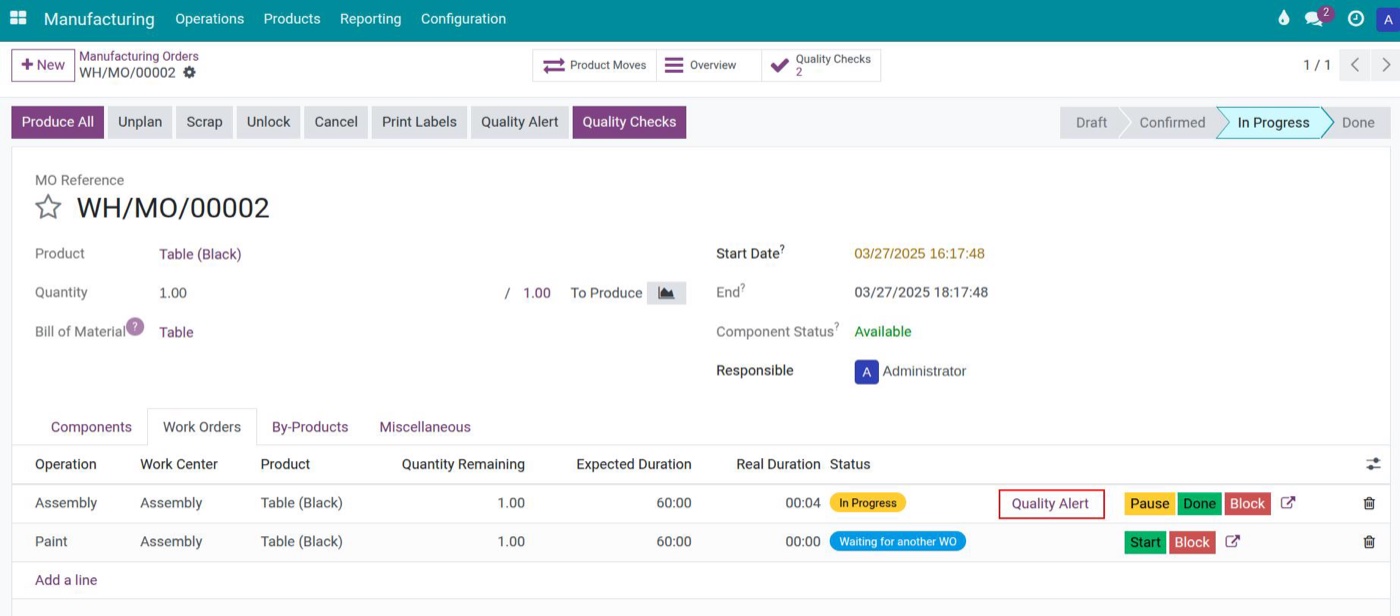
Quality control is a part that must be standardized: control points are set by product, product category or operation type. When a defect appears, a quality alert is created right on the work order instead of being handled outside the system.
Good ERP supports "controlled flexibility"
The goal of ERP is not to turn every job into one fixed straight line, but to let the business stay flexible within a frame it can track and control.
For example, a special order may need to skip an operation, use a different BoM, move an operation to another work center, jump the schedule or go through a special approval. What matters is that the exception is still recorded, so the business knows when it happened, why, who approved it and what the result was.
That is the difference between being flexible and being arbitrary.
Two ways of designing the system make this clearer:
Railway
Users have only one path. One wrong step and they cannot move on. This suits only extremely standardized processes.
Guardrail
Users have room to move, but there are still limits, warnings, approvals and minimum data. This keeps ERP flexibility for SMEs much better.
In practice, a guardrail design lets users change the supplier, change the schedule or create a dedicated BoM, while the business sets the rule that the reason and the person in charge must be stated. On key fields such as the quantity, status or responsible person, Viindoo keeps a history of who changed what and when.
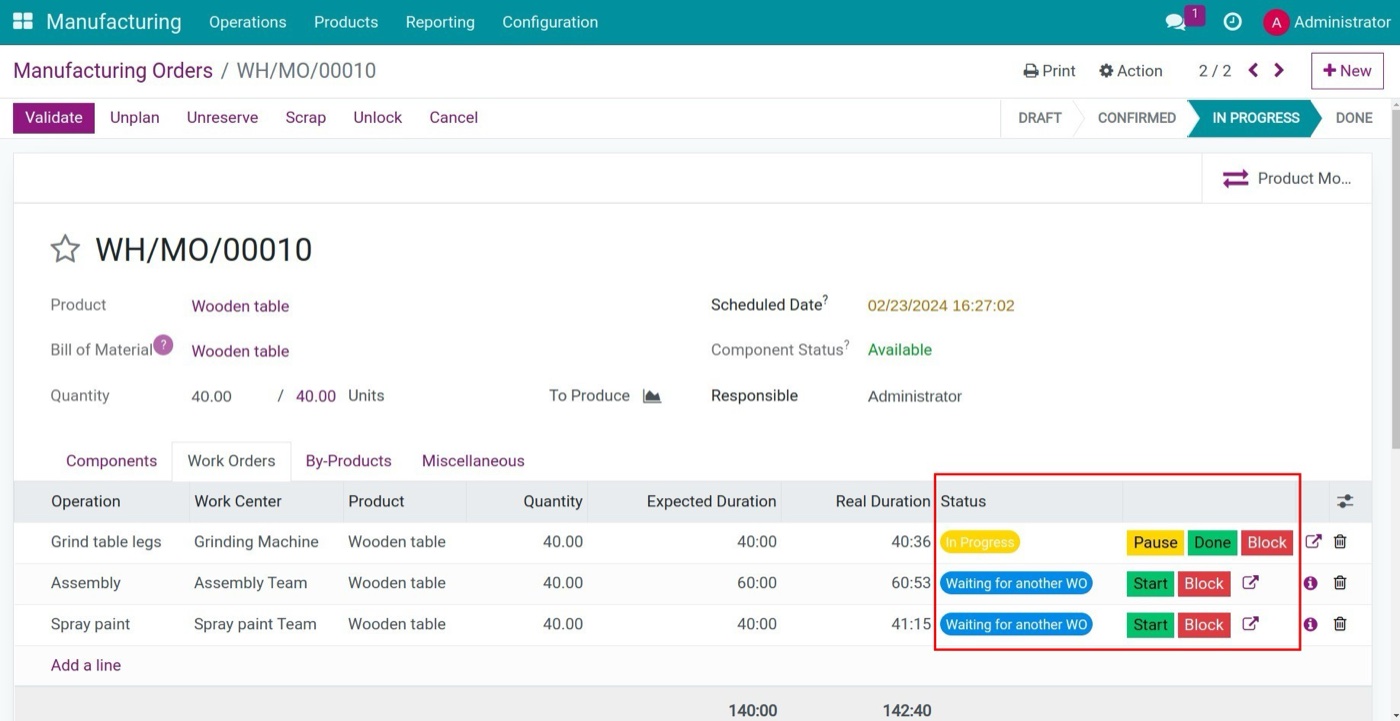
Each work order can be started, paused or blocked, with expected and real durations side by side. Blocking requires choosing a stop reason for the work center, so even an interruption leaves a trace.
Control the risk, not everything
More workflow is not always better. If the system demands too many approvals, statuses, confirmation steps and required fields, the business can lose its speed advantage. A process that used to take 30 minutes can turn into 2 days just waiting for approval (illustrative example).
That is a sign the ERP is protecting the process instead of serving the business.
Required data follows the same logic: as the articles on why digitalization sometimes adds tasks and the minimum management backbone show, every extra field has a cost. When that happens, it is time to run Kaizen on the ERP process itself. A simple question helps:
If we remove this control step, what is the risk?
If the risk is low, the step may not be needed. If the risk is high, keep it. For example (illustrative):
A VND 500,000 purchase
Probably does not need several approval layers.
A VND 500 million purchase
Needs control.
A minor BoM change
Engineering can take the initiative.
A BoM change affecting quality or safety
Needs approval.
The level of control should match the level of risk.
This is how ERP flexibility for SMEs is preserved without making the business heavy. In Viindoo, the OmniApproval app lets each request type have its own approvers and approval sequence, and each extra step can carry a condition, for example the value of the request, so small requests move fast and large ones get the scrutiny they deserve.
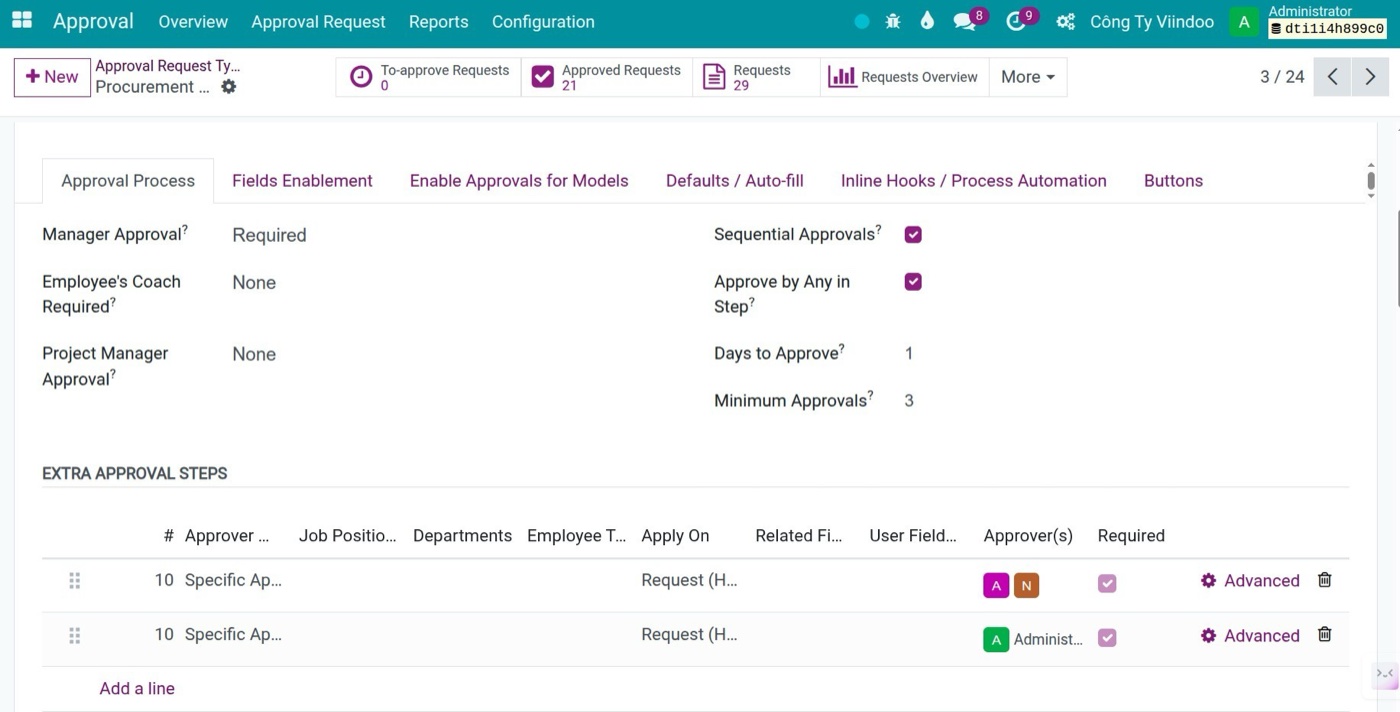
An approval type defines manager approval, sequential approval, the minimum number of approvals and extra approval steps, each with its own approvers.
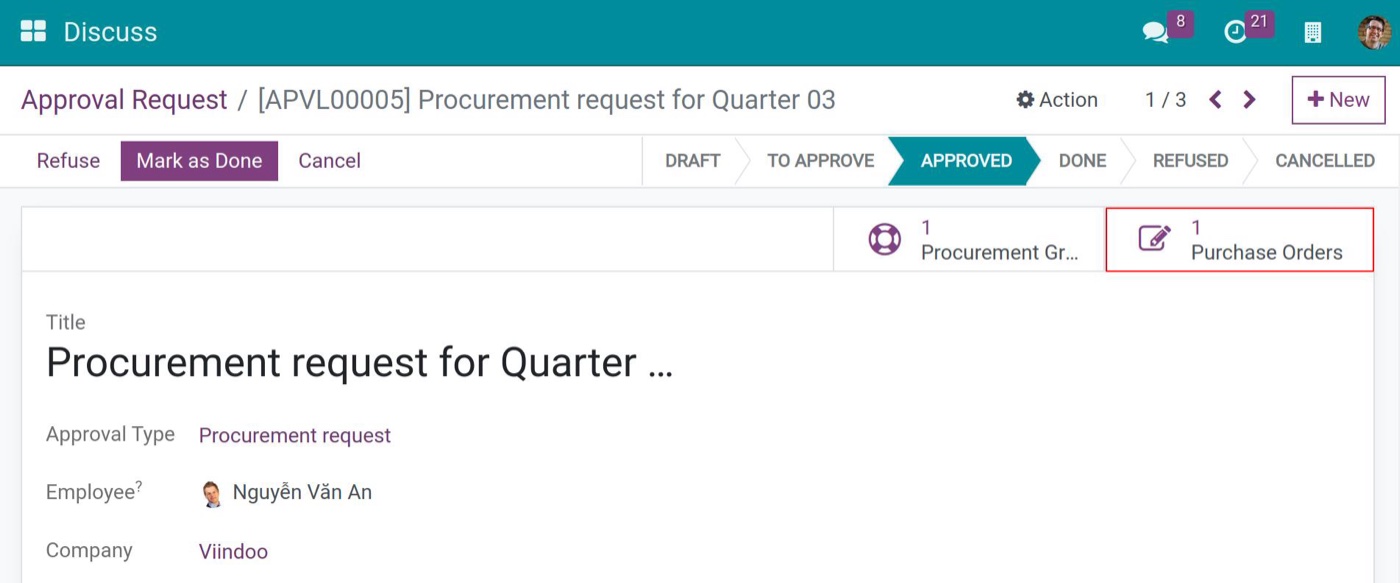
Once a procurement request is approved, Viindoo launches procurement and creates draft purchase orders according to the product's purchase rules, so the approval and the purchase stay linked.

Each purchase order keeps the approval request as its source document, so anyone can trace a purchase back to the person who asked for it and the people who approved it.
Example from a mechanical workshop: a rush order
Suppose a customer asks for delivery within 3 days (illustrative example). The standard flow is:
Sales Order
BoM
Purchase materials
Production
QC
Delivery
But the rush order may need to use substitute materials on the manufacturing order, move an operation to a free machine, subcontract the job and shorten the approval path.
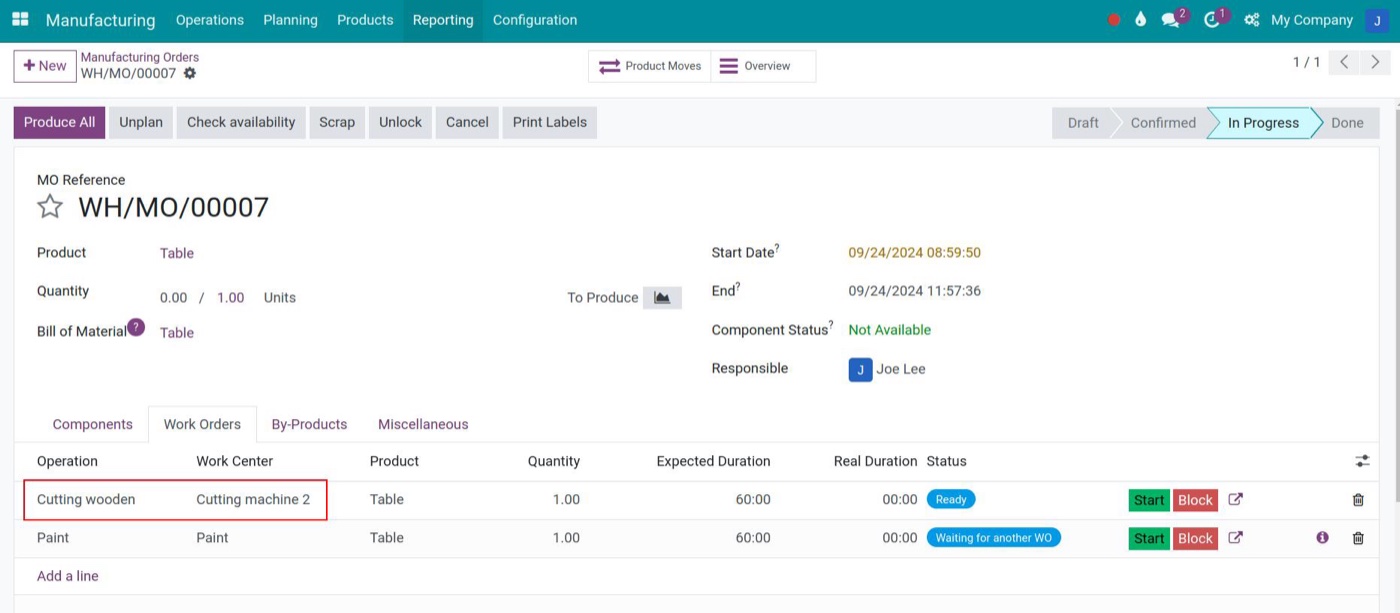
When alternative work centers are declared, planning can place an operation on a free alternative machine (here Cutting machine 1) instead of waiting for the main one.
If the ERP is too rigid
The business may not be able to handle the order at all.
If the ERP is too loose
Nobody knows who decided, which materials were used, how much extra it cost or how quality was affected.
The right answer: allow the exception, but record the exception.
When the change touches the BoM itself, the Product Lifecycle app records it as an engineering change order (ECO): which components are updated or removed, which operations change, who is in charge and when the change takes effect.
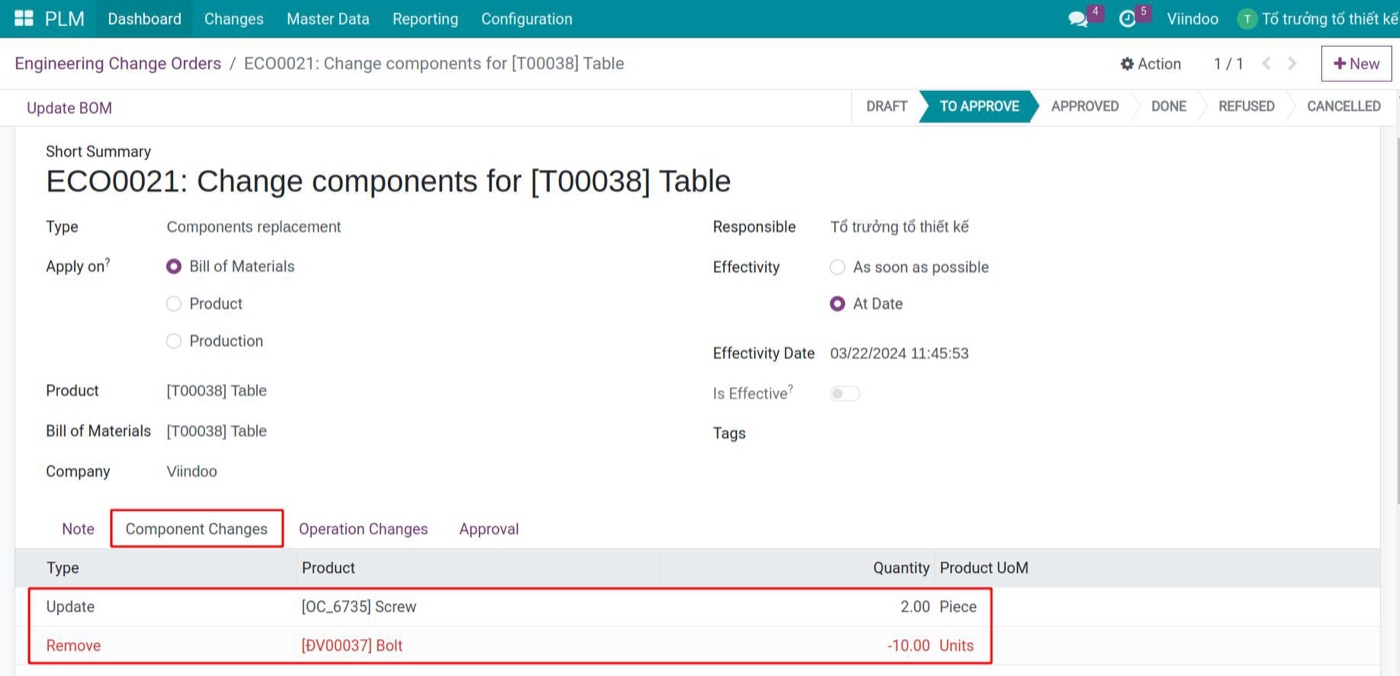
The ECO lists each component change (update or remove, with quantities) and waits in the To Approve stage. With approval enabled, the change is applied to the BoM only after it is approved.
Kaizen makes ERP more flexible over time
ERP should not be treated as a fixed system after go-live. Once it is running, the business will see which steps are redundant, which approvals take too long, which data is never used and which cases keep turning into exceptions. That is exactly the input for Kaizen.
For example, if 70% of orders have to "ask for an exception" at the same step (illustrative example), the chances are that the standard process is wrong. Rather than making users keep working around the process, update the standard.
Updating the standard does not mean overwriting it blindly. In an ECO, engineering edits a new version of the BoM, and the current version stays in use until the change is applied.
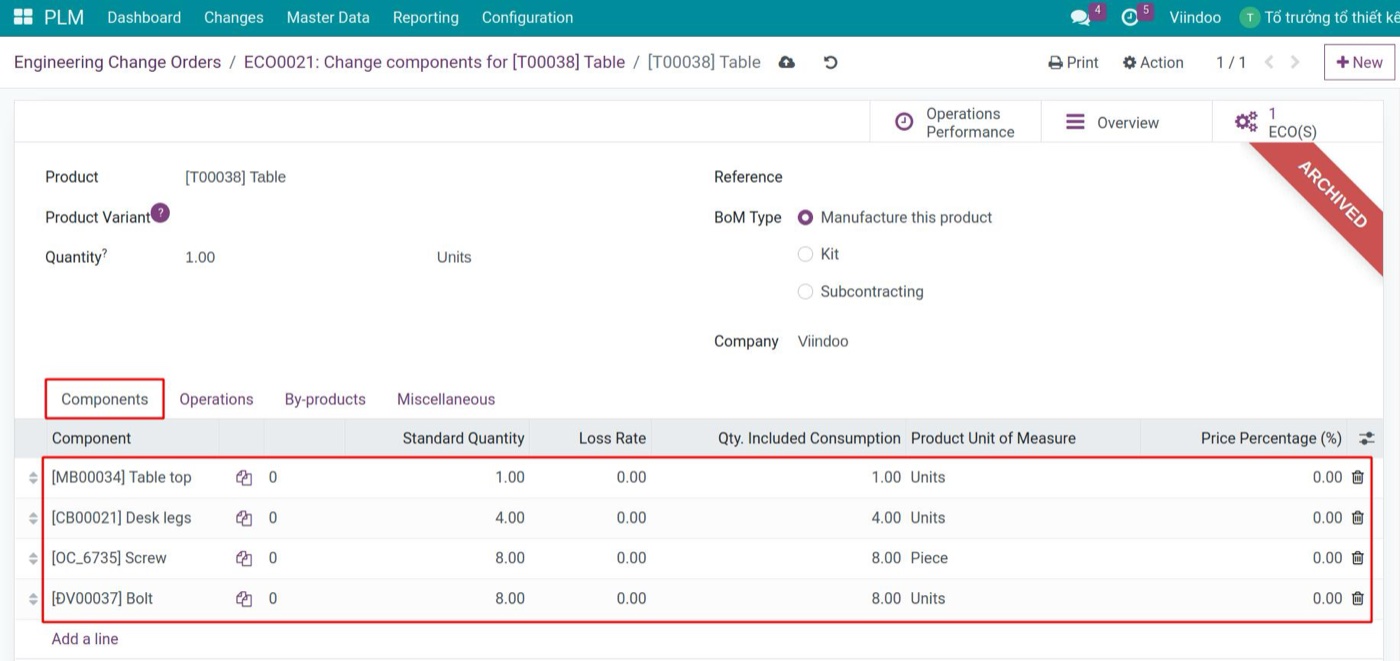
Components, quantities and operations are edited on the new BoM version linked to the ECO, not on the BoM that production is using today.
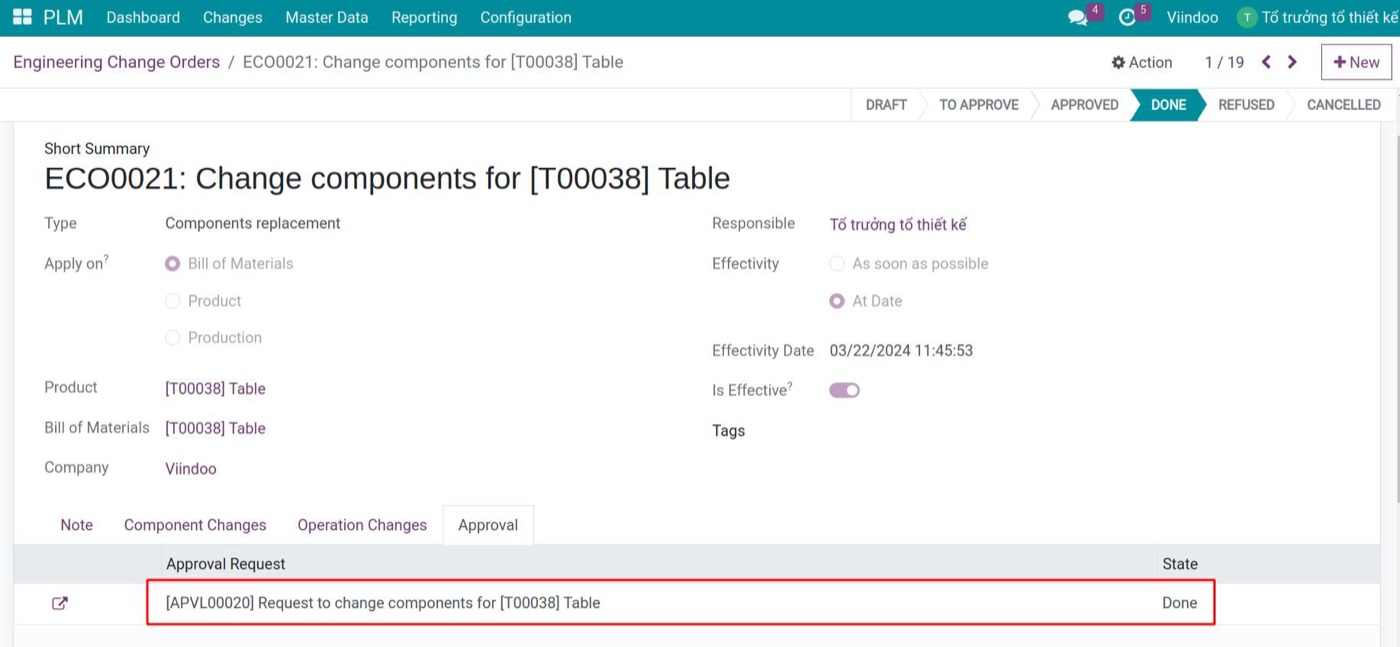
A completed ECO keeps its approval request, status and effective date: the new standard is updated with a clear trace of who approved it and from when it applies.
Good standardization makes SMEs more flexible, not slower
It sounds paradoxical, but once the basics are standardized, with clear data, clear responsibilities and clear statuses, the business handles exceptions faster. In other words, standardizing the right things actually increases ERP flexibility for SMEs.
Accurate inventory
You know immediately whether the materials are there, what needs to be bought and whether you can accept a rush order.
A standard BoM
Engineering only needs to adjust the special part.
Standard operations
Only the exceptional operation needs to change.
Standardizing the foundation makes the business more flexible where it is different.
How far to standardize is a question of detail, which the article on the level of data detail covers for the Sales Order, BoM and production.
Digitalize the main flow first, exceptions later
A practical frame for SMEs is 80% standard process + 20% controlled exceptions. It is not a fixed ratio, just an easy way to think.
The 80%
Repeated often, easy to standardize, needs control.
The 20%
Special customers, new products, rush orders, unusual situations.
ERP should support both. A common mistake is trying to build a system that handles every special case from day one. The project becomes complex, drags on, needs heavy customization and is hard to maintain. A more practical path:
Standardize the main flow
Go live
Record exceptions
See which repeat
Digitalize the ones that matter
When should an exception become the standard?
An exception deserves to be standardized when it happens often, affects many orders, creates a lot of manual work or carries high risk.
For example, make-to-order (MTO) orders start at 10% and are handled manually; some time later they reach 60% (illustrative example). At that point MTO is no longer an exception and has to become a standard process, for instance by setting the MTO route on the products concerned.
How Viindoo supports controlled flexibility
In an integrated platform, flexibility and control are configured rather than coded one case at a time:
Routes and BoMs
Buy, manufacture and MTO routes; several BoMs per product; change the BoM or add and remove operations on a single manufacturing order.
Multi-step approvals
OmniApproval: each request type has its own approvers and sequence, and steps can carry conditions.
Controlled BoM changes
Product Lifecycle: engineering change orders, BoM versions and effective dates.
Warnings and rules
Warning messages when selecting certain customers, vendors or products, plus Automation Rules for conditional actions.
Rights and activities
User groups and access rules, and scheduled activities to assign manual follow-up work when needed.
A trace of changes
Change history on key fields and a required stop reason when a work center is blocked.
More importantly, the data stays in one system. This keeps ERP flexibility for SMEs without losing traceability.
Signs that your ERP is too rigid or too loose
Too rigid
Users often work outside the system, many steps exist only to get around the workflow, approvals take longer than the value they create, exceptions are everywhere, people go back to Excel or chat apps. The process does not fit reality.
Too loose
Anyone can edit data, statuses are unclear, nobody knows who is responsible, data is not enough to trace, everyone uses the system differently. The business has software but not yet management.
A practical way to find the balance
Define the standard flow
Pick the most common way of working.
Define the must-haves
Required data, control points, approval rights.
Define the flexible zone
Change route, change schedule, choose another option.
Record exceptions
Do not ban exceptions, but make them visible.
Run Kaizen regularly
Which exceptions repeat, which steps are no longer needed, which standards must change.
Conclusion: SMEs do not have to choose between standardization and flexibility
So, does ERP flexibility for SMEs disappear? It can, if the ERP is designed too rigidly. But implemented well, ERP standardizes the repetitive work so the business can save its flexibility for the places that truly need it.
Kaizen is the mechanism that keeps the standard from turning rigid: today's standard can be improved into a better standard tomorrow.
Standardization is not the opposite of flexibility. Good standardization is the foundation for controlled flexibility.
That is also how Viindoo should be implemented for SMEs: standardize the main flow, allow controlled exceptions, measure, run Kaizen and update the standard.
Frequently asked questions about ERP flexibility for SMEs
It can, if processes are designed with too many steps, approvals or required fields. ERP should be configured to match the level of risk and how the business actually operates.
No. The standard is the baseline for measuring improvement. After Kaizen, a better standard replaces the old one.
No. Digitalize the main flow first, then track exceptions and only standardize those that happen often or carry high risk.
Design several options inside a controlled frame, allow exceptions but record the reason, the person responsible and the result, and review the rules regularly.
Standardize the core transactions, keep a flexible zone for special situations and keep improving the process with Kaizen based on real data.
Next in the series: Should automation come before or after standardization?
Once a business has processes and data, another question appears: should it automate right away to cut headcount and tasks, or standardize first and automate later? The next article explains why automating a process that is not yet good may only make waste run faster.