Stock Quality Control
| Lines of Code | 1343 |
| Technical name | to_quality_stock |
| License | OPL-1 |
| Website | https://viindoo.com/apps/modules/19.0/to_quality_stock |
| Read description for | v 12.0 v 13.0 v 14.0 v 15.0 v 16.0 v 17.0 v 18.0 |
| Required Apps | Discuss (mail) Inventory (stock) |
| Included Dependencies | Quality |
| Extensions | Manufacturing Quality Control Stock Quality & Multi Warehouse Access Control |

Goods move on only after their quality checks are done
For warehouses and quality teams that inspect what they receive, ship or move
Create quality checks on transfers and block validation of unchecked or held goods.
Odoo Community Edition · Viindoo Cloud · License OPL-1 · English, Vietnamese
Extends Quality: its control points, checks, decisions and alerts work on every transfer.
What changes for your team
The right checks on the right transfers
Someone at the dock has to remember which goods need inspecting, and a delivery slips through.
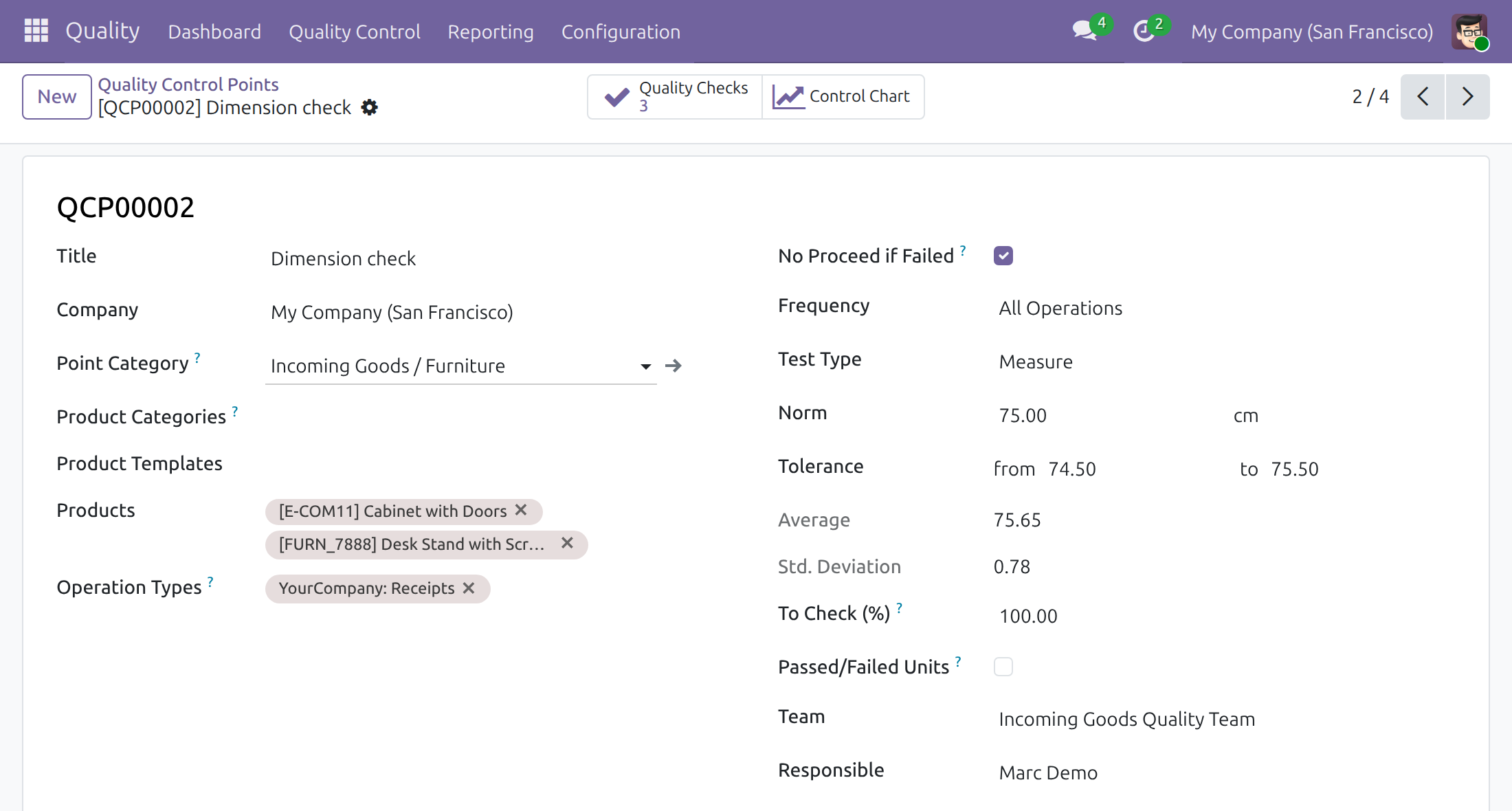
→ Each control point names the operation types it inspects. When a receipt, delivery or internal transfer is confirmed, its checks are created: one per control point and product.
Results recorded from the transfer
Inspection results go on paper or into a separate form, and are typed in later, if at all.
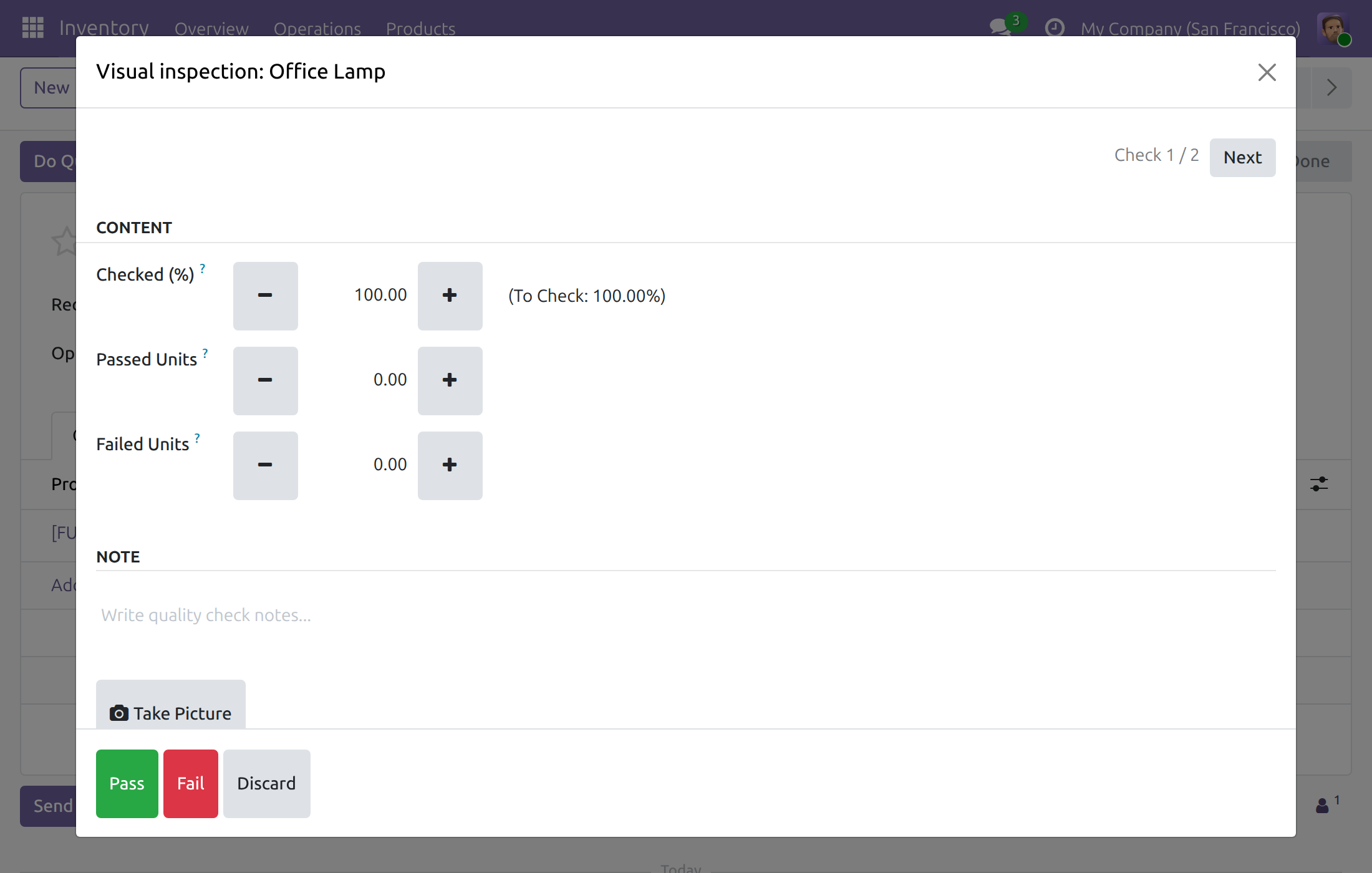
→ Do Quality Checks opens the checks still to do in a touch dialog, one after the other. Any warehouse operator records them with the Inventory access right alone.
Failed goods stay where they are
A lot is put away or shipped before anyone knows it failed inspection.
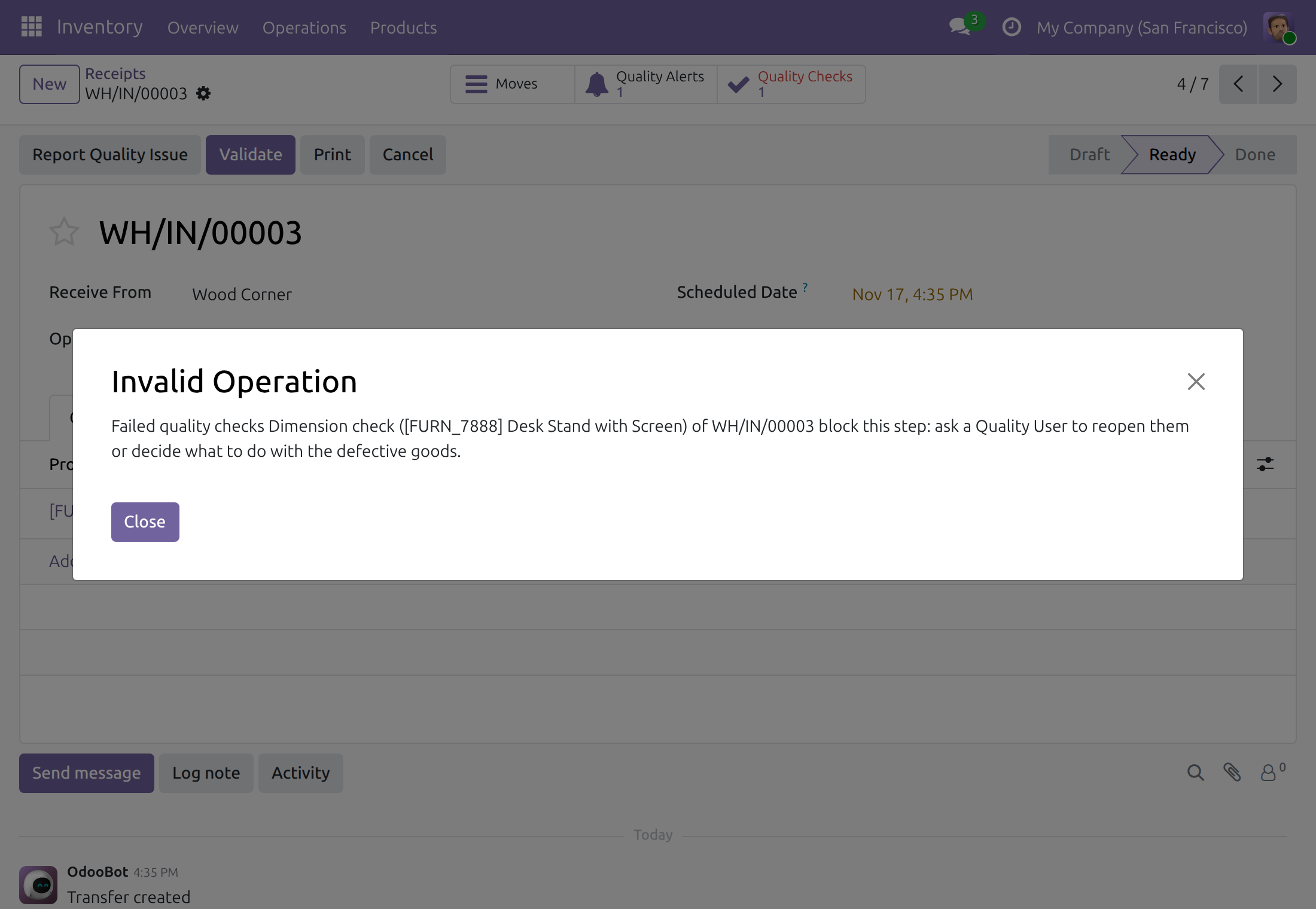
→ Validation is refused while a check of the goods is still to do, or a check of a No Proceed if Failed point has failed. The message names each check; only a Quality User's decision releases the goods.
Features
Plan where to inspect
- ✓ Choose receipts, deliveries or internal transfers on each control point
- ✓ Template lines pass their operation types to the control points they create
- ✓ Mark the control points whose failed check holds the goods
Inspect on the transfer
- ✓ Checks created on confirmation, also for lines added later
- ✓ Do Quality Checks opens the checks to do in a touch dialog
- ✓ The Quality Checks button turns red while a failed check holds goods
- ✓ Report Quality Issue fills the alert with product, lot and transfer
Hold goods that are not cleared
- ✓ Validation looks only at the goods being processed
- ✓ One message names every check that holds the goods
- ✓ Checks follow goods to backorders, splits and waves with their result
- ✓ Results freeze once a transfer is done or cancelled
Follow up as a quality team
- ✓ Ready to Validate: transfers whose checks are judged and hold no goods
- ✓ Done Transfers gathers finished transfers for review
- ✓ Checks searched and grouped by transfer, operation type and lot
- ✓ Alerts and corrective actions carry their transfer and lot
Built for daily use
- ✓ Warehouse staff record results but cannot create or delete checks
- ✓ Deleting a judged check leaves a note on its transfer
- ✓ Each company's transfers use that company's control points
Ready on day one
Your transfers, unchanged
Receipts, deliveries and internal transfers keep their usual flow; checks appear only where a control point matches the products and the operation type.
What you set up first
The operation types of each control point, the points that hold failed goods, and each person's access right; the Documentation tab covers each step.
Extend it
Manufacturing Quality Control
Checks on finished products and components when a manufacturing order is confirmed, and work orders held until they are recorded.
Stock Quality & Multi Warehouse Access Control
Running several warehouses? Each warehouse team sees the checks and alerts of its own warehouses' transfers only.
Before you decide
Do warehouse staff need a Quality access right?
No. With the Inventory access right they record the results of the checks of any transfer and read its alerts; they cannot create or delete checks. Once a transfer is done or cancelled, only a Quality User revises its results.
Who can release goods held by a failed check?
Only a Quality User. Accept with Conditions releases the goods, Reject keeps them held, and Reopen sends the check back for a new inspection.
What happens with partial receipts?
Goods that leave for a backorder take their checks with them, result and decision included: passed goods are not checked again and rejected goods stay held. Checks still to do of a cancelled or deleted line are dropped.
Does it run on Odoo Enterprise?
No. It is supported on Odoo Community Edition and Viindoo Cloud.
What does it take to install and run?
Inventory and Quality, installed with it if missing; no extra Python package or server program. Results stay in your own database; the module calls no outside service.
Try it, then ask us
Read the Documentation tab above, then try the live demo: v19demo-int.viindoo.com
Pre-sales & partnership
viindoo.com/contactusTechnical support
viindoo.com/ticketStock Quality Control
Note
Extends Quality - see its documentation. It explains the control points, the check types, the decisions about a failed check and the quality alerts that this guide builds on.
This guide is for the people who run inspections on goods that enter, leave or move inside the warehouse: the quality administrator who decides what is inspected, the warehouse operators who record the results from the transfer itself, and the quality users who decide what happens to goods held by a failed check.
Overview
Stock Quality Control puts the quality checks on the transfer. As soon as a receipt, a delivery or an internal transfer is confirmed, the checks its products require are created and stay with the goods they judge. The warehouse operator records the results without leaving the transfer, and the transfer cannot be validated while a check of the goods being processed is still to do, or while a check that holds the goods has failed.
The process runs in these stages:
- The Quality Administrator chooses, on each control point, the operation types it inspects, and whether a failed check keeps the goods out of stock.
- The Warehouse operator confirms the transfer (Mark as Todo) and finds its checks.
- The Warehouse operator records Pass or Fail for each check, then validates the transfer.
- When a check that holds the goods fails, the Quality User decides: accept the goods with conditions, reject them, reopen the check for a new inspection, or waive a check that does not need inspecting. The operator validates the transfer once nothing holds the goods.
- The Quality User follows the transfers that are ready to validate and the transfers that are done, and raises quality alerts.
| Role | What they do | Access right to assign |
|---|---|---|
| Quality Administrator | Chooses which products are inspected on which operation types, and which control points hold the goods when they fail. | Quality: Administrator |
| Quality User | Decides about failed and waived checks, follows the transfers that are ready to validate, raises quality alerts. | Quality: User |
| Warehouse operator | Receives, delivers and moves goods, records the results of the checks of any transfer and validates the transfer. | Inventory: User (no Quality access right needed) |
Setup (for the Administrator)
Install the app
- Open Apps.
- Search for Stock Quality Control.
- Click Install. The Inventory and Quality apps it needs are installed with it.
After the installation the Quality Control menu of the Quality app gains a Stock Operations section for Quality Users.
Give people their access right
- Open Settings ‣ Users & Companies ‣ Users and open the user.
- On the Access Rights tab, choose User in the Inventory line for a warehouse operator.
- For a Quality User, also choose User in the Quality line. For a Quality Administrator, choose Administrator in the Quality line.
- Click Save.
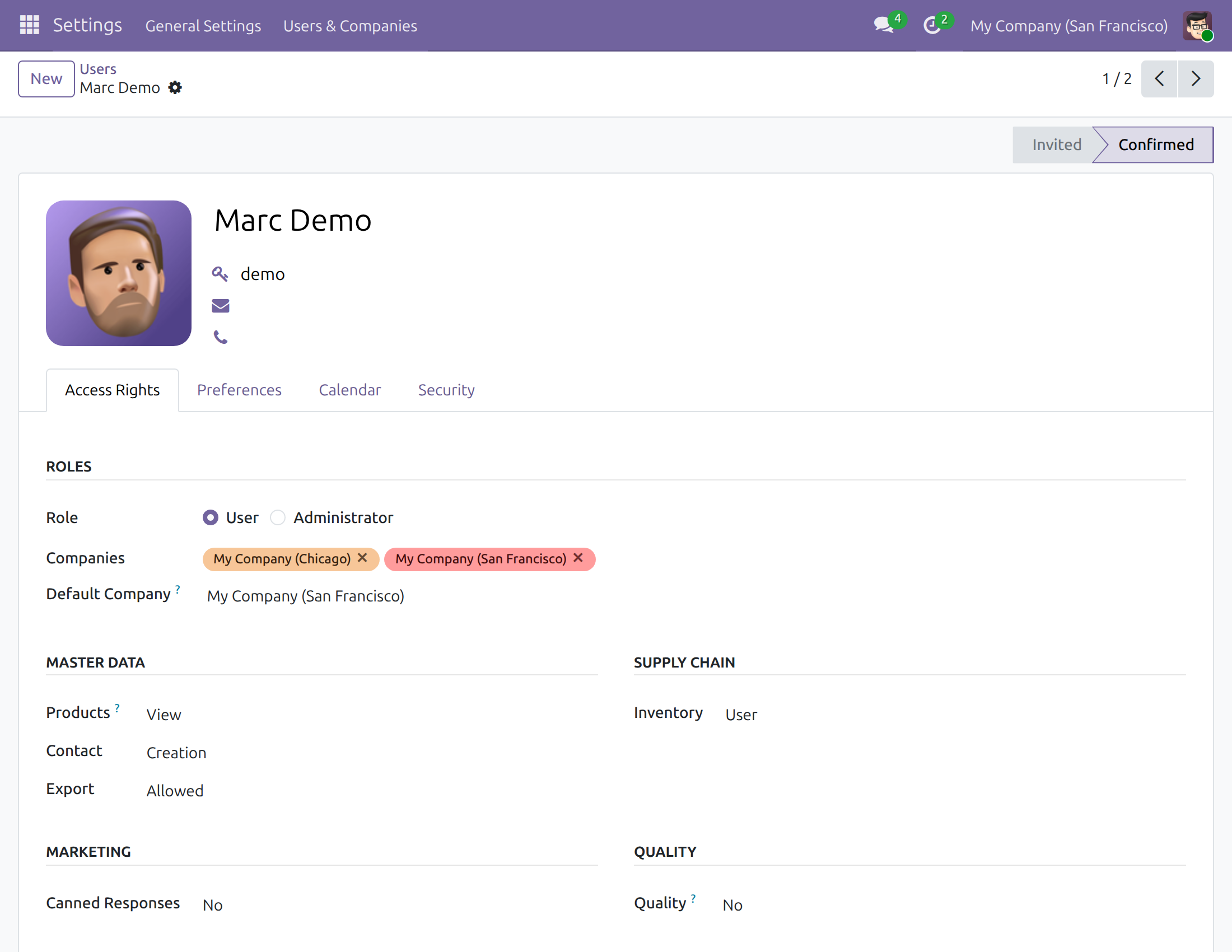
A warehouse operator needs no Quality access right: they read and record the results of the checks of every transfer, but they cannot create or delete a check. In the Quality app they see only Quality Control ‣ Quality Checks.
A Quality User who holds no Inventory access right reads transfers through the Quality role only. Such a user opens transfers from Quality ‣ Quality Control ‣ Stock Operations, sees them read-only and cannot validate them. See "Follow the transfers whose checks are judged" below.
To follow goods by lot or serial number, turn on Lots & Serial Numbers in the Inventory settings (Inventory ‣ Configuration ‣ Settings). The Lot/Serial Number field then appears on checks, quality alerts and corrective and preventive actions of a product that is tracked by lot or serial number.
Quality Administrator: choose what is inspected on which operations
A control point tells the system which products to inspect and on which operation types. The Quality guide explains the other fields of a control point, such as the test type, the frequency, the team and the responsible inspector. This app adds two things to the control point: Operation Types and No Proceed if Failed.
Choose the operation types of a control point
- Open Quality ‣ Quality Control ‣ Control Points and open a control point, or click New.
- In Product Templates, Products or Product Categories, choose what is inspected.
- In Operation Types, choose the operation types whose transfers get the check, for example YourCompany: Receipts. Add deliveries or internal transfers the same way if they must be inspected too.
- Tick No Proceed if Failed when goods whose check failed must stay out of stock until a Quality User decides. The option appears as soon as an operation type is chosen.
- Click Save.
The list of control points shows the Operation Types of each point in a column of its own.
Note
A control point without an operation type is never applied to a transfer. A control point created after a transfer was confirmed adds no check to that transfer. A control point of another company is never applied to the transfers of this company.
What happens when a transfer is confirmed
When a transfer is confirmed, the system creates one check for each control point and product that match the product and the operation type of the transfer. The same check is never created twice on one transfer. A Randomly control point is drawn once per transfer. A Periodically control point gives one check per period, even to transfers that are confirmed together. A scrap taken out of a transfer gets no check.
A line added to a confirmed transfer, or a line whose product is changed, gets its checks too. The checks still to do of goods that the transfer stops moving are deleted, which is what happens when a line is deleted or cancelled. Checks that already have a result stay.
Choose the operation types of a template
The lines of a quality point template have the same Operation Types field, and the same No Proceed if Failed option once an operation type is chosen. The control points created from the template take them over.
- Open Quality ‣ Quality Control ‣ Quality Point Template and open a template.
- On the List Quality Point Template tab, open a line, or click Add a line.
- In Operation Types, choose the operation types, and tick No Proceed if Failed if the control points must hold the goods.
- Click Save.
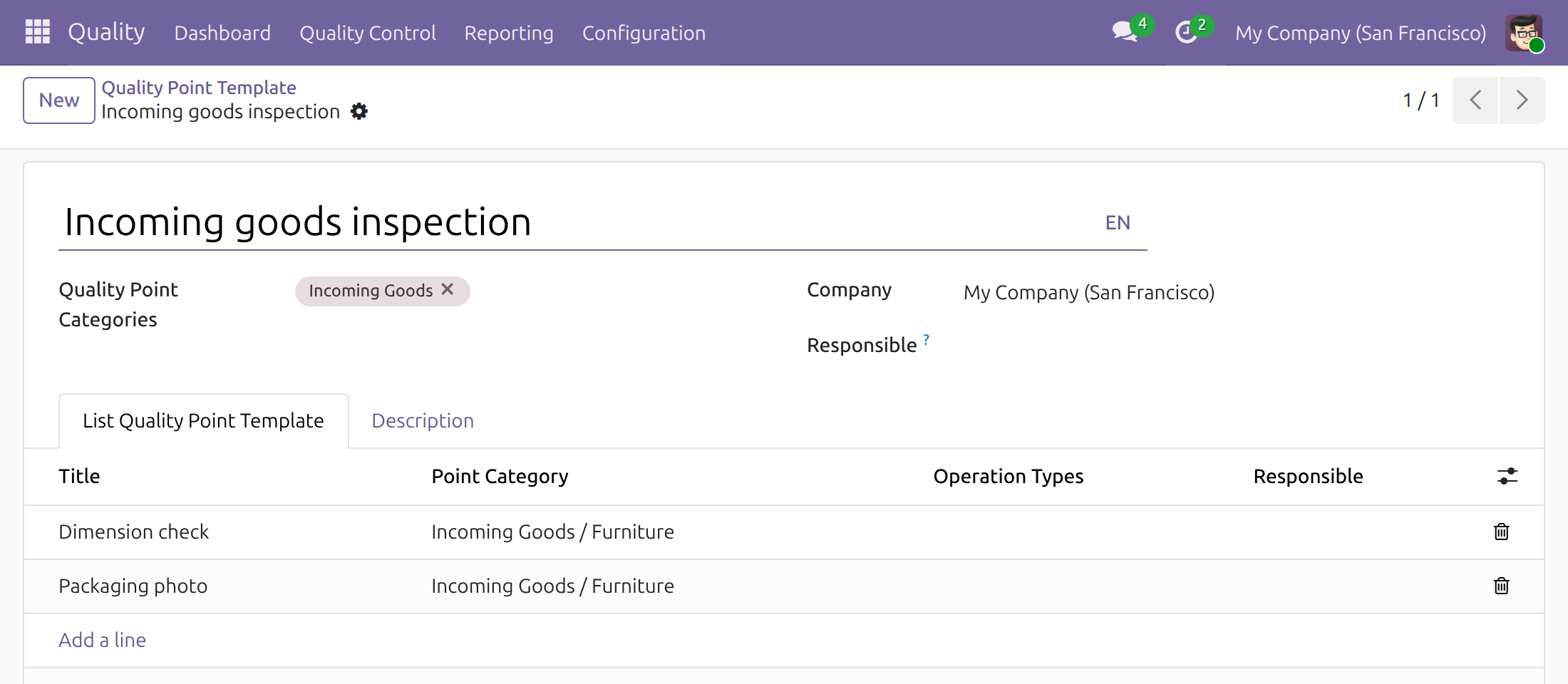
The Quality guide explains how to apply a template to a product.
Warehouse operator: receive goods and record the checks
Mark a transfer to do and find its checks
- Open Inventory ‣ Operations ‣ Receipts and click New.
- In Receive From, choose the supplier. Click Add a Product, choose the product (for example Office Lamp) and type the Demand.
- Click Save. The receipt is a draft and has no quality check yet.
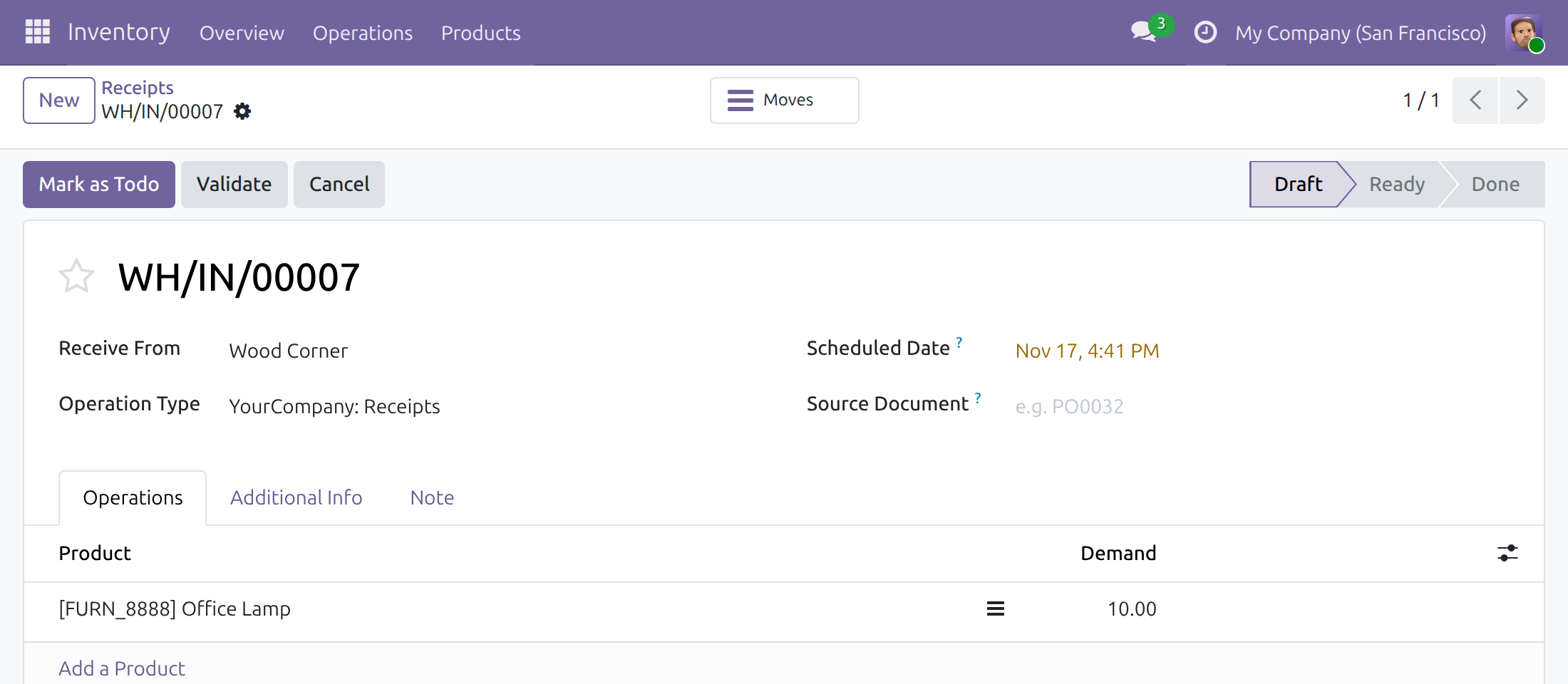
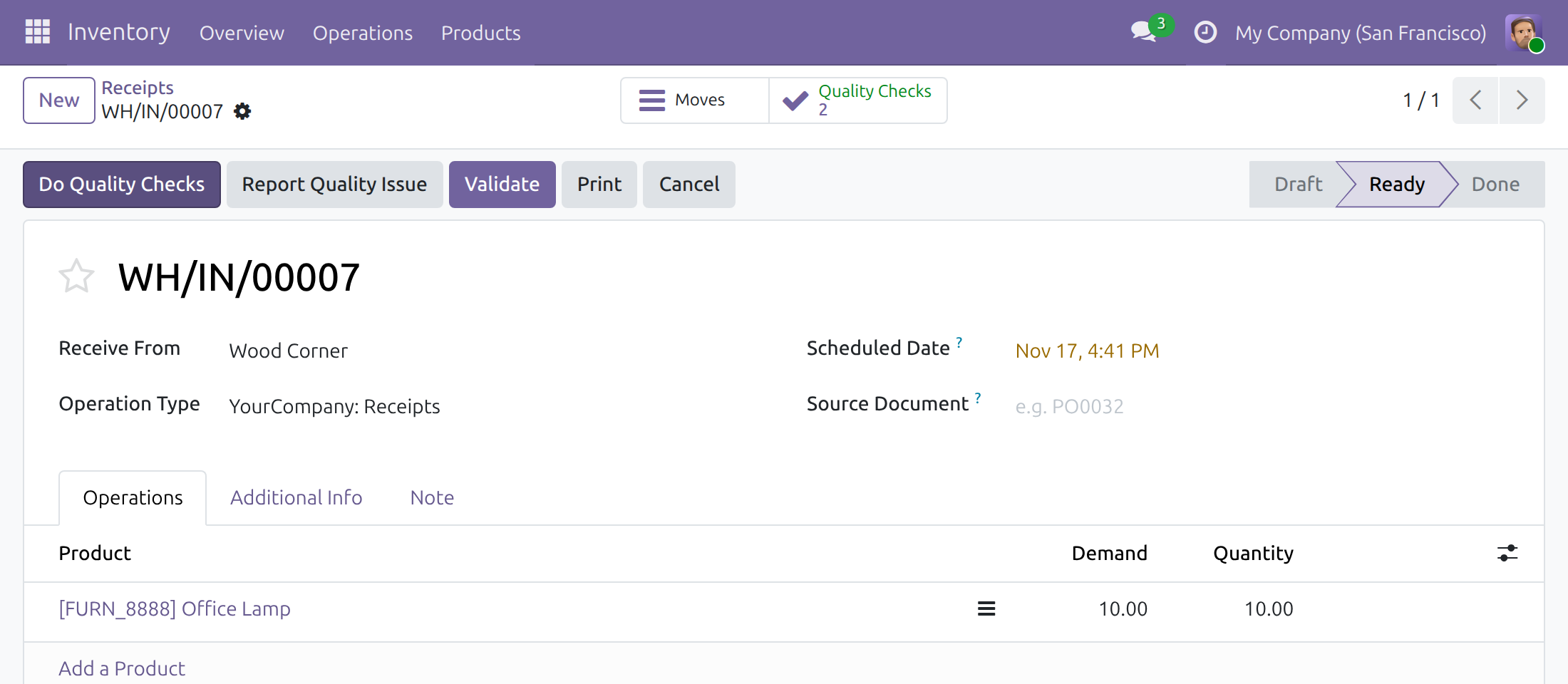
Click Mark as Todo. The receipt becomes Ready and the quality controls appear on it:
- The Quality Checks button at the top of the form shows the number of checks. Its text is green while no check has failed, and red once a check has failed and not been accepted with conditions.
- The Do Quality Checks button, highlighted, opens the checks still to do. It disappears when no check is left to do, and on a transfer that is done or cancelled.
- The Report Quality Issue button raises a quality alert.
Record the results one after the other
- On the transfer, click Do Quality Checks. A dialog opens with the control point and the product in its title, for example Visual inspection: Office Lamp, and the position of the check, for example Check 1 / 2.
- Inspect the goods and click Pass when they are good or Fail when they are not. Use Take Picture to attach a photo and Note to write what you saw.
- The dialog moves to the next check after each result. Next moves on to the next check, and Discard closes the dialog.
A check of another test type, such as a measure or a scorecard, offers the controls of its type in the same dialog. The Quality guide explains them.
You can also work from the checks themselves:
- Click the Quality Checks button of the transfer. When the transfer has one check, it opens directly. With several, you first see their list.
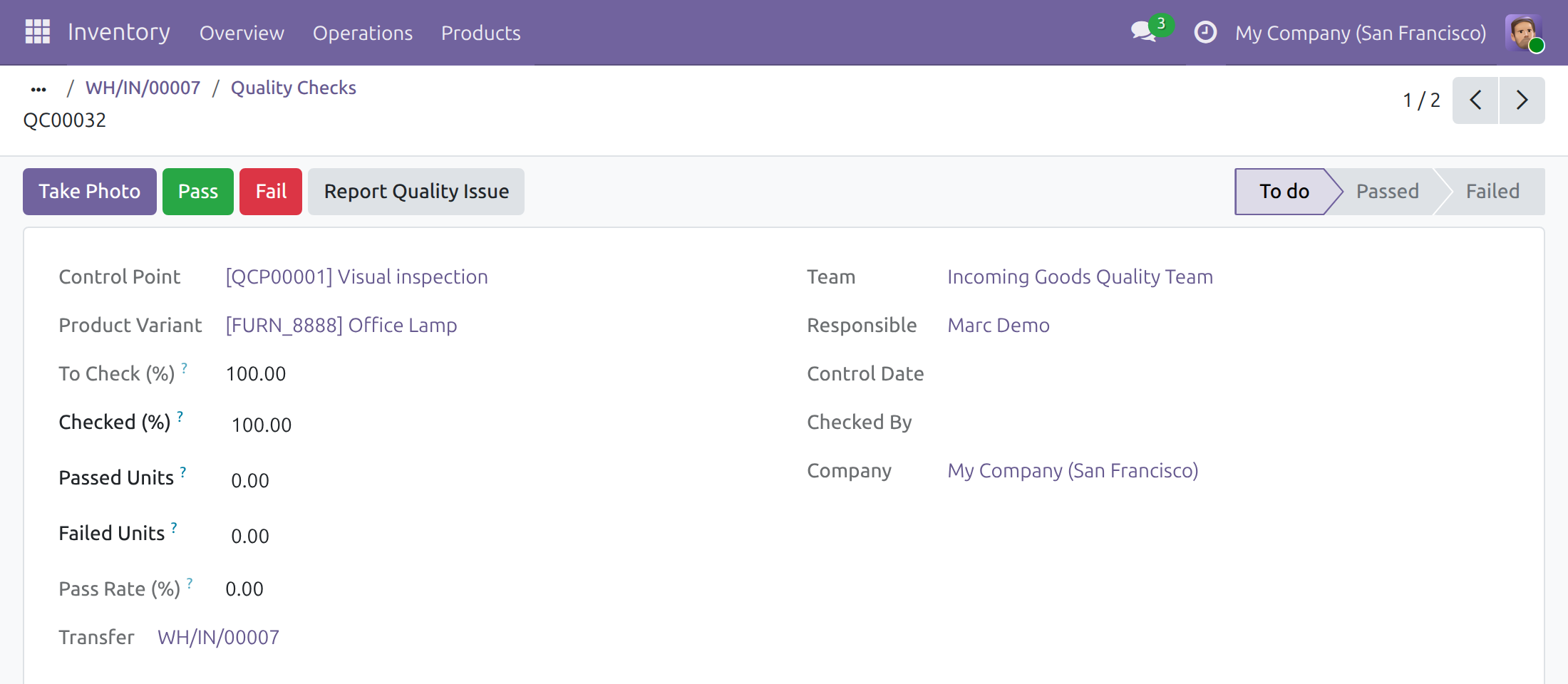
- Open a check. The status bar shows To do.
- Click Pass or Fail.
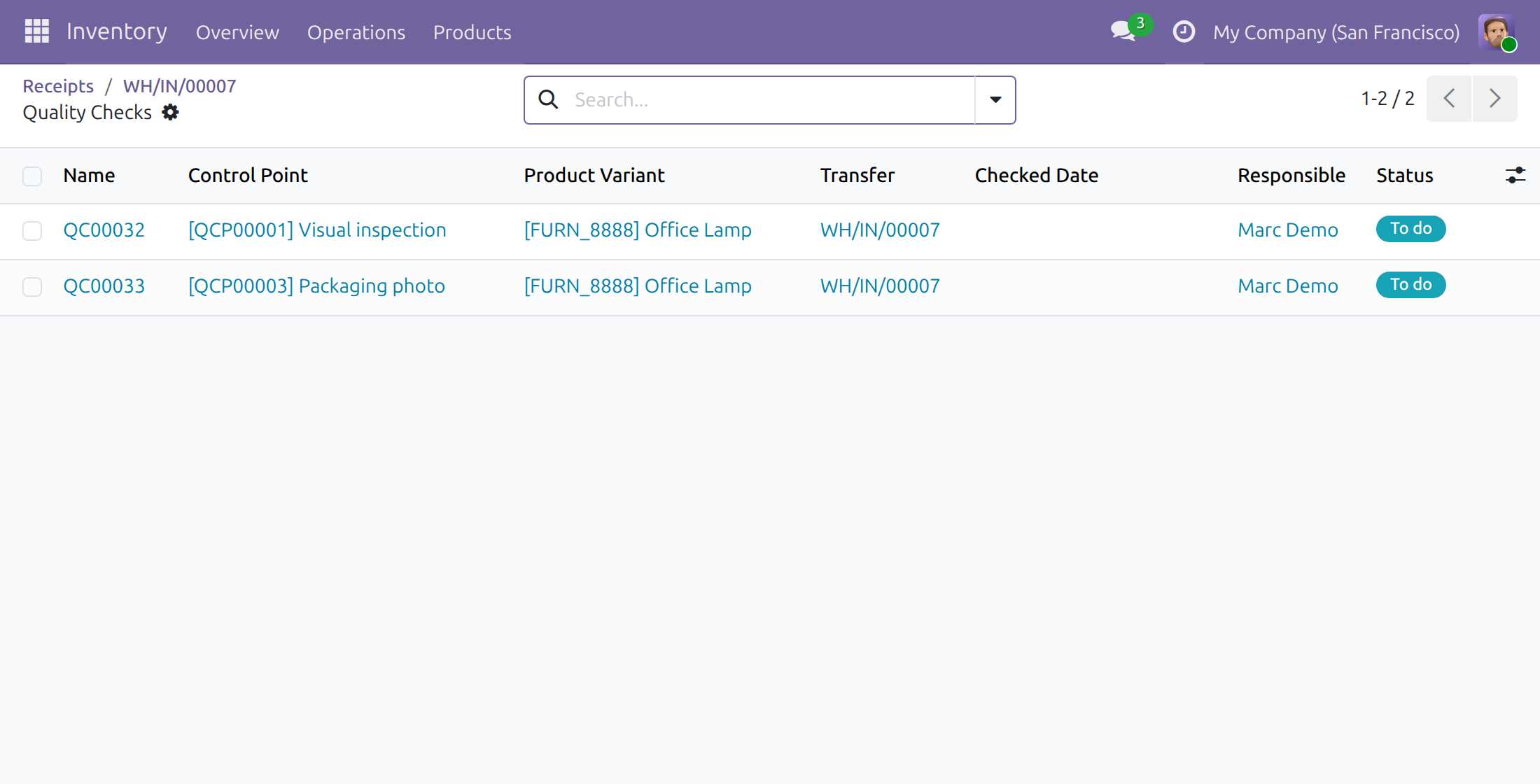
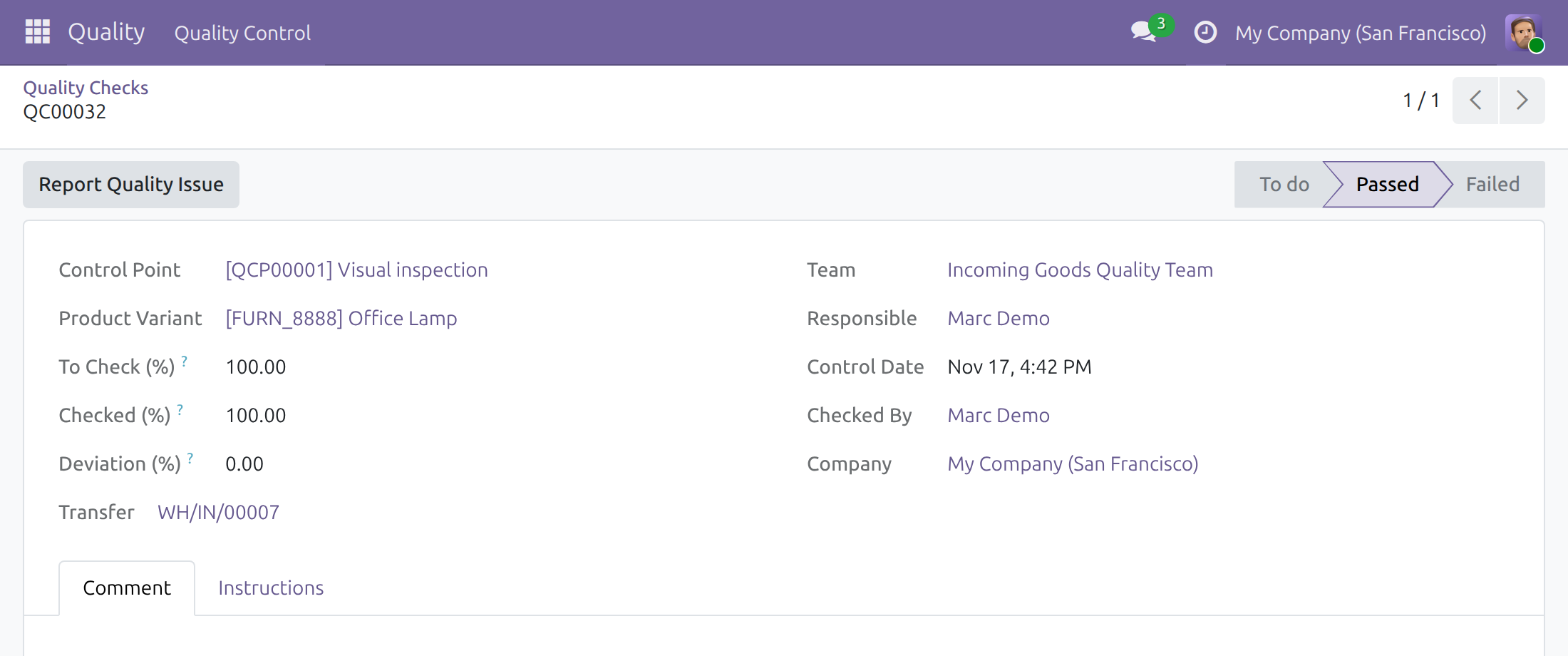
After Pass, the status bar shows Passed, and Checked By and Control Date show who recorded the result and when. You can correct a Passed check with Reopen while the transfer is not done or cancelled.
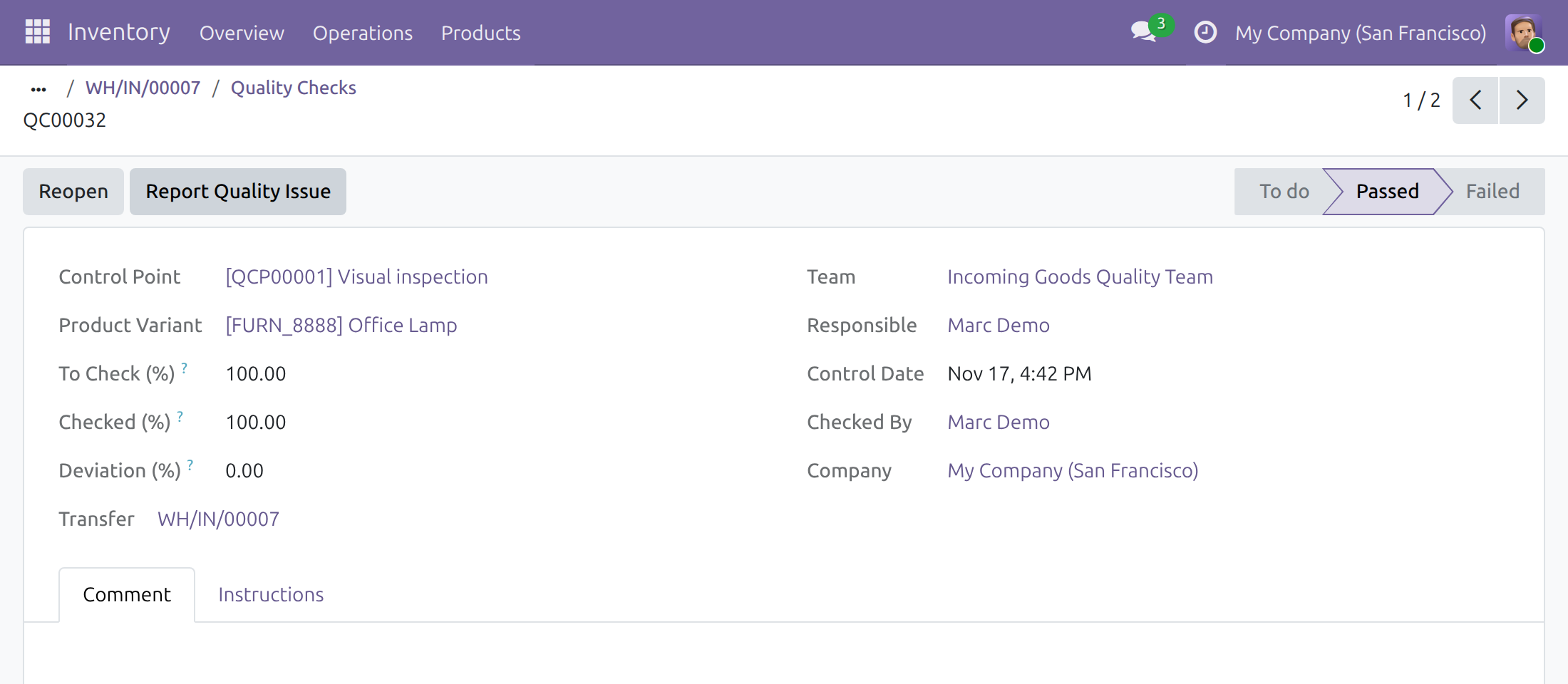
Any warehouse operator records the results of the checks of a transfer, whoever the control point names as Responsible.
When the transfer cannot be validated yet
A check still to do. If you click Validate while a check of the goods you process is still to do, the system refuses and names every check that holds the goods:
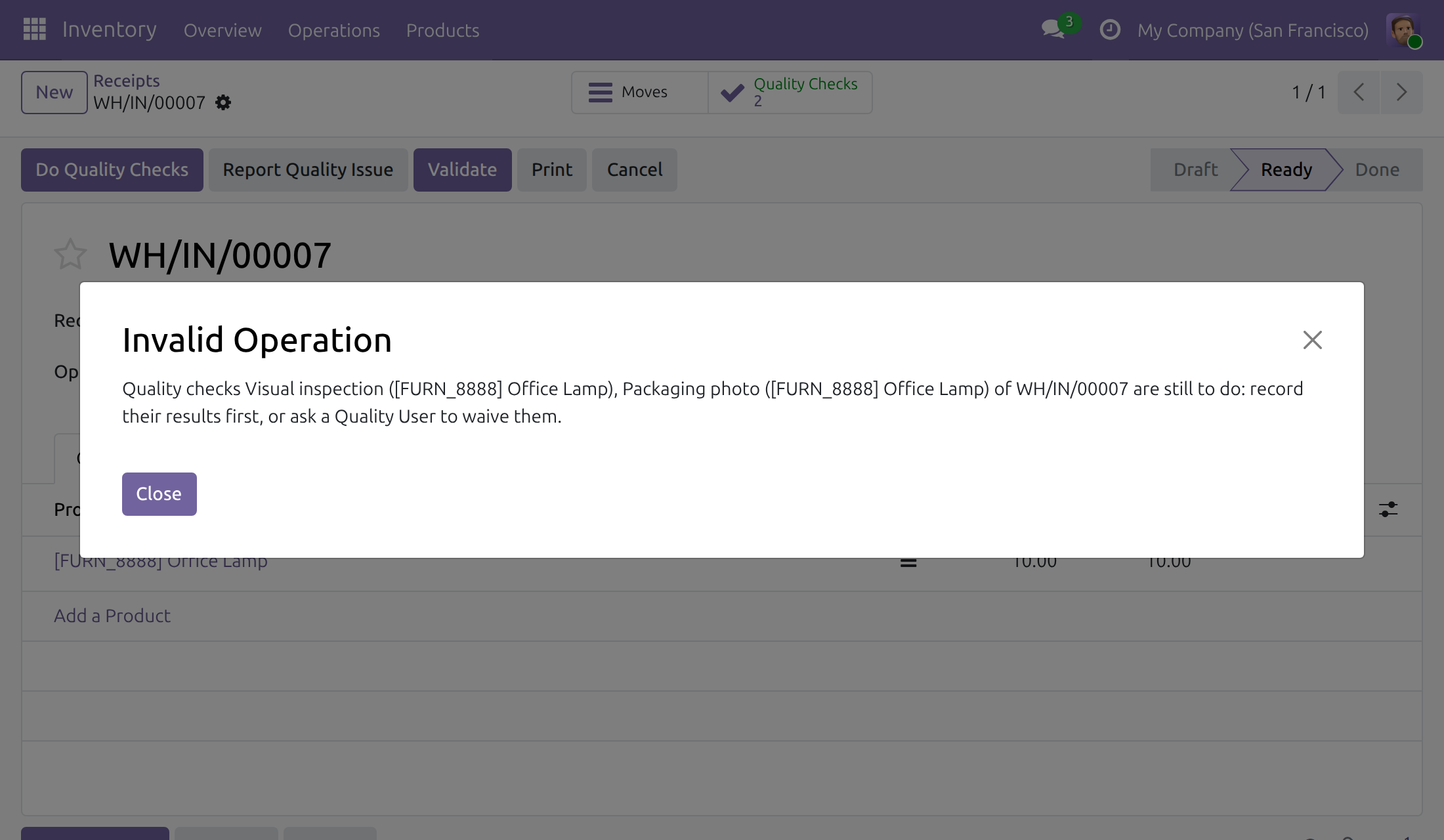
Click Close, record the results, go back to the transfer and click Validate again. A check of a product that has no quantity on the transfer does not hold it. The refusal comes before the question about a backorder, so nothing is created while a check is still to do.
A failed check that holds the goods. When a check of a control point with No Proceed if Failed has failed and no Quality User has accepted it with conditions, the text of the Quality Checks button is red and Validate is refused. The message names the check, with its product, and tells you to ask a Quality User:
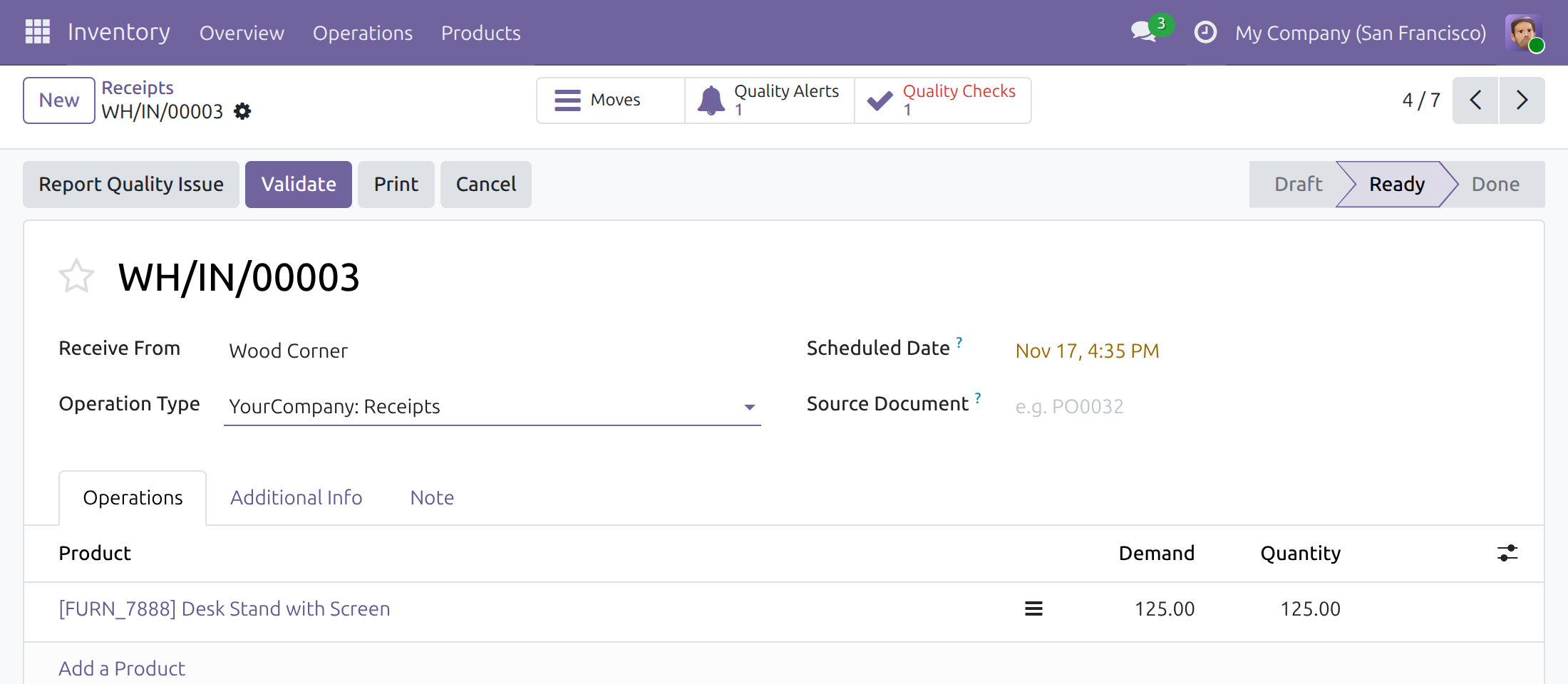
One message names both kinds of check when a transfer has both. A check that has failed on a control point without No Proceed if Failed does not stop the validation. A failed check cannot be taken out of Failed by a warehouse operator: open it to see that only Report Quality Issue is offered, and ask a Quality User.
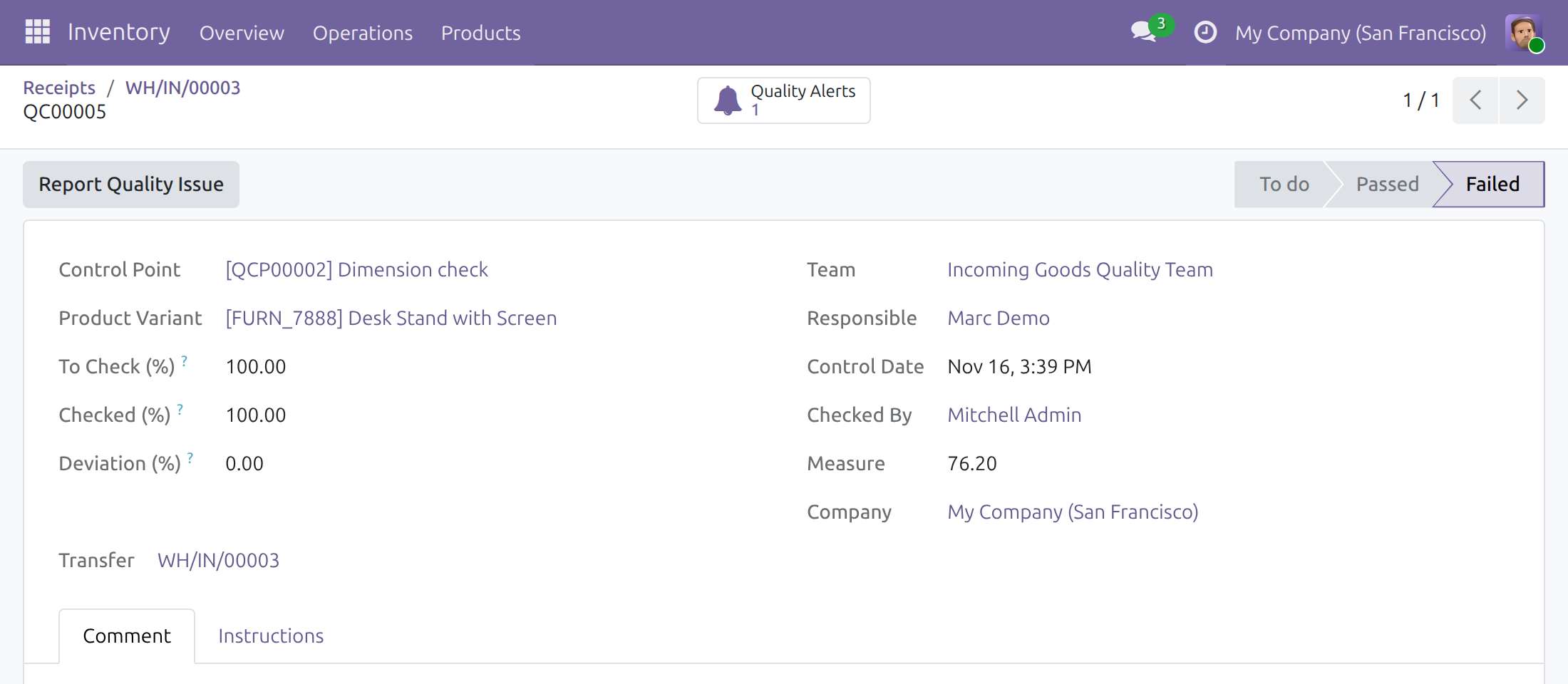
A Quality User can also waive a check that is still to do. The operator then validates the transfer without recording it.
Receive part of the goods: the checks follow the goods
- Record the results of the checks.
- On the Operations tab, type in Quantity what really arrived, for example 6 out of a Demand of 10.
- Click Validate. The window Create Backorder? opens.
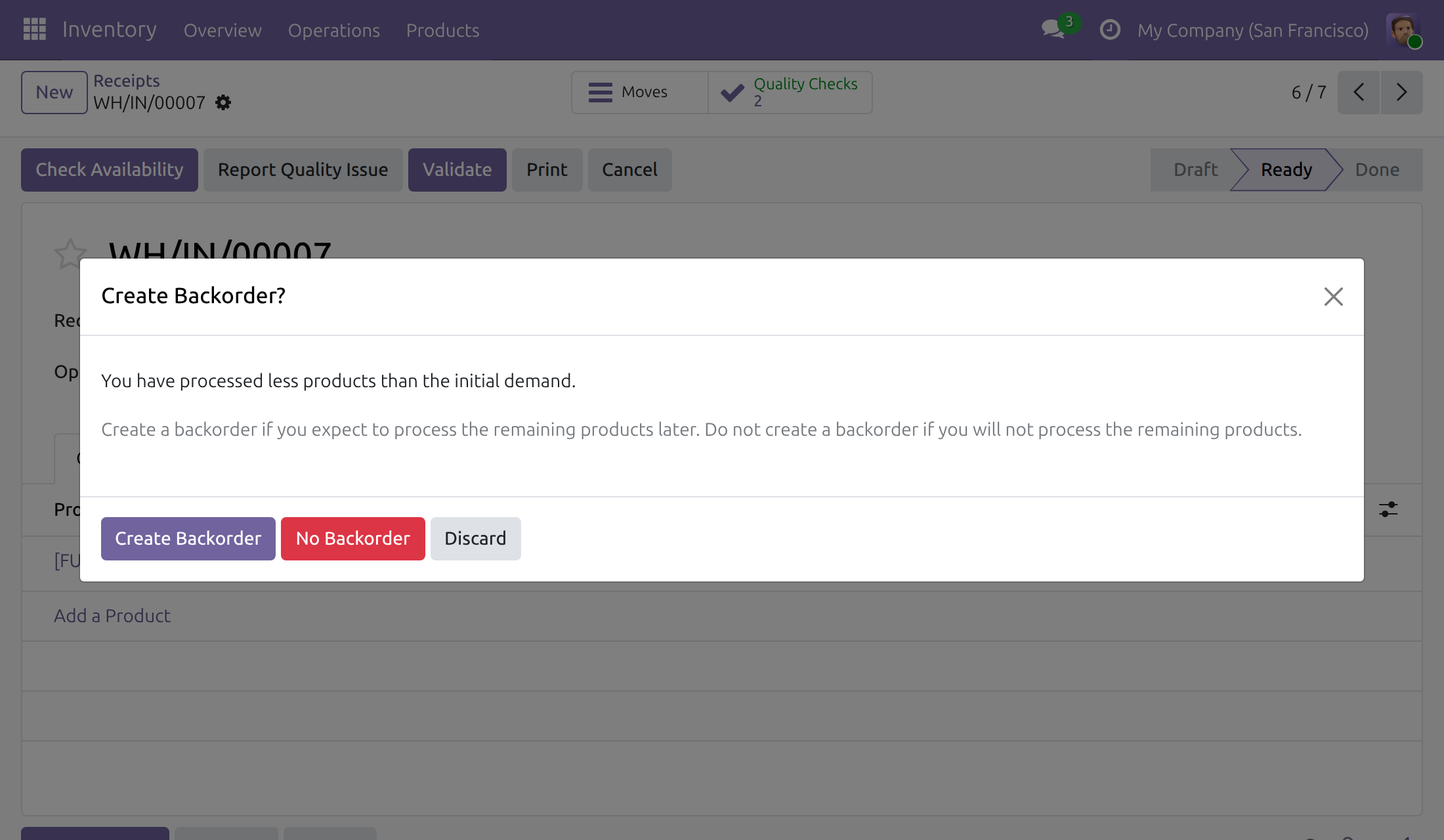
Every check of goods that leave a transfer, for a backorder, a split or a wave, goes with them, with its result and the decision about it:
- Goods that passed are not checked again.
- Goods held by a failed check stay held on the backorder, which cannot be validated until a Quality User decides. When a Quality User rejected the goods, the operator can cancel the backorder.
- A product that is partly received keeps its checks on the original transfer.
- A check still to do of goods that no transfer keeps is deleted. The backorder gets the new checks that its control points require.
If you cancel a transfer, its checks that are still to do are deleted. The checks that already have a result stay.
Results are frozen once the transfer is finished
When the transfer is Done or cancelled, a warehouse operator can open its checks and read them, but cannot change the result: Pass, Fail and Reopen are not offered. Only a Quality User revises the result of a check of a finished transfer.
Report a quality issue from a transfer
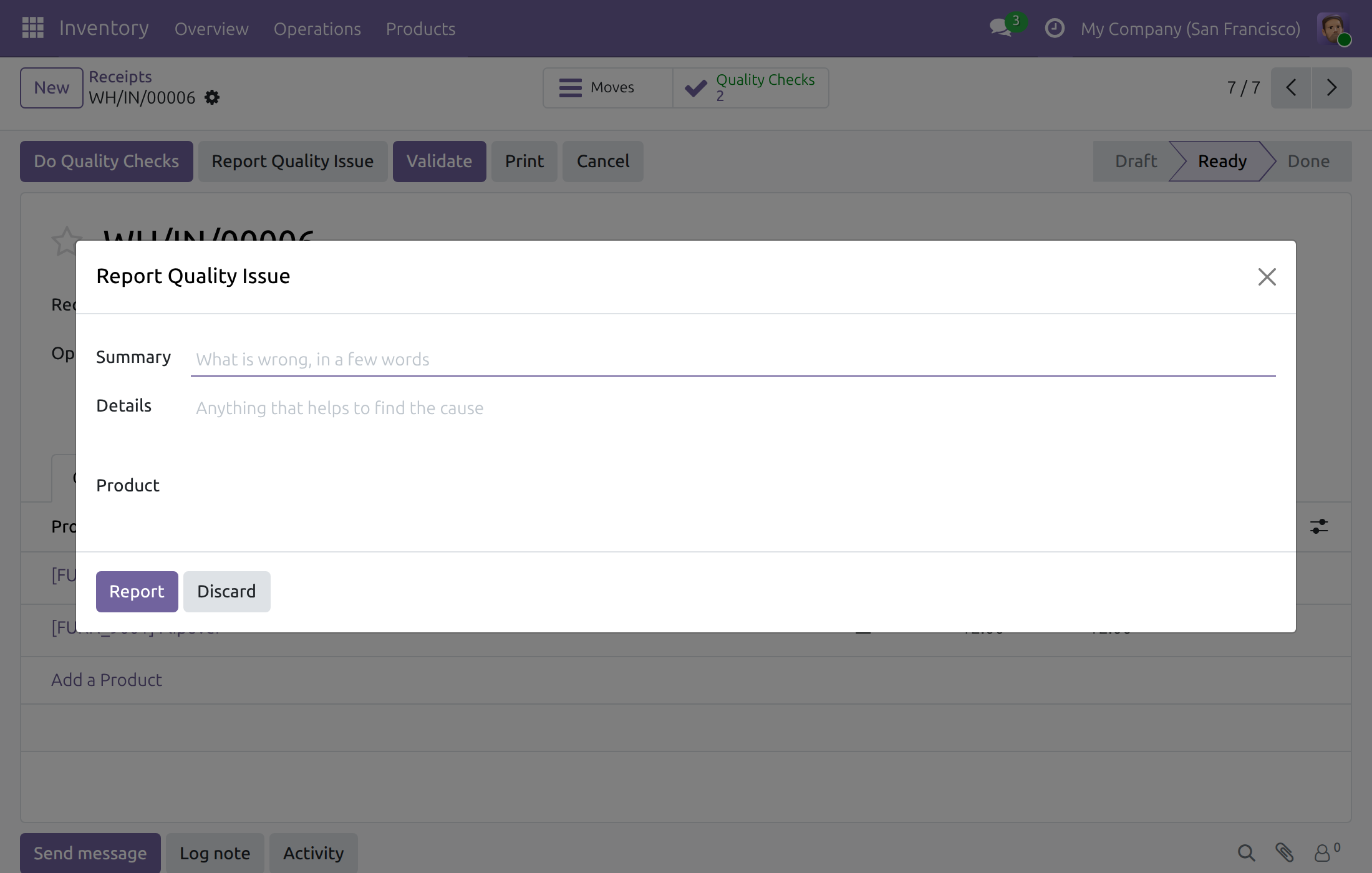
- On the transfer, click Report Quality Issue.
- In Summary, write what is wrong in a few words. Add Details if they help.
- When the transfer has no failed check, choose the Product the issue concerns. When that product is tracked by lot and the transfer has several lots of it, you also choose the Lot/Serial Number. The dialog asks nothing it already knows: a transfer of one product, or a failed check, fills them in.
- Click Report.
The alert is created with the transfer, the product and the lot. Its Source is Supplier for a receipt and Internal for any other transfer. When a failed check exists, the alert takes the product and the lot of that check.
Back on the transfer, a Quality Alerts button with the number of alerts appears next to Quality Checks. Click it to open the alert, or the list of alerts when there are several. A warehouse operator reads the alerts of the transfers they can read, writes in the discussion and attaches files, but does not change the alert itself.
Quality User: release the goods and follow the transfers
Release goods held by a failed check
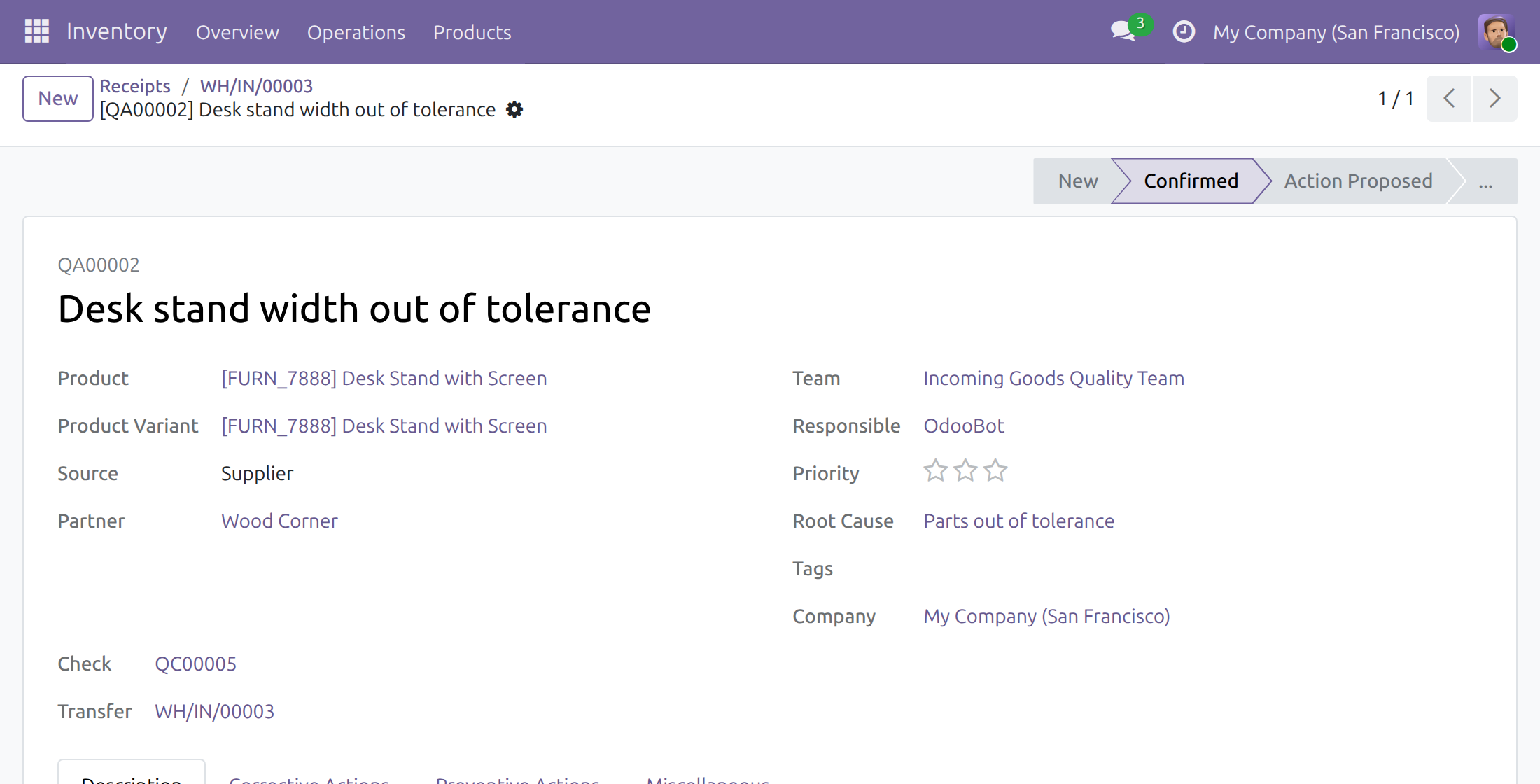
A Quality User decides, from the check, what happens to goods held by a failed check. The decision dialogs are explained in the Quality guide:
- Accept with Conditions releases the goods: the operator can validate the transfer, and the transfer stops showing the failed check as holding goods.
- Reject keeps the failure and the hold. The goods stay held, and the operator cancels the backorder or the transfer.
- Reopen sends the check back to To do for a new inspection. Record Pass to release the goods or Fail to confirm the defect.
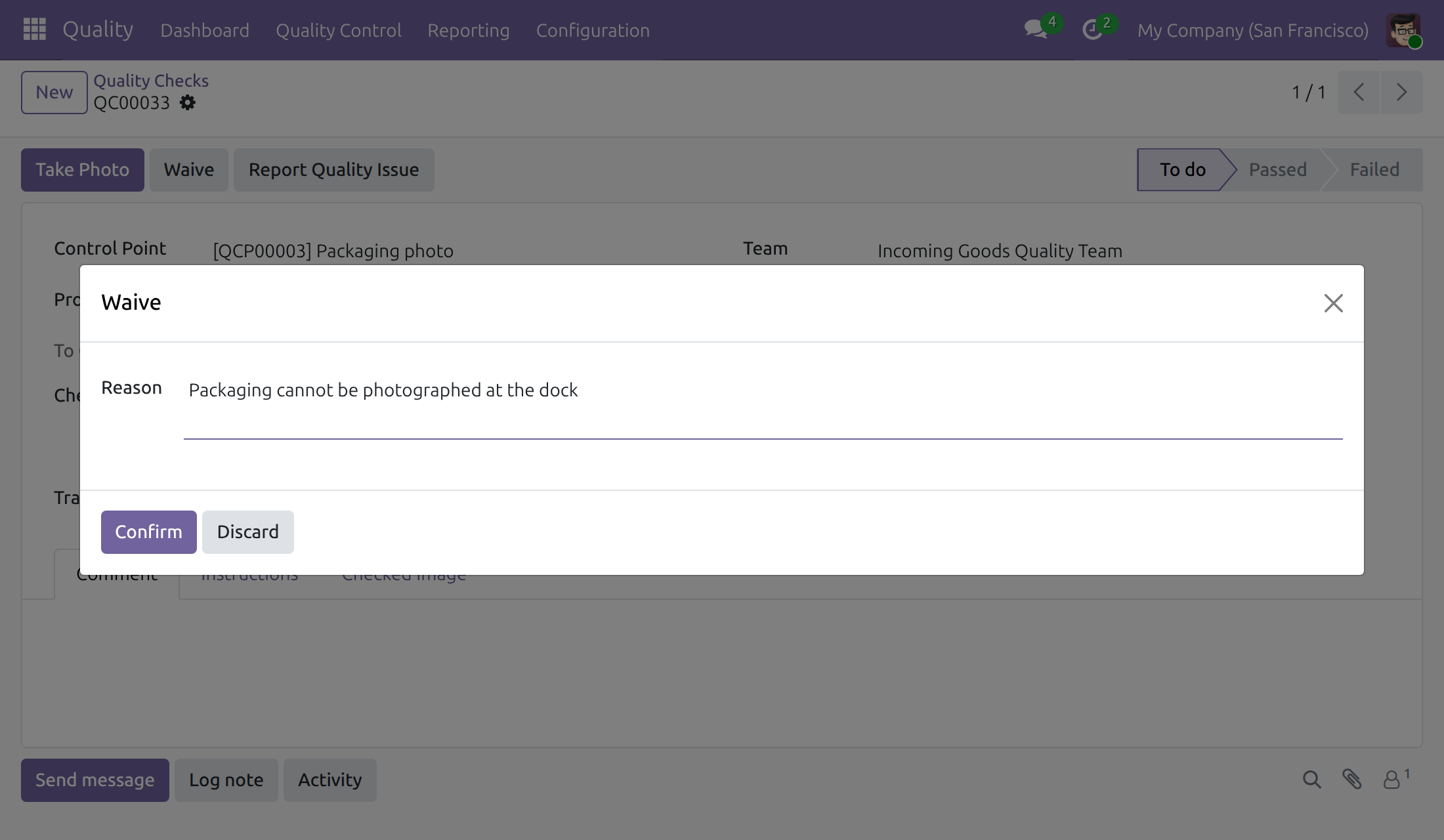
- Waive is offered on a check that is still to do and does not need inspecting. The check becomes Waived, is not counted as to do and does not hold the transfer.
Accept with Conditions, Reject and Waive ask for a Reason. Click Confirm to record it.
Open Quality ‣ Quality Control ‣ Quality Checks, use the Failed filter and open the check, or open it from the Quality Checks button of the transfer. Deleting a check that already has a result leaves a note on its transfer.
Follow the transfers whose checks are judged
Under Quality ‣ Quality Control, the Stock Operations section has two lists.
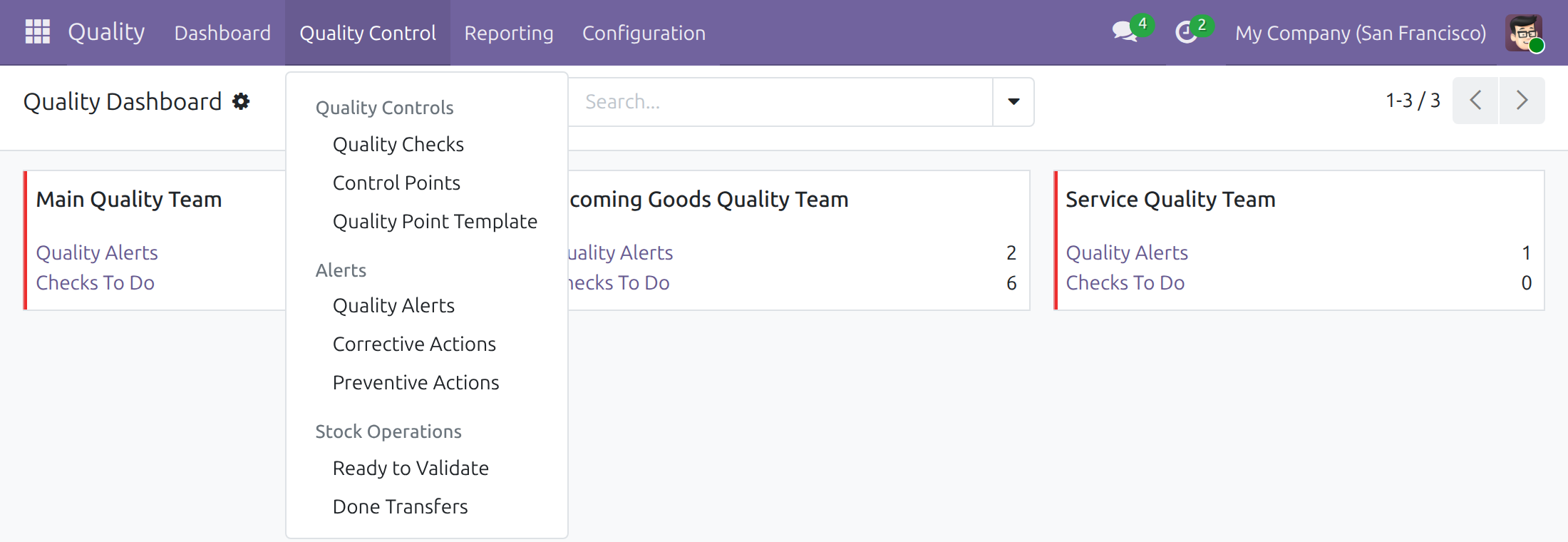
Ready to Validate lists the transfers that quality lets through: they have at least one check, no check still to do and no failed check that holds their goods, and they are neither draft, done nor cancelled. A failed check of a control point without No Proceed if Failed, a check accepted with conditions and a waived check do not keep a transfer out of the list.
A transfer whose goods are held by a failed check of a control point with No Proceed if Failed, not accepted with conditions, is not listed, and neither is a transfer with a check still to do. Find a held transfer in Quality ‣ Quality Control ‣ Quality Checks: use the Failed filter and read the Transfer column, or group the checks by Transfer. The list is deliberately cautious: a transfer held for one product is not listed even if its other goods could be validated with a backorder. A held transfer is listed again once a Quality User accepts the failed check with conditions, or reopens it and it is judged again.

Done Transfers lists the transfers that have checks and are Done, for review.
A Quality User who holds no Inventory access right opens these lists and the transfers in them read-only: the form shows the checks and alerts buttons and Report Quality Issue, and no Validate.
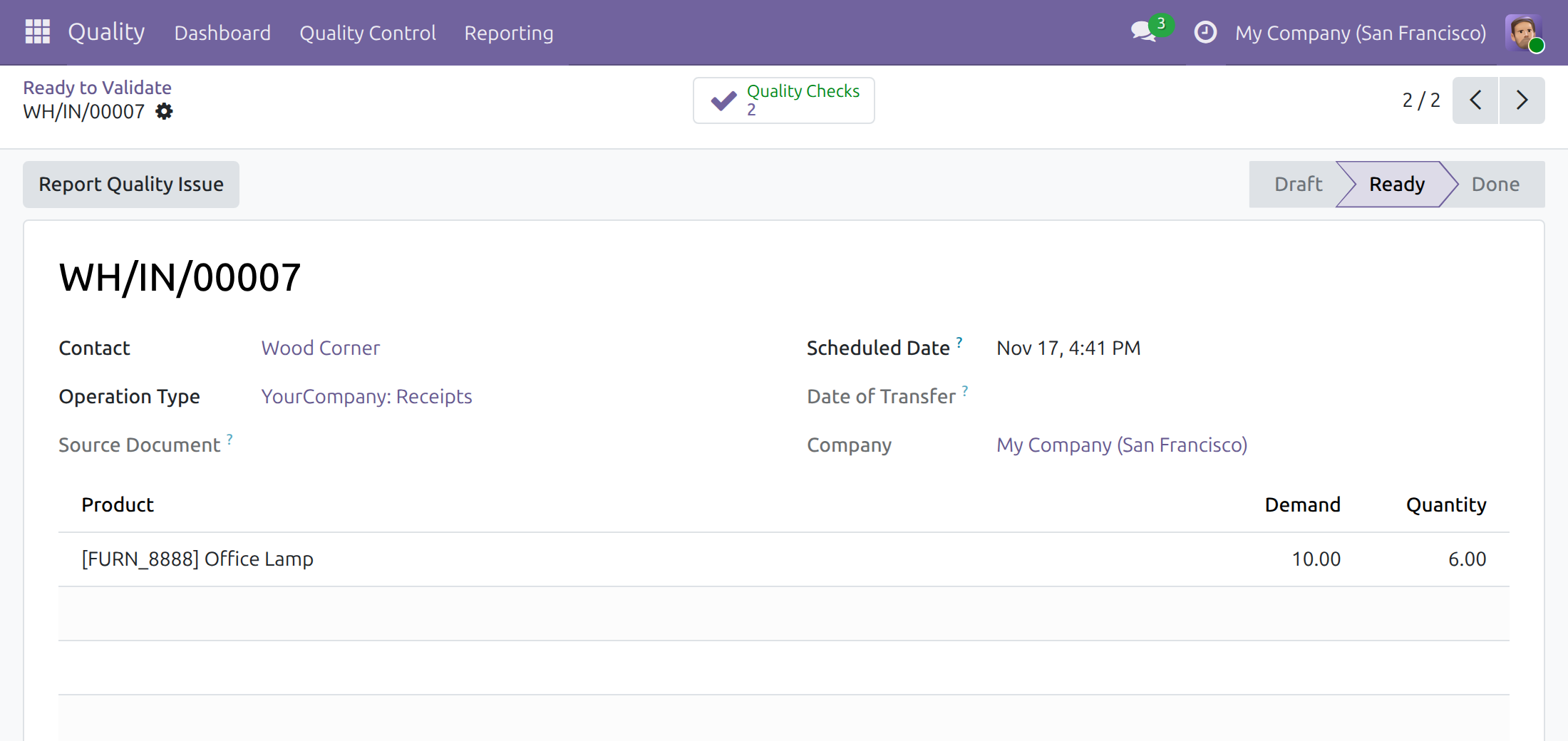
Find checks by transfer or by lot
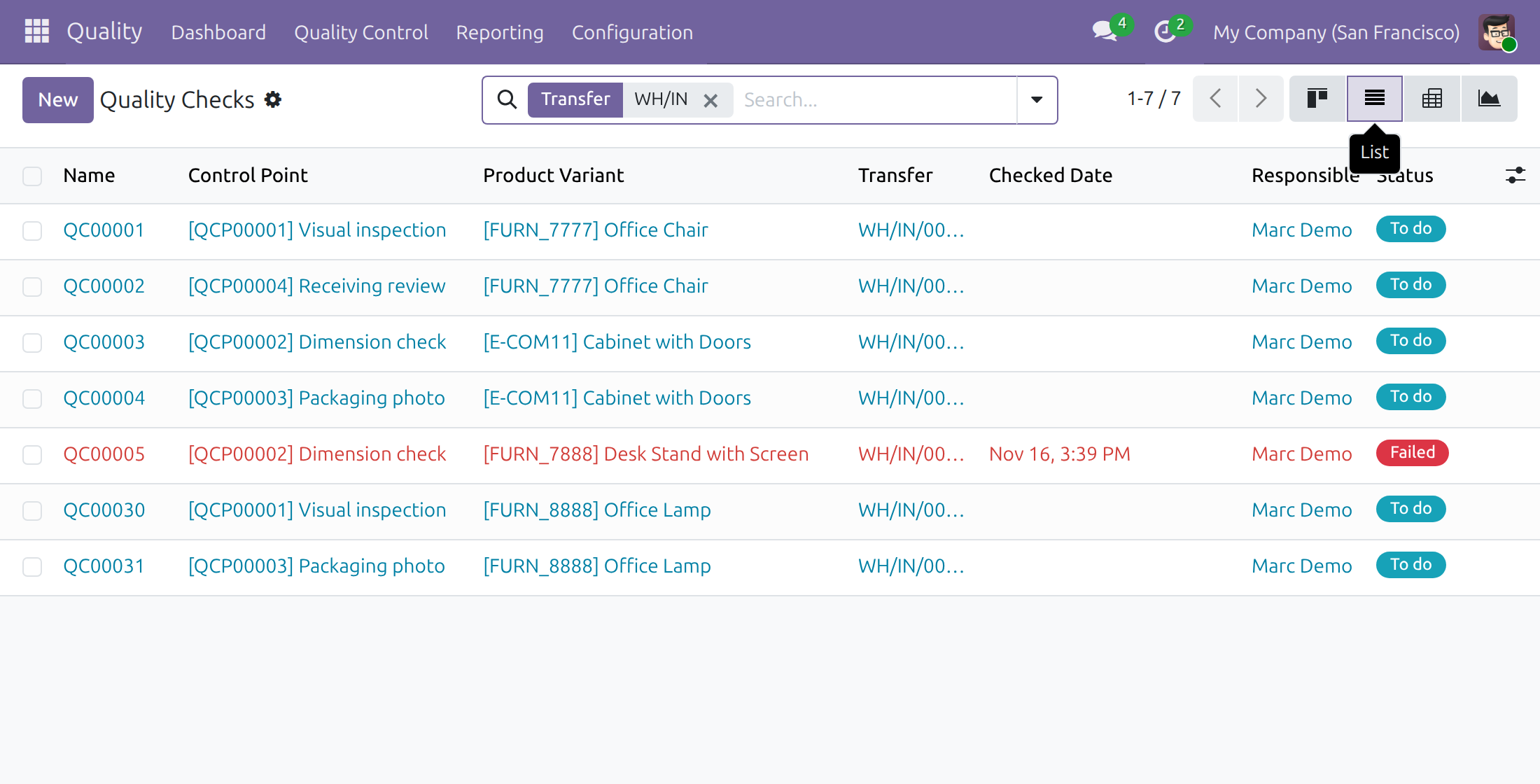
In Quality ‣ Quality Control ‣ Quality Checks, type a transfer reference in the search box and choose Search Transfer for to find its checks. You can also search by References, which finds the checks of every document of a chain, and by Lot/Serial Number when lots are used. In the list, the Transfer column shows the transfer of each check. You can group the checks by Transfer, Operation Type or Lot/Serial Number.
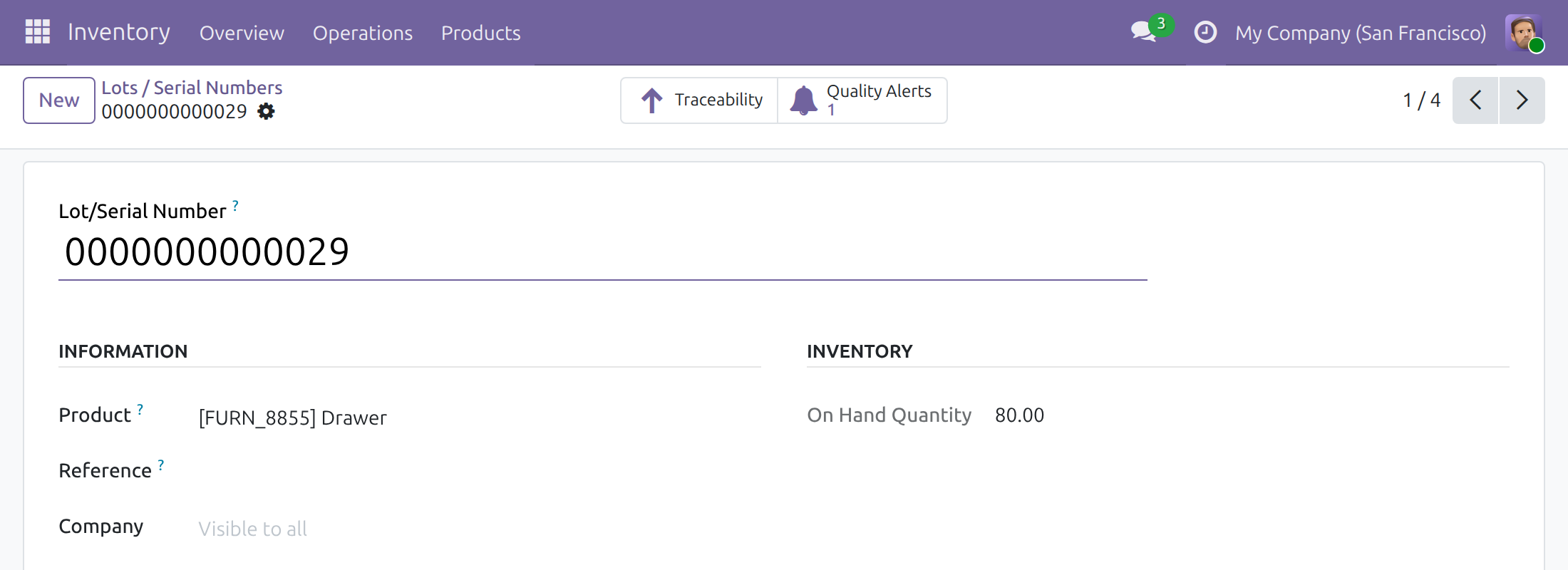
Alerts of a lot
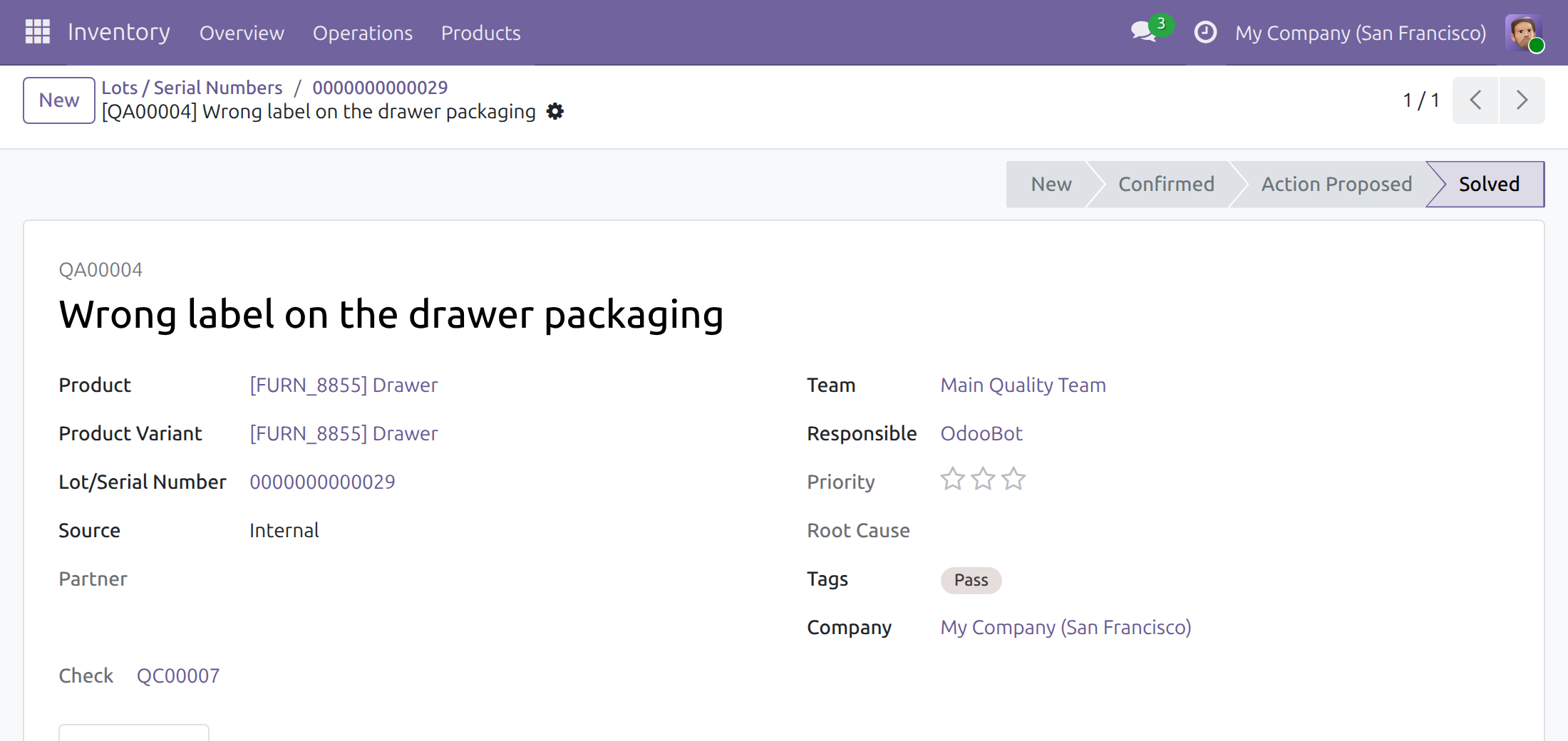
Quality alerts and corrective and preventive actions carry the transfer and the lot. On the form of a lot or serial number, the Quality Alerts button shows the number of alerts of the lot that you are allowed to read and opens them.
Limits
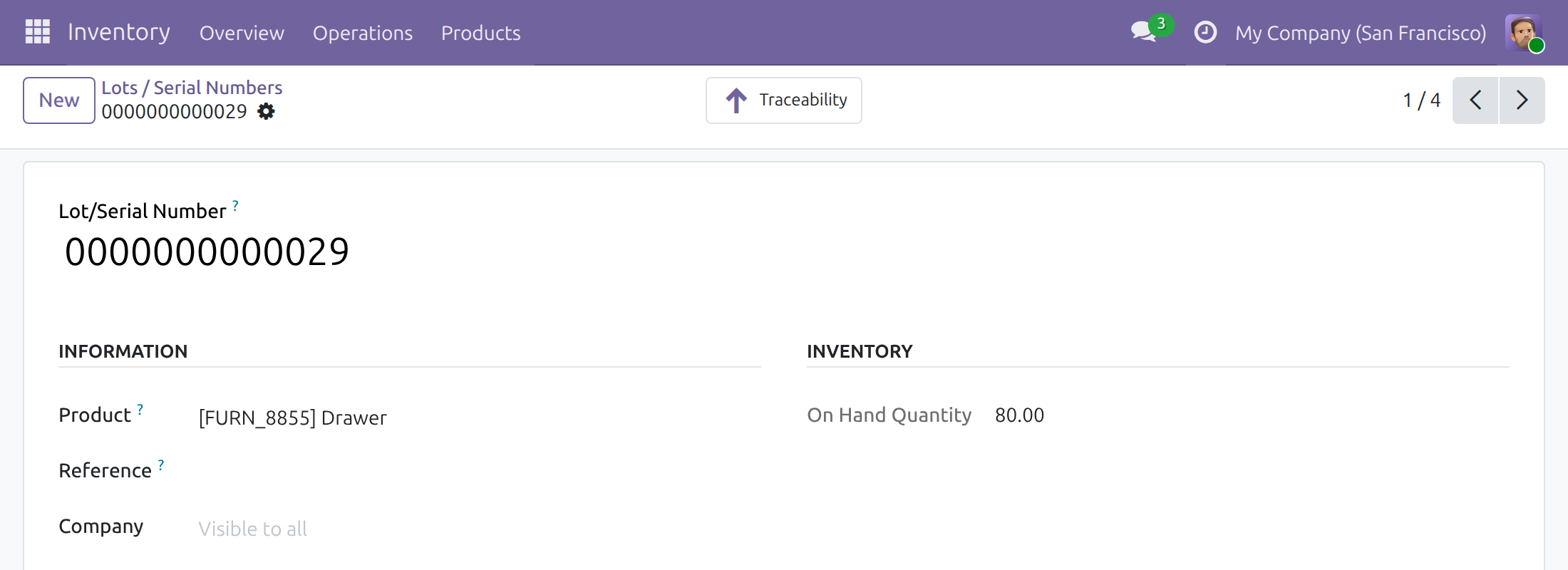
- Alerts of a lot. A lot gives nobody access to an alert. The Quality Alerts button of a lot counts and opens only the alerts that the person looking at it can read. A person without a Quality access right reads the alerts of a lot through their source document, a transfer or a manufacturing order they can read, or when they are assigned to the alert or follow it. An alert that is tied to a lot only reaches its assignee, its followers and the Quality Users. The usual way to let a warehouse person see every alert of a lot is to give them the Quality: User access right.
- Transfers read through the Quality role. A Quality User without an Inventory access right reads transfers, checks and alerts, and cannot create, edit or validate a transfer.
- Subcontracting. When Manufacturing Quality Control is installed, a receipt from a subcontractor closes the subcontracting order, so the checks that hold the order hold the receipt. A warehouse operator who receives the goods cannot record the checks of the subcontracting order. See the Manufacturing quality control documentation.
Troubleshooting
- I marked a transfer to do and it has no Quality Checks button.
- No control point matches. Ask a Quality Administrator to check that a control point exists for the product (or its category) and that its Operation Types field contains the operation type of the transfer. A control point created after the transfer was confirmed does not add checks to it.
- Validate says that quality checks are still to do.
- One or more checks of the goods you process are still To do. The message names them with their product. Record Pass or Fail for each, or ask a Quality User to waive them, then validate again.
- Validate says that failed quality checks block this step.
- A check of a control point with No Proceed if Failed has failed. Ask a Quality User to reopen the check or to decide what to do with the goods.
- I cannot change the result of a check.
- The check is Failed or Waived, or its transfer is done or cancelled. Only a Quality User can change it.
- I do not see the Quality Alerts button of a lot.
- The button shows the alerts of the lot that you can read, and nothing when there are none. See "Alerts of a lot" in the Limits section.
- A transfer whose checks are all judged is not in Ready to Validate.
- A failed check of a control point with No Proceed if Failed holds its goods, and the list does not show a held transfer, even when its other goods could be validated with a backorder. Find it in Quality Checks with the Failed filter. A Quality User decides about the check.
FAQ
- Does the warehouse operator need access to the Quality app?
- No. An operator reads and records results from the transfer and cannot create or delete checks.
- Do deliveries and internal transfers work like receipts?
- Yes, as long as the control point lists their operation type in Operation Types.
- What happens to the checks when I create a backorder?
- The goods that leave the transfer take their checks with them, with their results. The backorder also gets the new checks that its control points require.
- What happens to the checks when I cancel a transfer?
- Its checks that are still to do are deleted. Checks that already have a result stay.
This software and associated files (the "Software") may only be used (executed, modified, executed after modifications) if you have purchased a valid license from the authors, typically via Odoo Apps, or if you have received a written agreement from the authors of the Software (see the COPYRIGHT file).
You may develop Odoo modules that use the Software as a library (typically by depending on it, importing it and using its resources), but without copying any source code or material from the Software. You may distribute those modules under the license of your choice, provided that this license is compatible with the terms of the Odoo Proprietary License (For example: LGPL, MIT, or proprietary licenses similar to this one).
It is forbidden to publish, distribute, sublicense, or sell copies of the Software or modified copies of the Software.
The above copyright notice and this permission notice must be included in all copies or substantial portions of the Software.
THE SOFTWARE IS PROVIDED "AS IS", WITHOUT WARRANTY OF ANY KIND, EXPRESS OR IMPLIED, INCLUDING BUT NOT LIMITED TO THE WARRANTIES OF MERCHANTABILITY, FITNESS FOR A PARTICULAR PURPOSE AND NONINFRINGEMENT. IN NO EVENT SHALL THE AUTHORS OR COPYRIGHT HOLDERS BE LIABLE FOR ANY CLAIM, DAMAGES OR OTHER LIABILITY, WHETHER IN AN ACTION OF CONTRACT, TORT OR OTHERWISE, ARISING FROM, OUT OF OR IN CONNECTION WITH THE SOFTWARE OR THE USE OR OTHER DEALINGS IN THE SOFTWARE.