How do you measure ROI without a baseline when an SME does not yet know how much it is wasting? Article 11 of the "From Data to Kaizen" series shows how to build a minimum baseline and measure value layer by layer.
Measure ROI without a baseline: why it is so hard for SMEs
One of the hardest questions when implementing ERP, digitalization or Kaizen is:
"How much money will this investment bring?"
It is a perfectly fair question. The problem for SMEs is that they often do not have enough data to answer it. They know revenue, costs and profit, but not the current lead time, waiting time, rework rate, defect rate, actual material consumption, hours spent on data entry or the number of orders delayed by missing materials.
The business wants to measure ROI, but has no baseline to know where it stands "before the improvement".
This is why many digitalization projects get stuck: leadership wants to see results right away, the implementation partner sees long-term value, but there is no shared data to prove it.
Without a baseline, full ROI cannot be measured from day one
Return on investment is essentially a before and after comparison. For example, lead time goes from 15 to 11 days, or rework from 12% to 7% (illustrative examples). If the "before" has no number, it is very hard to state the financial effect precisely.
So for an SME without a baseline, the practical approach is not "try to calculate ROI precisely from the start", but "build a minimum baseline first, then measure ROI step by step with real data". This is also different from the ROI analysis done before a digital transformation, which estimates the case for investing; here the question is how to measure what actually happens.
ROI is not just about cutting headcount
A common mistake is to see ROI only as how many people can we cut? In reality, the value of ERP and Kaizen sits in several layers:
Time saved
Less double entry, less report consolidation, fewer status questions.
Fewer errors
Wrong BoMs, wrong quantities, wrong stock, wrong quotations.
Shorter lead time
Faster processing, less waiting, fewer late deliveries.
Lower inventory
More accurate buying, less dead stock, faster turnover.
Fewer defects and rework
Less rework, less scrap, fewer warranty claims.
More capacity and better decisions
The same team handles more orders, sees the right data and reacts earlier.
ROI should be seen across all of these layers, the same idea as the management value of data discussed earlier in the series.
Start with a minimum baseline
To measure ROI without a baseline, there is no need to track hundreds of indicators. Pick 3 to 5 that are closest to the biggest problem.
A manufacturer might start with
Order lead time, on-time delivery rate, defect rate, material consumption variance, average inventory.
A service business might choose
Request handling time, on-time completion rate, utilization, billable hours, hours of manual data entry.
Only measure what the business intends to improve.
In an ERP, much of this baseline comes from data that is recorded anyway. On a manufacturing order, for instance, each work order already keeps its expected and real duration.
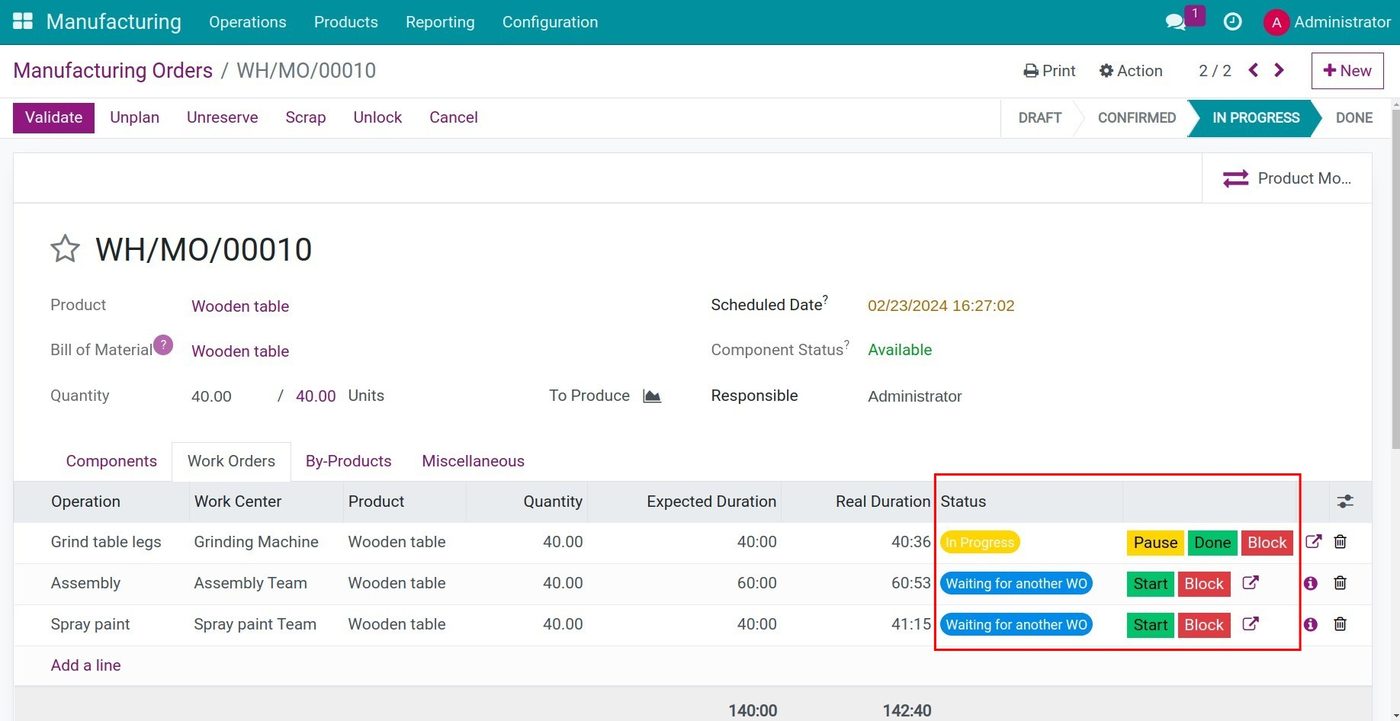
Each work order shows its expected and real duration. Collected over a month, this is already a baseline for cycle time, before any improvement.
A baseline does not have to be perfect
SMEs often worry: "My old data is not accurate, so how can I measure?" There is no need to wait for perfect data. Start with one month, 20 orders, one product group, one department or one process. The goal is a starting point reliable enough to compare against, not a complete BI system from day one. It is the same logic as a baseline in project management: a fixed reference to measure progress, applied here to operations.
Standard costs are a good example: the multi-level BoM overview gives a standard cost structure that later serves as the reference against actual costs after production.
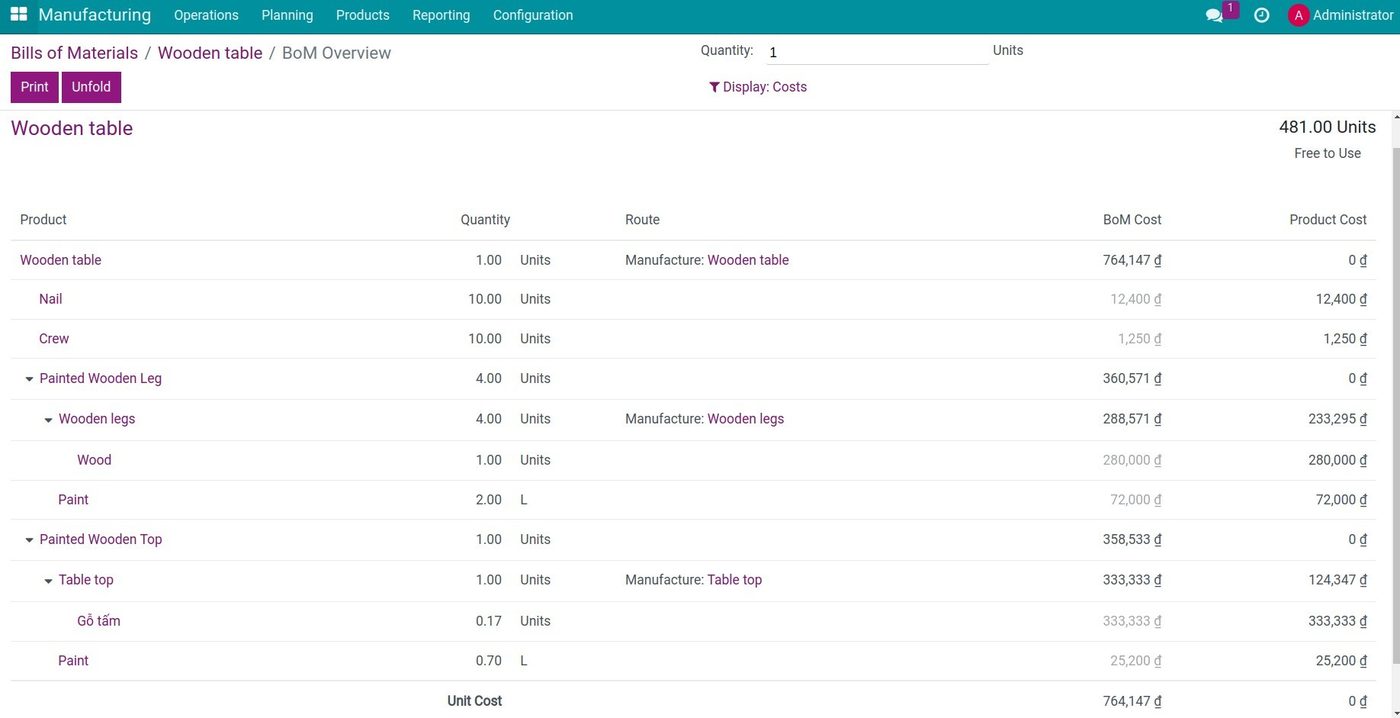
The BoM overview adds up component and operation costs level by level, giving a standard cost to compare with actual production cost.
Measure value layer by layer
The value of digitalization can be split into five layers, which is how to measure ROI without a baseline step by step:
Visibility value
Knowing where orders are, where materials are short, where defects appear.
Control value
Controlling limits, quality, progress and stock: less risk, less deviation.
Productivity value
Fewer tasks, less time, less double entry, more transactions handled.
Optimization value
Using data to cut lead time, defects and stock, and to optimize schedules.
Financial value
Lower cost, higher margin, more revenue, freed working capital.
Visibility does not necessarily make money right away, but it is the foundation for improvement. Control reduces risk. Productivity is when operational ROI becomes clear. Optimization is where Kaizen value shows. Financial value is the layer leadership cares about most, but it usually comes after the others.
A simple example: less time per order
Suppose that before digitalization each order takes 20 minutes to gather information, with 500 orders a month (illustrative example). That is 10,000 minutes, about 167 hours a month. After the data is integrated, it drops to 8 minutes per order:
12 minutes × 500 = 6,000 minutes = 100 hours a month
At a labor cost of VND 150,000 per hour, that is worth VND 15 million a month. This is an ROI anyone can understand.
Many values cannot be turned into money right away
Spotting late orders earlier, reducing the risk of wrong deliveries, knowing stock accurately, having data to trace defects: these are hard to convert into money at once. But they can be measured with proxies:
On-time delivery
Measure OTD.
Quality
Measure defect or rework rate.
Inventory
Measure inventory days.
Speed
Measure lead time.
Manual work
Measure processing hours.
Rule of thumb
There is no need to force everything into money from day one.
The cost of blindness
A part of ROI that is often forgotten is the cost of not having data. When a business does not know that materials are short, orders are late, defects are rising or stock is swelling, the result can be late deliveries, rush purchases, excess stock, lost customers, rework and emergency costs.
None of these costs appear in the software fee, yet this is where ERP and Kaizen create a lot of value. A forecast of stock, for example, shows early whether planned demand will leave the business short.
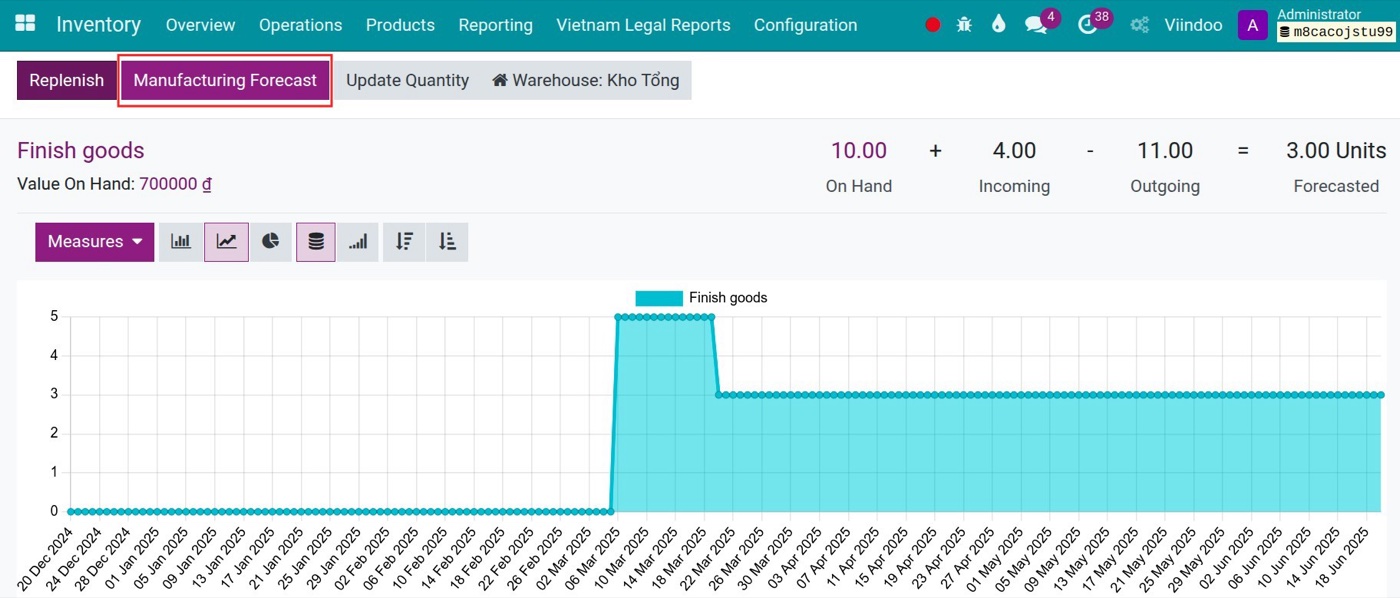
The forecast combines on-hand, incoming and outgoing quantities into a forecasted stock over time, so a shortage becomes visible before it happens.
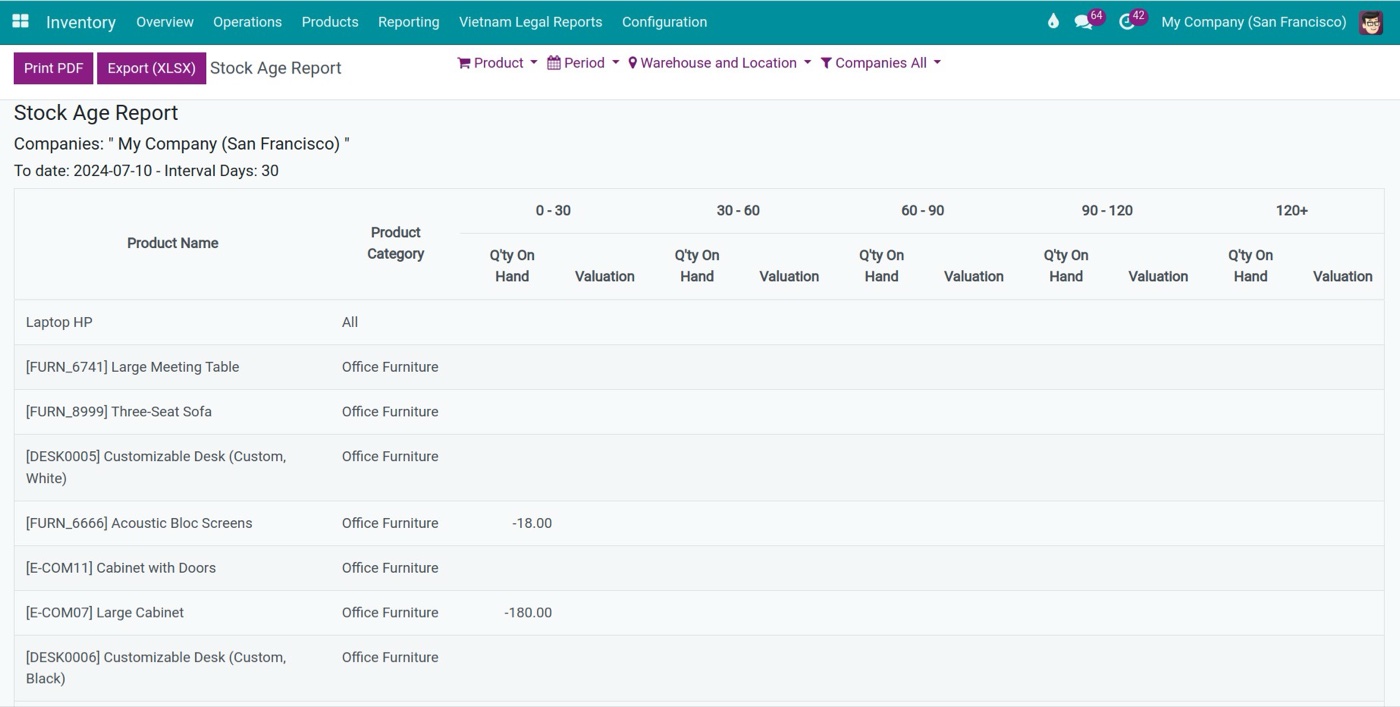
The stock age report groups quantity and value by age bucket (0-30, 30-60 days...), a starting point to see slow-moving stock before calculating inventory days.
A practical way for SMEs to measure ROI
There is no need for a complicated financial model. A simple formula works:
Value created = Time saved + Costs avoided + Extra capacity + Capital freed
ROI = (Value created - Investment cost) / Investment cost
But more important than the formula is that before and after data must be measured the same way.
Choose KPIs by problem
Late deliveries
Lead time, OTD, waiting time.
High inventory
Inventory days, stock turnover, dead stock.
Many defects
Defect rate, rework rate, scrap cost.
Heavy data entry
Processing hours, times re-entered, number of steps.
Inaccurate cost
Material variance, time variance, gross margin per order.
For material variance, a comparison of standard and actual consumption per manufacturing order is a direct baseline:
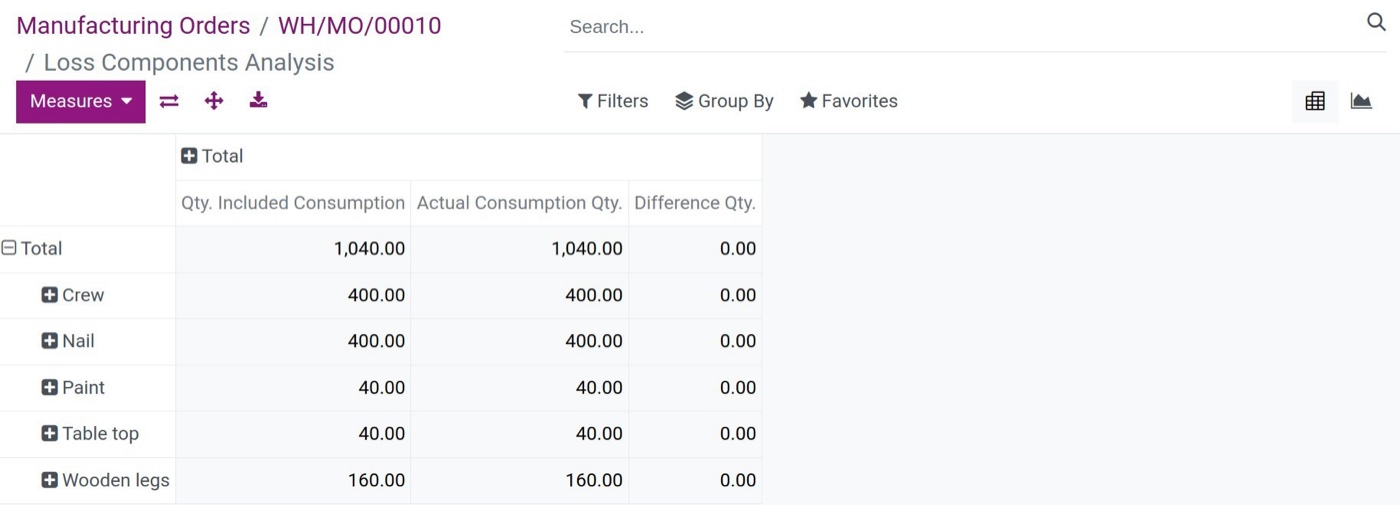
For each manufacturing order, the analysis compares the quantity including standard loss with the actual consumption and shows the difference per component.
For productivity, the equipment effectiveness report shows productive time and stop reasons per work center. For quality, the quality check report counts passed and failed checks, from which the business calculates its defect rate.
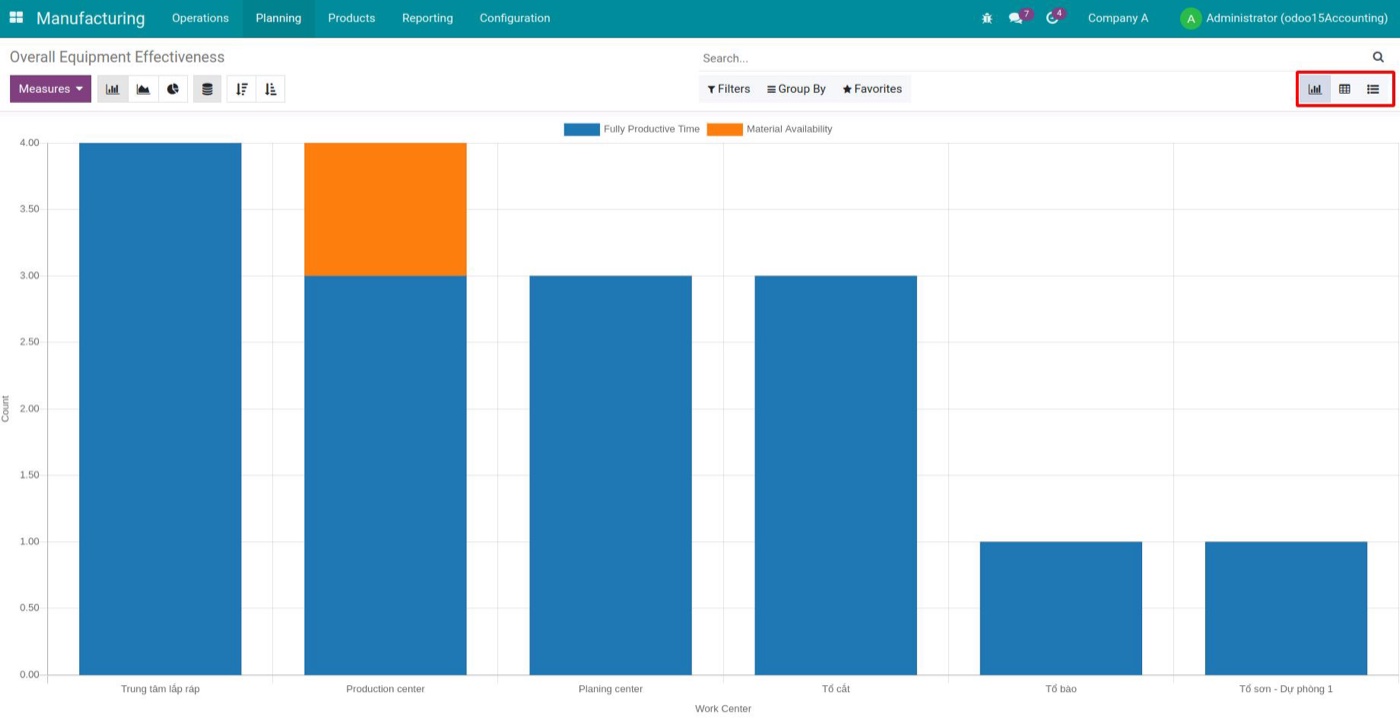
The report breaks time down into fully productive time and losses (here material availability) for each work center, based on recorded running and stop times.
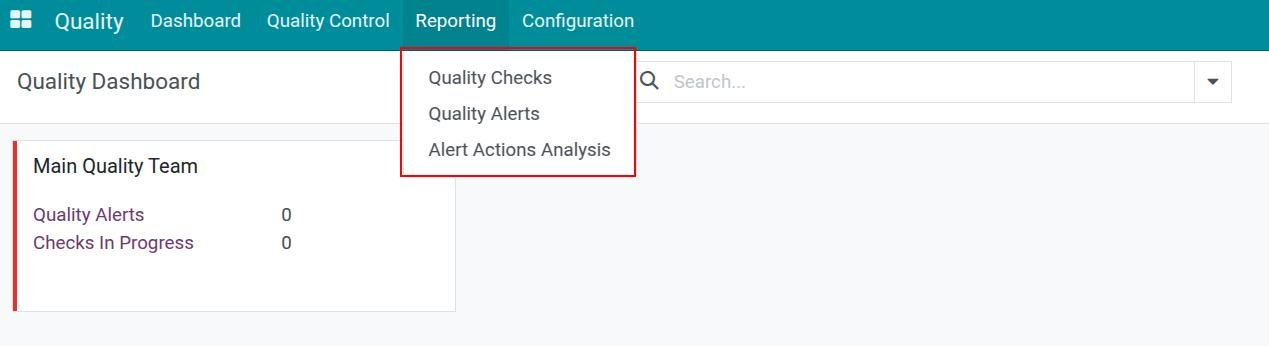
Quality reporting covers quality checks, quality alerts and the analysis of alert actions: the raw material for a defect and rework baseline.
Measure ROI on a small scope first
One way to reduce debate is not to try proving ROI for the whole company at once. Instead, pick one process, one product group, one plant or one department. For example, measure only the ROI of the Sales Order to Manufacturing Order process. After 2 to 3 months, the business has real numbers, and only then expands. This is also the least risky way to measure ROI without a baseline.
How Viindoo helps build a baseline
An advantage of an integrated ERP is that data is recorded during operations, which makes it possible to measure ROI without a baseline project of its own:
Sales
Order date and committed delivery date on each sales order.
Manufacturing
Start and end dates, quantity produced, expected and real duration per work order.
Inventory
Stock levels, stock moves and stock age.
Quality
Passed and failed checks, quality alerts.
Accounting
Revenue, costs, production cost and profit and loss.
When this data sits on one platform, the business can build a baseline without a separate BI project at the start. Some indicators come ready as reports; others, such as customer on-time delivery rate or stock turnover, are calculated from data already in the system, for example the committed date against the actual delivery date.
Do not promise ROI too early
Implementation partners often face the pressure: "Commit to how much you will save me." If you have to measure ROI without a baseline, a very specific number easily lacks a basis. It is better to commit to the data scope, the KPIs to measure, how before and after will be compared and when the review happens. For example: after 3 months, review lead time, OTD, rework and data entry hours. This is more transparent.
It is the same principle as KPI-based implementation design: agree on what will be measured before arguing about numbers.
Measure Kaizen ROI as before and after
Before
The current indicator: 14 days.
Change
What was changed.
After
The new result: 10 days.
That is a 28.6% reduction (illustrative example). If inventory or late-delivery costs fall with it, the result can then be converted into money, for instance by comparing production cost across periods.
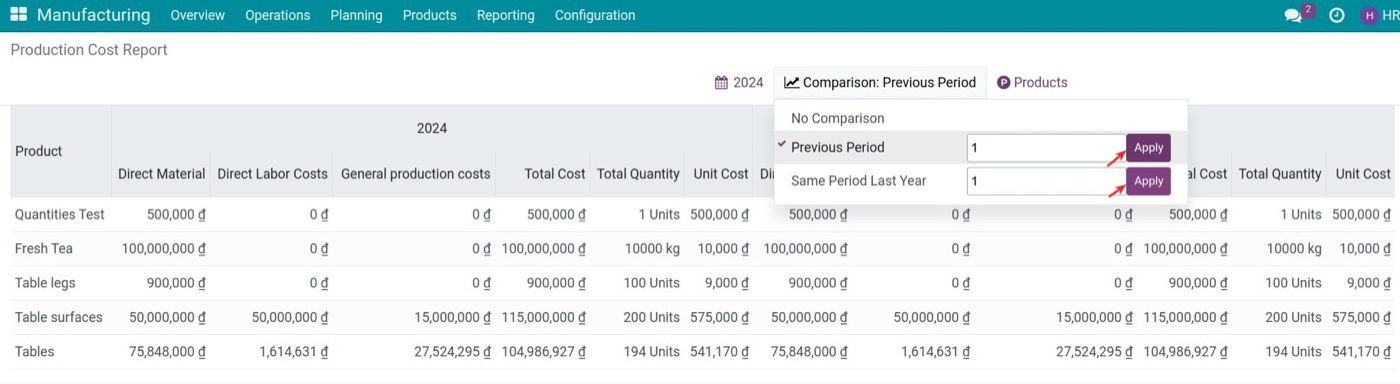
The production cost report shows direct material, direct labor and overhead per product, and can compare the current period with the previous one or the same period last year.
How can AI support ROI?
With enough data, AI can spot trends, group causes, compare before and after and suggest KPIs to track. But as the previous article explained, AI does not replace the baseline; it only helps analyze the baseline better.
A minimum KPI set for manufacturing SMEs
To start really lean, five KPIs are enough:
Lead time
On-time delivery
Defect / rework rate
Inventory days
Material variance
If these five indicators are measured before and after, the business already has a very good foundation to see ROI, in line with the minimum management backbone.
Do not let ROI become a barrier to starting
There is a paradox: to have ROI you need data, but to have data you need to start digitalizing. If the business waits for a perfect ROI proof before implementing, it may never start. A more sensible path, and the safest way to measure ROI without a baseline:
Start small
Build a baseline
Measure
Prove
Expand
Conclusion: without a baseline, the first goal is the ability to measure
An SME that has to measure ROI without a baseline should not try to calculate it too precisely from the start. The first goal is to create the ability to see and measure; then measure before, improve, measure after and convert the value.
The ROI of digitalization is not always known in advance. Often it is digitalization itself that creates the data for the business to know its real ROI.
At the financial layer, the profit and loss report with period comparison is where the operational improvements finally show up in money.
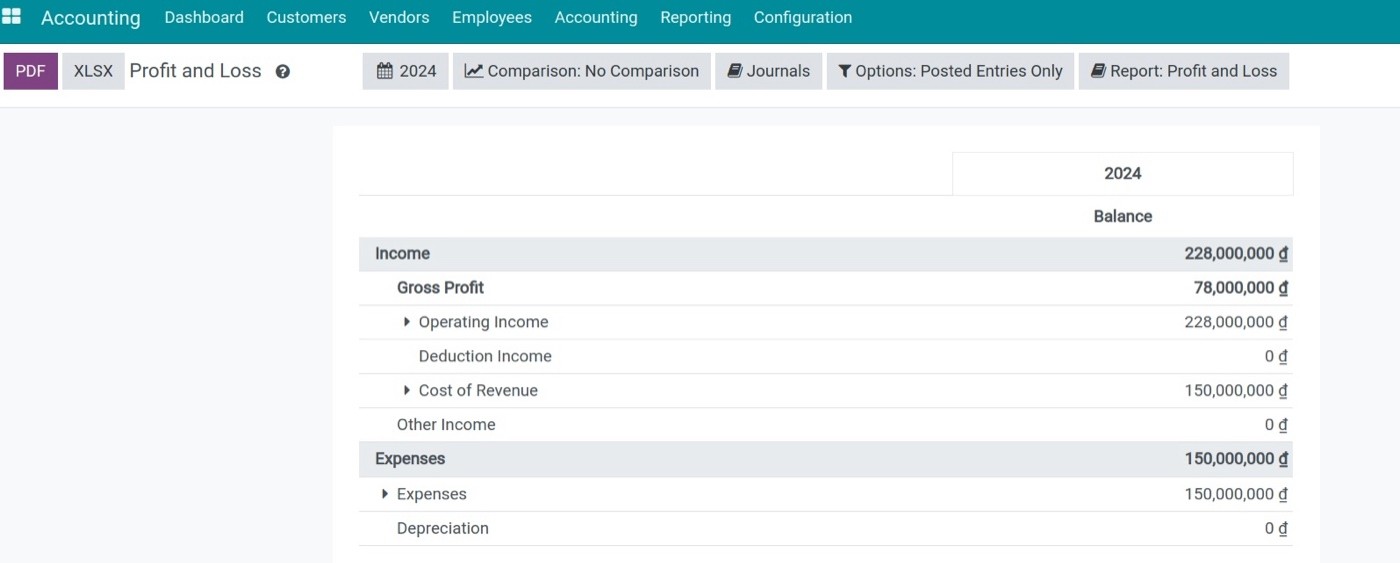
The profit and loss report shows revenue, gross profit, expenses and net profit, and can compare periods: the place where financial value becomes visible.
That is also how Viindoo should be implemented:
Start small
Baseline
Measure KPIs
Kaizen
Prove value
Expand
Frequently asked questions: how to measure ROI without a baseline
A rough estimate is possible, but accurate ROI should be measured after the business has built a minimum baseline.
Start with 3 to 5 KPIs directly tied to the biggest problem.
No. Measure lead time, OTD, defect rate, inventory or hours saved first, then convert to financial value later.
Viindoo records data across sales, inventory, manufacturing, quality and accounting during daily operations, so the baseline comes from real operating data; some indicators are ready-made reports, others are calculated from that data.
When the small scope has before and after data and has proven its value.
Next in the series: Is ROI the only measure of digitalization?
Some values are very hard to convert into money right away: traceability, control, less dependence on individuals, faster decisions. The next article asks: is ROI the only measure, or does a business need a broader value framework?
Related articles
- When Should You Use AI in Kaizen and ERP?
- More Data Is Not Always Better: Just Enough to Manage
- When Is Data Entry Waste, and When Is It Management Value?
- Why do businesses need to have ROI analysis before Digital Transformation?
- Cost and Efficiency Control in Software Implementation with Viindoo KPI-Based Design