Decisions on AI layoffs are usually worked out on a spreadsheet: hours AI can take over, divided by hours per person, equals the number of people who can go. The saving is real, but it is only the part that can be counted. The spreadsheet has no row for who will handle the off-list price, the order over the credit limit, the delivery that clashes with another shipment, and those cases are exactly what the people being cut were handling.
The people doing the repetitive work are usually also the ones handling exceptions, checking results and knowing whom to call. None of that is in the hours AI saves. When the decision to cut comes before anyone checks who does the rest, the cost does not disappear. It moves: managers absorb the exceptions, errors reach customers, and experience walks out with the people who had it.
Cutting costs is a legitimate goal, and so is keeping jobs. This article splits "cutting staff" into three different decisions, shows the costs that arrive later, how to find the real break-even point, and four things to do before deciding.
"Cutting staff" is really three different decisions
When AI frees up time, a company can reduce its need for people in three ways. They differ in how fast the saving comes, in risk, and in what the company keeps.
| Route | How it works | What the company keeps | Main risk |
|---|---|---|---|
| Hire less | Do not replace people who leave; do not add staff as volume grows | The experienced people and what they know | The saving comes slowly; fewer young people learn the job, so there are fewer experts later |
| Redeploy | Move people from routine work to work that needs judgement, customer contact or checking AI | Know-how and relationships, in a new role | Retraining cost; not everyone fits the new role |
| Cut current staff | End the contracts of roles AI has taken over | Only what was written down before people left | Fastest saving, but exceptions and experience leave too; legal duties and allowances |
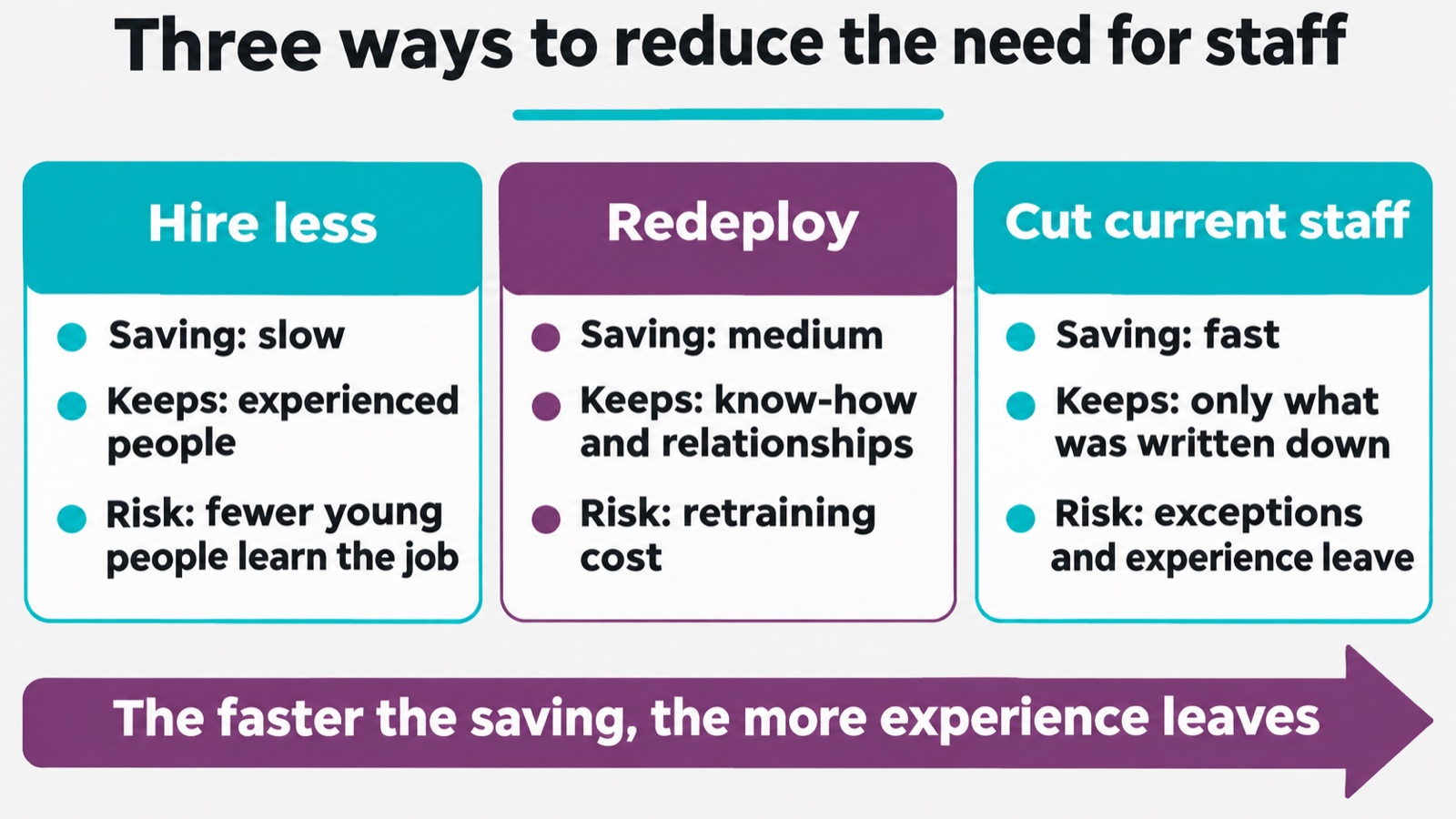
The faster the saving, the more experience leaves with it.
Data so far suggests that companies adjust mostly through the first route. A Stanford team using payroll data for millions of US workers found that employment of 22-25-year-olds in the jobs most exposed to AI is 19% below where it would be had it kept pace with less-exposed jobs, with no comparable gap for experienced workers. The gap comes mainly from hiring fewer young people, not from more layoffs. The authors call it an early signal, not proof of cause.
The most cited case points the same way. Klarna, a Swedish payments company, reduced its workforce by about 40%, from about 5,000 to almost 3,000 people by its CEO's count, mainly through a hiring freeze and natural staff turnover, with AI as one factor among others, according to CNBC in May 2025.
Hiring less is not always possible. If demand is falling or few people leave each year, cutting current staff can be the right call, as long as it is chosen knowingly, not by default.
Standard work is easy to automate; exceptions, judgement and relationships are not
AI takes over tasks, not whole roles. Most office roles have two parts: standard work that follows rules and repeats every day, and exceptions, judgement and relationships, meaning what to do when a case does not fit the rules and whom to call to fix it.
Common signs: once AI reads orders, checks stock and creates delivery orders, most orders need no one, and cutting the order team looks like an easy saving. Then come the exceptions: a price that is not on the price list, an order that takes a customer over the credit limit, a delivery date that clashes with another shipment. If the person who knew how to handle them has left, the CEO has removed a fixed cost, the sales manager and the chief accountant have gained unplanned work, and those who stay read it as a signal of what comes next. The decision rested on the standard part of the work only.

Exceptions on price, credit and delivery still need someone who knows the customer.
There is a second reason to be careful: AI often learns its good answers from the best people. A study of 5,179 customer support agents at one company found that an AI assistant raised the number of issues resolved per hour by 14% on average and by 34% for new and less-skilled agents, with little effect for the most experienced. The authors' explanation: the AI spreads the habits of the best agents to everyone else. Let the best agents go, and the AI keeps what it has learned but loses its source for new cases.
The argument weakens when exceptions are rare, cheap to get wrong and easy to turn into rules. For that kind of work, cutting can be safe. The test is not how much of the work AI can do, but who handles what AI cannot, and at what cost.
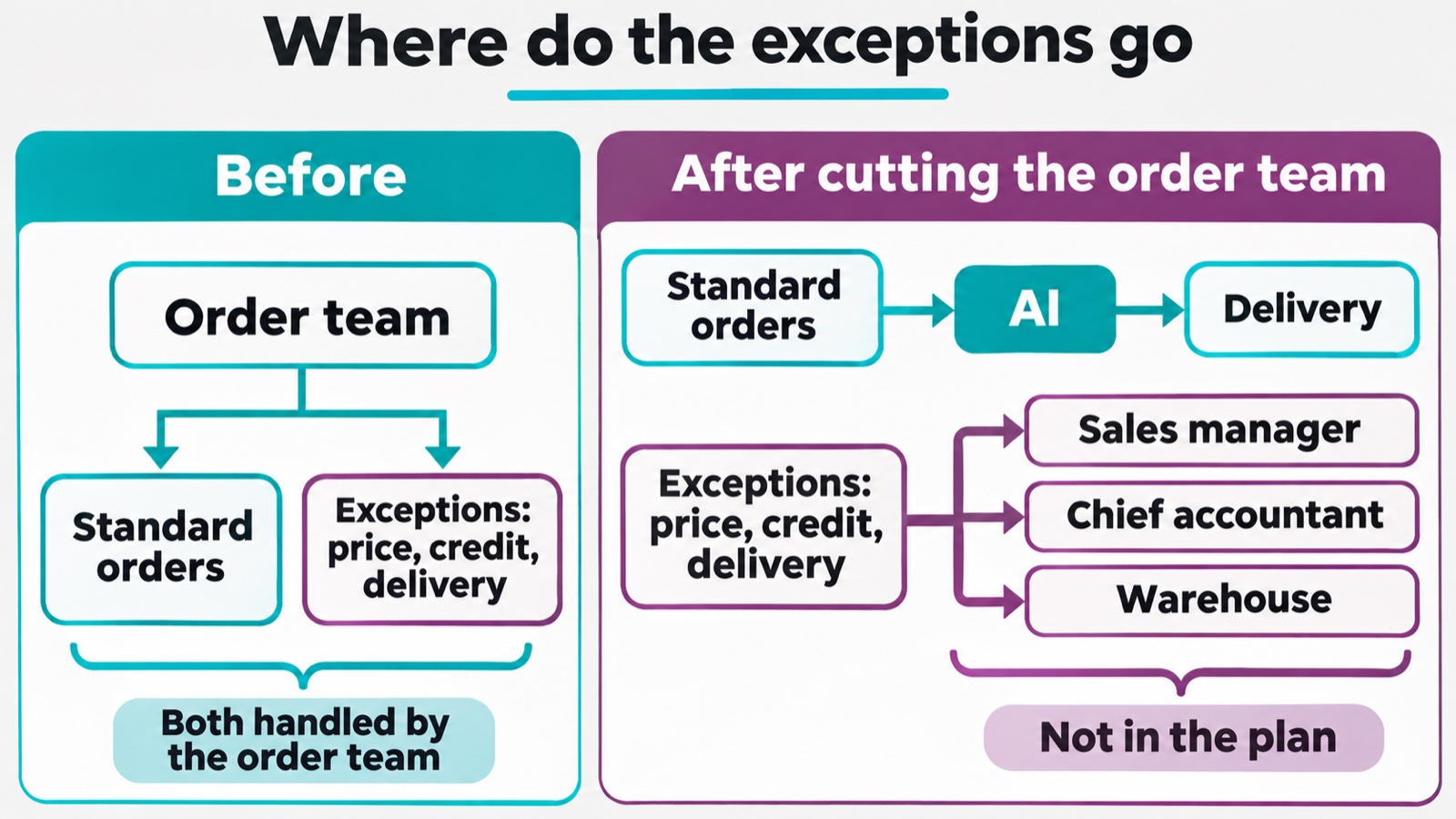
The standard flow gets faster; exceptions land on managers who were not part of the plan.
The hidden costs of AI layoffs: the saving shows at once, the costs come later
The saving appears in the payroll the next month. Most of the costs appear in other budgets and later, which is why they are easy to miss. Five of them matter most:
Checking AI's work
Someone has to check AI output, at least at first. That time usually comes from senior staff, whose hours cost the most.
Errors
A wrong price or a delivery promise the warehouse cannot keep costs money and trust. The cost lands in sales and customer service, not in the AI budget.
Disruption
While the old and new ways run side by side, work piles up and the remaining team is stretched.
Training
Those who stay must learn to work with AI and to take over the exceptions. Later hires take longer to learn without the people who used to teach them.
Dependence on the supplier
Once the people who did the work are gone, the company depends on the AI supplier's price, quality and terms. Going back costs more than staying.
The Klarna case shows how this can play out. In 2024 the company said its AI assistant did the work of 700 customer service agents. In May 2025 its CEO told Bloomberg that cost "seems to have been a too predominant evaluation factor" and that the result was "lower quality". The company began recruiting human agents again, on flexible terms. Klarna says it remains "AI-first" and does not see this as reversing its AI layoffs. One company proves nothing general, but it shows that quality costs can return months after the saving was booked.

Checking AI's work takes time from the most experienced people.
AI layoffs lose unwritten experience, and the company weakens when things go wrong
Every company has experience that was never written down: which customer always pays late but always pays, which supplier needs a call before the order goes out, what to do when the system fails at month-end. It is learned only by doing the work, and it leaves with the people who hold it.
A classic 1983 paper on factory automation described this trap as the "ironies of automation": when machines take over the routine, people are left with watching the system and stepping in when something goes wrong, the hardest tasks of all. Yet skills fade when unused, so an operator who only watches slowly loses experience. Its conclusion: automation needs a more skilled operator, not a less skilled one.
The same logic applies in an office. After AI layoffs, the remaining staff see fewer ordinary cases, so they get less practice for the unusual ones. When a real incident comes, such as a large customer dispute, a supplier failure or a tax inspection, the company discovers it has fewer people who know what to do.

Experience with unusual cases is passed on by working side by side.
There is a second loss: people who were not cut may leave too. A 2008 study of US companies across many industries found that downsizing predicts higher voluntary turnover afterwards, because those who stay feel less committed. The effect was weaker where HR practices made people feel the process was fair. Our own reading, not tested by the study: the first to leave are usually those with the most options, often the most experienced.
If the experience is already written down, checked and used by several people, the loss is smaller. Getting there takes preparation, the subject of the next article.
Scenarios for AI layoffs and the real break-even point
A spreadsheet that shows only salary saved has one scenario. A decision needs at least three, compared on the same items:
| Item | Cut now | Hire less and redeploy | Keep the team, grow volume |
|---|---|---|---|
| When the saving starts | Next month | Gradually, as people leave | No cost saving; the gain is more output per person |
| One-off costs | Allowances, transition, lost experience | Retraining | Training to work with AI |
| Running costs | Checking AI work; senior staff handle exceptions | Checking AI work by experienced staff | Checking AI work |
| Risk to quality and in an incident | High at first | Low | Low |
| Fits when | Demand is falling and the role really disappears | Some people leave each year and the business is stable | Demand is growing |
The real break-even point of AI layoffs is the month in which the salary saved, added up, exceeds all of the costs above, including errors and lost customers. Few companies can calculate it precisely in advance, and no spreadsheet can promise it. What a company can do is measure it: run AI alongside the current team for two or three months and record, for each case, how long it took, who touched it, whether it was an exception, and whether there was an error.
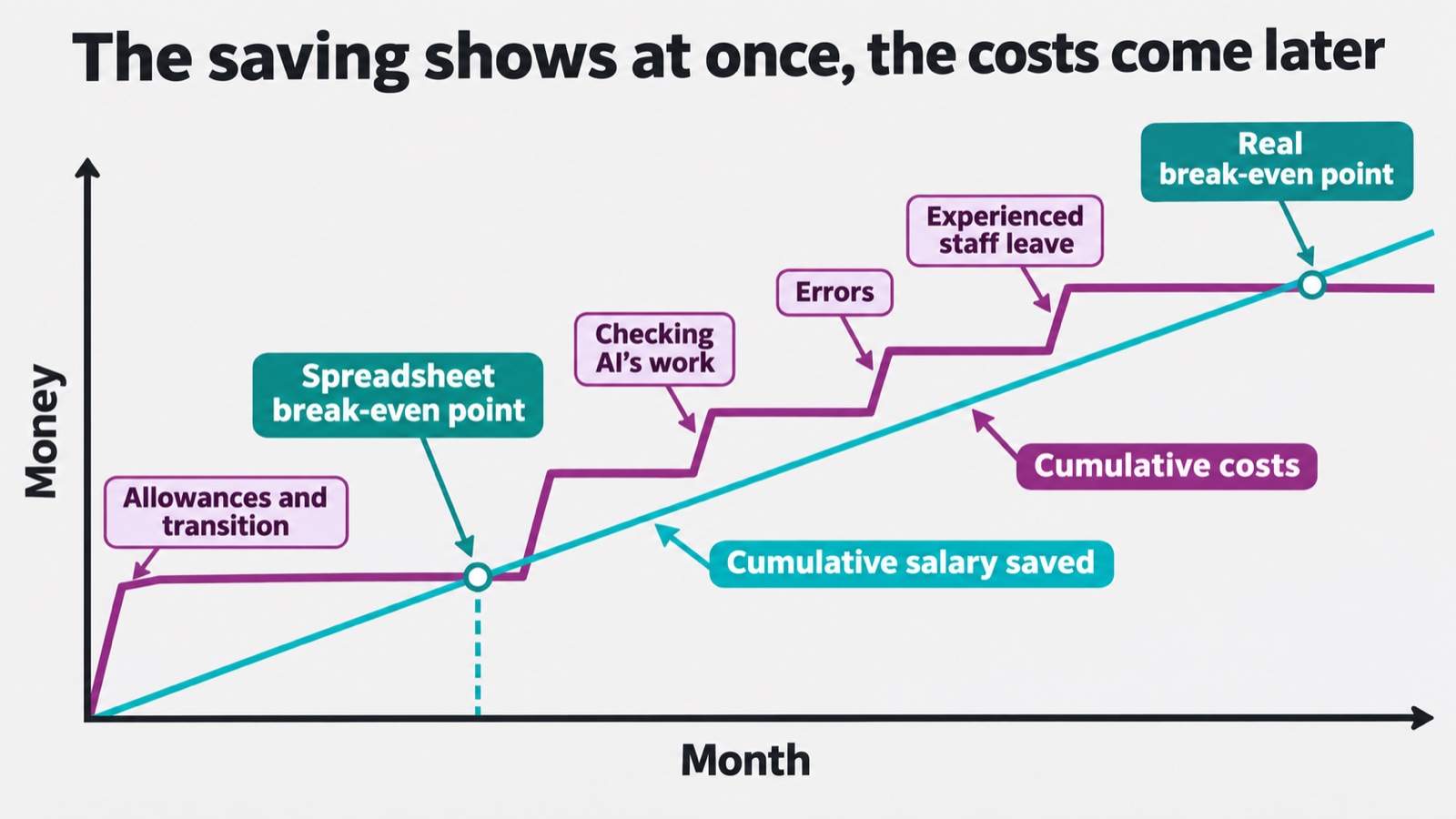
Salary saved builds up month by month; checking, errors and transition costs arrive later and are easy to leave out.
Time saved does not turn into money on its own. A Danish study linking surveys to official labour records found that two years after ChatGPT arrived, most employers in exposed occupations used AI chatbots and workers reported productivity gains, yet earnings and recorded hours barely moved: any effect above 2% could be ruled out. Employers did add new tasks, such as checking AI output. Minutes saved across many people are not yet a salary saved.
Ethics and transparency in restructuring: how you cut decides who stays
How a company carries out AI layoffs affects the people who stay as much as those who leave. Staff watch whether the criteria are clear, whether people were told early, and whether those affected got real support. That is also what the 2008 study above found to reduce the later wave of departures.
In Vietnam, part of this is a legal duty, not a choice. Under the 2019 Labour Code, a change of process, technology or machinery counts as a change of structure or technology (Article 42). When it affects the jobs of many employees, the employer must draw up and carry out a labour use plan (Article 44), give priority to retraining people where new positions exist, consult the employee representative organisation, notify the provincial People's Committee and the employees 30 days in advance, and pay a job-loss allowance of one month's salary for each year worked, at least two months (Article 47). Check the current text and take legal advice before acting.
Beyond the law, three practices separate a fair restructuring from a damaging one:
- Say early what AI will change and what it will not, before rumours say it for you.
- Use criteria people can see: which tasks disappear, not who is liked.
- Offer a real path first: retraining, a new role, or support to find other work.
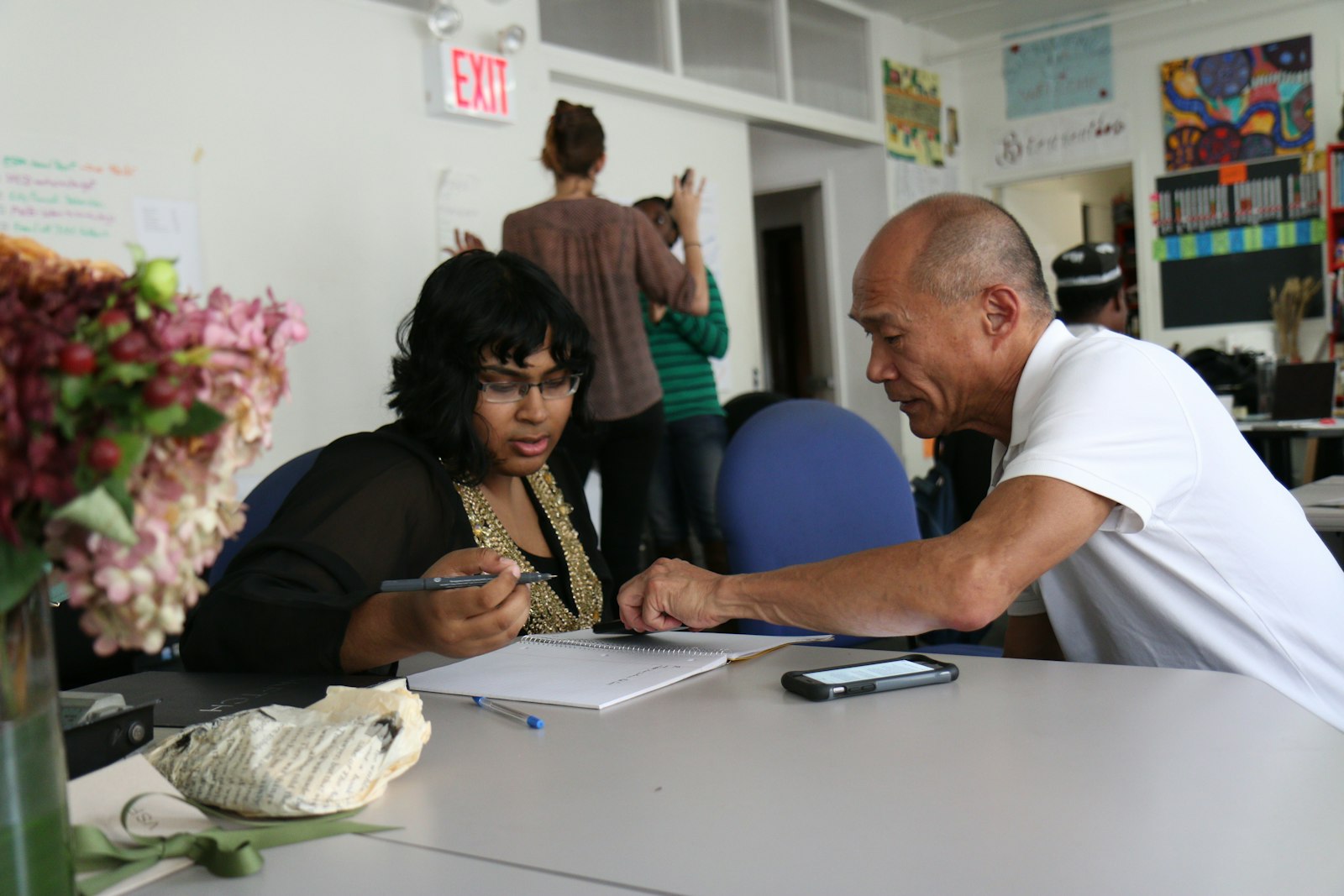
Retraining is both a legal priority in Vietnam and the cheapest way to keep experience.
Four things to do before deciding on AI layoffs
Map tasks before mapping positions
List the tasks of each role. Mark which AI can do alone, which need a person to check, and which need an expert. Decide on positions only after that.
Run a controlled pilot and measure quality and exceptions
Run AI alongside the current team. Measure errors, the share of exceptions, checking time and customer complaints. Agree in advance what result counts as good enough.
Name the capabilities to keep
For each area, such as pricing, credit, delivery and key customers, name who will handle exceptions afterwards and who backs them up. If the answer is nobody, the cut is not ready.
Plan the transition, retraining and support
Decide a path for each person: stays in the role, moves, is retrained, or leaves with support. Keep experienced people until their experience is written down and checked.
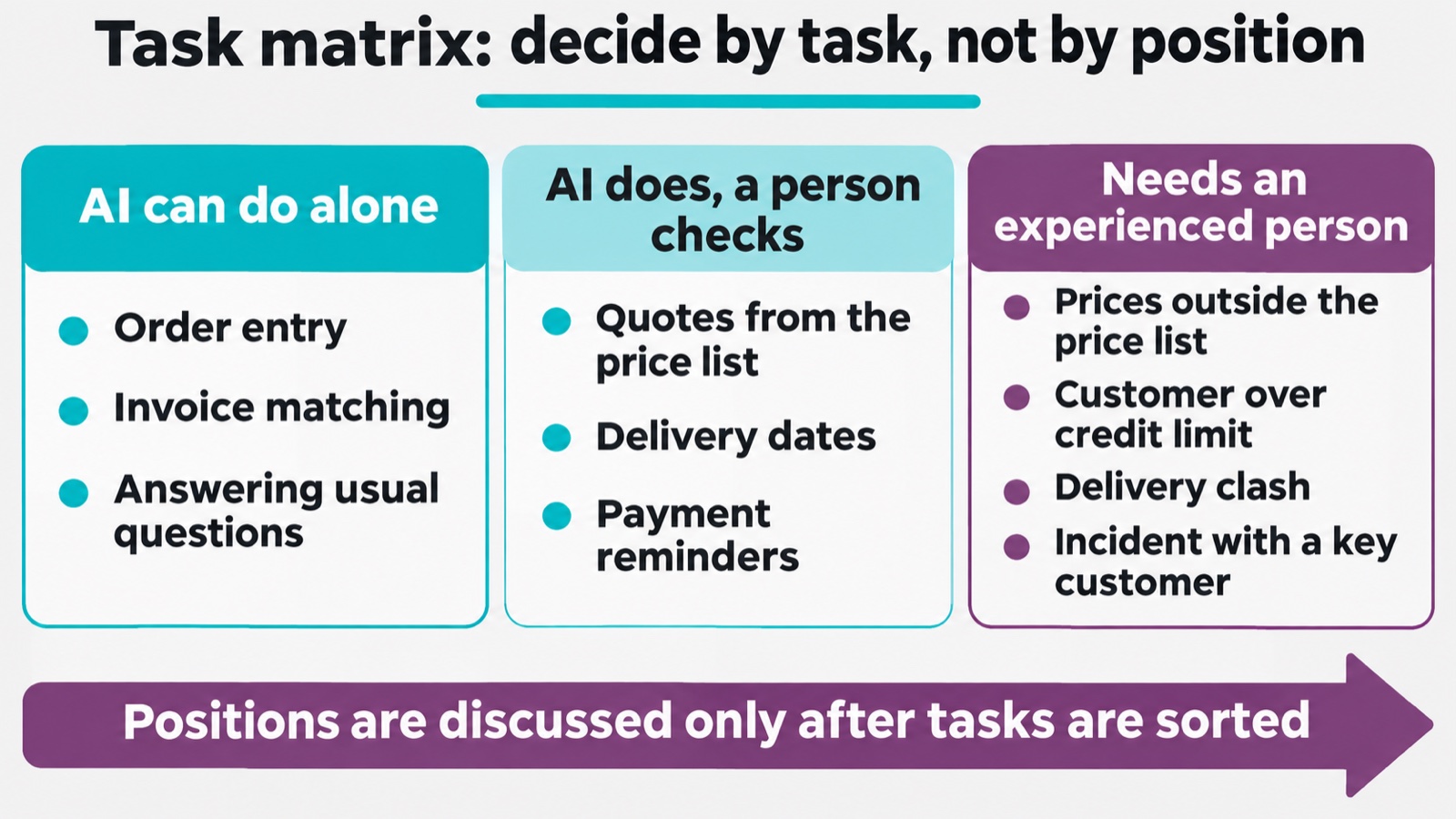
Decide on tasks first; the decision on positions follows from the matrix.
Points to keep in mind
Cutting is not always wrong. When the work truly disappears, a clear and fair cut can be better for everyone than keeping roles with no future.
AI does not always reduce headcount. In the Danish data, wide use of AI has not changed earnings or hours. The IMF estimates that almost 40% of jobs worldwide are exposed to AI, and that in advanced economies roughly half of the exposed jobs may benefit from AI rather than be replaced by it. The outcome depends on what the company does with the time saved.
The evidence has limits. The studies cited come from the US, Denmark and one company's customer support team, and Klarna is a single case reported by the press. None of them measures Vietnam. Read them as signs of a pattern, not as a forecast for your company.
Separate the goal from the way it is carried out. Most of the damage from AI layoffs described here comes from speed and from the order of the steps, not from the goal of lowering cost.
The direction Viindoo has chosen
When AI takes over order processing, it handles most orders well. What breaks the plan are three ordinary exceptions: a price outside the price list, an order over the credit limit, a delivery date that clashes with another shipment. They are never on the spreadsheet used to decide AI layoffs, because they live in the heads of the people about to be cut.
For Viindoo, this is a problem of visibility before it is a problem of cost. A company can only decide well about people once it can see the work: which tasks are routine, which deviate, who carries them. So Viindoo builds its Agentic AI business management platform around bringing orders, approvals and exceptions into one system where each step is recorded, and around starting where the work hurts most, one area at a time.
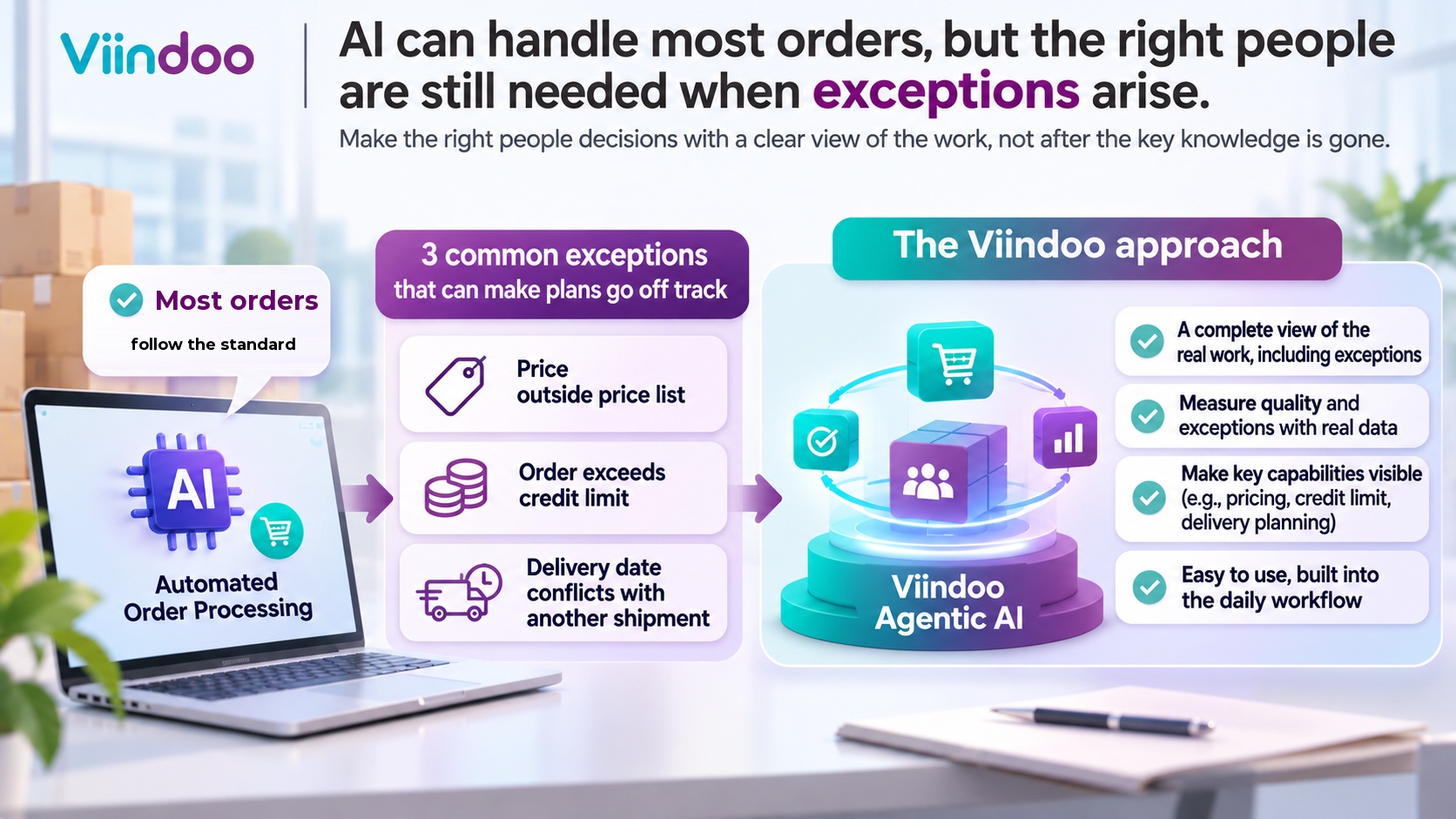
AI handles the standard orders; the exceptions show which people the company must keep.
That supports the four steps this article recommends before AI layoffs. A task map can be built from how orders actually ran, exceptions included, rather than from job titles. A controlled pilot in one area can be measured on quality and exceptions with real figures. And the capabilities to keep become visible: the people who decide on off-list prices, credit limits and clashing deliveries, because AI suggests and warns while people decide and sign.
AI also has to be easy for the people who stay after any round of AI layoffs: they should not need to become technology experts to work with it. The complex part, meaning data, authority, approvals and history, is carried by the platform underneath. Viindoo plays that backbone role, so bringing AI in does not shake day-to-day operations.
A platform does not calculate the full cost of restructuring and does not make staffing decisions. It only helps make sure that any decision on AI layoffs is taken with the exceptions in plain view, not after the people who understood them have left.
Four questions to check where you stand
- Are we cutting people, or hiring fewer as people leave, and why that route?
- After automation, who handles exceptions on price, credit and delivery, and does that person know it yet?
- Have we counted the costs of checking, errors, transition and allowances, or only the salary saved?
- Which capability must we keep, and is it held by more than one person?
Frequently asked questions
No. When tasks truly disappear, it can be the right decision. It becomes costly when the company cuts before knowing who will handle the exceptions, or without a clear, fair and lawful process.
Not by job title. It depends on how much of each role is standard work and how often costly exceptions occur. A two- to three-month pilot that records every case answers this far better than any general estimate.
Hiring less keeps experience and avoids allowances, but saves slowly and, over time, leaves fewer young people learning the job. Layoffs save faster with more risk to quality. The choice depends on demand and on how many people leave each year.
Under the 2019 Labour Code, a change of technology that affects many employees requires a labour use plan, priority for retraining, consultation with the employee representative organisation, 30 days' notice to the provincial People's Committee and the employees, and a job-loss allowance. Check the current text with a lawyer.
Next in this series: if the company keeps its good people, or wants to keep their experience after they leave, can AI simply learn all its processes? AI has learned every process: does the company still need its best people?
Sources
- Brynjolfsson, E., Chandar, B., & Chen, R. (2025, revised Aug 2026). Canaries in the Coal Mine? Six Facts about the Recent Employment Effects of Artificial Intelligence. Stanford Digital Economy Lab.
- Brynjolfsson, E., Li, D., & Raymond, L. (2025). Generative AI at Work. The Quarterly Journal of Economics, 140(2), 889-942. NBER Working Paper 31161.
- Humlum, A., & Vestergaard, E. (2025, revised Mar 2026). Still Waters, Rapid Currents: Early Labor Market Transformation under Generative AI. NBER Working Paper 33777.
- Trevor, C. O., & Nyberg, A. J. (2008). Keeping Your Headcount When All About You Are Losing Theirs: Downsizing, Voluntary Turnover Rates, and the Moderating Role of HR Practices. Academy of Management Journal, 51(2).
- Bainbridge, L. (1983). Ironies of automation. Automatica, 19(6), 775-779.
- Palmer, A. (14 May 2025). Klarna CEO says AI helped company shrink workforce by 40%. CNBC. Ivanova, I. (9 May 2025). Klarna plans to hire humans again. Fortune, citing Bloomberg.
- Georgieva, K. (14 Jan 2024). AI Will Transform the Global Economy. Let's Make Sure It Benefits Humanity. IMF Blog.
- National Assembly of Vietnam (2019). Labour Code No. 45/2019/QH14, Articles 42, 44, 47.