Employees afraid of AI are no longer a fringe group: 52% of US workers say they are worried about how AI will affect their workplace (Pew Research Center, 2024). In organisations that have already adopted AI, nearly one in four believe their own job could be eliminated within five years (Gallup, 2026). These are the very people now being asked to teach AI how they do their work.
They keep using AI every day for their own tasks, because that helps them. They hesitate at one step: putting their experience into the company's shared AI, because that step could make them easier to replace. And a company's most valuable experience is rarely on paper. It sits with a few people who know how to rush an urgent order, which supplier is about to deliver late, which customer must get a phone call before a quote. Without them, the company's AI learns only the easy part of the job.
An instruction from the top will not fix this. Rules that make sharing worth it for the person who shares will. This article explains why the best people hold back most, what the research actually shows, and the four things leadership should settle before asking anyone to teach AI.
Using AI for yourself and teaching the company AI are two different things
Companies often lump three different behaviours under "using AI". For the employee, the gain and the risk of each are very different.
| What the employee does | Who gains | What the employee risks |
|---|---|---|
| Uses AI for their own work | The employee: faster work, fewer mistakes | Almost nothing |
| Teaches a colleague | The team | Some advantage, but the colleague still needs them |
| Puts their experience into the company AI | The company | Their know-how can be reused without them |
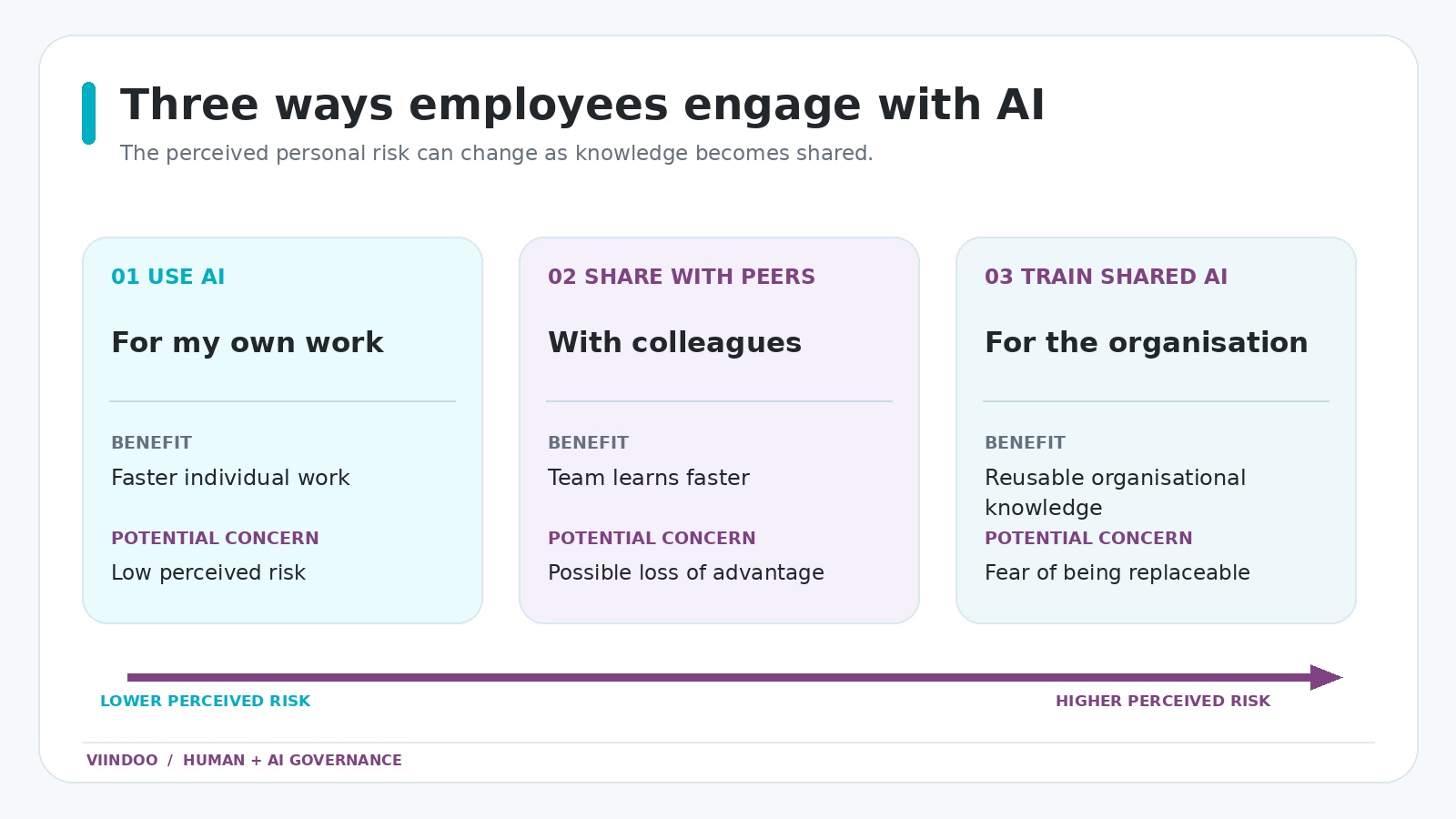
The further knowledge travels from the employee, the greater the risk they see for themselves.
The first behaviour needs no encouragement: the employee is the one who benefits. The second has always depended on trust; people teach colleagues when they do not lose by it. The third is new. A colleague who learns from you still needs you. An AI that learns from you can repeat your answers as many times as the company wants.
That is why the common assumption is wrong: "they already use AI a lot, so they will happily help the company AI learn." Someone who uses AI well understands better than anyone how much of their own job it could take over.
Employees afraid of AI: why the best people hold back most
Every company has experience that never made it into a procedure. Researchers call it tacit knowledge: we know more than we can tell. In small and mid-sized companies it usually takes three forms:
Handling exceptions
Procedures cover the normal case. The experienced person knows what to do when a code is missing, a customer changes the order mid-production, or a supplier's papers are wrong.
Judgement
Knowing when an odd number is a typing error and when it is a real warning sign.
Relationships
Knowing whom to call at the customer, the supplier or the authority to get things moving.
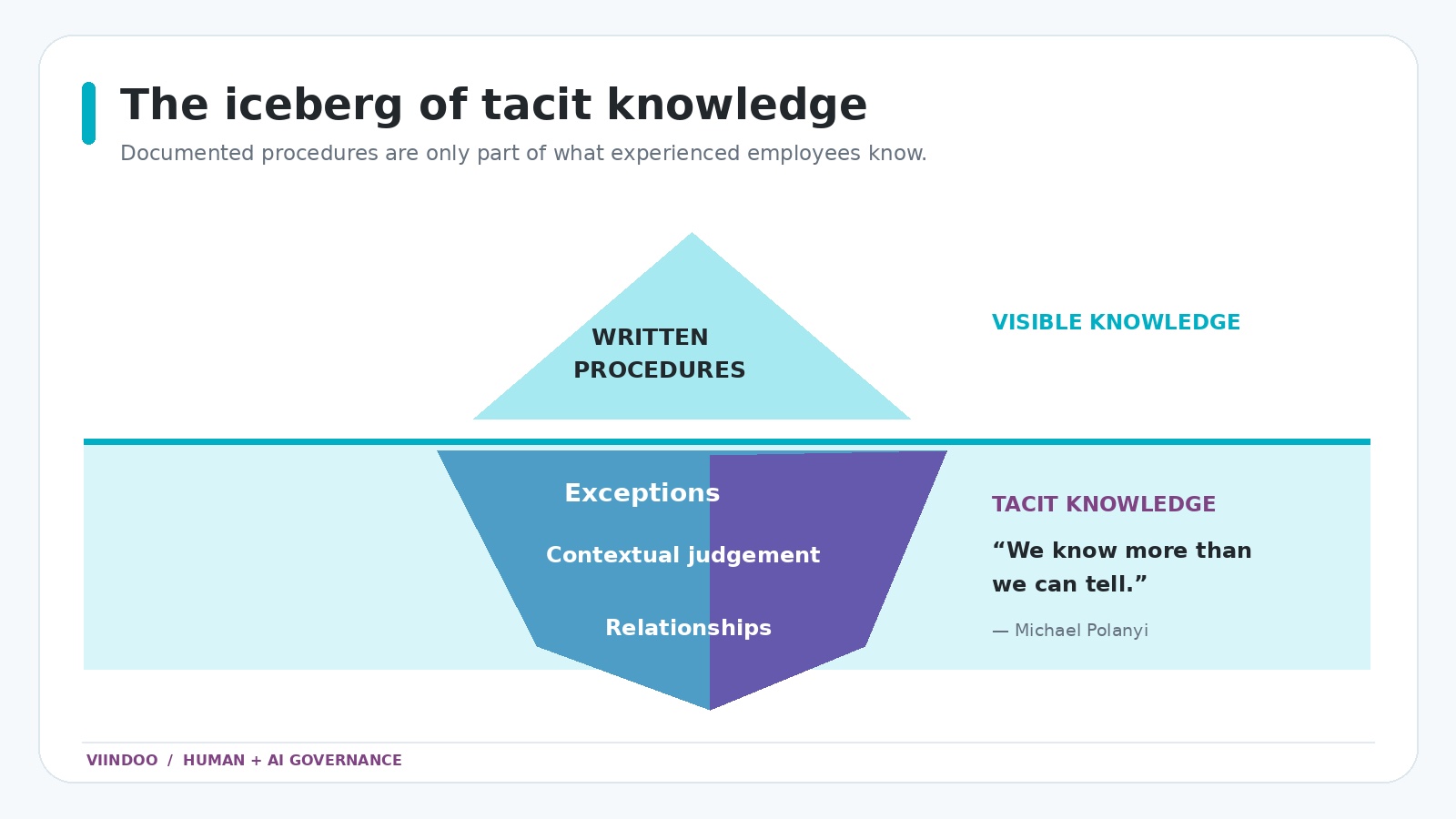
Written procedures are only the visible tip of what experienced staff know.
These three things are exactly what makes a person hard to replace. They are also what gives that person weight when discussing salary and position. So when a CEO asks them to "write down the exceptions so the AI can help", the employee hears something else: give the company the thing that makes you valuable. This is why many employees afraid of AI are among the most experienced.
Common signs: the most valuable know-how sits with one or two people, such as the buyer who knows how to handle short deliveries, wrong specifications and sudden price changes. The CEO wants it in an AI assistant so new staff can look it up. For the CEO the benefit is depending less on one person; for that person, the same move means being needed less. Both are right. The problem is not goodwill on either side, but that one side gains and the other may lose.
Four fears of employees afraid of AI, and how common they really are
"Afraid of losing my job" is only one of four fears employees can have when asked to teach AI:
Losing the job
If AI can do my part, my position is no longer needed.
Losing their edge
I keep the job but stop being indispensable, and lose weight in salary talks.
Not getting credit
My experience makes the AI good, but the credit goes to the AI project or my manager.
Getting more work
On top of my job I now write documents and check the AI's answers, and nothing is taken off my plate.
How many employees afraid of AI are there? Two large surveys give a clearer picture than general opinions do:
| Survey | Finding |
|---|---|
| Pew Research Center, 5,273 US workers, October 2024 | 52% are worried about how AI will affect the workplace; 36% are hopeful; 32% expect fewer job opportunities for themselves |
| Gallup, 23,717 US employees, February 2026 | 18% think their job is likely to disappear within five years because of AI or automation; 23% in companies that already use AI |
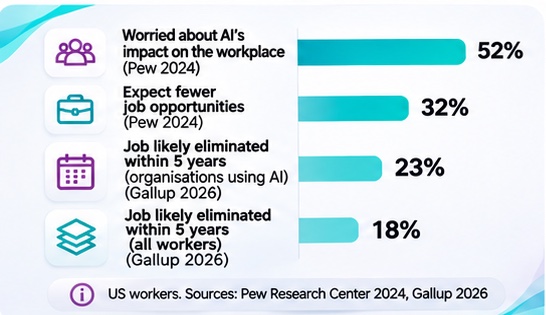
Worry is widespread; employees afraid of AI taking their job are about one in five. Sources: Pew Research Center 2024, Gallup 2026.
Read together, the numbers say two things. General worry is common, about half of workers. The specific fear of losing one's job is held by about one in five, and it is higher where AI is already in use. These are two different survey questions, not two readings of the same measure. So "most employees are afraid of AI" is not true. What is true is that a real group, often the people who hold the key experience, have good reasons to hold back.
One caution: both surveys were done in the United States. There is no reliable public survey of this question in Vietnam yet, so the numbers show the pattern, not the size of the issue in your company.
Hiding know-how, or simply lacking the conditions?
Research on knowledge hiding at work describes three common behaviours when someone does not want to share:
- Stalling: giving partial information, promising to send something and never sending it.
- Playing dumb: saying "I don't really know".
- Finding a reason: "that's confidential", "it's not the right time".
The same research finds that hiding know-how usually goes with distrust. In an AI project it shows up as documents so general that the important cases are missing, the answer "every case is different", or documentation that never gets finished.
But before a manager concludes that employees afraid of AI are hiding know-how, four other explanations need to be ruled out. Each one needs a different fix:
| What you see | Could be hiding know-how | Or could simply be |
|---|---|---|
| Vague documents | Keeping back the valuable part | Experience that is genuinely hard to put into words |
| Slow progress | Deliberate delay | No time given; documentation competes with the real job |
| "Every case is different" | Avoiding the task | The work really does depend on judgement |
| Distrust of the AI's answers | Protecting one's role | A fair quality concern: if the AI is wrong, they still take the blame |
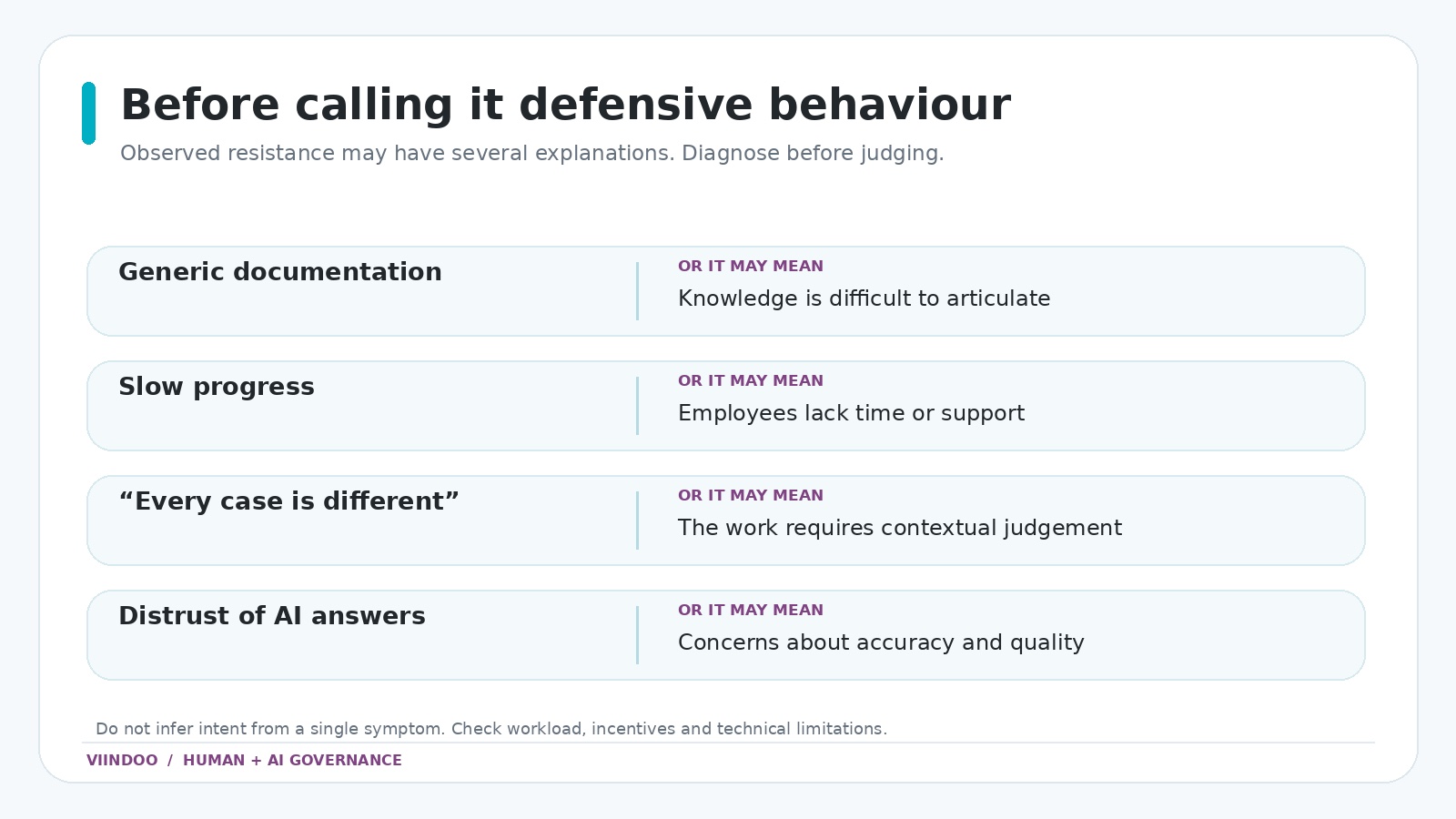
The same sign can have four different causes, each needing a different response.
Telling these apart is the job of the direct manager, not the IT team. Treating a time problem or a quality concern as an attitude problem is the fastest way to turn a cooperative employee into one who really does hold back, the same resistance to change seen in any transformation project.
The vicious circle: the more you push, the less you get
If the company pushes harder without addressing the four fears, a vicious circle can form:
Pressure to hand over
Feeling insecure
Sharing the minimum
AI learns only part
Weak answers, more pressure
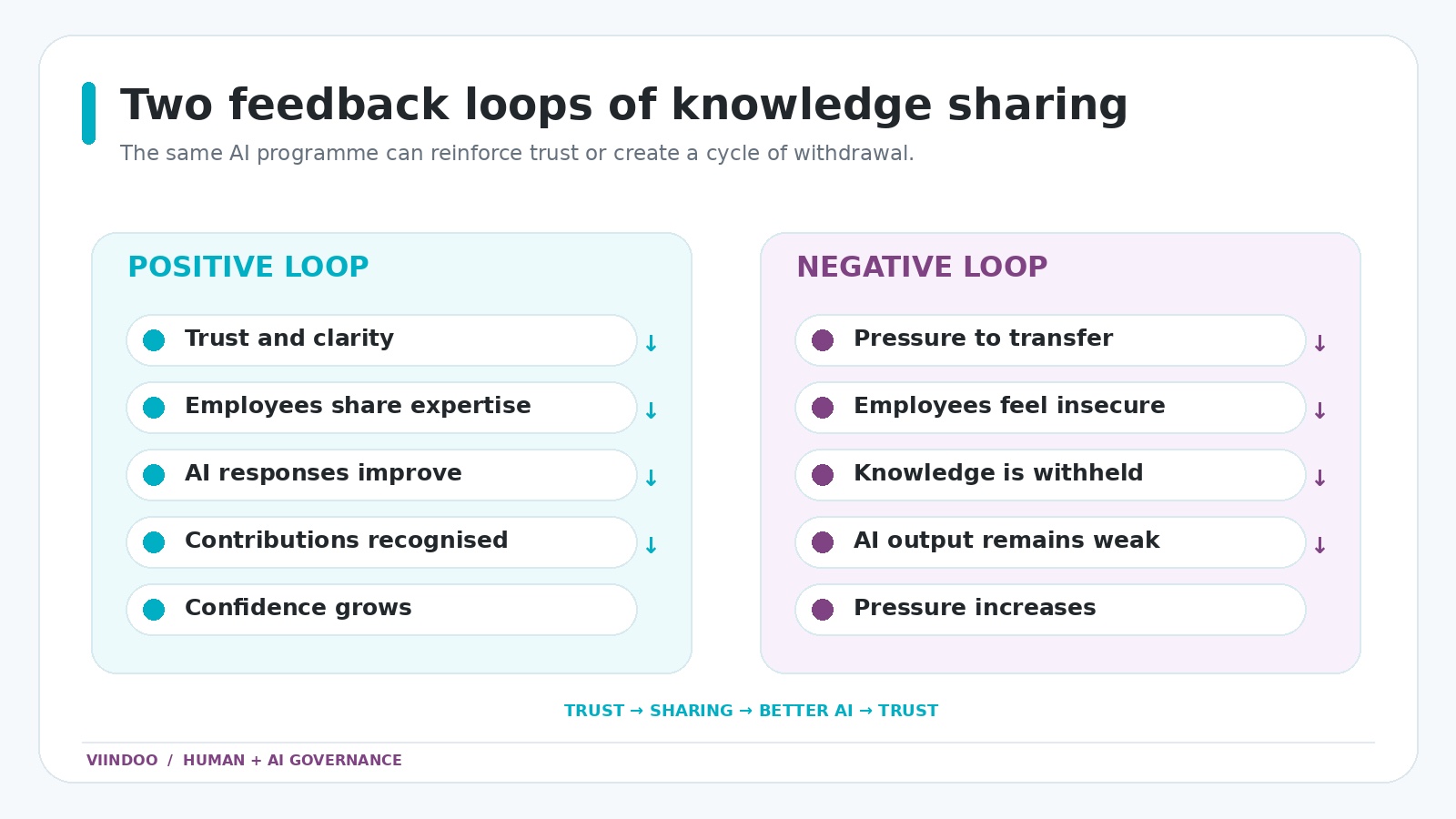
The same project can run in either loop; what decides is how the conditions for sharing are designed.
Recent studies support this pattern. Research in China in 2025, with 348 office workers surveyed three times, found that people working closely with AI felt less secure about their jobs, and those who felt less secure shared less. Another study, published in 2024, found the same link and showed it is weaker among people who feel confident learning AI. A review of 248 studies found that whether people hide know-how depends a lot on how they are managed and rewarded, not only on their personality.
These findings should not be overstated. They are based on what people report about themselves, mostly in China, and the effects are moderate. They do not prove that AI makes employees hide know-how. They show that when people feel insecure, they share less.
The point for a CEO is that nobody in this circle is acting in bad faith, and it does not even need employees afraid of AI at the start. Leadership sees weak AI answers and pushes harder. Employees see more pressure and no commitment, and hold back more. The company pays for AI and ends up with a system that only knows the surface of its own processes.
What reassures employees afraid of AI is management, not the tool
If the cause is that one side gains and the other may lose, the fix has to change that balance. Asking for a "sharing culture" does not.
Gallup's 2026 analysis of about 30,000 US workers gives the clearest evidence. There are fewer employees afraid of AI where people feel respected: workers who feel respected, or feel the company cares about them, are about 6 to 7 percentage points less likely to fear being replaced. Among heavy AI users the gap reaches 11 points. Using AI more does not reassure people on its own: heavy users are more than twice as likely to expect their job to disappear.
This matches older research on teams by Amy Edmondson: people speak up and share what they know when they feel safe doing so, and that feeling depends mainly on how their direct manager behaves.
Employees' fear of AI is not fixed by more AI or more training. It is fixed by how they are managed. This is a management problem, not a technology problem.
Before asking employees to teach the AI, a company needs clear answers to three questions they are already asking:
- What will my experience be used for? To help new staff, to cut repetitive work, or to cut positions. If the company does not say, people will guess, and they usually guess the worst.
- Who gets the credit? When the AI handles a hard case well, that is the work of the person who taught it, and it should count in their evaluation.
- What is my role afterwards? A good practitioner does not become unnecessary once their experience is written down. They move from handling cases to setting the rules, checking the AI and handling new situations. That role is only real if it appears in their job description and evaluation.
Four things to settle before asking employees to teach AI
Say honestly what AI is for and what it means for staff
If the goal is to grow without hiring more, say so. If some roles will change, say which and when. A clear answer, even an unwelcome one, builds more trust than silence.
Reward quality, not volume
Counting documents produces many poor documents. Reward experience that is actually used, solves real cases and reduces mistakes, as part of a wider total rewards approach.
Link sharing to career growth
A bonus helps, but a say in how AI is used, a mentoring role and a path to expert positions usually matter more.
Give each area an owner, a checker and a review date
Each area of knowledge in the AI needs one person who keeps it correct, one who checks it, and a date to review it. This protects quality and turns the expert into an official role, not someone used once and forgotten.
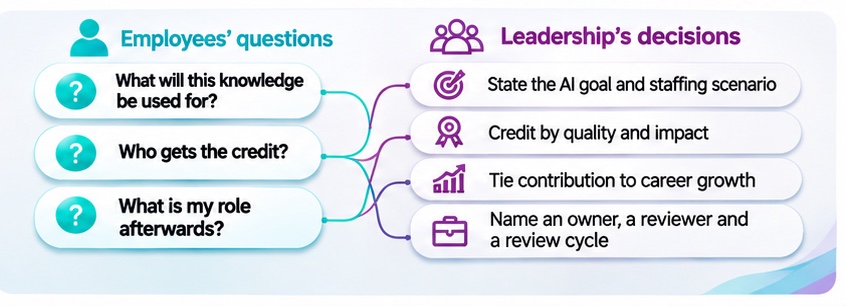
Each decision answers a question employees are already asking themselves.
Points to keep in mind
Not every hesitation is hiding. Much of the difficulty comes from experience being hard to put into words, from lack of time, or from fair concerns about quality. Treating every delay as an attitude problem leads to the wrong fix.
Research on AI specifically is still new. Most studies on hiding know-how look at colleagues, not AI. Studies on AI are recent, small and from a few countries. Read the AI-related points here as well-founded management judgement, not proven rules.
The interests of company and employee cannot always be aligned. Sometimes AI really does make a role unnecessary. Good management cannot remove that conflict. It can only make sure it is handled openly, instead of through people quietly keeping back what they know.
The direction Viindoo has chosen
Whether the know-how of an experienced employee reaches the AI does not depend on the AI. It depends on whether that person can see what happens to them afterwards: who benefits, who gets the credit, who still decides. Employees afraid of AI are usually not afraid of the tool; they are afraid of rules nobody has written down.
Viindoo starts from that point. AI creates value not through how clever the model is, but through the management system it works inside. Once AI joins operations it is a new kind of team member, and the company has to decide its role the way it decides anyone else's: what work it does, what it may decide, who answers for it. That is why Viindoo is building an Agentic AI business management platform, where the whole company runs on one platform and the company itself sets the rules for people and AI alike.
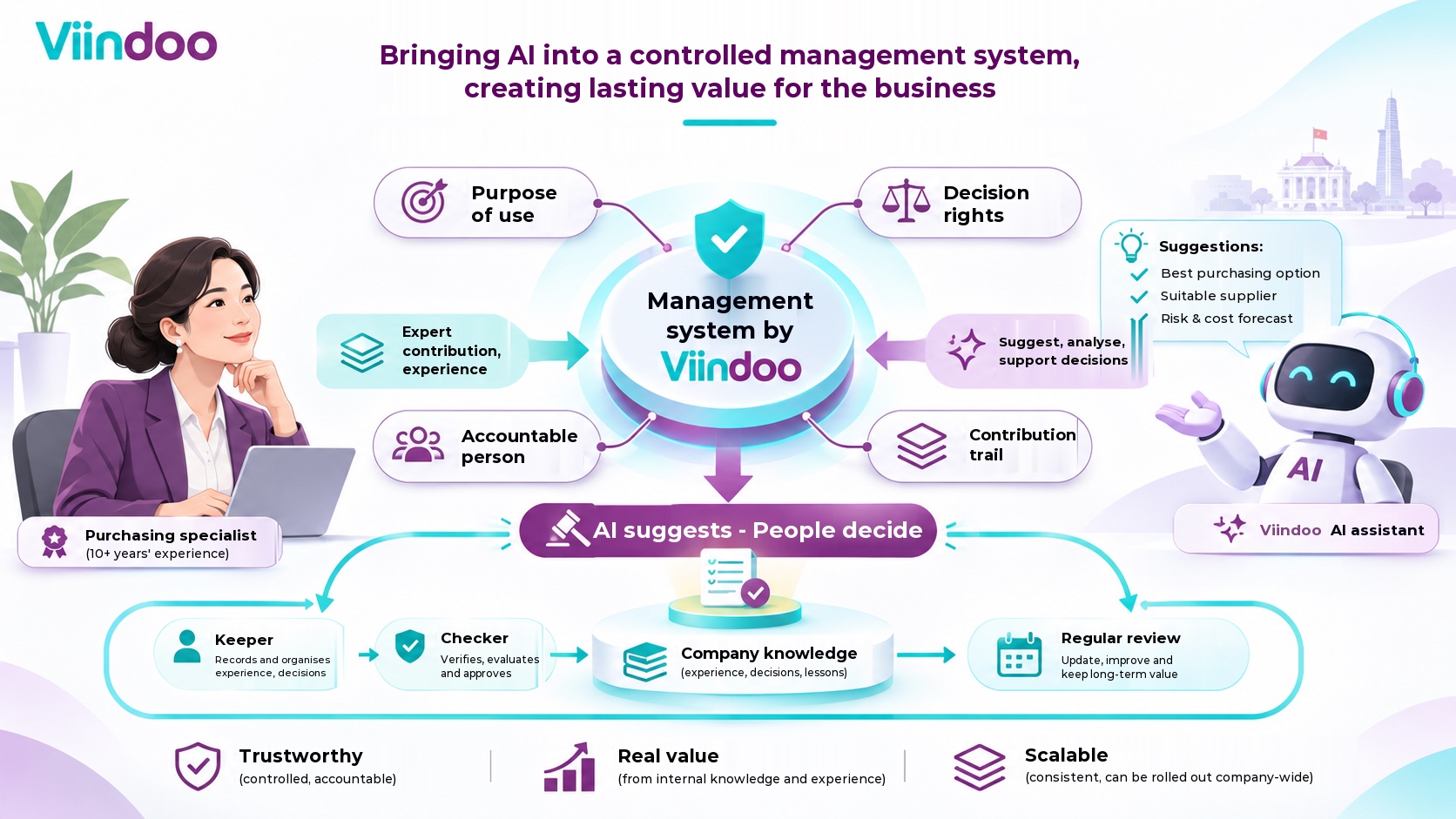
AI suggests, people decide: expert know-how enters the system with a keeper, a checker, a regular review and a record of who contributed.
The four decisions in this article then stop being promises and become part of how work runs. What AI is for is written as a rule staff can read. Each area of experience has a named owner and checker, so each person's know-how enters the system with their name on it. And experienced staff move up to deciding the cases the AI has not seen, because AI supports, people stay accountable and in control.
For the new staff who look things up, using AI should be as simple as asking an experienced colleague in the middle of their work, with no need to become an AI expert. The hard part, meaning data, authority and the record of who contributed what, is carried underneath. Viindoo plays that backbone role, so AI feels light for the people doing the work and stays stable and safe for the company.
Software cannot replace a bonus policy, a career path or an honest conversation about staffing plans; those remain leadership's work. What a platform can do is put the rules where everyone can see them, so the fear of AI replacing people is answered by how the company runs, not by reassurance alone.
Four questions to check where you stand
- Have we told employees clearly how AI will change their work?
- When the AI handles a hard case well, who gets the credit?
- Which experience in the company sits with only one person, and what reason does that person have to share it?
- When someone is slow to share, has their manager checked whether it is hiding, lack of time or a quality concern?
Frequently asked questions
Not necessarily. Using AI for yourself and teaching the company AI have different gains and risks, and good users see more clearly how much of their job AI could do. Gallup (2026) found heavy AI users are more than twice as likely to expect their job to disappear.
No. In the United States about 18-23% think their job is likely to disappear because of AI within five years (Gallup, 2026), although about half have a general worry about AI at work (Pew, 2024). There is no comparable reliable data for Vietnam yet.
It helps, but it does not answer the worry about one's role afterwards. Feeling respected and the way people are managed matter a lot. Combine rewards with an expert role and a say in decisions.
Change the conditions and watch. If they get dedicated time and progress still does not improve, and the documents still skip the hard cases, it is likely a trust problem. If progress improves right away, it was workload.
No. Part of it, especially judgement in new situations and personal relationships, is very hard to write down. That is why good people are still needed after the AI has been loaded with documents, a topic a later article in this series looks at in detail.
Next in this series: once employees are willing to share and AI starts to speed up the work, another question follows: who does the extra productivity belong to? AI raises productivity, but who owns the gains?
Sources
- Pew Research Center (25 Feb 2025). U.S. Workers Are More Worried Than Hopeful About Future AI Use in the Workplace. 5,273 US workers, 7-13 Oct 2024.
- Gallup (12 Apr 2026). Rising AI Adoption Spurs Workforce Changes. 23,717 US employees, 4-19 Feb 2026.
- Gallup, Makridis, C. (9 Sep 2026). Using AI More Does Not Reassure Workers, Managers Do.
- Connelly, C. E., Zweig, D., Webster, J., & Trougakos, J. P. (2012). Knowledge hiding in organizations. Journal of Organizational Behavior, 33(1), 64-88.
- Shen, Lythreatis, Singh & Cooke (2025). A meta-analysis of knowledge hiding behavior in organizations. Journal of Business Research, 186.
- Kim & Kim (2024). How AI-induced job insecurity shapes knowledge dynamics: the mitigating role of AI self-efficacy. Journal of Innovation & Knowledge, 9(4).
- Li, Liao, Tsai & Wu (2025). Employee-AI collaboration and knowledge hiding. Behavioral Sciences, 16(1), 13.
- Edmondson, A. (1999). Psychological Safety and Learning Behavior in Work Teams. Administrative Science Quarterly, 44(2), 350-383.
- Nonaka, I. (1994). A Dynamic Theory of Organizational Knowledge Creation. Organization Science, 5(1), 14-37.
- Polanyi, M. (1966). The Tacit Dimension.