AI productivity gains are real, but they do not land where most CEOs expect. In a study of 5,172 customer support agents, an AI assistant raised the number of requests resolved per hour by 15% on average. The biggest winners were newcomers. The best performers barely got faster, even though their answers were what the AI learned from (Brynjolfsson, Li and Raymond, 2025).
The problem starts after the gain. Many companies measure AI by the time it saves, but few decide in advance where that time goes. By default it turns into higher targets and more work of the same kind, while pay and recognition stay the same, and the people who made the AI good carry the heaviest load. They learn quickly that improving the work means getting more of it, and the next improvement stays in their own heads.
Nobody plans this. It comes from a decision no one has made in the open: where the extra time goes. This article shows who actually creates the gain, three ways to use the time AI frees up, and four things to agree before the gains arrive.
Faster staff are not yet a more productive company
AI productivity gains can be measured at three levels. They are often mixed up, and the gap between them is where most disappointment comes from.
| Level | What it measures | Example in customer service |
|---|---|---|
| Individual | Time one person needs for one task | Minutes to answer one request |
| Process | Result of the whole chain, including waiting, rework and handovers | Days until the customer's problem is actually solved |
| Economic value | What the company actually gains | Customers kept, cost per request, repeat orders |
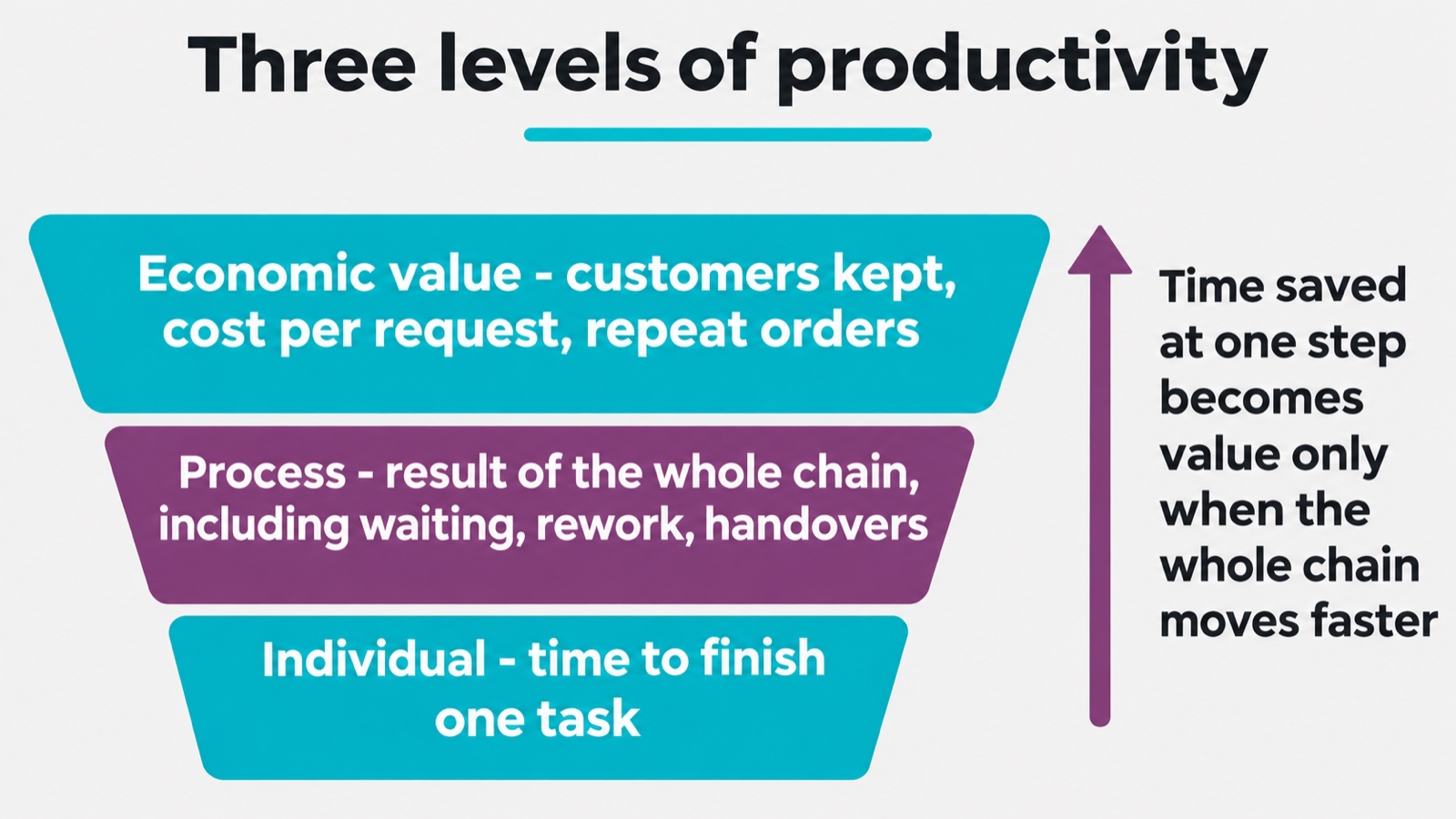
Time saved at one step becomes value only when the whole chain moves faster.
Time saved by one person becomes value only if something useful is done with it, and only if that person's step was the bottleneck. If support staff answer twice as fast but technical fixes still take a week, the customer waits just as long. The company has a faster step, not a faster process.
Two large studies show both sides of this:
| Study | Finding |
|---|---|
| Generative AI at Work: 5,172 customer support agents at one US software company, most working in the Philippines; published 2025 | With an AI assistant, issues resolved per hour rose 15% on average. Less experienced agents gained most in both speed and quality; the most experienced gained a little speed and lost a little quality. |
| Danish labour market study: 25,000 workers in 7,000 workplaces, surveyed late 2024 and linked to official earnings records | 85% of AI chatbot users said they spent the time saved on other work tasks; fewer than 10% took more breaks. Two years after ChatGPT, earnings and recorded hours showed no measurable change; effects larger than 2% were ruled out. |
Read together, the two studies say that AI productivity gains at the task level are real, but they do not move by themselves into pay, profit or time off. Where they go is decided by how work and pay are organised, in other words by management.
The distinction matters less where one step is the whole job, for example a team that only answers inbound requests with no handover. There, faster individuals do mean a faster process. In most small and mid-sized companies, work passes through several hands, and the gap is real.
Common signs: a few experienced staff spend weeks building a library of tested answers for the AI assistant, and handling time falls sharply. The manager sees more capacity, raises the target and adds new work, while bonuses stay as before. For the manager, cost per request falls. For the experienced staff, they did the extra work, now carry more volume, and newcomers using their library nearly match their numbers. Both readings are reasonable. What is missing is one decision, agreed in advance: what the saved time will be used for.

Handling time can halve while the people behind it feel they lost out.
Who actually created the AI productivity gains
AI productivity gains are recorded at the point of use: the person who answers the customer, and the manager whose team hits the target. But at least four groups contributed, and the work of two of them is usually invisible.
Domain experts
They write the answers, the exceptions and the rules the AI draws on. Without them the AI gives generic answers.
Checkers
They review AI answers, catch mistakes and correct the library. Their work shows up as errors that did not happen, which no report counts.
IT and system staff
They connect the AI to the right data, set who can see what and keep it running.
Daily users
They use the AI on real cases, report wrong answers and suggest new ones. They are the source of the next improvement.
The customer support study shows what can happen to the first group. The AI spread the working habits of the best agents to everyone else. The top performers supplied many of the examples the AI learned from, yet their own productivity barely rose. Because bonuses at that company were based on performance relative to colleagues, the researchers note that top performers might even see their pay fall. They conclude that the results raise the question of how workers, especially top performers, should be paid for what they give to AI systems.

An expert's contribution is made once and used by everyone, so it rarely appears in their own numbers.
The mechanism is simple. An expert's contribution is made once and used by everyone, so it does not appear in their own results. Unless someone records it, it disappears into the team average. The risk is smaller where building shared knowledge is already written into someone's job and evaluation, for example a dedicated quality or training role.
Three ways to use AI productivity gains
Once time is saved, the company has three basic choices. Each is legitimate. They differ in who gains first and what is put at risk.
| Choice | Who gains first | Main risk |
|---|---|---|
| Do more: the same people handle more volume | The company: lower cost per unit, growth without hiring | Turns into a productivity tax if targets rise and nothing else changes |
| Do better: time goes to quality, faster response, fewer errors, training newcomers, hard cases | Customers and the team; the company later, through customers kept | Harder to measure; on a volume report it can look as if nothing changed |
| Use fewer resources: less overtime, fewer new hires or fewer people | The company: direct savings | Loss of experience and trust; the subject of the next article |
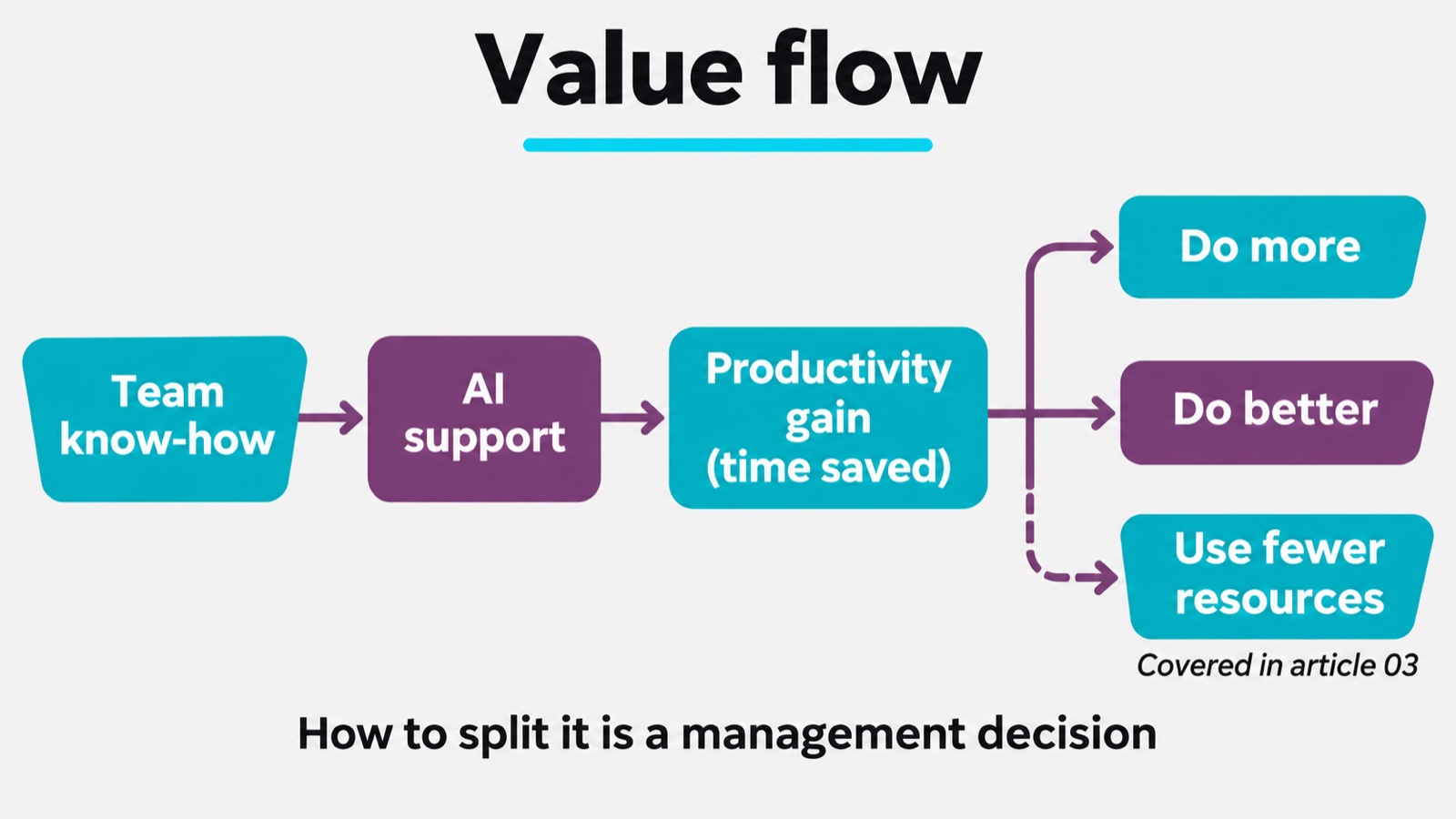
The same gain can go to volume, quality or savings. The split is a management decision.
In practice companies mix the three. What matters is that the mix is decided and announced before the gains appear, not discovered by employees afterwards in a new target. Raising the target alone means choosing only the first option. The same gain could have been split: part to volume, part to faster resolution of complex cases, part to time for the experts to keep the library correct.
The third choice, using fewer people, raises its own questions about hidden costs and lost experience. This article stays with the case where the company keeps its people; the next article in the series looks at that decision directly.
The risk of rewarding the number of prompts or documents
To encourage AI use and show results, some companies count things: how often staff use AI, how many prompts they write, how many documents they add. Counting is easy. The problem is what it rewards.
A classic 1975 management paper called this "rewarding A while hoping for B": the company hopes for better results but pays for something easier to count, and people sensibly deliver what is paid for. An idea known as Goodhart's law puts it shortly: when a measure becomes a target, it stops being a good measure.
In a customer service team, a bonus per answer added to the library produces many short, overlapping answers. The library grows, the AI more often picks the wrong one, and checkers spend more time cleaning it up. A target for AI usage pushes people to use AI on easy requests where it adds little.
| Instead of counting | Measure |
|---|---|
| Prompts written | Requests resolved with AI help and not reopened |
| Documents added | Answers actually used last month, and how many were correct |
| Hours of AI use | Time to resolution and error rate across the whole process |
Counting usage is still useful at the start, as a sign that people are trying the tool, as long as it is short-term and not tied to money.
The productivity tax: when doing well means doing more
The most common way AI productivity gains are lost is not dramatic. People who work faster with AI receive more work, while pay and recognition stay the same. Employees often call this a productivity tax. Economists have a name for the usual response: the ratchet effect. People who expect their target to rise after a good result hold their output below what they can do.
This is old behaviour, not an AI problem. A well-known 1952 study of a US machine shop described workers keeping output below what they could produce, so that piece rates would not be cut. A 2011 experiment found that people on performance pay clearly held back output when good results led to tougher terms, and that this almost disappeared when they could move to another employer.
Work faster with AI
Target is raised
More work, same pay
Real speed kept quiet
Company cannot see real gains
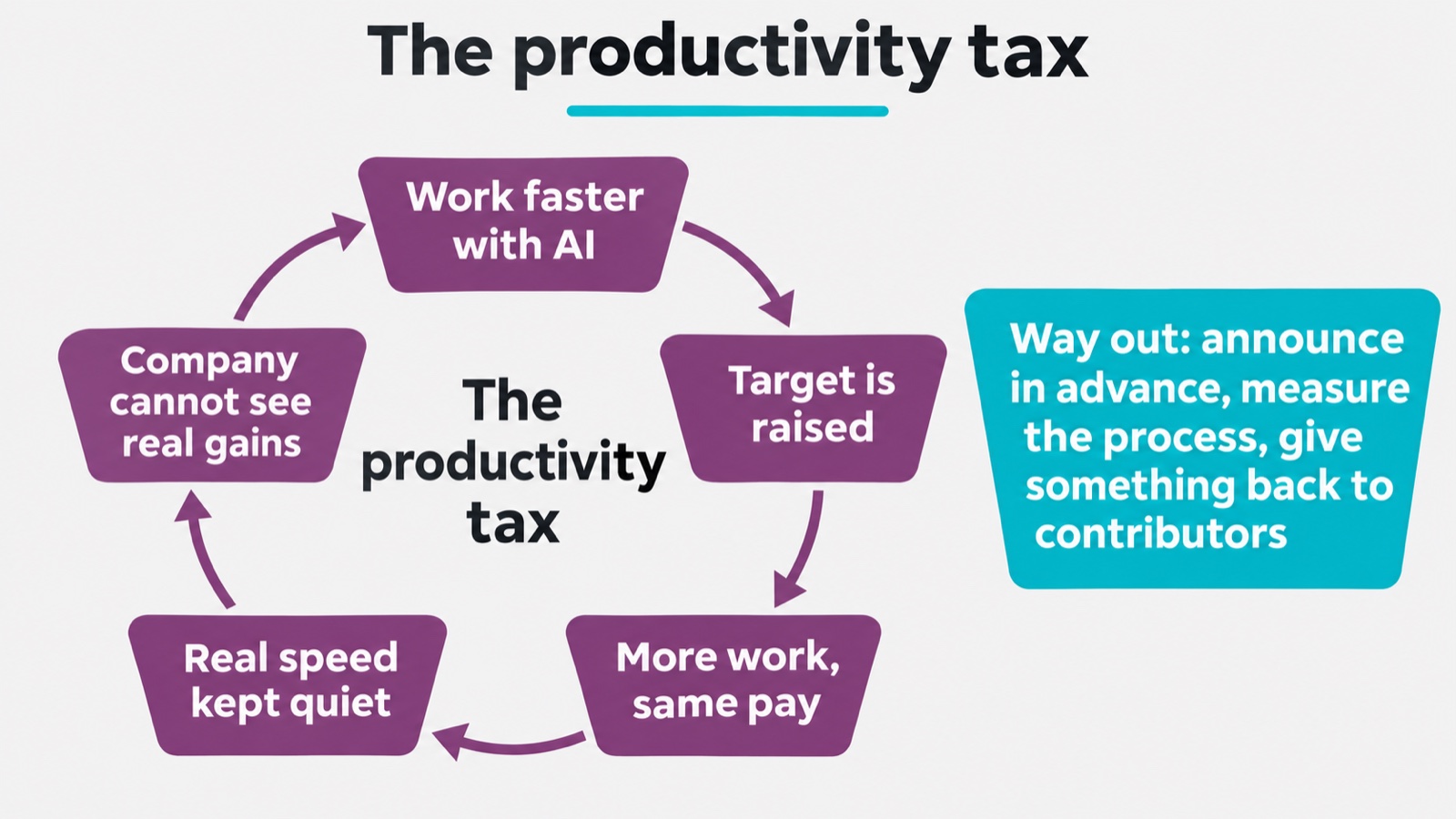
When doing well only brings more work, people keep their real speed to themselves.
With AI, holding back is easier than in a machine shop. A person can use AI quietly, finish early and not report the time saved. Management then sees neither the gain nor the method behind it, and cannot spread it to others.
Raising targets is not wrong in itself. It becomes a tax when it is one-sided, unannounced, and the people who made it possible receive nothing in return: no share of the bonus, no time for development, no say in the new target.
Individual rewards or shared knowledge
AI makes one person's knowledge available to everyone. That changes how rewards work, in two opposite ways.
If rewards are purely individual, and especially if people are ranked against each other, sharing knowledge helps colleagues catch up and lowers one's own rank. The customer support company had exactly this kind of pay. If rewards are purely team-based, individual contributions blur, and the expert who wrote half the library is paid the same as someone who wrote nothing.
A workable mix has two parts. The team shares in process results: time to resolution, error rate, customer feedback. Individuals are recognised for specific contributions that are used: who wrote or checked the answers that close cases. In customer service, that means tracking how often each person's answers are used successfully and counting it in their evaluation, rather than counting how many they wrote.
In a team of three to five people, a formula is often unnecessary. The manager's judgement, explained openly, is enough. Formulas matter more as teams grow and people no longer see each other's work.

Recognition works best when it follows contributions that are actually used.
Four things to agree before AI productivity gains appear
Set a baseline before rollout
Record handling time, errors, rework and customer feedback before AI arrives. Without it, any later claim about gains is a guess. If you have already started, the baseline can still be rebuilt: How to measure without a baseline.
Measure quality, errors, time and value together
Measuring time alone rewards speed at the expense of quality. Measure the whole process and the value it creates, not only minutes saved: Value beyond return on investment.
Credit both the team and individuals
Share process results with the team. Recognise by name the people whose knowledge and checking are actually used, and count it in their evaluation.
Agree in advance how time, rewards and growth are shared
Say what share of saved time goes to more volume, to quality, and to learning and keeping knowledge correct; how bonuses change when targets change; and which new roles open for those who contribute.
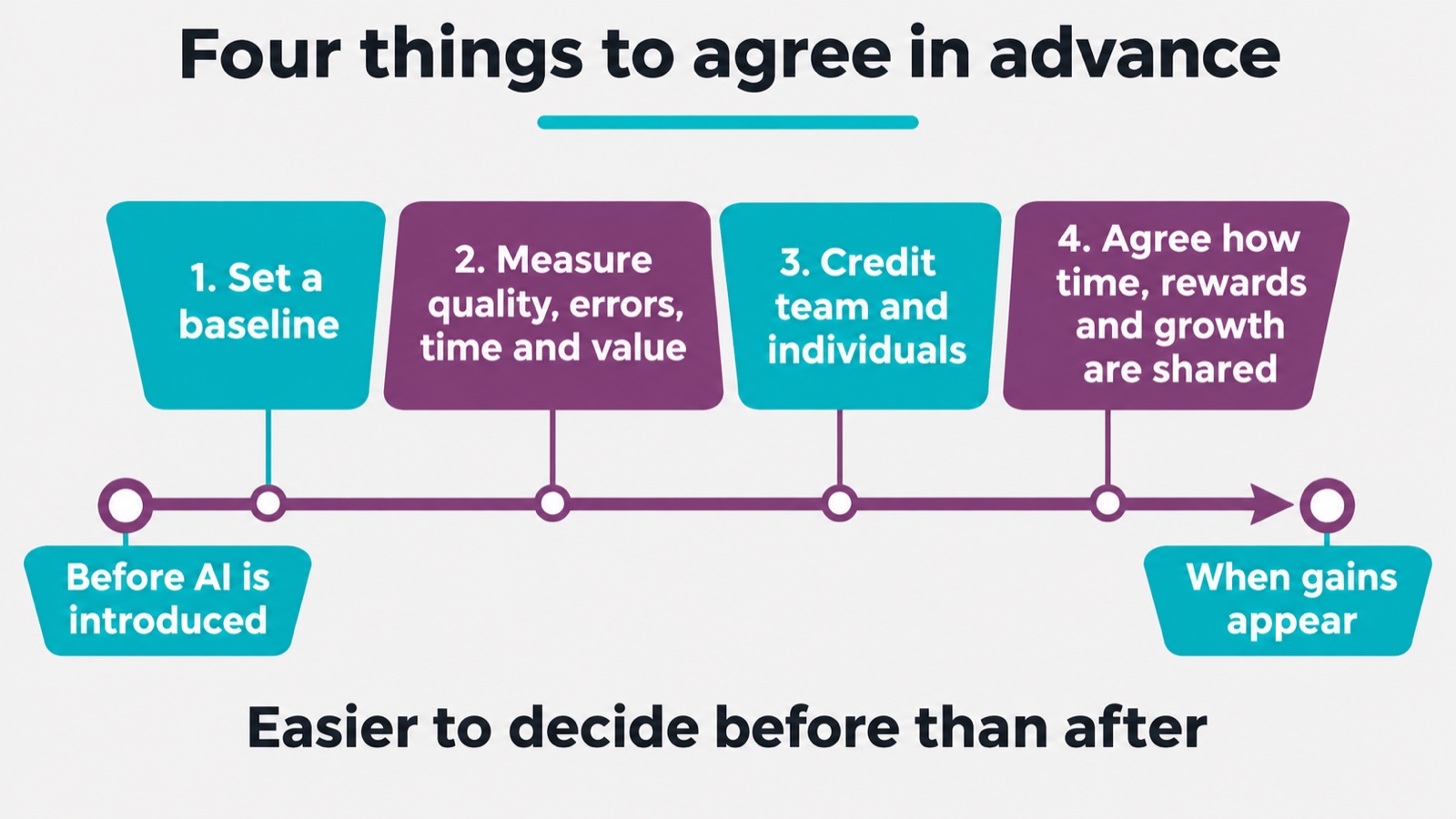
Each decision is cheaper to make before the gains exist than after.
Points to keep in mind
Not every saving has to be paid in money. Less overtime, time to learn, more interesting work and a secure role are also real shares of the gain. Many employees value them as much as a bonus.
Beware of AI productivity gains that exist only on paper. If minutes saved are reported but the process is no faster and errors are no fewer, there is nothing to share yet, and no reason to raise targets either.

Only gains that show up in the process are worth sharing or building targets on.
Asking for a share is not being demanding. When a job changes, asking how the gain will be shared is a fair question. The company is equally entitled to part of the gain from tools it pays for. Both are interests, not attitudes.
The evidence has limits. The customer support study covers one company, with most agents in the Philippines. The Danish data are early and the time savings are self-reported. The evidence on holding back output comes from an old factory study and a laboratory experiment, not from AI. None of it was measured in Vietnam. Read it as patterns that help ask the right questions, not as numbers to expect.
The direction Viindoo has chosen
When AI lifts a team's output, nobody needs to act in bad faith for conflict to start. Managers see more capacity; senior staff see their extra effort turn into a higher target. The conflict comes from one thing: the company measures individuals, while the gain is created by a system of people, a shared library of answers and the AI. When only individuals are visible, AI productivity gains get counted in the wrong place.
Viindoo looks at productivity from the side of the system. A company running on scattered files and separate tools cannot see which part of a result came from whose work. So the direction Viindoo pursues is an Agentic AI business management platform that brings the whole company into one place and one set of data, where AI works inside the shared flow of work and under rules the company sets itself.

One platform, one set of data, AI inside daily work: the gain is visible to everyone, and people still decide.
Applied to the four agreements in this article, that view helps in a concrete way. The baseline before rollout and the later results sit in the same figures, so nobody argues over whose numbers are right. Quality, errors and handling time are read together, not speed alone. And the work of those who built and check the shared knowledge stays visible, so credit can go to the team and to individuals, as agreed before the gains arrive.
AI also has to be easy for the very people who create the gains: staff get help from AI on the request in front of them, without learning another separate tool. Viindoo stands behind them as the backbone, keeping every result in the same set of figures, so the gain is seen and shared in a stable way.
Whether the gain is shared as time, rewards or growth is still leadership's choice, and no software can make it for them. A platform only makes sure that choice rests on the same real numbers for everyone.
Four questions to check where you stand
- What are AI productivity gains in our company being used for today, and who decided that?
- Do the people who wrote and checked the knowledge the AI uses get credit in their evaluation?
- Does any KPI, without anyone intending it, penalise the people who work fastest?
- Before the next AI rollout, have we agreed what the saved time will go to?
Frequently asked questions
At the task level, yes. In a study of 5,172 customer support agents, issues resolved per hour rose 15% on average with an AI assistant. Gains were uneven: large for less experienced staff, small for the most experienced. Whether they reach the whole process and the bottom line depends on how the time saved is used.
Partly, but not necessarily all of it. Time to learn, less overtime and a clearer career path are also real shares. What matters most is that the split is agreed in advance and the people who made the gain possible are not left with only more work.
It can be, if the increase is announced in advance, based on measured process results, and comes with something in return for those who contributed. Raised quietly and one-sidedly, it teaches people to hide their real speed.
Because AI spreads their know-how to others. In the customer support study, top performers supplied many of the examples the AI learned from but saw little gain themselves, and with bonuses ranked against colleagues they could even lose out.
Start now with a few process measures: time to resolution, errors, rework, customer feedback. A baseline can also be rebuilt from existing records; the Kaizen series article on measuring without a baseline explains how.
Next in this series: when the time saved is large enough, a tempting option appears: needing fewer people. What does a company really save, and what does it lose? CEOs who want to cut staff with AI: what is saved, and what is lost?
Sources
- Brynjolfsson, E., Li, D., & Raymond, L. (2025). Generative AI at Work. The Quarterly Journal of Economics, 140(2), 889-942. Earlier version: NBER Working Paper 31161 (2023). 5,172 customer support agents, one US software company.
- Humlum, A., & Vestergaard, E. (2026). Still Waters, Rapid Currents: Early Labor Market Transformation under Generative AI. NBER Working Paper 33777, revised March 2026. Denmark, 25,000 workers, 7,000 workplaces, late 2024.
- Kerr, S. (1975). On the Folly of Rewarding A, While Hoping for B. Academy of Management Journal, 18(4), 769-783.
- Strathern, M. (1997). 'Improving ratings': audit in the British University system. European Review, 5(3), 305-321.
- Roy, D. (1952). Quota Restriction and Goldbricking in a Machine Shop. American Journal of Sociology, 57(5), 427-442.
- Charness, G., Kuhn, P., & Villeval, M. C. (2011). Competition and the Ratchet Effect. Journal of Labor Economics, 29(3), 513-547.