HR Employee Training
| Lines of Code | 1133 |
| Technical name | to_hr_training |
| License | OPL-1 |
| Website | https://viindoo.com/apps/app/17.0/to_hr_training |
| Read description for | v 10.0 v 11.0 v 12.0 v 13.0 v 14.0 v 15.0 v 16.0 v 17.0 |
| Required Apps | eLearning (website_slides) Discuss (mail) Employees (hr) Website (website) Skills Management (hr_skills) |
| Included Dependencies | HR Skills Framework HR Employee Grade Advanced HR Management HR Employee Rank HR Employee Role |
HR Employee Training
Manage courses for each position, each skill of employees
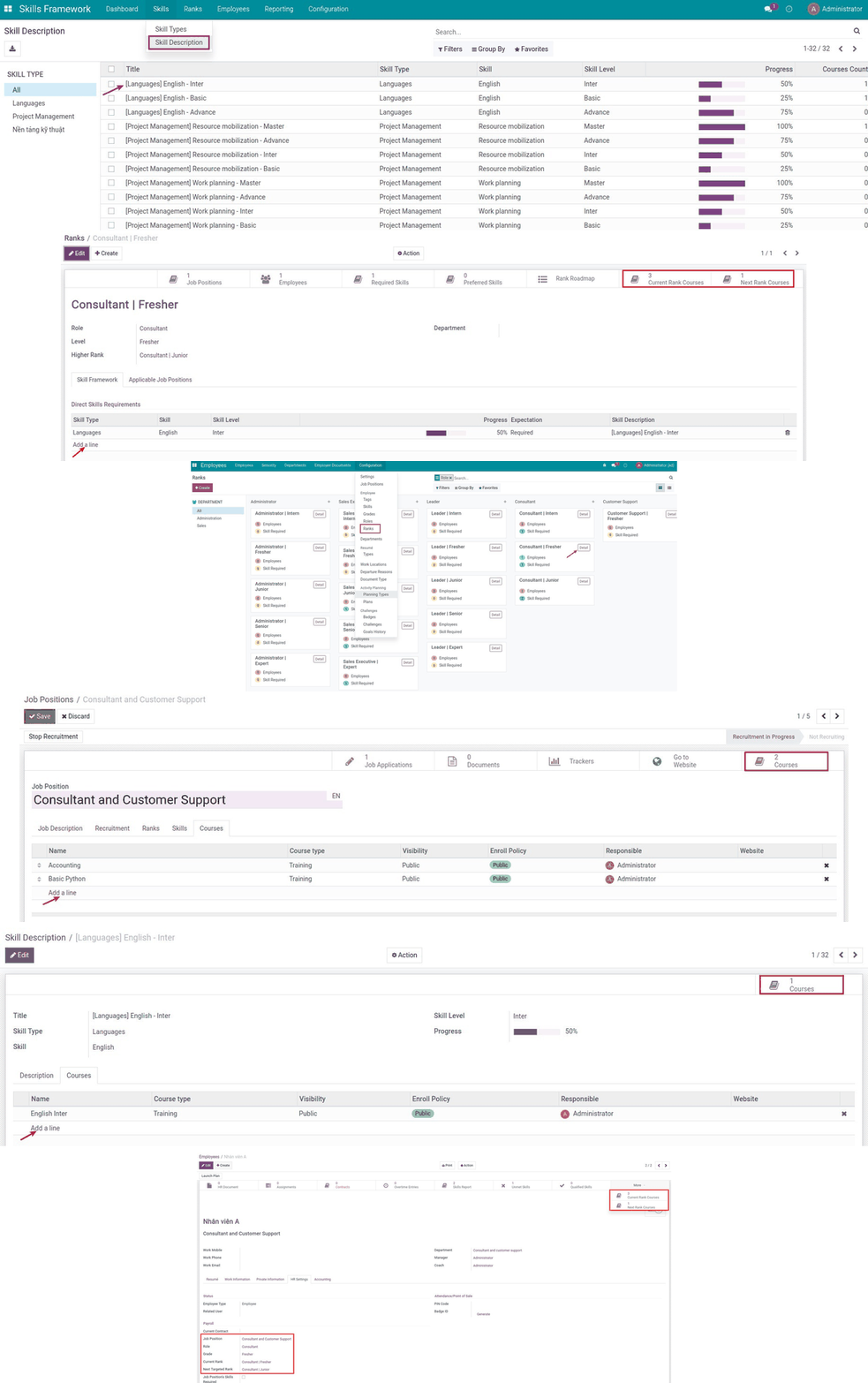
Key Features
Built natively on Odoo/Viindoo to streamline real business operations:
Manage online training courses associated with each position
Manage online training courses associated with each skill type
Manage online training courses associated with each rank
Automatically calculate and give the list of training courses corresponding to the current rank and the next rank for employees
List of skills
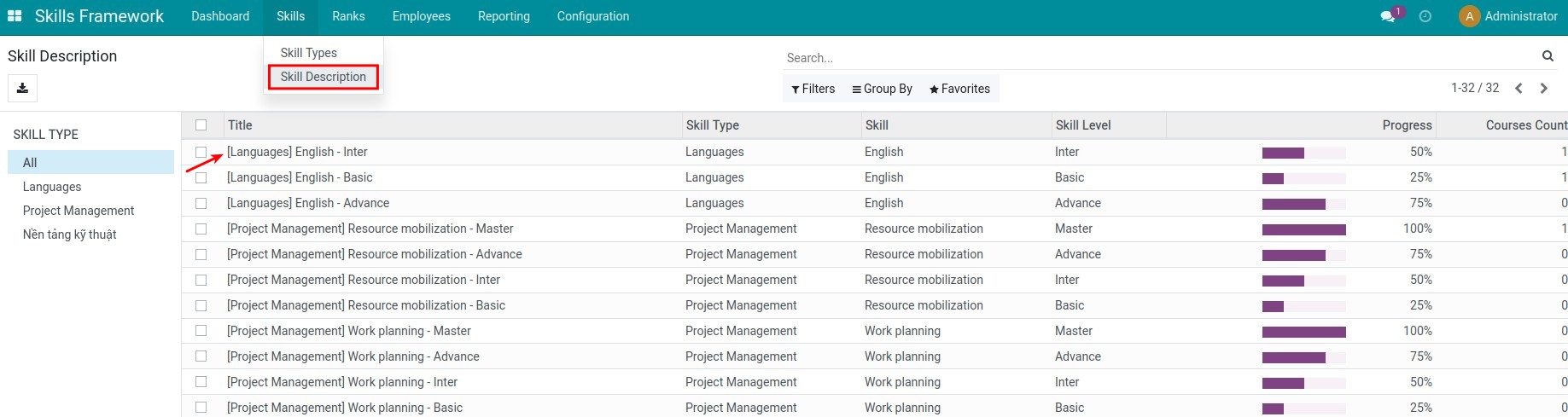
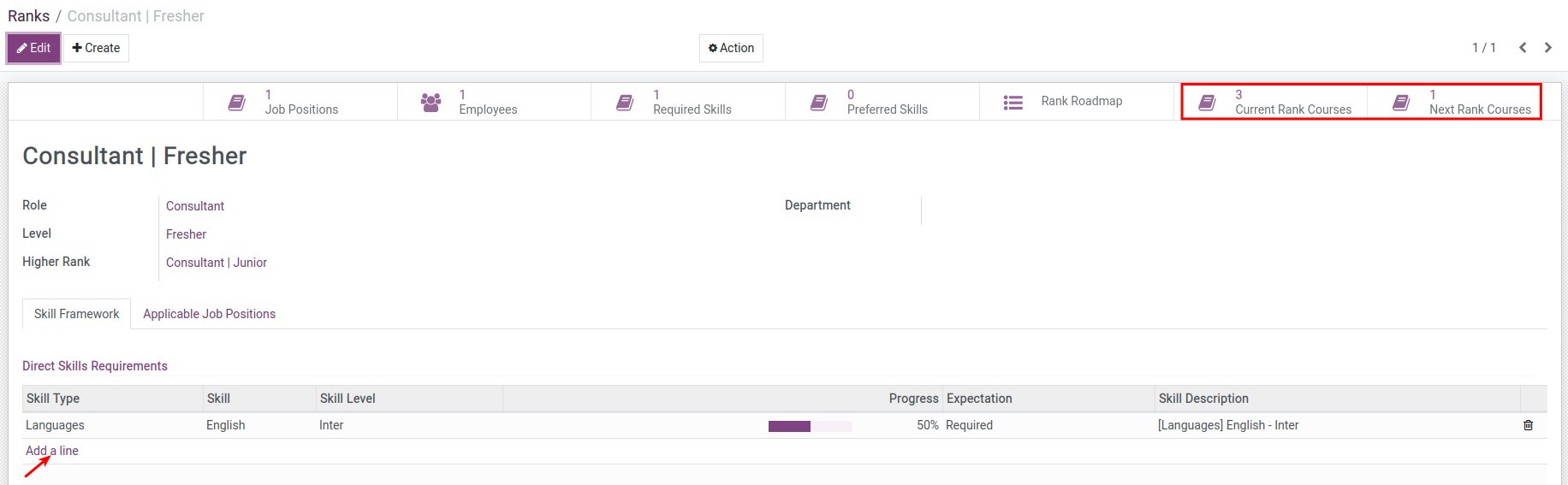
Assign skills to ranks
Skills framework for ranks
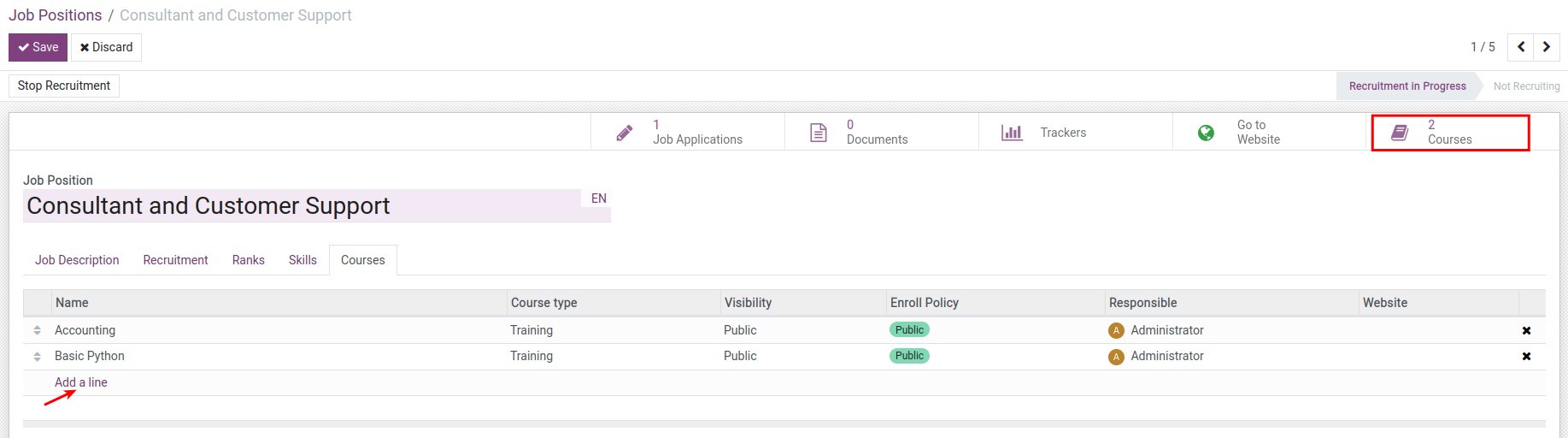
Manage the list of courses for each position
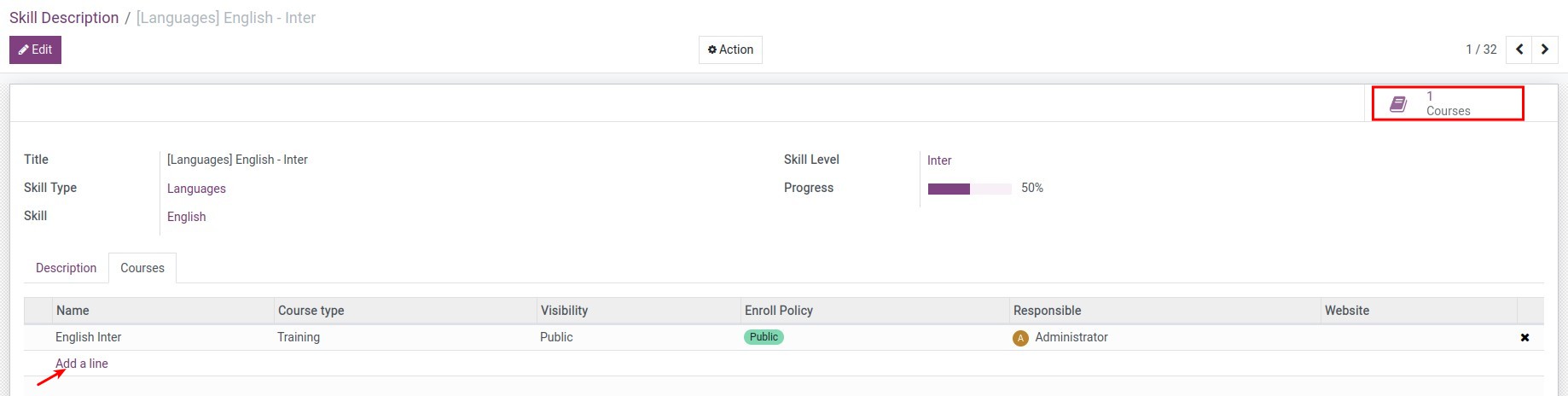
Manage the list of courses for each skill
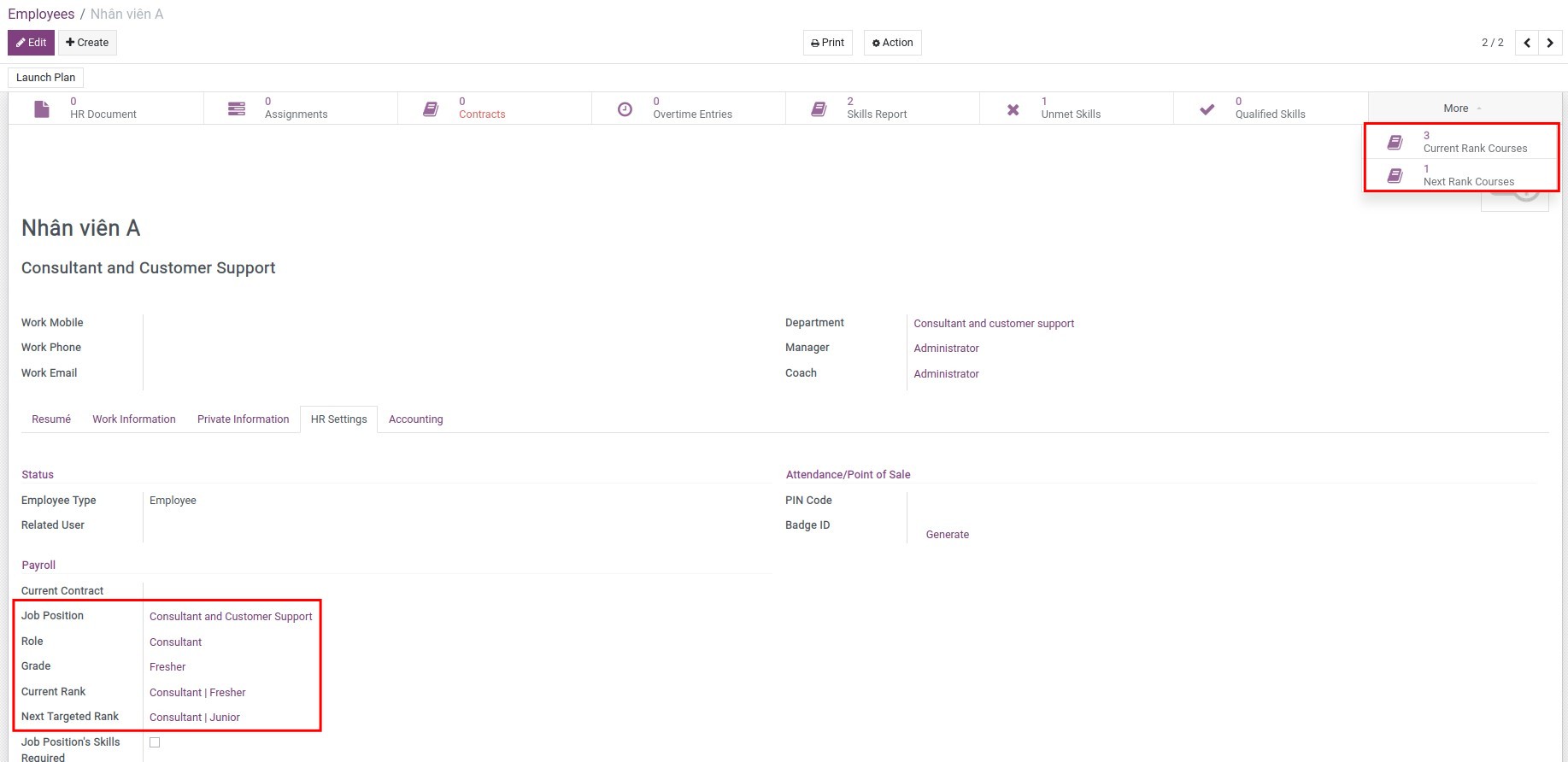
Manage courses for each employee
See HR Employee Training in Action
See how this module solves real business problems in a working Viindoo environment.
Need help with HR Employee Training?
For questions, implementation support, or consulting services, contact Viindoo.
Pre-Sales & Partnership
When contacting us, please include:
- Odoo/Viindoo version (CE/EE).
- Number of users and business scope.
- Other modules currently in use.
Technical Support
For faster troubleshooting, please provide:
- Order number or app reference.
- Odoo/Viindoo version & edition.
- Steps to reproduce the issue.
- Screenshots/logs if available.
Technical Requirement
Who Should Use This Module?
Built for teams that need this capability fully integrated into their Odoo/Viindoo stack.
Executives & Business Owners
Need clear visibility into operations and a stack that scales without bespoke development.
Operations / Department Leaders
Want to streamline daily workflows, remove manual handoffs, and keep data consistent across teams.
Implementers & Odoo Partners
Looking for production-ready Viindoo modules to deliver projects faster and at lower risk.
Installation
- Navigate to Apps.
- Search with keyword to_hr_training.
- Press Install.
Instruction
Instruction video: HR Employee Training
Conception
- Position: These are job positions in each department, company. For example: Sales Manager, Consultant & Customer Support, etc.
- Role: A more detailed classification of the position, which can be based on expertise, responsibilities, roles in each job. For example, Consultant & Customer Support can be divided into 2 roles as Consultant and Customer Support Specialist.
- Level: Classified by level. For example: Intern, Trainee, Junior, Senior, etc.
- Rank: a manner to classify employees based on the employee's role and level. Rank = Role + Level. For example: Senior Consultant, etc.
Usage
Step 1: Create online courses.
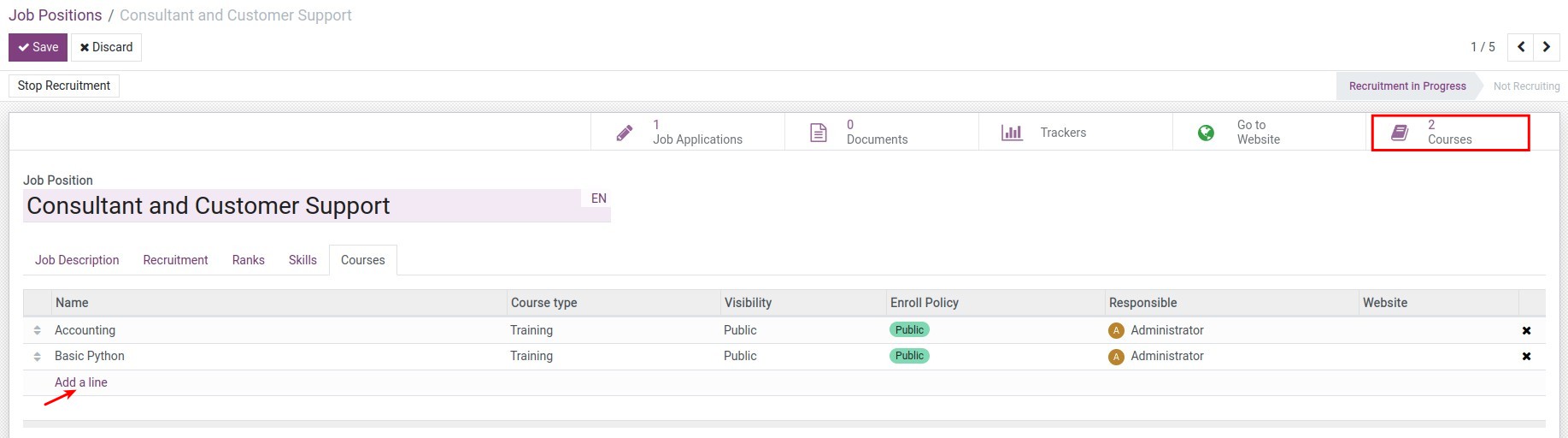
Step 2 Manage the list of courses for each position.
- Go to Employees ‣ Configuration ‣ Job Positions, select a position in the existing list or create a new one.
- At the Courses tab, press Add a line to select the courses that the employee needs to be trained with this position. After selecting the list of courses, you will see them on the statistics bar of this position.
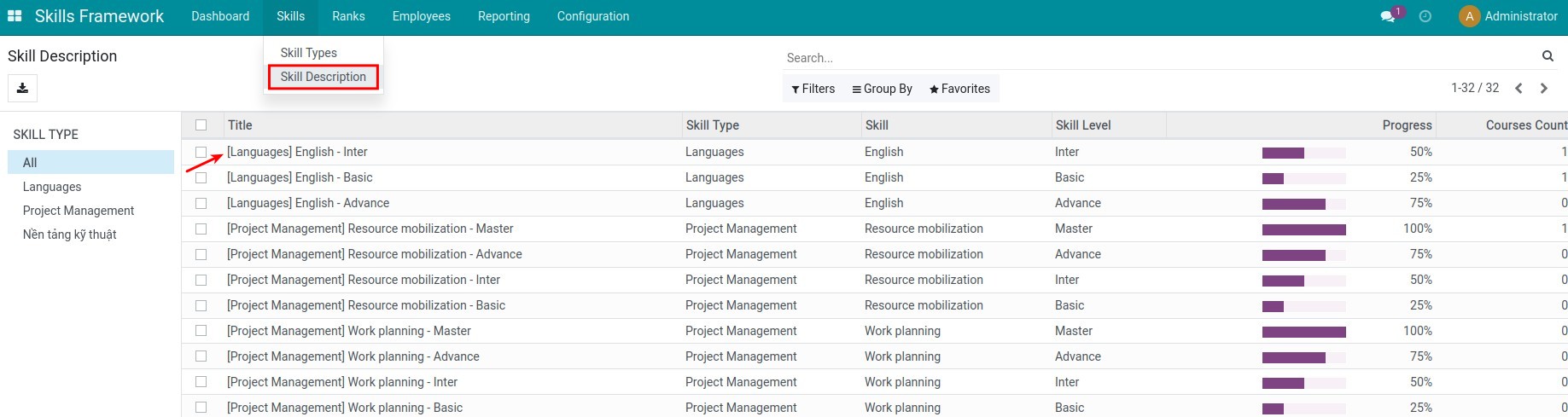
Step 3: Manage the list of courses for each skill.
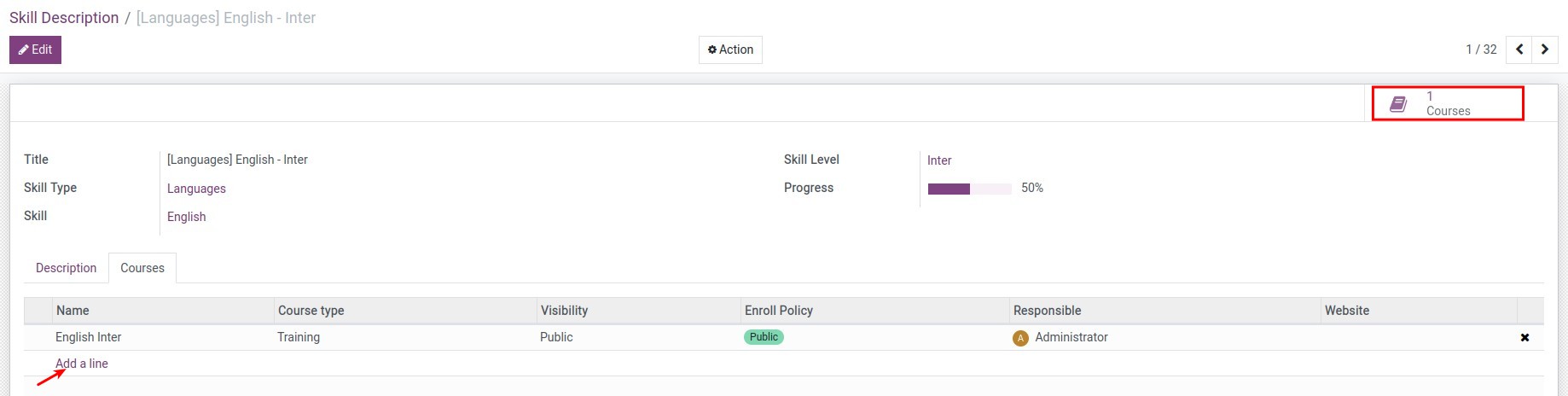
- Go to Skills Framework > Skills > Skill Description, select a skill from the list.
- At the Courses tab, press Add a line to select the courses that the employee needs to learn for this skill. After selecting the list of courses, you will see the number of courses on the statistics bar of this skill.
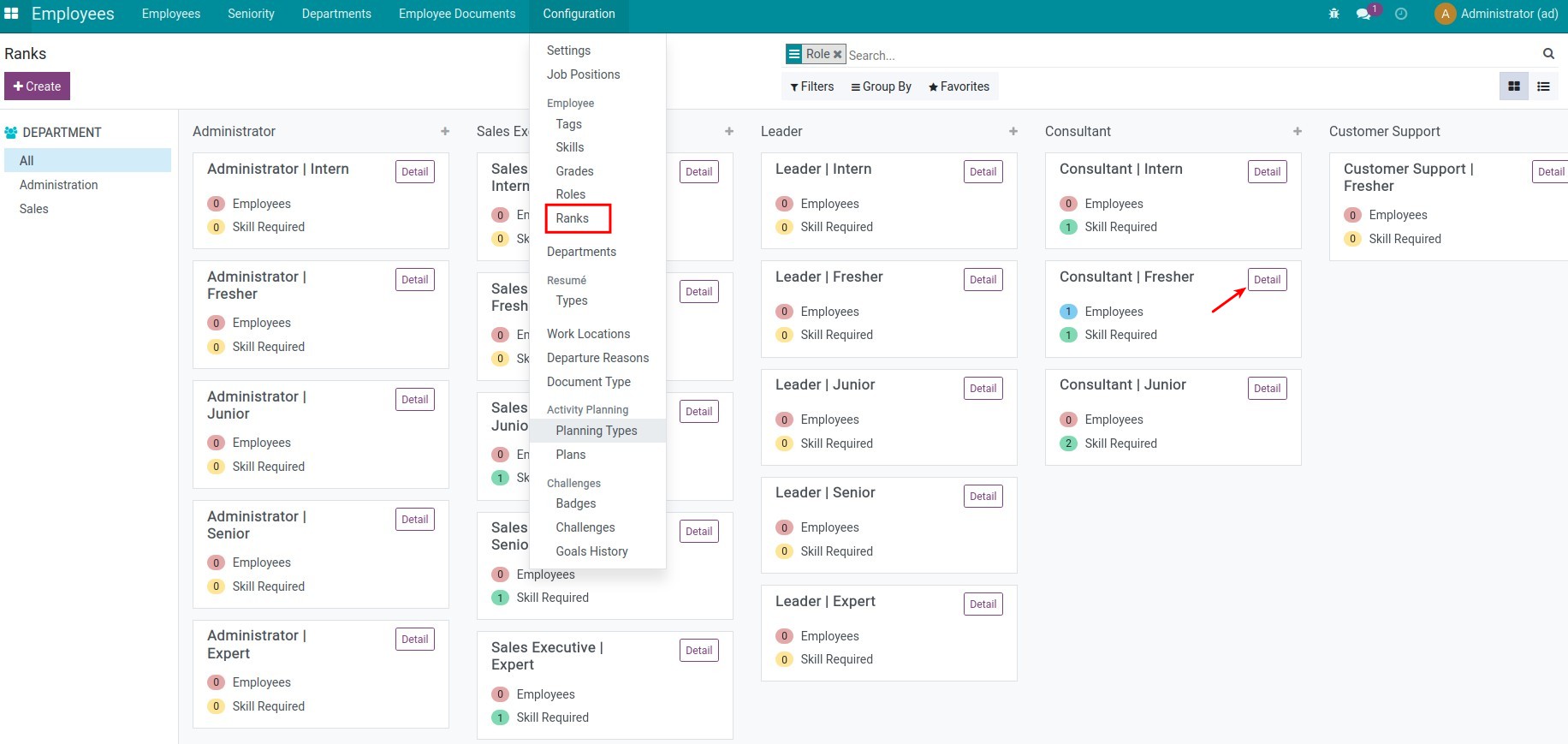
Step 4: Build the skills framework for each rank.
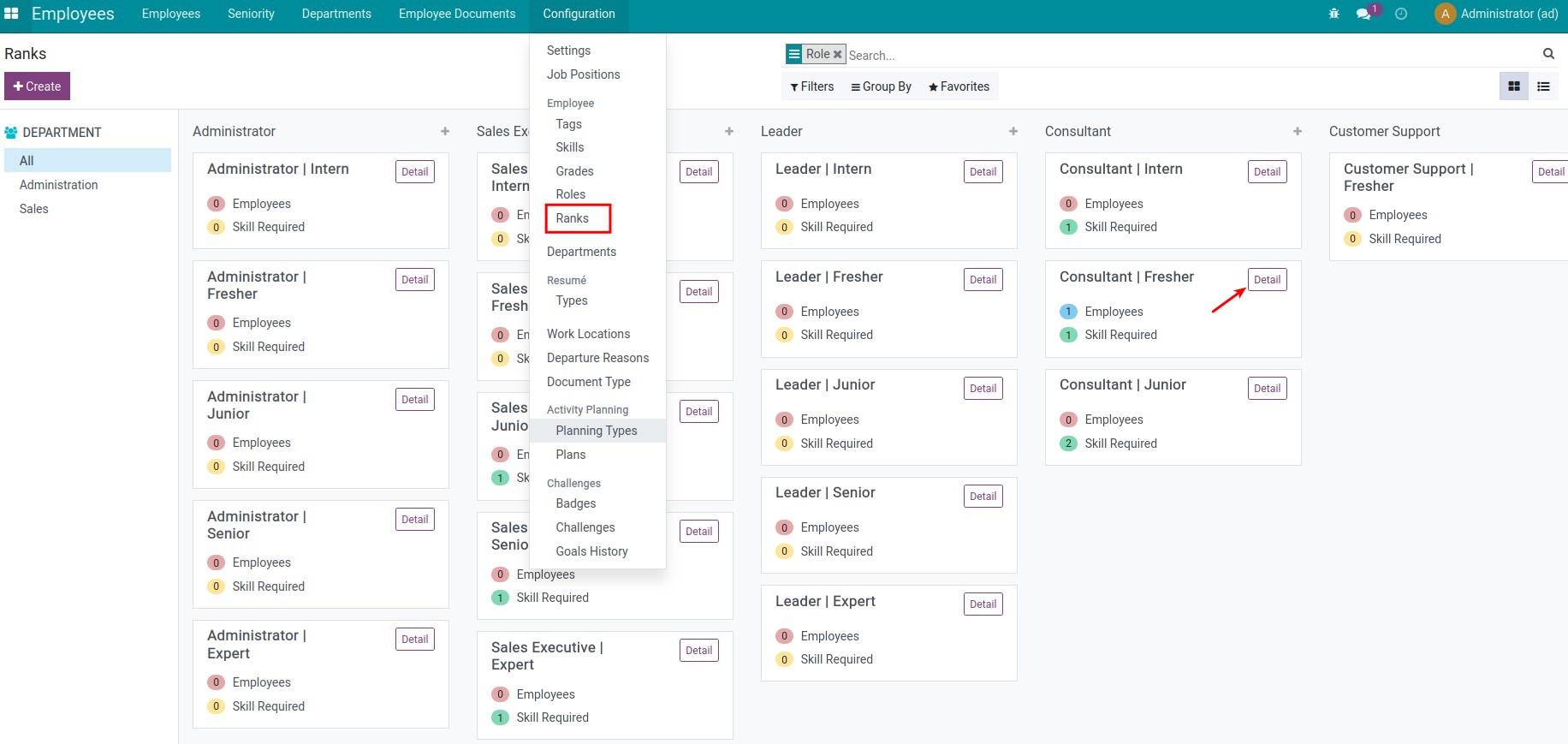
- Go to Employees ‣ Configuration ‣ Ranks, select a rank from the available list or create a new one. (Note: enable developer mode).
- At the Skill Framework tab, press Add a line to assign the required skills to this rank. The system will automatically calculate the number of courses for this rank and the next rank in the statistics bar.
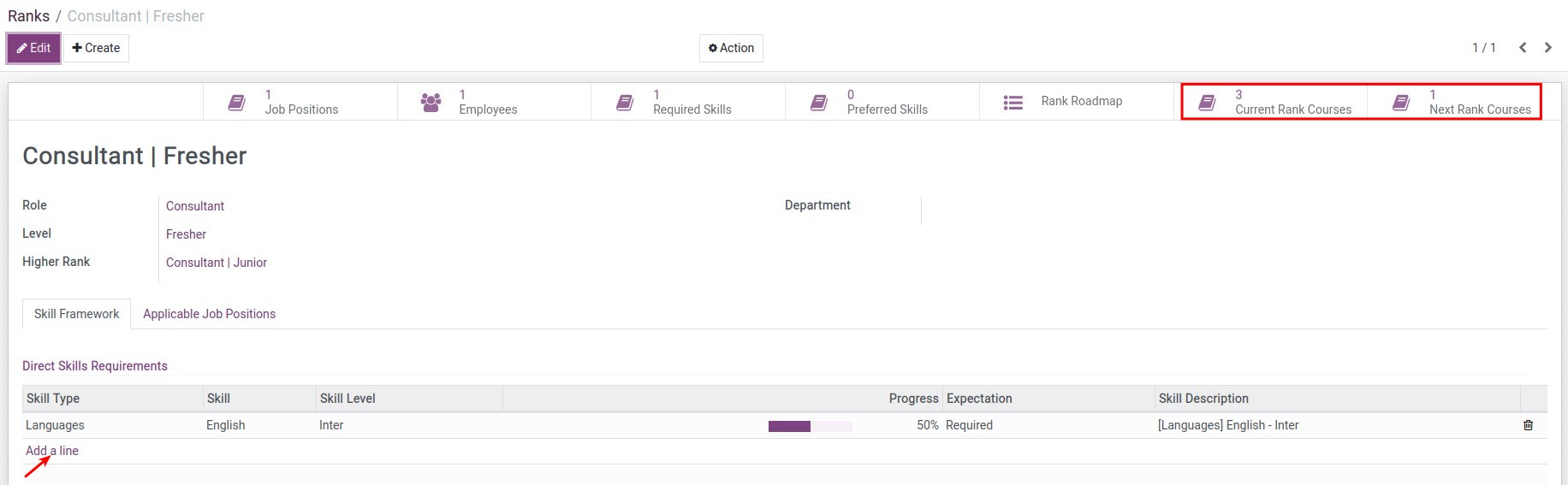
See the module HR Skills Framework. for more detail.
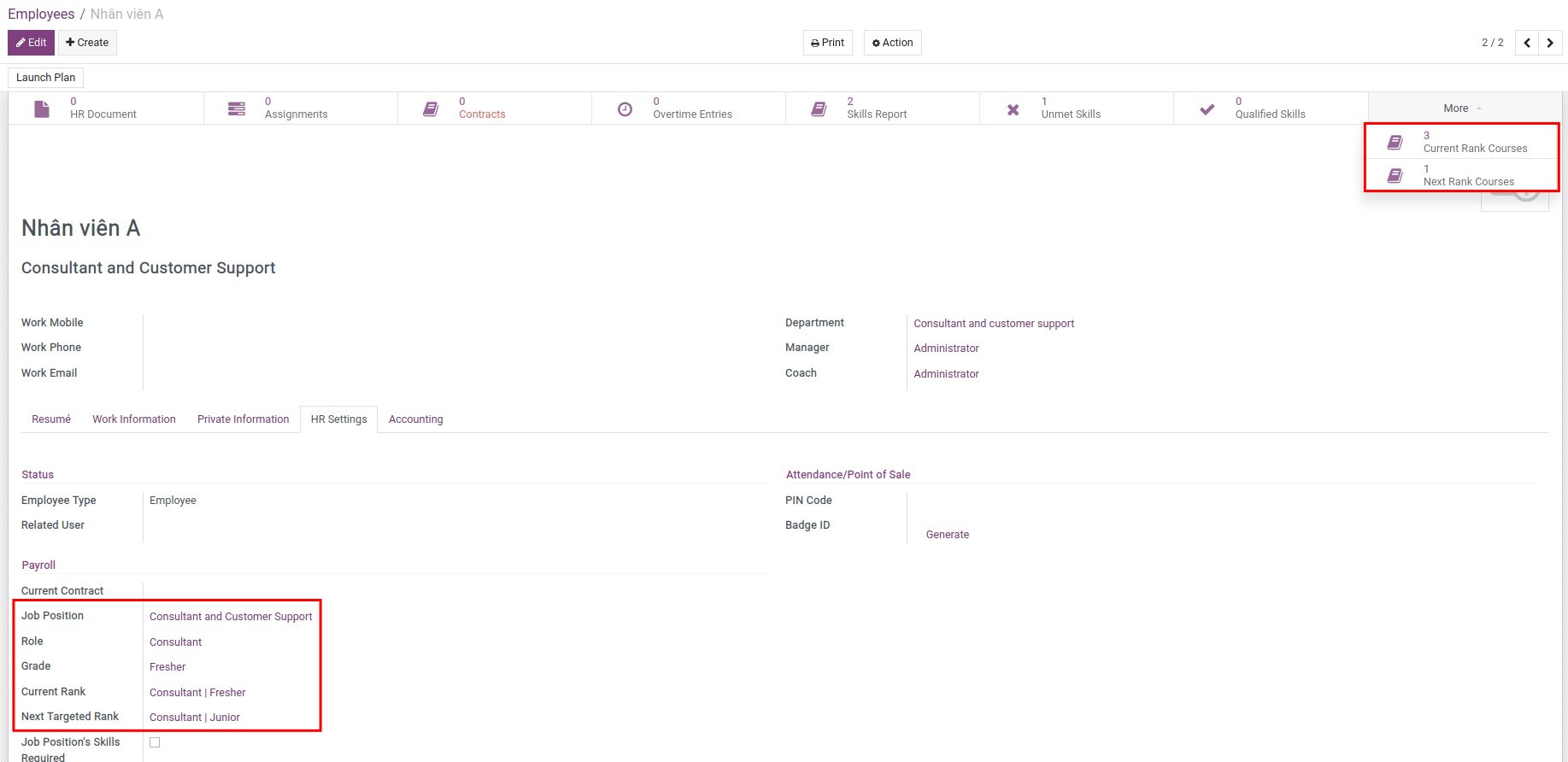
Step 5: Manage courses for each employee.
- Go to Employees ‣ Employees to select or create a new employee. At the tab HR settings, Payroll area, fill in the corresponding information in the fields:
- Job Position;
- Role;
- Grade.
- According to the configuration in steps 2 & 4, the system will automatically calculate and fill a list of courses for employees based on their positions and ranks.
This software and associated files (the "Software") may only be used (executed, modified, executed after modifications) if you have purchased a valid license from the authors, typically via Odoo Apps, or if you have received a written agreement from the authors of the Software (see the COPYRIGHT file).
You may develop Odoo modules that use the Software as a library (typically by depending on it, importing it and using its resources), but without copying any source code or material from the Software. You may distribute those modules under the license of your choice, provided that this license is compatible with the terms of the Odoo Proprietary License (For example: LGPL, MIT, or proprietary licenses similar to this one).
It is forbidden to publish, distribute, sublicense, or sell copies of the Software or modified copies of the Software.
The above copyright notice and this permission notice must be included in all copies or substantial portions of the Software.
THE SOFTWARE IS PROVIDED "AS IS", WITHOUT WARRANTY OF ANY KIND, EXPRESS OR IMPLIED, INCLUDING BUT NOT LIMITED TO THE WARRANTIES OF MERCHANTABILITY, FITNESS FOR A PARTICULAR PURPOSE AND NONINFRINGEMENT. IN NO EVENT SHALL THE AUTHORS OR COPYRIGHT HOLDERS BE LIABLE FOR ANY CLAIM, DAMAGES OR OTHER LIABILITY, WHETHER IN AN ACTION OF CONTRACT, TORT OR OTHERWISE, ARISING FROM, OUT OF OR IN CONNECTION WITH THE SOFTWARE OR THE USE OR OTHER DEALINGS IN THE SOFTWARE.